
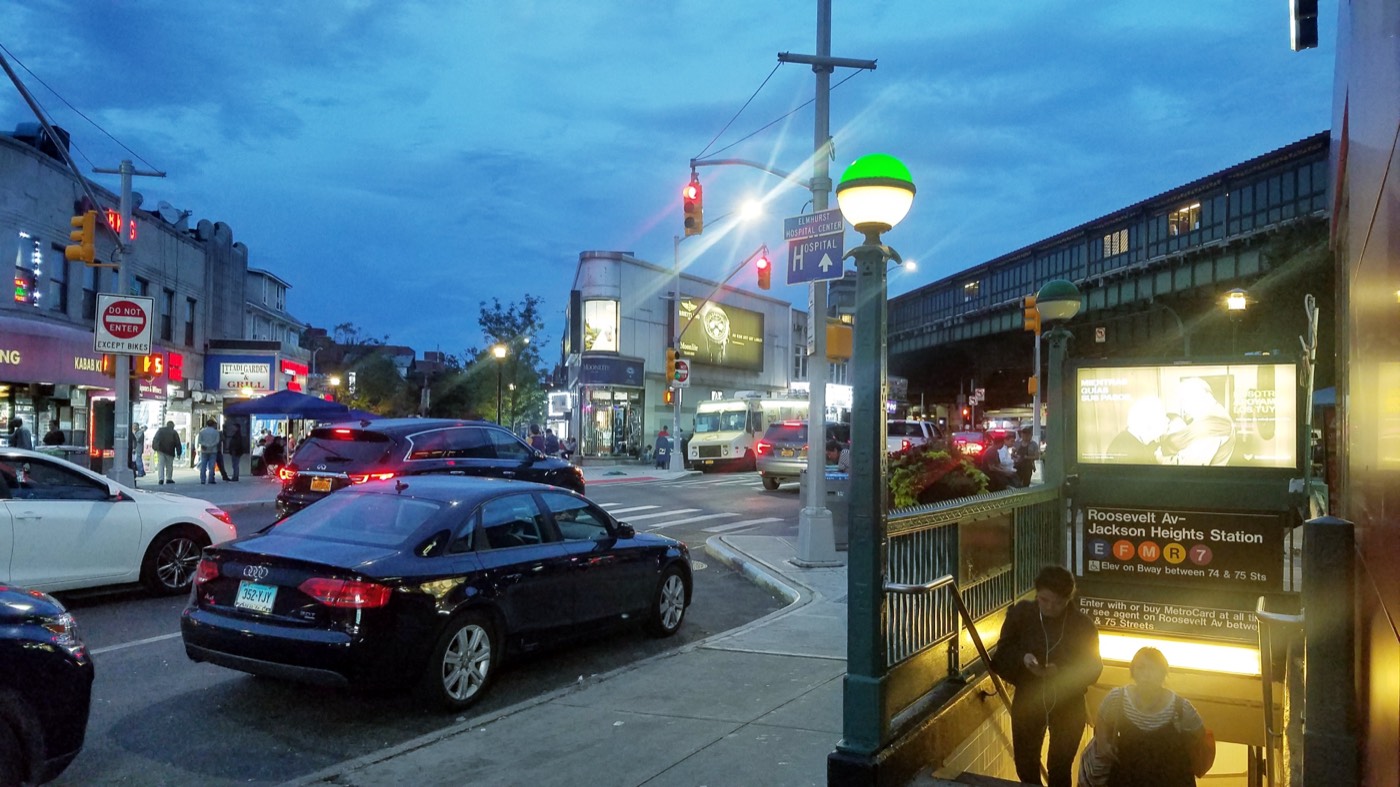
Walk east along 37th Avenue in Queens, past the sari shops and the gold merchants, and somewhere around 73rd Street the soundtrack shifts. The Bollywood playback fades and Bangla pop takes over, drifting out of phone-card kiosks and tea stalls. This is the heart of the Bangladeshis in Jackson Heights, a community that has, over roughly four decades, turned a slice of one of the most diverse neighbourhoods on earth into something that feels, on a good evening, a little like a corner of Dhaka.
The Place
Jackson Heights sits in north-western Queens, hemmed in by Roosevelt Avenue to the south and the residential blocks of garden apartments that gave it its name to the north. It is famously, almost officially, diverse: the New York Times once called Jackson Heights the most culturally diverse neighbourhood in New York, if not on the planet.
The commercial spine runs along 37th Avenue, 37th Road and Roosevelt Avenue, beneath the rumble of the elevated 7 train. Within a few hundred metres you can hear Spanish, Tibetan, Nepali, Hindi, Urdu and Bangla, and eat accordingly.
For Bangladeshis, the centre of gravity is 73rd Street and the small pedestrian square known as Diversity Plaza. It is here, between the halal carts and the 24-hour sweet shops, that the community is most visible and most at home.
How It Became Bangladeshi
Jackson Heights was not built for immigrants. It was built to keep them, and most other people, out.
A garden suburb behind a velvet rope
The neighbourhood was the creation of Edward A. MacDougall and his Queensboro Corporation, which assembled roughly 350 acres of the old Trains Meadow section of Newtown between 1910 and 1914. MacDougall, inspired by the English Garden City movement and a 1914 trip to Europe, imagined a model commuter suburb within the city limits.
The 1909 Queensboro Bridge and the 1917 extension of the elevated IRT Flushing Line, today’s 7 train, made the dream feasible. In 1917 the corporation completed its first major complex and called it the Garden Apartments, coining the very term. For decades these co-operatives were genteel, leafy and, by deed and by custom, closed to Jewish, Black and immigrant buyers.
That exclusivity broke down slowly through the mid-twentieth century. By the time South Asians began arriving in numbers in the 1970s, Jackson Heights had become something its founders never intended: a port of entry.
The Indian decade, then the Bangladeshi wave
The 1965 Immigration and Nationality Act, which abolished national-origin quotas, opened the door. The first South Asian merchants to colonise 74th Street were largely Indian, drawn by cheap rents and a hungry market for spices, saris and gold. By the 1980s 74th Street was a recognised Little India.
Bangladeshis arrived in the same current but crested later. Many came through the Diversity Visa lottery, the green-card scheme created by the Immigration Act of 1990 to broaden the sources of immigration. The lottery proved enormously popular in Bangladesh, and Bangladeshi winners settled across Queens, in Jamaica, Astoria, Woodside and Jackson Heights.
How a lottery became a chain
The lottery was only the beginning. As pioneers gained citizenship, they sponsored spouses, parents and siblings, and the flow shifted from individual lottery winners to family-based chain migration. One analysis found that annual immigrant visas issued to Bangladeshis rose from 5,845 in 2000 to 15,801 in 2016, an increase of about 170 per cent.
Bangladesh was eventually removed from the Diversity Visa lottery after 2012, precisely because so many of its nationals had become eligible through family categories instead. The lottery had done its work: it had seeded a community large enough to reproduce itself.
The numbers tell the story. The Bangladeshi-born population of New York City became one of the fastest-growing immigrant groups in the city, and Queens holds the largest share of it. Recent estimates put the citywide Bangladeshi population above 100,000.
From 74th Street to 73rd
As the community grew, it spread one block west. Where 74th Street had been Indian, 73rd Street, between 37th Avenue and Broadway, filled with Bangladeshi restaurants, grocers, pharmacies, money-transfer offices and the cramped storefront newsrooms of the Bangla press.
The shift was real enough that local Indian and Nepalese businesses noticed the change after the turn of the century. By the 2010s, 73rd Street had earned an unofficial nickname that has since become official.
On 26 March 2023, the 52nd anniversary of Bangladesh’s independence, the city co-named 73rd Street between 37th Avenue and Broadway as Bangladesh Street. The renaming, sponsored through the City Council by Council Member Shekar Krishnan of District 25, was attended by Congresswoman Grace Meng, State Senator Michael Gianaris and a row of Queens state legislators. A community that had arrived on lottery tickets now had its name bolted to a street sign.
The Landmarks
Bangladesh Street (73rd Street), between 37th Avenue and Broadway. The renamed heart of the community, lined with restaurants, grocers and pharmacies, much of it open around the clock. The co-naming ceremony in March 2023 timed itself to Bangladesh’s Independence Day, and the corner of 37th Avenue and 73rd Street is where the new sign went up.
Diversity Plaza, 37th Road between 73rd and 74th Streets. A pedestrianised triangle created in 2012 and given its official name in 2016. By day it is a thoroughfare of momo carts and halal trucks; by evening it becomes a stage for melas, rallies and vigils. It is the community’s town square in everything but title.
Premium Sweets & Restaurant, 37-14 73rd Street. A 24-hour fixture on Bangladesh Street serving Bangladeshi sweets and meals, from mishti to biryani. Open at any hour, it is the kind of place where a midnight craving for roshogolla or a cup of cha is never a problem.
Apna Bazar Farmers Market, 72-20 37th Road. One of the large South Asian grocers anchoring the district, stocked with the fish, lentils, mustard oil and fresh produce that a Bengali kitchen runs on. Grocers like this are the quiet infrastructure of the neighbourhood, the reason a family can cook the food of home without compromise.
Subzi Mandi, 72-30 37th Avenue. A bustling South Asian supermarket on the main commercial avenue, drawing Bangladeshi, Indian and Pakistani shoppers alike. The overlapping clientele is a reminder that these communities live shoulder to shoulder here, not in separate enclaves.
The Bangla press, along 73rd Street. The storefront offices of Bangla-language newspapers such as Thikana sit among the shops, printing news of both Queens and Dhaka. They are tiny, easy to miss, and disproportionately important: for many older residents they are still the first place to read about home.
The 74th Street commercial row, off Roosevelt Avenue. The older Indian-founded stretch of jewellers and sari shops that the Bangladeshi blocks grew out from. Walking the two streets in sequence is a short course in how the neighbourhood’s South Asian map was redrawn over three decades.
Where They Came From
Bangladeshi migration to the United States, like Bangladeshi migration to Britain before it, has long had a regional accent. The pioneering migrants drew heavily on Sylhet, the north-eastern district with a centuries-old tradition of seafaring and emigration, and chain migration then concentrated newcomers from the same home regions in the same American neighbourhoods.
Jackson Heights is more mixed than the older British settlements. The Diversity Visa lottery, by design, drew winners from across Bangladesh, so the Queens community includes families from Dhaka, Chittagong and beyond as well as Sylhet. What unites them is less a single home district than a shared language, a shared faith and a shared route through the lottery and the family-sponsorship system that followed it.
The result is a community that is genuinely national in its origins, a slice of Bangladesh rather than of any one province, reassembled under the 7 train.
Jackson Heights Today
The Bangladeshi presence in Jackson Heights is now visible, organised and politically awake. A street bears the country’s name. Local and state officials court the community’s votes. The Boishakhi season brings Bengali New Year celebrations to the wider Queens calendar, and the businesses along 73rd Street trade in two currencies of belonging, food and remittance.
It is not without strain. Rents along the commercial corridor have climbed, and the neighbourhood’s very desirability now pressures the immigrant businesses that made it desirable. Many newer Bangladeshi arrivals and the second generation are dispersing to more affordable parts of Queens and the Bronx, where Parkchester has grown its own Little Bangladesh.
Yet Jackson Heights retains its pull as the symbolic centre. You can be a Bangladeshi family in Jamaica or the Bronx and still come back to 73rd Street for the sweets, the newspapers, the gossip and the simple pleasure of a street where your language is the default. That, more than any census figure, is what a community looks like when it has put down roots.
For more on how Bangladeshis have settled across the city and the country, see our companion pieces on the Bangladeshis in Kensington, Brooklyn and the Bangladeshis in Hamtramck, Michigan. Jackson Heights itself has been home to several diasporas at once, from the Indians in Jackson Heights to the Tibetans in Jackson Heights and the Colombians in Jackson Heights. For other corners of New York shaped by a single community, read about the Jews in Forest Hills.
Frequently Asked Questions
Where do the Bangladeshis in Jackson Heights live and shop?
The Bangladeshis in Jackson Heights centre on 73rd Street, between 37th Avenue and Broadway, which the city co-named Bangladesh Street in 2023. The nearby Diversity Plaza and the grocers along 37th Avenue form the rest of the community’s commercial core.
Why is 73rd Street called Bangladesh Street?
On 26 March 2023, Bangladesh’s Independence Day, New York City officially co-named 73rd Street between 37th Avenue and Broadway as Bangladesh Street. The renaming, championed by Council Member Shekar Krishnan, recognised the dense cluster of Bangladeshi restaurants, grocers and businesses there.
How did the Bangladeshi community in Jackson Heights begin?
Many of the first arrivals came through the Diversity Visa lottery created by the Immigration Act of 1990, settling across Queens. Those pioneers later sponsored relatives, and chain migration turned a scattering of lottery winners into one of the city’s fastest-growing immigrant communities.
What is Diversity Plaza?
Diversity Plaza is a pedestrianised square on 37th Road between 73rd and 74th Streets, created in 2012 and officially named in 2016. It serves as the unofficial town square for Jackson Heights, hosting food carts, festivals, rallies and vigils.
Where in Bangladesh did the community come from?
As with Bangladeshi migration more broadly, the north-eastern district of Sylhet supplied many early migrants and chains. Because the Diversity Visa lottery drew winners from across the country, however, Jackson Heights families also trace their roots to Dhaka, Chittagong and other regions.
Is Jackson Heights still the centre of Bangladeshi New York?
It remains the symbolic centre, even as rising rents push many families to Jamaica, Woodside and the Bronx neighbourhood of Parkchester. The Bangladeshis in Jackson Heights still draw people back to 73rd Street for food, newspapers and the comfort of a Bangla-speaking high street.
If your family’s story passed through Jackson Heights, or any of the places Bangladeshis have made home in America, Atlas of Home can trace that journey. From a Sylhet village or a Dhaka neighbourhood, to a 24-hour sweet shop on Bangladesh Street, to wherever you are now.