
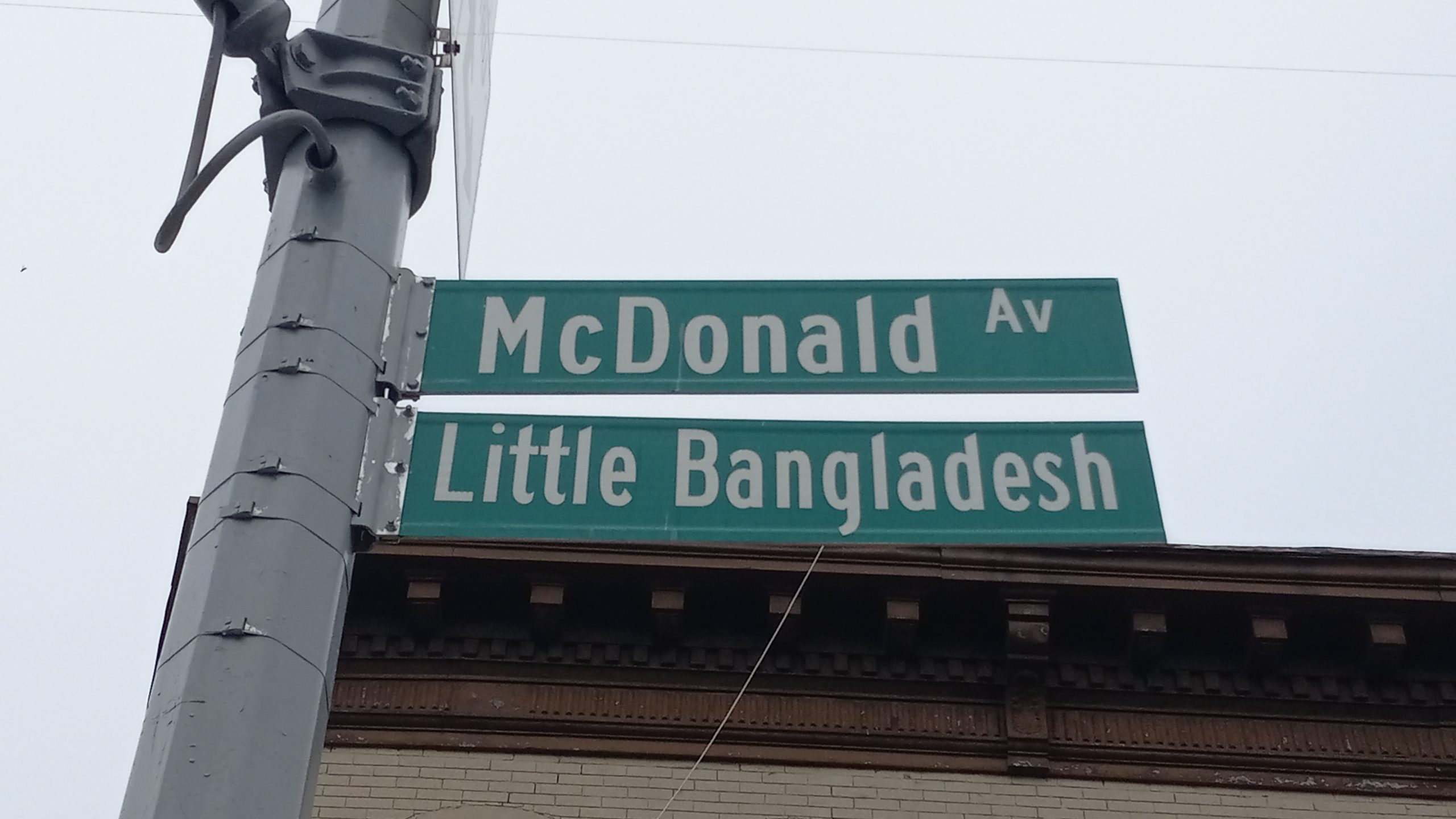
At seven in the evening, the windows of the fish stalls on McDonald Avenue still glow with crushed ice and rohu carp staring out at the F train rumbling overhead. The air carries cardamom and mustard oil from Ghoroa, where men in white prayer caps lean over plates of beef tehari. Two blocks east, the call to maghrib drifts out of Masjid Nur Al-Islam on Church Avenue, and a queue forms outside Radhuni Sweets for sandesh boxes wrapped in pink string. The street signs, posted in 2022, say what residents already knew. This is Little Bangladesh.
Kensington, The Place
Kensington sits in south-central Brooklyn, south of Prospect Park and Green-Wood Cemetery, bounded loosely by Caton Avenue, Coney Island Avenue, the rail cut along McDonald, and the edges of Borough Park. It is a flat neighbourhood of brick rowhouses, prewar apartment buildings, and a few wood-frame holdouts from the Dutch farm era.
The F and G trains stop at Church Avenue, an express station that opened in 1933 and made the neighbourhood commutable to Manhattan. Above ground, two commercial spines cross at right angles. Church Avenue runs east to west. McDonald Avenue runs north to south under the elevated tracks. Their intersection is the heart of Bangladeshi Brooklyn.
How Kensington Became Bangladeshi
Before the Bangladeshis
Kensington was Dutch farmland before it was anything, settled in 1737 and named after the London borough only in 1885, when Ocean Parkway was finally finished and developers started laying out streets. Through the 1920s and 1930s, Italian, Irish, and Eastern European Jewish families poured in, drawn by the new IND Culver Line and the cheap frame houses south of Park Slope.
By 1945, a parish survey of just over three thousand local families found that 41 percent were Roman Catholic, 33 percent Jewish, and 26 percent Protestant. Italian bakeries lined Church Avenue. Synagogues and butcher shops anchored the side streets. For half a century, Kensington was a quiet, second-generation white-ethnic neighbourhood, the kind people described as “still affordable” while pointing at Brownstone Brooklyn.
The 1965 Immigration and Nationality Act, which abolished the old national-origins quotas, slowly rewrote that. The Italian and Jewish families aged. Their children moved to Long Island, to New Jersey, to Park Slope when Park Slope was still cheap. The houses they left behind would soon become the first Bangladeshi homes in Brooklyn.
The Bangladeshis Arrive
Bangladesh won its independence from Pakistan in December 1971 after a nine-month war that killed hundreds of thousands. The new country exported its people almost immediately. A small first wave reached the United States in the 1970s, mostly students and professionals on family-preference visas.
The real movement to Kensington started in the early 1980s. Single men from Sandwip, Noakhali, and Chittagong arrived first, often via cousins already in Queens, and found cheap shared rooms on Ocean Parkway and around McDonald Avenue. Asian Oriental Grocery, one of the earliest Bengali stores, opened in the 1980s and began stocking mustard oil, panch phoron, and halal goat for the handful of families who had followed.
The third and largest wave came in the 1990s and 2000s through the Diversity Immigrant Visa lottery. Between 1992 and 2009, more than 34,000 Bangladeshis entered the United States as diversity immigrants, and a remarkable share of them ended up in New York. Bangladesh remained one of the top sending countries for the DV programme until it was removed from eligibility around 2012, by which point the network in Kensington was already self-sustaining.
A cousin in Brooklyn sponsored a brother. A brother sponsored a wife. A wife sponsored her parents. The street called itself Little Bangladesh long before the city did.
Kensington at Its Peak
By the mid-2000s, the corridor between Cortelyou Road and Avenue C on McDonald, and along Church Avenue between Coney Island Avenue and Dahill Road, had filled with Bangladeshi groceries, jewellery shops, tailors, halal butchers, and sweet houses. Three Bengali-language schools opened to teach the children of immigrants how to read the alphabet their parents grew up with.
Masjid Nur Al-Islam, founded on Church Avenue in 1995, became the spiritual anchor. Its congregation outgrew the two-storey brick building so quickly that the Department of Transportation eventually closed part of the street for Friday prayers, the first car-free open street in the city created in partnership with a mosque.
Estimates suggest that roughly 35 percent of all New York City Bangladeshis live in or around Kensington. The Bangladeshi-born population of the city passed 93,000 by 2011 and has continued growing, making it the largest Bangladeshi community in the United States.
Daily life in this period had a specific cadence. Men gathered at the corner of Church and McDonald before dawn looking for day-labour pickups, a kind of informal hiring hall that operated for years without a sign. Women shopped for hilsa fish and bitter gourd at the small markets along McDonald. After Friday prayer, families walked to Ghoroa or Sagar for biryani served in foil trays, and to Radhuni or Mawa for rasmalai and mishti boxed up for relatives.
The Change
In November 2021, Shahana Hanif, born and raised in Kensington to Bangladeshi immigrant parents, won the Democratic primary for the City Council seat covering District 39. She took office in January 2022 as the first Muslim woman and the first Bangladeshi American ever elected to the New York City Council.
Less than ten months later, on October 16, 2022, she stood at the intersection of Church and McDonald and helped unveil a green city sign that read “Little Bangladesh.” It was the first time New York had formally recognised the neighbourhood by the name its residents had used for two decades.
The recognition arrived just as the pressure on the community sharpened. Rents in Kensington have risen steadily since the late 2010s as Park Slope priced out younger families and pushed them south across the Prospect Expressway. Bangladeshi families tend to be larger than average, and three-bedroom apartments at affordable rents have become almost impossible to find. During the pandemic, a noticeable number of neighbours left for the Bronx, for Jamaica in Queens, and for Buffalo, where a parallel Bangladeshi community has been growing for a decade.
At the same time, the neighbourhood has continued layering. Bukharian Jewish families from Uzbekistan now share the western edge with Hasidic Borough Park. Tibetans, Chinese, and Hispanic families fill the apartment blocks east of Coney Island Avenue. Kensington in the 2020s is not becoming less Bangladeshi so much as becoming Bangladeshi alongside more of everything else.
The Landmarks of Bangladeshi Kensington
Masjid Nur Al-Islam, 21 Church Avenue. Founded in 1995, this two-storey brick mosque became the centre of religious and civic life for Bangladeshi Kensington. When its membership outgrew the building during the pandemic, the city closed part of Church Avenue for Friday prayer, making it the first mosque-led open street in New York. The sound of the adhan, audible from the F train platform, still surprises first-time visitors.
Ghoroa Restaurant, 478 McDonald Avenue. A counter-service spot that locals treat as the unofficial community canteen. The beef tehari, served on yellow rice with a hard-boiled egg, is the dish people order to feel at home. Tea is poured into small glasses and refilled without asking, and the conversation at the tables runs almost entirely in Sylheti and standard Bengali.
Radhuni Sweets and Restaurant, Church Avenue. Founded by the father of Council Member Shahana Hanif, Radhuni sits at the intersection of family business and political symbol. Its mishti counter draws customers from across Brooklyn and Queens during Eid and Pohela Boishakh, and its dining room hosts engagement parties, mehndi nights, and quiet weekday lunches in equal measure.
Asian Oriental Grocery, McDonald Avenue. One of the first Bengali shops to open in Kensington, in the 1980s, when there were still more Italian bakeries than Bangladeshi groceries on the block. It sold mustard oil, panch phoron, dried fish, and halal goat to the earliest arrivals. Its descendants line both avenues today.
The Church and McDonald Avenue intersection. Co-named Little Bangladesh in October 2022, this is the place name on the green metal sign and the place name in the head of every Bangladeshi cab driver delivering a relative from JFK. It is, in plain administrative ink, the only Little Bangladesh in any American city.
Bangladeshi Sweet Shops along Church Avenue. Abdullah Sweets, Mawa Sweets, and several smaller mishti houses keep the Bengali confectionery traditions alive in Brooklyn. The cases hold rasmalai, chomchom, kalo jam, and sandesh, and the boxes come tied with pink twine the same way they would in Dhaka or Sylhet town.
Annual Pohela Boishakh celebration. Every April 14, the Bengali New Year fills the streets with red and white saris, alpana chalk drawings on the sidewalk, and an all-female samba drumline that has become a Kensington tradition. It is one of the largest Pohela Boishakh celebrations in any American neighbourhood.
Where the Kensington Bangladeshis Came From
Most Bangladeshi Americans in Kensington trace their families to a small handful of regions in the country’s south and east. Chittagong, the port city on the Bay of Bengal, sent the earliest waves in the 1980s, along with Sandwip, the long island off its coast, and the densely populated districts of Noakhali and Comilla.
Sylhet, in the country’s far northeast, has a particular weight in Bangladeshi New York. Sylhetis were historically the lascars, the Bengali seamen recruited onto British merchant ships at the Calcutta docks, and they began jumping ship in American ports as early as 1910. Their descendants formed the original Bangladeshi-American backbone, and a disproportionate share of New York Bangladeshis still speak Sylheti at home, a dialect distinct enough that some linguists treat it as a separate language.
Dhaka, the capital, sent the professional class of the 1990s and 2000s, often via the diversity visa or via student visas that converted to green cards. Together, these regions form a kind of demographic map of Kensington itself, where a woman shopping for ilish on McDonald Avenue is as likely to be from Sandwip as from Sylhet, and the man behind the counter may have grown up within twenty miles of her grandmother’s village.
Kensington Today
Walk Church Avenue on a Saturday afternoon in 2026 and the neighbourhood reads as Bangladeshi at first glance and as a layered, working immigrant Brooklyn at second. Boys in white panjabis run home from Bengali school. A Bukharian jewellery shop sits across from a halal butcher. A Mexican fruit cart parks outside a Chinese laundry next to a sari boutique.
The Bangladeshi community is still here, still the largest single group, still anchored at the Church and McDonald intersection. The mosque is busier than it was a decade ago. Radhuni’s mishti counter still runs out of rasmalai on Eid morning. The Pohela Boishakh celebration draws families back from the Bronx and Queens every April. On February 21, residents gather to mark Ekushey February, the commemoration of the 1952 Bengali Language Movement that gave the world International Mother Language Day.
The pressures are real. Rent has climbed. Some families have moved out to Parkchester in the Bronx, to Jamaica in Queens, to Buffalo, even to Hamtramck in Michigan. But Shahana Hanif’s office on Cortelyou Road is still pushing affordable-housing legislation, and a generation of Bangladeshi Americans born on these blocks is now old enough to vote, to run for office, and to decide what comes next. The street sign on McDonald Avenue is not a monument to something that ended. It is a marker for something still being written.
Frequently Asked Questions
Why did Bangladeshis settle in Kensington?
Bangladeshis began settling in Kensington in the early 1980s because the neighbourhood offered cheap apartments, easy F-train access to Manhattan jobs, and an existing chain of cousins and brothers who could host new arrivals. The diversity visa lottery in the 1990s and 2000s accelerated the growth, and the corridor along Church and McDonald Avenues became the densest Bangladeshi neighbourhood in the United States.
Is Kensington still Bangladeshi today?
Yes, Kensington remains the heart of Bangladeshi Brooklyn, with roughly 35 percent of all New York City Bangladeshis living in or around the neighbourhood as of the mid-2020s. Rising rents have pushed some families to the Bronx and to Buffalo, but the mosque, the sweet shops, and the Pohela Boishakh celebrations are all still very much in place.
What are the most famous Bangladeshi landmarks in Kensington?
The key Bangladeshi landmarks in Kensington include Masjid Nur Al-Islam on Church Avenue, Ghoroa Restaurant on McDonald Avenue, Radhuni Sweets and Restaurant founded by Council Member Shahana Hanif’s father, and the co-named intersection of Church and McDonald officially called Little Bangladesh since October 2022. The Bengali sweet shops along Church Avenue and the annual Pohela Boishakh street celebration are also defining features.
Where in Bangladesh did the Kensington Bangladeshis come from?
Most Kensington Bangladeshis trace their families to Chittagong, Sandwip, Noakhali, and Comilla in the country’s south and east, with a significant Sylheti minority from the northeast. The Sylheti presence reflects an older lascar seamen migration that began in the early 1900s, while the Chittagong, Noakhali, and Dhaka arrivals largely came through family reunification and the diversity visa programme from the 1980s onwards.
When did Bangladeshis first arrive in Kensington?
A small number of Bangladeshi immigrants began arriving in Kensington in the early 1980s, following the country’s independence in 1971 and the loosening of US immigration quotas after 1965. The community grew rapidly in the 1990s and 2000s through the diversity visa lottery and family reunification, and Kensington was formally co-named Little Bangladesh in October 2022.
If your family’s story passed through Kensington, or through Chittagong, Sylhet, or any of the places Bangladeshis made home, Atlas of Home can trace that journey. From the lascar docks of Calcutta to McDonald Avenue, to wherever you are now.