
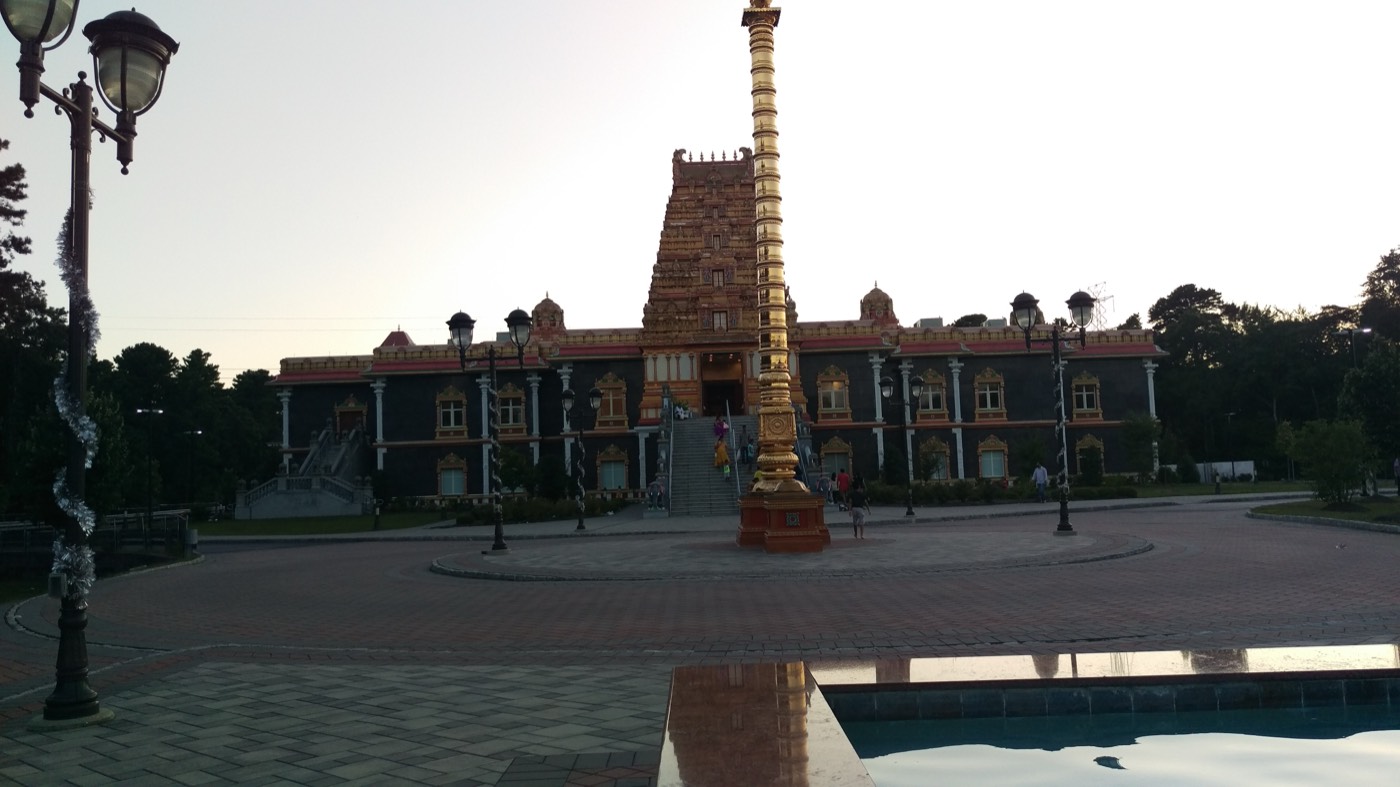
On a wooded rise off Wooleytown Road, a granite gopuram tower carved in the style of Kerala’s coastal temples rises above the oaks of Monmouth County. Inside, priests perform the same dawn rituals offered to Lord Krishna in Guruvayur, six thousand miles away. The Indians in Marlboro, New Jersey, have built a township where the suburbs of central Jersey meet the shrines of the Malabar Coast, and where a cricket pitch sits a short drive from one of the state’s best-ranked high schools.
The Place
Marlboro Township sits in northern Monmouth County, about thirty miles south of Newark and an easy run up Route 9 to the older Indian centres of Edison and Old Bridge. It was carved from Freehold Township in 1848 and named for the marl beds that farmers once dug here for fertiliser. For most of its history it was farmland and orchard.
That changed in the late twentieth century, when the township became one of the wealthiest in the state. The 2010 median household income topped $130,000, and median home prices ran well above the national average. Marlboro today is a town of cul-de-sacs, mature trees, and the neighbourhoods of Morganville and Robertsville, where much of the Indian community has settled.
How It Became Indian
The story of Indians in Marlboro is, in part, the story of central New Jersey’s whole South Asian corridor moving south and east in search of space.
The pull from Edison and Old Bridge
By the 1980s, Indian families who had arrived under the 1965 Immigration and Nationality Act had concentrated heavily in Edison, Iselin, and Old Bridge along the Route 1 and Route 9 spine. As those families prospered, many looked for larger houses, lower density, and stronger schools without leaving the orbit of the temples and grocers they relied on. Marlboro, a half-hour down Route 9, fit exactly.
The families who came were largely professionals: physicians and pharmacists drawn by the hospitals of central Jersey, engineers and finance workers commuting to New York, and small-business owners. They were not pioneers in a wilderness. They were a second wave, moving outward from an established core to a quieter suburb that still kept the old centres within reach.
It was a familiar pattern across the region. The same logic that filled the townhouses of Iselin in the 1980s now sent the next generation looking for detached houses and bigger lots, and Marlboro had both. A doctor at a Monmouth County hospital could buy a colonial on a half-acre, send children to a top-ranked district, and still reach a Hindu temple inside twenty minutes. Few suburbs in America offered that combination as cleanly.
A temple takes root
The decisive institution arrived almost by accident of geography. In May 1988 a group of devotees incorporated the Hindu American Temple and Cultural Center, meeting first in members’ homes and rented halls. In 1995 the organisation bought a 32-acre property in the Morganville section of Marlboro and began holding services in a small hall on the land.
What grew there became one of the most significant South Indian temples in the northeastern United States. The presiding deity is Lord Krishna in the form of Guruvaayoorappan, the child Krishna worshipped at the famous Guruvayur temple in Kerala. For Malayali and South Indian families across the region, finding that specific deity in suburban New Jersey was reason enough to move within driving distance.
Guruvayur is one of the holiest Vaishnava shrines in southern India, the spiritual home of millions of Keralites. To find its presiding form installed off a country road in Monmouth County was, for those families, a small miracle of replication. The temple did not merely serve a community that already lived nearby. It helped pull one into being, drawing households who weighed where to settle in part by how close they could be to the morning aarti.
Consecration and growth
The temple expanded steadily. A roughly 400-square-foot extension went up in 2008, followed by a major build of around 35,000 square feet that added the main sanctum, a multi-purpose hall, and priest quarters. The main temple was consecrated through a seven-day Maha Kumbhabhishekam ceremony culminating on 1 July 2012, blessed by the Jagadguru Sankaracharya of the Sringeri Sharada Peetham in India, who provided the energised yantras for each shrine.
As the temple grew, so did the residential community around it. Indian families clustered in Morganville and Robertsville, drawn by the township’s schools and the gravitational pull of the mandir. By 2010 the census recorded that roughly seventeen per cent of Marlboro’s residents were Asian. By 2020, with a population of 41,502, the Asian share had climbed to nearly twenty-three per cent, a large portion of it Indian, making Marlboro one of the most heavily South Asian suburbs in New Jersey outside the Edison-Iselin core.
From temple to township life
The community’s footprint moved beyond the temple grounds. In 2020 a group of residents founded the Marlboro Indian Foundation, a volunteer-run nonprofit that organises the township’s Diwali Milan, a Holi colours festival, and a municipal Diwali lighting ceremony, alongside food drives and youth programmes. The foundation has also worked to develop a cricket pitch for local youth, planting the sport firmly in a town that not long ago knew only baseball and soccer.
India became one of the cultures regularly represented at Marlboro High School’s annual Multi-Cultural Day, where Kathak classical dance shares the stage with performances from across the township’s many communities. The arrival of Indian families did not replace Marlboro’s character. It layered onto it.
The Landmarks
Sri Guruvaayoorappan Temple, 27 Wooleytown Road, Morganville. The heart of Indian Marlboro. Its carved gopuram tower and 40-foot dvajasthambham flagpost rise from a 32-acre campus that also holds a goshala cow barn and a yagashala for fire rituals. Three annual Brahmotsavam festivals honour Shiva, Venkateswara, and Guruvaayoorappan.
Sri Krishna Bhojana Shala, 27 Wooleytown Road, Morganville. The temple’s vegetarian bhojanashala, serving South Indian prasadam to visiting devotees through the year. For many families it doubles as a community canteen, where a plate of sambar and rice follows the morning darshan.
Tandoor Indian Chinese Thai Cuisine, Route 9 South, Garden Plaza, Marlboro. Set in a strip plaza before the Costco, Tandoor serves the Indian-Chinese fusion that diaspora families crave, drawing diners from Manalapan, Old Bridge, and Monroe as easily as from Marlboro itself.
Indian grocers of Morganville. A cluster of South Asian markets, among them Patidar and other India grocers along South Main Street and the Route 9 corridor, keeps kitchens stocked with curry leaves, lentils, and fresh paneer. They are the everyday infrastructure of a community that cooks at home.
Marlboro High School, 95 North Main Street. Part of the Freehold Regional High School District, the school ranks among the stronger public high schools in New Jersey, with math and reading proficiency well above state averages and a graduation rate near 98 per cent. For many Indian families, the schools were the reason they chose Marlboro at all.
Robertsville and Morganville. These two sections of the township hold the densest Indian settlement, their newer subdivisions filling with families who wanted the temple close and the commute to New York manageable.
Where They Came From
Marlboro’s Indian families trace to several regions, but the dedication to a Guruvaayoorappan temple points to a strong South Indian and Malayali presence, families with roots in Kerala and Tamil Nadu who carried the worship of the child Krishna across the ocean. Around them are Gujarati, Telugu, and North Indian households drawn from the wider central Jersey diaspora.
Most did not arrive in Marlboro directly from India. They came by way of Edison, Iselin, and Old Bridge, the first landing places of the post-1965 wave, moving south as their careers in medicine, pharmacy, engineering, and finance let them trade a townhouse for a house with a yard. The chain ran from the subcontinent to the Route 1 corridor and then, one family at a time, down Route 9 to Monmouth County. For some, the first American address was further north still, in the dense Indian streets of Jackson Heights, Queens, before the move across the river to suburban New Jersey.
Marlboro Today
Marlboro today is a settled, prosperous suburb where the Indian community is no longer new. The temple draws worshippers from across the region for its festivals, and the township’s autumn calendar now includes Diwali celebrations organised by Indian residents rather than imported as novelties.
The pull of the larger temples remains. Families regularly make the drive to the vast BAPS Swaminarayan Akshardham in nearby Robbinsville, the largest Hindu temple in the United States, consecrated in 2023 on a 183-acre campus of hand-carved marble. Marlboro’s own mandir serves the daily and the local; Robbinsville serves the grand occasions. Together they anchor central New Jersey as one of the densest concentrations of Hindu life in America.
For comparison, the older and larger Indian world of Edison still sets the regional tone, while suburbs like West Windsor and Bridgewater tell the same story of professionals moving outward to good schools. Marlboro’s distinction is its South Indian temple, a quiet anchor that gives a Monmouth County suburb a piece of the Kerala coast.
Frequently Asked Questions
How large is the Indian community in Marlboro, New Jersey?
The 2020 census recorded Marlboro’s population at 41,502, with nearly twenty-three per cent identifying as Asian, up from about seventeen per cent in 2010. A large share of that figure is Indian, making the Indians in Marlboro, New Jersey, one of the most prominent communities in the township and one of the larger South Asian suburbs in the state.
Why did Indian families move to Marlboro?
Most came from the older Indian centres of Edison, Iselin, and Old Bridge, moving south down Route 9 for larger homes, lower density, and strong public schools. Marlboro stayed within easy reach of the temples, grocers, and restaurants of central New Jersey while offering a quieter suburban life.
What is the main Hindu temple in Marlboro?
The Sri Guruvaayoorappan Temple at 27 Wooleytown Road in the Morganville section is the community’s central institution. Run by the Hindu American Temple and Cultural Center, founded in 1988, it was consecrated in 2012 and worships Lord Krishna in the Guruvaayoorappan form of Kerala’s Guruvayur temple.
Are there Indian restaurants and grocers in Marlboro?
Yes. Tandoor on Route 9 South serves Indian, Chinese, and Thai dishes, the temple runs the vegetarian Sri Krishna Bhojana Shala, and several Indian grocers operate in Morganville along South Main Street and the Route 9 corridor.
How do the Indians in Marlboro celebrate Diwali?
The Marlboro Indian Foundation, founded in 2020, organises a Diwali Milan celebration and a township Diwali lighting ceremony, along with a Holi colours festival. The Indians in Marlboro, New Jersey, also celebrate festivals at the Sri Guruvaayoorappan Temple throughout the year.
How far is Marlboro from Edison and the Robbinsville temple?
Marlboro lies roughly half an hour down Route 9 from the Edison and Old Bridge Indian centres, and a short drive from the BAPS Swaminarayan Akshardham in Robbinsville, the largest Hindu temple in the United States. Both keep Marlboro tightly connected to central New Jersey’s wider Indian life.
If your family’s story passed through Marlboro, or any of the places Indians have made home in America, Atlas of Home can trace that journey. From the Guruvayur coast of Kerala to a gopuram tower in Monmouth County, to wherever you are now.