
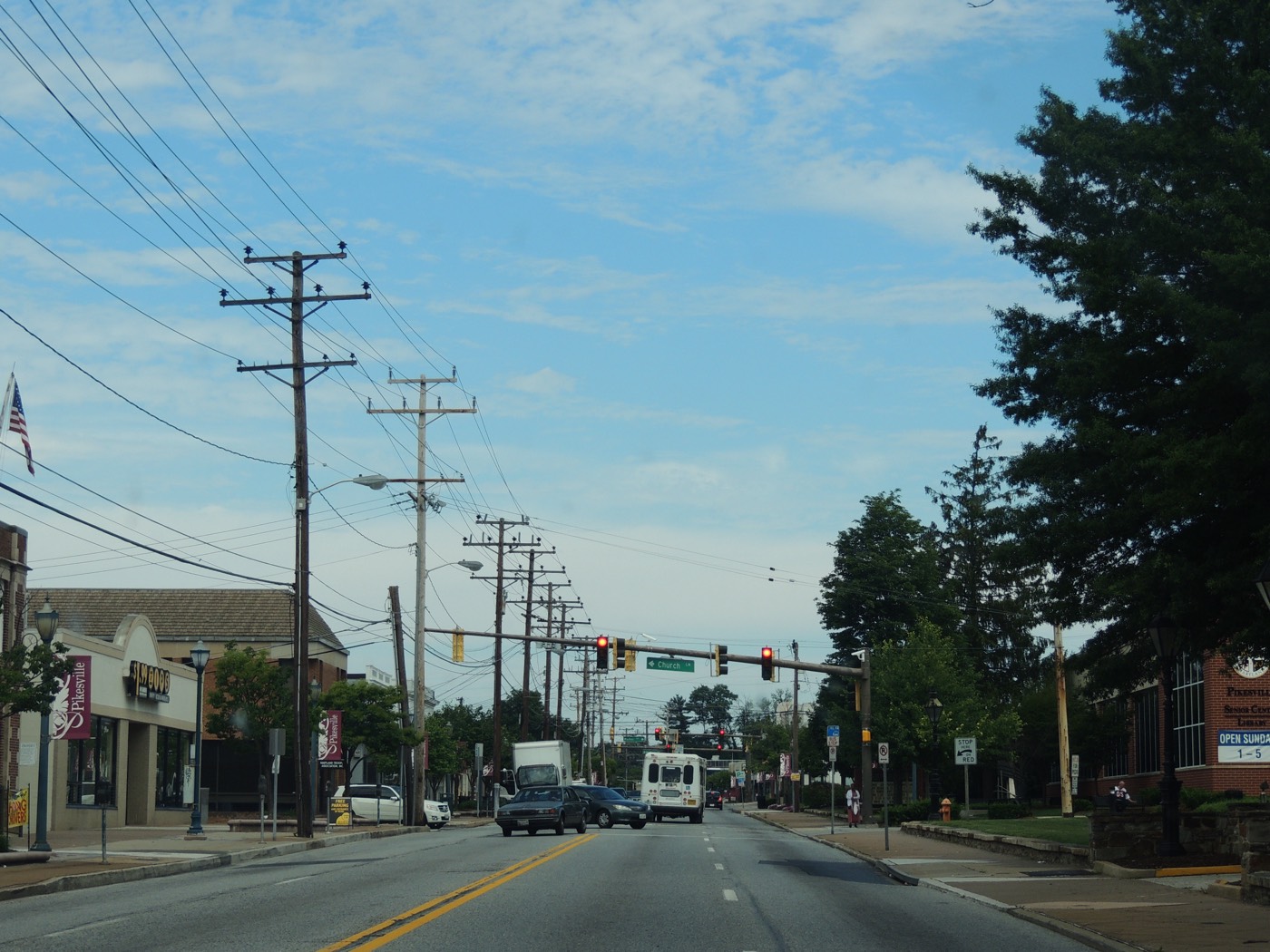
Drive northwest out of Baltimore on Reisterstown Road and somewhere past the Beltway the city quietly becomes something else. Kosher delis sit beside synagogues with sanctuaries the size of theatres, and a grocery store the size of a warehouse stocks more than two thousand certified products. This is Pikesville, and the story of the Jews in Pikesville, Maryland is really the story of a whole community that picked itself up from the rowhouses of East Baltimore and moved, block by block and decade by decade, to higher ground.
The Place
Pikesville is an unincorporated suburb in Baltimore County, just northwest of the city line, named for Zebulon Pike, the soldier and explorer whose name also marks the Colorado peak. It is the closest northwestern suburb to Baltimore, a little over twelve square miles of leafy streets, mid-century split-levels and a busy commercial spine along Reisterstown Road.
The 2020 census counted around 34,000 residents. For most of the last seventy years it has carried a second, unofficial identity: the heart of Baltimore’s Jewish community, a place where Hebrew school carpools and Shabbat tables shape the weekly rhythm as much as the morning commute.
How It Became Jewish
To understand Jewish Pikesville you have to start downtown, in the cramped streets where the community first took root, and then follow it as it moved relentlessly northwest.
From Lombard Street and East Baltimore
Baltimore’s Jews first concentrated in East Baltimore, around Lombard Street and the old Jonestown district, where Eastern European immigrants arriving in the late nineteenth and early twentieth centuries crowded into rowhouses, sweatshops and small shops. Lombard Street earned its nickname, Corned Beef Row, from the kosher butchers and delicatessens packed along it.
It was a poor, dense, intensely communal world, the Baltimore equivalent of the tenement blocks that the Jews on the Lower East Side of Manhattan knew so well. Lombard Street had its synagogues and its landsmanshaft societies, its Yiddish theatre and its arguments over politics conducted half in English and half in the old language.
As the children and grandchildren of those immigrants found their footing, they did what generations of American newcomers have always done. They looked for room to breathe, and they found it to the northwest.
Up Park Heights Avenue
The first big move took the community up Park Heights Avenue, into northwest Baltimore neighbourhoods like Forest Park and, later, upper Park Heights. By 1968, upper Park Heights was roughly 83 per cent Jewish, a self-contained world of synagogues, schools and shops.
The institutions followed the families. Beth Tfiloh, founded in 1921, built its grand domed synagogue on Garrison Boulevard in 1927. The momentum was always in one direction, and it did not stop at the city line.
Across the line into Pikesville
From the mid-1950s the migration crossed into Baltimore County, and Pikesville became its centre. Builders saw the market plainly and marketed whole new neighbourhoods to Jewish buyers, and Pikesville, Owings Mills and Reisterstown began to boom together.
The congregations made it official. Beth El, founded in 1948 as the first Conservative congregation in Maryland by lay leaders who had split from Orthodox Beth Tfiloh, broke ground on its Pikesville sanctuary in June 1959 and opened around 1960. It had grown from 97 families in 1950 to 1,100 families by 1955, and it needed the room.
Chizuk Amuno, a Conservative congregation founded downtown in 1871 by traditionalists who had broken from Baltimore Hebrew, moved out to its Stevenson Road campus by the 1960s. Beth Tfiloh completed its current home on Old Court Road in 1966. The Jewish Community Center anchored the corridor when its building at 5700 Park Heights Avenue opened in 1960.
A community that brought its institutions with it
What set the Pikesville migration apart was its completeness. This was not a scattering of families into the suburbs. It was the wholesale relocation of an entire civic infrastructure: synagogues, day schools, the JCC, kosher butchers, bakeries and funeral homes, all rebuilt within a few square miles.
By the mid-1970s, more than 85 per cent of the metro area’s Jewish population lived inside seven northwestern postal zones, with Pikesville at their core. The community had not dispersed so much as migrated intact, the same density of Jewish life simply transplanted to greener ground.
It is a pattern repeated in Jewish suburbs across the country. The move from a crowded urban core to a leafy, institution-rich suburb echoes the story of the Jews in Squirrel Hill, Pittsburgh and the established communities that took shape among the Jews in Boca Raton, Florida. What makes Pikesville distinctive is how tightly the whole apparatus stayed packed together, more like the dense observant enclave of the Jews in Borough Park, Brooklyn than a scattered commuter suburb.
The Landmarks
Beth Tfiloh Congregation, 3300 Old Court Road. A Modern Orthodox congregation that claims roughly 3,500 members and seating for 1,600, calling itself the largest Modern Orthodox congregation in the United States. Its Pikesville sanctuary opened in 1966, and Rabbi Mitchell Wohlberg led it for more than four decades from 1978 to 2021.
Beth El Congregation, 8101 Park Heights Avenue. Maryland’s first Conservative congregation, its sweeping 1960 sanctuary was designed by Sigmund Braverman to seat 1,500 across 91,000 square feet. Granite pillars evoke Solomon’s Temple, and stained-glass windows mark the Jewish festivals.
Chizuk Amuno Congregation, 8100 Stevenson Road. A traditional, egalitarian Conservative congregation tracing its roots to an 1871 walkout over reforms at Baltimore Hebrew. Its campus houses preschool through high school, including the Krieger Schechter Day School, opened in 1981.
Seven Mile Market, 201 Reisterstown Road. Established in 1988 and in its current building since November 2010, this is the largest kosher grocery store in the United States, with more than 55,000 square feet of floor space, kosher meat and fish counters, a floral section and even an in-store optometrist. On a Thursday before a holiday the car park overflows.
Suburban Orthodox Congregation Toras Chaim, 7504 Seven Mile Lane. A neighbourhood Orthodox shul on the residential streets where much of the observant community lives, close enough to walk to on Shabbat, which for an Orthodox congregation is the whole point.
The Knish Shop, 508 Reisterstown Road. A long-running kosher delicatessen and takeaway on the Reisterstown Road strip, part of a cluster of kosher eateries that includes Israeli grills and dairy bistros, the everyday food culture that keeps the corridor humming between the High Holidays.
Beth Tfiloh Dahan Community School, on the Old Court Road campus. A pluralistic Jewish day school running from preschool through twelfth grade, one of the institutions that anchors families to Pikesville for an entire childhood, not just a Sabbath.
Where They Came From
Virtually all of Pikesville’s Jews are Ashkenazi, descendants of the great wave of Eastern European immigration that crossed the Atlantic between the 1880s and the 1920s, fleeing poverty and pogroms in the Russian Empire and the lands that are now Ukraine, Poland, Lithuania and Belarus.
The census still carries the fingerprint. In 2000, 19.3 per cent of Pikesville residents claimed Russian heritage and 3.7 per cent Ukrainian, the highest such share in Maryland, almost all of them Jewish families whose grandparents and great-grandparents first landed in the rowhouses of East Baltimore.
From Lombard Street to Park Heights to Pikesville, the journey unfolded over three or four generations without anyone ever crossing an ocean again. The distance from Corned Beef Row to Reisterstown Road is only a few miles, but it represents a century of climbing.
The Jewish Museum of Maryland, housed in two of the city’s oldest surviving synagogues on the original East Baltimore site, keeps that earlier chapter alive. Its timeline of Baltimore Jewry traces the same northwest arc, from the immigrant streets to the suburban campuses, that every Pikesville family carries in its own memory.
Pikesville Today
Pikesville remains the unmistakable centre of Jewish Baltimore, a metro Jewish community estimated at around 100,000 people, concentrated heavily in the northwest corridor that runs from the city’s Cheswolde and Park Heights edges out through Pikesville to Owings Mills.
You can read the community in the streetscape: eruv wires overhead, men in dark hats walking to shul on Saturday mornings, the Star-K kosher symbol in storefront windows along Reisterstown Road. The denominational range is wide, from the Modern Orthodox crowds at Beth Tfiloh to the Conservative congregations at Beth El and Chizuk Amuno to the strictly Orthodox shuls tucked into the residential streets.
The community is also visibly Israeli and increasingly diverse in its observance. Reisterstown Road carries Israeli grills and Hebrew signage alongside the old-school delis, a reminder that the neighbourhood keeps absorbing new arrivals even as its founding families age into their fourth and fifth American generations.
Like every American Jewish neighbourhood, it is not static. Younger families weigh Pikesville against Owings Mills and the city’s own revitalising Jewish pockets, and the corridor keeps shifting northwest as it always has, the same restless momentum that built the place to begin with. The 2020 Greater Baltimore Jewish community study from Brandeis University confirms what the streets already tell you: this corridor is still where the community lives.
But for now, if you want to find the soul of Jewish Baltimore, you find it here, somewhere between the synagogue parking lots and the Seven Mile Market checkout lines.
Frequently Asked Questions
Why is Pikesville so Jewish?
The Jews in Pikesville, Maryland arrived through a long northwest migration out of East Baltimore, up Park Heights Avenue and across the county line from the mid-1950s. Builders marketed new neighbourhoods to Jewish buyers, and synagogues, schools and kosher businesses relocated en masse, making Pikesville the centre of Jewish Baltimore.
How many Jews live in the Baltimore area?
The greater Baltimore Jewish community has been estimated at around 100,000 people, concentrated heavily in the northwest corridor that includes Pikesville, upper Park Heights and Owings Mills. Pikesville itself is one of the densest Jewish areas in Maryland.
What synagogues are in Pikesville?
Major congregations include Beth Tfiloh (Modern Orthodox, on Old Court Road), Beth El and Chizuk Amuno (both Conservative, on Park Heights Avenue and Stevenson Road), and Suburban Orthodox Toras Chaim. Beth Tfiloh claims to be the largest Modern Orthodox congregation in the United States.
Where can you find kosher food in Pikesville?
Reisterstown Road is the heart of kosher Pikesville. Seven Mile Market at 201 Reisterstown Road is the largest kosher grocery store in the country, and the strip includes kosher delis, Israeli grills and dairy bistros such as the long-running Knish Shop.
What Jewish schools are in Pikesville?
The Beth Tfiloh Dahan Community School runs from preschool through twelfth grade on the Old Court Road campus, and Chizuk Amuno operates the Krieger Schechter Day School, opened in 1981. Both anchor families to the neighbourhood through an entire childhood.
Where did Baltimore’s Jews live before Pikesville?
They first concentrated in East Baltimore around Lombard Street, nicknamed Corned Beef Row for its kosher butchers and delicatessens. From there the community moved northwest into Forest Park and upper Park Heights before crossing into Pikesville from the mid-1950s.
If your family’s story passed through Pikesville, or any of the places Jews have made home in America, Atlas of Home can trace that journey. From a rowhouse on Lombard Street to a synagogue pew on Old Court Road, to wherever you are now.