
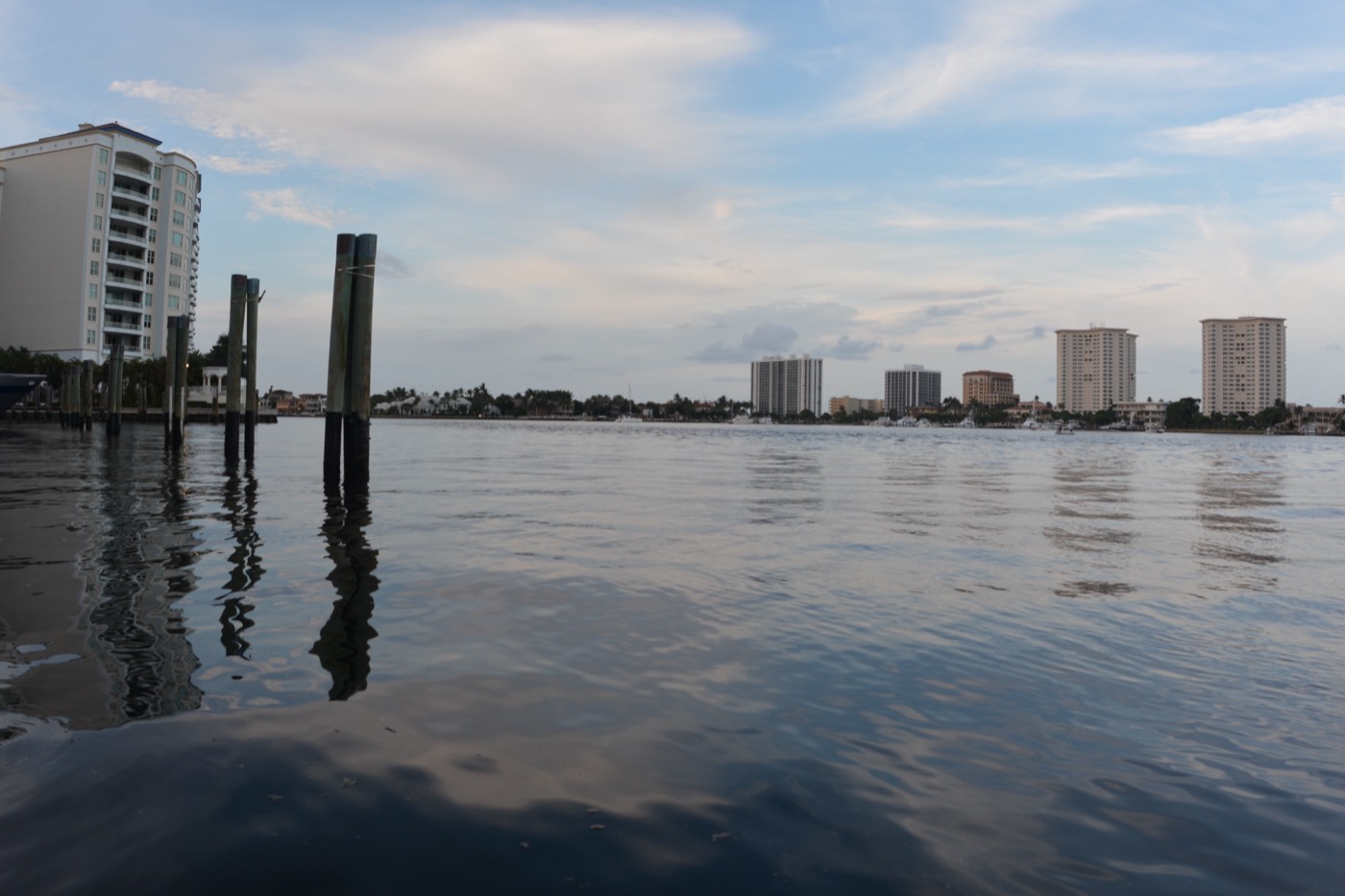
The Jews in Boca Raton did not arrive with the city’s founders. They arrived later, in station wagons and on Eastern Air Lines flights, trading the cold of Brooklyn and Bergen County for a planned Florida town of pink stucco and royal palms. Today this affluent stretch of southern Palm Beach County holds one of the densest Jewish populations of any place in America, a community built almost entirely within living memory.
The Place
Boca Raton sits on the Atlantic coast of Palm Beach County, roughly halfway between West Palm Beach and Fort Lauderdale. It is a city of manicured boulevards, gated developments and golf, with a coastline of public beaches and a downtown organised around the open-air plaza of Mizner Park.
The town owes its look to one man. The architect Addison Mizner, who had already remade Palm Beach for the very rich, was hired as Boca Raton’s planner after the city incorporated in June 1925. His Mediterranean Revival vision, all barrel-tile roofs, arches and courtyards, gave Boca its centrepiece in the 1925 Cloister Inn, now the sprawling resort known simply as The Boca Raton.
The Florida land bust of 1926 ended Mizner’s grand scheme before it was finished. For decades afterwards Boca Raton stayed small. The transformation into the wealthy, heavily Jewish suburb of today came later, on the back of air conditioning, interstate highways and a postwar generation looking south.
What Mizner left behind was a style and a name to live up to. The Mediterranean Revival idiom, with its arches, courtyards and pale stucco, set the template for the gated communities and shopping plazas that would later fill the city’s western edge. When Jewish families arrived in numbers from the 1970s onward, they settled into a town that already presented itself as a sun-washed escape, an aspiration made of stone and royal palms.
How It Became Jewish
The postwar pull south (1950s-1960s)
For the first half of the twentieth century, Jewish Florida meant Miami Beach. Palm Beach County, and Boca Raton in particular, was quieter and in places openly restricted. That began to change as air conditioning made year-round life bearable and as a comfortable, mostly Northeastern Jewish middle class started to retire.
Boca’s first synagogue, Temple Beth El, was founded in 1967 by a small group of families. Its arrival marked the moment when Jewish life here stopped being seasonal and started to put down roots.
That first congregation was small and Reform, suited to a community of professionals and retirees who wanted a familiar Jewish framework without the demands of strict observance. For years it stood largely alone. The deeper texture of Jewish Boca, the day schools, the kosher butchers, the Orthodox shuls within walking distance of one another, was still a generation away.
The condominium boom (1970s-1980s)
The real engine of Jewish Boca was housing. Large planned communities, among them the Boca Raton branch of Century Village, a sprawling development aimed at residents aged 55 and over, drew tens of thousands of retirees, most of them from the Atlantic seaboard and a great many of them Jewish.
Institutions followed the people. The Adolph and Rose Levis Jewish Community Center was established in 1972. Donna Klein Jewish Academy, a K-12 day school, opened in 1979. In 1983 three couples met to plan an Orthodox congregation, and Boca Raton Synagogue broke ground on its first building in 1985.
Families, not just retirees (1990s-2010s)
What began as a retirement haven matured into a full community with children, schools and year-round congregations. The 100-acre Jewish Federation campus on Donna Klein Boulevard became a hub, gathering a day school, the JCC and other services on a single site.
The change is measurable. The 2018 South Palm Beach County study found nearly 167,000 people living in roughly 78,000 Jewish households, a 21 per cent rise over the previous 2005 count, with the number of children up by 88 per cent. The fastest-growing segment was young families, and a plurality lived in central Boca Raton and neighbouring Delray Beach.
The Landmarks
Temple Beth El of Boca Raton, 333 SW 4th Avenue. Founded in 1967, this Reform congregation was the city’s first synagogue. Its Schaefer Family Campus anchors the older part of town and remains one of the largest Reform communities in South Florida.
B’nai Torah Congregation, 6261 SW 18th Street. One of the largest Conservative congregations in the region, B’nai Torah sits west of downtown between Military Trail and Powerline Road. Its broad campus and full calendar of programmes make it a centre of communal life.
Boca Raton Synagogue, near Montoya Circle off SW 18th Street. The city’s first Orthodox congregation grew from a meeting of three couples in 1983 and broke ground in 1985. It has since become the spine of a thriving Modern Orthodox neighbourhood within walking distance of its doors.
Adolph and Rose Levis JCC, 9801 Donna Klein Boulevard. Founded in 1972, the Levis JCC offers preschool, fitness, arts and senior programmes. It anchors the western Federation campus and serves Jewish families across the age range.
Donna Klein Jewish Academy, 9701 Donna Klein Boulevard. Opened in 1979, this co-educational community day school spans kindergarten through grade 12. It shares the Federation’s 100-acre campus with the JCC and other agencies.
Katz Yeshiva High School of South Florida, 20900 Ruth and Baron Coleman Boulevard. A co-educational Modern Orthodox yeshiva of roughly 480 students in grades 9 to 12, Katz draws families to Boca specifically for its dual programme of rigorous Jewish and secular study.
Boca Grill, 8903 Glades Road. A glatt kosher restaurant in the heart of the Glades Road corridor, where much of Boca’s kosher dining clusters. It is one of a row of supervised eateries that make observant life here practical rather than a constant compromise.
Where They Came From
Trace a Boca Raton Jewish family back a generation or two and you almost always land in the Northeast. New York above all, the outer boroughs and the suburbs of Long Island and Westchester, and after that New Jersey, from Bergen County to the shore. The same migration that filled neighbourhoods like Borough Park in Brooklyn sent its grandchildren and retirees south to Florida.
This was chain migration in its purest form. A retired couple bought a condominium, a sister followed, then the friends from the old synagogue back home, then the adult children who came to be near ageing parents. Snowbirds who once split the year eventually stayed for good, and seasonal residents still make up about a fifth of the adult Jewish community each winter.
Behind that lies an older story. Many of these families reached New York and New Jersey through the great Eastern European migration of the late nineteenth and early twentieth centuries, the world of the shtetl and the tenement that runs through the Lower East Side of Manhattan. Boca’s affluent comfort is, for many, the third or fourth chapter of a story that began in poverty in the Pale of Settlement.
South Florida also holds the largest community of Holocaust survivors in the country, and Boca Raton is part of it. Survivor groups still gather, including at the Century Village clubhouse, a reminder that the sunlit retirement was for some the end of a far darker road.
The result is a community whose accents and habits often still carry the Northeast within them. The rhythm of summers spent up north and winters spent in Florida, the loyalty to a deli sandwich done the right way, the conversations about which grandchildren have moved down too, all of it marks Boca as a kind of transplanted New York, warmed and re-rooted in Florida soil.
Boca Raton Today
Boca Raton is now one of the most identifiably Jewish places in the United States. The wider tri-county area of Miami-Dade, Broward and Palm Beach is home to more than 625,000 Jews, roughly a tenth of all American Jews, and southern Palm Beach County is among its densest concentrations.
The community spans every stream of Jewish life. Reform, Conservative, Orthodox and Chabad congregations operate within a few miles of one another, alongside day schools, a yeshiva, kosher restaurants and the Federation campus that ties much of it together.
It is also unusually layered by age. Holocaust survivors and Northeastern retirees share the city with young Modern Orthodox families who moved precisely for the schools and synagogues, and with seasonal snowbirds who keep the winter pews full. The pattern echoes other transplanted Jewish suburbs such as Skokie outside Chicago and Scarsdale in Westchester, the kind of places people moved to rather than were born in.
That makes Boca part of a broader Florida story of communities reassembled far from their origins, much as the Cubans of Little Havana in Miami rebuilt their world to the south. Jewish Boca was not inherited. It was chosen, condominium by condominium and congregation by congregation, and it is still growing.
Frequently Asked Questions
How large is the Jewish community in Boca Raton?
The 2018 South Palm Beach County study, covering Boca Raton and Delray Beach, found nearly 167,000 people living in around 78,000 Jewish households, a 21 per cent increase over 2005. A plurality of the community lives in central Boca Raton, making it one of the densest Jewish areas in the country.
Why did so many Jews move to Boca Raton?
Most came from the Northeast, especially New York and New Jersey, drawn by warm weather, retirement-oriented housing such as Century Village and a growing cluster of Jewish institutions. Air conditioning and the postwar interstate boom made year-round life practical, and chain migration did the rest as relatives and friends followed.
What is the oldest synagogue in Boca Raton?
Temple Beth El of Boca Raton, founded in 1967, was the city’s first synagogue. It is a Reform congregation and remains one of the largest in South Florida, with its Schaefer Family Campus on SW 4th Avenue.
Is Boca Raton a good place for Orthodox Jewish life?
Yes. Boca Raton Synagogue, founded in the 1980s, anchors a walkable Modern Orthodox neighbourhood, and Katz Yeshiva High School draws observant families from across the region. Glatt kosher restaurants and groceries cluster along the Glades Road corridor.
Are there Jewish schools in Boca Raton?
Boca Raton has several. Donna Klein Jewish Academy, founded in 1979, is a K-12 community day school on the Jewish Federation campus, and Katz Yeshiva High School of South Florida is a co-educational Modern Orthodox yeshiva for grades 9 to 12.
Does Boca Raton have Holocaust survivors?
Yes. South Florida is home to the largest community of Holocaust survivors in the United States, and Boca Raton is part of it. Survivor groups continue to meet locally, including at the Century Village clubhouse.
If your family’s story passed through Boca Raton, or any of the places Jewish families have made home in America, Atlas of Home can trace that journey. From a shtetl to a Brooklyn block to a condominium off Glades Road, to wherever you are now.
Further reading: the 2018 South Palm Beach County Jewish Community Study from Brandeis University, and the history of the Jews in South Florida.