
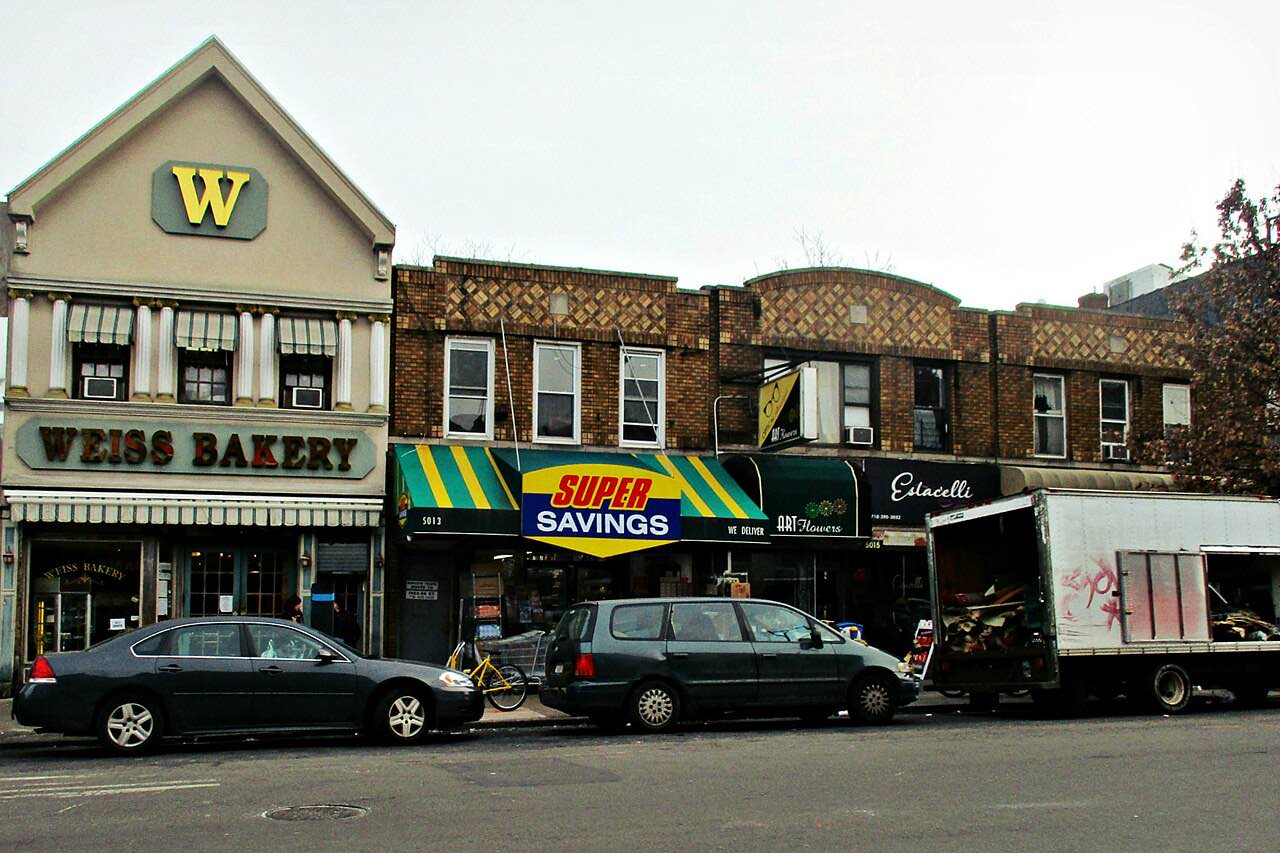
On an ordinary weekday morning, 13th Avenue belongs to the strollers. Mothers steer them past Weiss Bakery and the seforim shops while school buses with Hebrew lettering idle at the curb. Yiddish carries over the traffic, the language of the sidewalk more than English. By the time you reach 48th Street, the storefronts give way to the great Bobover beis medrash, and you understand that you have walked into the largest Orthodox Jewish community in the United States. This is Borough Park, and its density of Jewish life has no rival on American soil.
The Jews of Borough Park did not simply move here. They rebuilt here, often from almost nothing, in the decades after the Holocaust nearly erased the world they came from.
Borough Park: The Place
Borough Park sits in southwestern Brooklyn, bordered by Bensonhurst to the south, Sunset Park to the west, Kensington and Green-Wood Cemetery to the north, and Flatbush to the east. It covers roughly two square miles, served by the D train on the West End line and the F train along McDonald Avenue. The housing is mostly low-rise: brick rowhouses, two- and three-family homes, and apartment buildings, almost all with balconies. Those balconies matter, because for one week every autumn they become sukkahs.
How Borough Park Became Orthodox Brooklyn
Before the Jews
The land was farmland first, part of the old Dutch town of New Utrecht, dotted with nurseries well into the 1800s. In 1887 an architect named Electus Litchfield bought vacant ground and laid out a community of cottages he called Blythebourne, a name meant to evoke a happy home. In 1902 the state senator and developer William H. Reynolds bought a tract just to the northeast and named it Borough Park. By the 1920s the real estate boom had merged the two, and Blythebourne vanished into the larger name.
The Jews Arrive
Jewish families began arriving around 1904 and 1905, many of them moving up and out from the crowded tenements of Manhattan’s Lower East Side and from Williamsburg. A YMHA had formed by 1914, buying a lot on 58th Street and 14th Avenue. By 1925 the Jewish population numbered around 60,000, and by 1930 roughly half the neighborhood was Jewish. In the late 1920s and 1930s a small community of Yemenite Jews settled in too, eventually establishing the Ohel Shalom synagogue at 12th Avenue and 44th Street in a former church.
This early Borough Park was middle-class and broadly American. It held modern Orthodox families, secular Jews, and Conservative congregations, all stitched together by the pushcart vendors and pickle sellers who lined 13th Avenue in the 1930s. Temple Beth El even hired a celebrated cantor in those years, hoping a great voice would keep members from drifting toward the Conservative synagogues opening nearby.
Borough Park at Its Peak
The transformation came after 1945. Thousands of Hasidic survivors, refugees from the camps and ruined towns of Poland, Hungary, and Galicia, arrived to start over. Some came directly. Others arrived by way of Crown Heights and Williamsburg, pushed out in the late 1950s when the Brooklyn-Queens Expressway tore through their streets. In the mid-1960s the Bobover Hasidim relocated here in force, then a far quieter and safer corner of Brooklyn, and the Belzer Hasidim followed, making Borough Park one of the fastest-growing Jewish communities in North America.
No story captures the rebuilding better than that of the Bobover rebbe, Rabbi Shlomo Halberstam. During the war he lost his wife and most of his children, was once taken toward execution at Bochnia and turned back at the last moment, and at one point disguised himself to smuggle Jews to safety. He reached America with his eldest son and almost nothing else, opening a yeshiva for sixteen boys on Manhattan’s West Side. Over the next half century he rebuilt Bobov into one of the largest Hasidic groups in New York, and by his death in 2000 he was mourned by far more followers than his dynasty had counted before the war.
As secular and Reform families left for the suburbs in the 1960s, Hasidic families took their place block by block. By 1983 an estimated 85 percent of residents were Jewish. The neighborhood had completed a rare reversal, what observers came to call the journey from suburb to shtetl.
The Change
What changed was the scale and the certainty. The early waves of Hasidim were small, sometimes a few hundred families clustered around a single rebbe. Within two generations, high birthrates and chain migration turned those clusters into one of the densest Jewish populations on earth. The 2000 census counted roughly 76,600 Jews; by 2011 the wider area held about 140,000 people, and today Borough Park is home to an estimated 100,000 Jews, the overwhelming majority Orthodox and most of them Hasidic.
The Landmarks of Borough Park
The Bobover Beis Medrash, 1533 48th Street. This is the spiritual heart of the neighborhood, the great study hall built for the Bobover community at 48th Street and 15th Avenue and opened in the mid-1980s. When it rose it was unlike anything in Brooklyn, a sanctuary of its size built without supporting columns down the center, so that nothing stood between the worshippers and the rebbe. It is the building that announced Bobov had not merely survived but flourished.
Temple Beth El of Borough Park, 4802 15th Avenue. Founded in August 1902, this congregation built the oldest synagogue in Borough Park, a brick structure raised in 1906 at 12th Avenue and 41st Street. Its grand current home, built between 1920 and 1923 by the firm Shampan & Shampan in a mix of Moorish and Egyptian Revival styles, carries a dome by the Guastavino studio and was added to the National Register of Historic Places in 2010. In the 1980s it merged with Young Israel of Borough Park.
Maimonides Medical Center, 4802 10th Avenue. The neighborhood’s hospital began in 1911 as the New Utrecht Dispensary on 37th Street, grew through a 1920 merger into United Israel Zion Hospital, and took the name Maimonides in 1947. Its birthing center now delivers more babies than any other hospital in New York State, a fitting role in the neighborhood the New York Post once called the city’s baby boom capital.
Eichler’s, 5004 13th Avenue. When this Judaica store opened in 1987 it became a fixture of the avenue, its shelves carrying everything from tefillin and tallis to the full ArtScroll library. To walk in is to see the entire material world of Orthodox practice gathered under one roof.
J. Korn’s Bakery, 5004 16th Avenue. Open since 1948, Korn’s is one of the elder statesmen of the neighborhood’s kosher bakeries, its name passed between generations of Borough Park families buying challah for Shabbos. Around it, on 13th Avenue, newer institutions like Weiss Bakery keep the same Friday rhythm.
The Bobov-45 Beis Medrash, 14th Avenue and 49th Street. The newest landmark, a roughly $55 million sanctuary among the largest in New York City, was unveiled in the fall of 2025 after years of construction. Its scale, with thousands of seats and multiple mikvahs, is the clearest measure of how far the community has grown.
Where the Borough Park Jews Came From
The roots run through the towns and courts of pre-war Eastern Europe. Bobov takes its name from Bobowa in Galicia, in what is now southern Poland. The other dynasties carry the names of their old homes like maps of a vanished geography: Belz and Skver from Ukraine, Ger from Poland, Munkacs from Carpathian Ruthenia, Satmar from the Hungarian-Romanian borderland. Each rebbe who survived gathered his scattered Hasidim and reestablished his court here.
Borough Park is overwhelmingly Hasidic, but not only Hasidic. It holds a sizable Litvish or yeshivish community drawn from the non-Hasidic Lithuanian tradition, along with Sephardic and Syrian Jewish families and a smaller number of modern Orthodox households. The shared thread is observance, and the shared origin is a world that war tried to end.
The chain migration that built the neighborhood still runs along family lines. A young couple settles near the rebbe, near the right yeshiva, near a sister or a father-in-law, and the streets fill in one household at a time. The map of Borough Park is really a map of these courts laid one over another, Bobov beside Belz beside Ger beside Satmar.
Borough Park Today
Borough Park is not a neighborhood in decline, and it carries no air of nostalgia. It is growing, and the pressure shows. With families often raising six or seven children, and roughly 130 religious schools enrolling close to 30,000 students, the demand for housing and classroom space is relentless. The city recently approved a plan to build new family-sized apartments on a platform over the rail yards, designed with the balconies and bedroom counts the community actually needs.
The institutional density remains unmatched. There are close to 300 shtiebels, the small intimate prayer rooms Hasidim favor, plus roughly 100 larger synagogues, all packed into two square miles. On 13th Avenue the wig shops, silver dealers, and kosher bakeries do steady trade, and on Purim the whole avenue turns into a moving spectacle of costumes, music from rooftop speakers, and dancing in the street.
The story of Borough Park is the story of a world rebuilt by people who had every reason to believe it could not be. The children in those strollers on 13th Avenue are the proof, and the future, of a community that chose to begin again.
Frequently Asked Questions
Why did Jews settle in Borough Park?
Jewish families first moved to Borough Park around 1904 and 1905, leaving the crowded Lower East Side and Williamsburg for a quieter, more spacious neighborhood. After 1945, Hasidic survivors of the Holocaust settled here in large numbers and rebuilt their religious courts, drawn by affordable family housing and a growing observant community.
Is Borough Park still a Jewish neighborhood today?
Yes, intensely so. The Jews of Borough Park form the largest Orthodox Jewish community in the United States, an estimated 100,000 people, most of them Hasidic. With high birthrates and constant new construction, it is one of the fastest-growing Jewish neighborhoods in the country rather than a fading one.
What are the most famous landmarks in Borough Park?
The Bobover beis medrash on 48th Street is the spiritual anchor, and the new Bobov-45 sanctuary on 14th Avenue is among the largest synagogues in New York City. Temple Beth El, the oldest congregation, and Maimonides Medical Center, which delivers more babies than any hospital in the state, are also central landmarks.
Where did the Jews of Borough Park come from?
Most trace their roots to the Hasidic courts of pre-war Eastern Europe, including Bobowa in Galicia, Belz and Skver in Ukraine, Ger in Poland, and Munkacs in Carpathian Ruthenia. After the Holocaust, surviving rebbes regathered their followers in Borough Park, alongside Litvish, Sephardic, and Syrian Jewish families.
When did Jews first arrive in Borough Park?
Jewish settlement began around 1904 and 1905, and by 1925 the Jewish population had reached roughly 60,000. The defining transformation came after World War II, when Hasidic refugees rebuilt their communities and turned Borough Park into the Orthodox stronghold it is today.
If your family’s story passed through the streets of Borough Park, the tenements they left behind, or the courts they helped rebuild, those threads are worth following.