
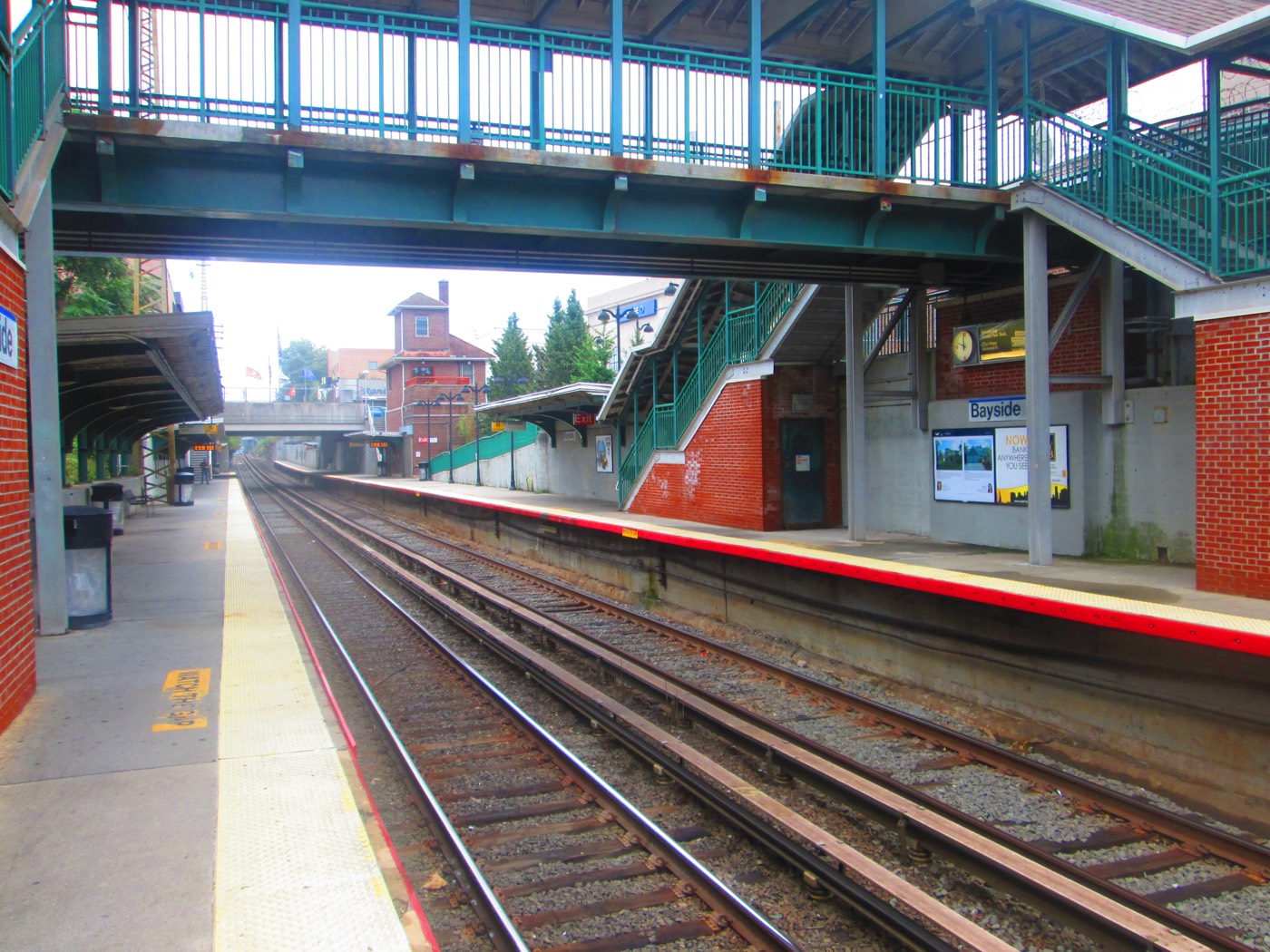
On a weekday morning along Bell Boulevard, the Long Island Rail Road platform fills with commuters bound for Manhattan, and a striking share of them are Chinese families who chose Bayside for the same reason their grandparents once chose the suburbs: good schools, a quieter street, a little more room. The story of the Chinese in Bayside, Queens, is the story of what happens after Chinatown, after the first crowded walk-up, after the long shifts. It is a story of arriving, and then of moving up and out, east along Northern Boulevard, into a neighbourhood that for most of the 20th century had no Chinese residents at all.
The Place
Bayside sits in the north-eastern corner of Queens, hard against Little Neck Bay and the Cross Island Parkway, with Flushing to its west and the Nassau County line just beyond Little Neck to its east. It is one of the lowest-density, leafiest parts of New York City, a neighbourhood of single-family homes, detached porches, and tree-lined side streets that feel closer to Long Island than to the five boroughs.
Its spine is Bell Boulevard, the commercial strip that runs down to the Bayside station of the Long Island Rail Road. For a century that train has defined the place, putting Grand Central and Penn Station within a half-hour ride and turning farmland into one of the most sought-after addresses in Queens.
That combination, suburban calm with a fast commute and some of the best public schools in the city, is exactly what drew the families this story is about. For a fuller history of the neighbourhood, the Bayside entry on Wikipedia traces its arc from farmland to film-star retreat to commuter suburb.
How It Became Chinese
Bayside did not become Chinese the way Manhattan’s Chinatown did, through a single dense wave settling block by block. It became Chinese gradually, household by household, as families who had first put down roots elsewhere in Queens looked for somewhere better to raise their children.
Hollywood’s Suburb
For its first chapter, Bayside was glamorous and entirely un-Asian. In the silent-film era of the 1920s and 1930s, when motion-picture studios still operated in Astoria, stars including Rudolph Valentino, Gloria Swanson, Norma Talmadge, W.C. Fields, and Charlie Chaplin kept homes in Bayside. It was a country retreat with bay views, reachable from the city by that same rail line.
After the Second World War the studios were gone and the bay views gave way to subdivisions. The LIRR’s Bayside station made the neighbourhood a classic commuter suburb, and through the postwar decades it was overwhelmingly white, Irish, Italian, and Jewish, the children of an earlier outer-borough generation buying their first detached houses.
The Flushing Spillover
The change that matters here began a few miles to the west. Through the 1970s and 1980s, Flushing transformed into the largest Chinatown outside of Manhattan, drawing immigrants from Taiwan first and then, in growing numbers, from mainland China. As Flushing filled and rents climbed, its successful families began doing what successful immigrant families have always done in New York: they moved to where the schools were better and the streets were calmer.
The natural direction was east. The Chinese in Flushing pushed their commercial district outward along Kissena Boulevard and beyond Northern Boulevard, and the residential overflow followed the same arteries toward Auburndale, Bayside, and Little Neck. Bayside was the prize at the end of that road: a recognisable step up, still a single bus or short drive from Flushing’s markets and restaurants, but with its own train and its own schools.
The Numbers Turn
The census tells the story plainly. As recently as the 2000 count, Asian Americans made up 22.7 per cent of Bayside, with Chinese Americans at 9.2 per cent and Korean Americans slightly ahead at 10.4 per cent. The neighbourhood was still about two-thirds white.
A decade later that balance had tipped. By the 2010 census Bayside was 37.3 per cent Asian and 46.9 per cent white, the Asian share having jumped by more than half in ten years. By the 2020 census the white and Asian populations were roughly equal, each in the tens of thousands.
Step up to the surrounding community district, which folds in Auburndale and Douglaston, and the scale of the shift is clearer still: China is now the single most common birthplace among foreign-born residents, and Chinese, in Mandarin and Cantonese, is the most-spoken language at home after English, ahead of both Spanish and Korean.
The School Magnet
Ask Chinese parents in Bayside why they came, and the answer is almost always the same: the schools. The neighbourhood sits inside New York City’s Geographic District 26, which is consistently rated the highest-performing district for the elementary and middle grades in the entire city.
This is not a small thing in a culture that prizes education. For a family weighing a longer commute against a child’s chances, a top-ranked elementary school within walking distance is the deciding factor. District 26’s reputation has, in turn, become self-reinforcing, drawing in more academically ambitious Chinese and Korean families and pushing test scores and home prices higher together. The same pull toward schools and stability has shaped Korean settlement nearby, much as it did for the Koreans of Manhattan’s Koreatown a generation earlier.
The Landmarks
Bayside LIRR Station, 213th Street and 41st Avenue. The reason Bayside exists as a commuter neighbourhood, and the reason it became reachable for upwardly mobile families. The Port Washington Branch puts Grand Central and Penn Station roughly half an hour away, 12.6 miles down the line. Every weekday it carries a heavily Asian ridership into Manhattan and back.
Walfood Supermarket, 39-20 Bell Boulevard. A full Asian grocery on the main strip, stocking live and frozen seafood, fresh produce, Taiwanese foods, soup dumplings, and the packaged goods and sauces a Chinese kitchen runs on. Its presence on Bell Boulevard, rather than a side street, signals how mainstream the community has become.
Ji Bei Chuan, 42-26 Bell Boulevard. A Sichuan rice-noodle and ramen house whose menu leans into the numbing-spicy mala flavours that a Taiwanese-and-mainland clientele expects, not the Americanised takeout that older Bayside knew. It is the kind of regional, unapologetically authentic restaurant that follows a confident immigrant community.
Bell Garden Chinese Restaurant, 39-21 Bell Boulevard. A neighbourhood mainstay on the boulevard, the sort of dependable sit-down room that anchors a strip and feeds families on a weeknight. It sits almost directly across from Walfood, a small node of Chinese Bayside in a few hundred feet.
Martha’s Country Bakery, 41-06 Bell Boulevard. Not a Chinese bakery but a Bayside institution, and a reminder that the neighbourhood’s Chinese families share the boulevard with an older Queens. The block in front of it is a fair portrait of present-day Bayside: Asian groceries, a German doner shop, and an old-school cake counter within a single stretch.
Crocheron Park, 33rd Avenue at 215th Place. Forty-five acres of meadow, ballfields, and pond sloping down toward Little Neck Bay, named for the Crocheron family who farmed here in the 19th century. On weekends it fills with multigenerational Chinese and Korean families, the grandparents who often anchor these households out walking the paths.
Alley Pond Park, along the Cross Island Parkway. The second-largest park in Queens, straddling Bayside’s eastern edge, with wetlands, trails, and an environmental centre. Its scale is part of what makes Bayside feel suburban, and part of what families trade Flushing’s density to get.
Where They Came From
The Chinese of Bayside are, for the most part, a second move rather than a first arrival. Comparatively few stepped off a plane straight into a Bayside house. Most came by way of Flushing, and before that from Taiwan and from mainland China, particularly the Mandarin-speaking provinces and the Fujianese and Cantonese networks that built modern Queens Chinatown.
That two-step path shapes the community’s character. These are disproportionately professional and entrepreneurial households, the families who did well enough in Flushing or in Manhattan to trade up: doctors, engineers, accountants, small-business owners, and the parents pouring everything into a child’s education. Taiwanese and mainland professionals sit side by side here, a quieter, more suburban version of the diversity packed into Flushing’s blocks.
Bayside Today
Today Bayside is one of the most solidly Asian middle-class neighbourhoods in New York, without ever quite announcing itself the way Flushing does. There is no single Chinatown gate, no one block that stands for the whole. Instead the community is woven through the housing stock and the schools, visible on Bell Boulevard in the supermarkets and noodle shops, and audible in the Mandarin and Cantonese spoken on the LIRR platform every morning.
The commercial scene keeps deepening. Bell Boulevard now ranges from Sichuan rice noodles to Taiwanese groceries to a new Asian supermarket chain preparing to open in a former drugstore, alongside the German, Italian, and Irish-American businesses that have held their corners for decades. It is less a Chinatown than a fully shared main street.
What has not changed is the engine underneath it all. The schools still draw the families, the train still carries them to work, and the parks still gather the grandparents on Sunday. Bayside remains what it has been for the Chinese families who chose it: not the first stop in America, but the one you work your way toward. For the longer arc of that journey, it is worth reading about the Flushing many of these families came from, and the Chinatowns, from Sunset Park in Brooklyn to Monterey Park in California, that tell variations of the same story across the country.
Frequently Asked Questions
How many Chinese people live in Bayside, Queens?
The Chinese in Bayside have grown from about 9 per cent of the neighbourhood in the 2000 census to a much larger share today, with Asians overall reaching roughly parity with white residents by 2020. In the wider community district that includes Bayside, China is the single most common birthplace for foreign-born residents.
Why did Chinese families move to Bayside?
Most Chinese families in Bayside arrived as a second move, relocating east from Flushing in search of better schools, quieter streets, and more space. The neighbourhood’s standing as part of New York City’s top-rated school district, combined with its Long Island Rail Road commute, made it the natural step up.
What is the connection between Bayside and Flushing?
Bayside is in many ways a suburban offshoot of Flushing. As Flushing became the largest Chinatown outside Manhattan and grew crowded, successful Chinese families moved east along Northern Boulevard toward Auburndale, Bayside, and Little Neck, staying close enough to return for markets, restaurants, and family.
Where can you find Chinese food and groceries in Bayside?
Bell Boulevard is the centre of it. Walfood Supermarket at 39-20 Bell Boulevard stocks Asian groceries and live seafood, while restaurants such as Ji Bei Chuan and Bell Garden serve a Chinese clientele, with a further Asian supermarket chain preparing to open on the same strip.
What schools serve Bayside, Queens?
Bayside sits in New York City’s Geographic District 26, regularly rated the highest-performing district for the elementary and middle grades in the city. Well-regarded schools include P.S. 41 Crocheron, J.H.S. 74 Nathaniel Hawthorne, and P.S. 205 Alexander Graham Bell, a major reason Chinese families settle here. The district’s standing is documented by independent reviewers such as Niche.
Is Bayside an affluent neighbourhood?
Yes. Bayside is one of the wealthier, lower-density parts of Queens, a neighbourhood of single-family homes that was a country retreat for silent-film stars in the 1920s and became a prized commuter suburb after the war. That affluence and calm are precisely what draw upwardly mobile Chinese families today.
If your family’s story passed through Bayside, or any of the places Chinese families have made home in America, Atlas of Home can trace that journey. From a Taiwanese or mainland village, to a first crowded walk-up in Flushing, to a porch on a quiet Bayside street, to wherever you are now.