
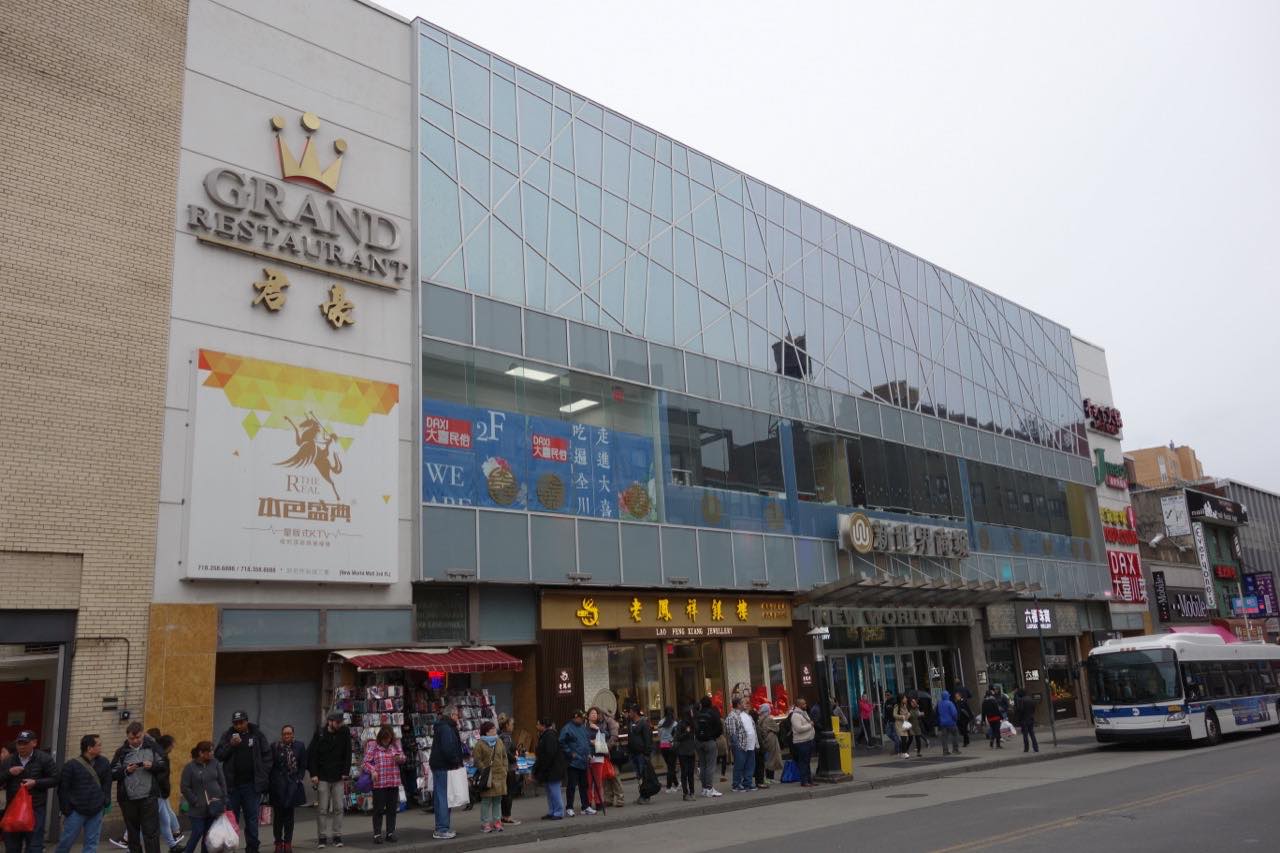
Step off the 7 train at its last stop, climb the stairs at Main Street, and the city changes language. The signs overhead are red and gold and almost entirely in Chinese characters, the air smells of cumin lamb and steaming pork buns, and the sidewalk at Main and Roosevelt is so dense with people that you move at the pace of the crowd. This is Flushing, the terminus of the line and the beating heart of the largest concentration of Chinese in Flushing and, by many measures, in all of America. It does not feel like a quaint enclave. It feels like a capital.
For all the talk of Manhattan’s Chinatown, the most dynamic Chinese commercial district in the United States is here in northern Queens, a forty-minute ride from Times Square. The story of how it got that way runs from seventeenth-century Quakers to Taiwanese engineers to noodle stalls that became national chains.
Flushing: The Place
Flushing sits in north-central Queens, an old colonial town that became a streetcar suburb and then a transit hub. It is the eastern terminus of the 7 subway line and a stop on the Long Island Rail Road, which empties tens of thousands of commuters onto Main Street every day. The downtown core clusters tightly around Main Street and Roosevelt Avenue, then gives way to quieter residential blocks of brick rowhouses, prewar apartment buildings, and, increasingly, glass condominium towers. It is one of the most crowded and most international square miles in the city.
How Flushing Became Chinese
Before the Chinese
Flushing’s deepest claim to fame has nothing to do with immigration policy and everything to do with conscience. In 1657, a group of about thirty residents signed the Flushing Remonstrance, a petition to New Netherland’s director-general Peter Stuyvesant protesting his ban on Quaker worship. None of the signers were themselves Quakers. They simply objected to persecuting their neighbors, and the document is now read as an early American argument for religious freedom.
The man at the center of the fight was John Bowne, who hosted Quaker meetings in his Flushing farmhouse. Built in 1661 on what is now Bowne Street, the John Bowne House still stands. Stuyvesant had Bowne arrested in 1662 and banished from the colony, but Bowne appealed to the Dutch authorities in Amsterdam, who overruled the governor and ordered an end to the persecution.
That tolerance left a physical mark. The Old Quaker Meeting House, raised in 1694 on land acquired two years earlier, is the oldest house of worship in New York State and is still used by the Friends today. Long before it was a Chinese city, Flushing was the place in America where the door had been pried open for people who did not fit the official mold. The irony is hard to miss.
The Chinese Arrive
The first seed was diplomatic. When the Republic of China’s delegation to the new United Nations set up offices in the area in the 1950s, it gave Flushing an early Mandarin-speaking foothold, unusual at a time when nearly every Chinese neighborhood in America spoke Cantonese.
The real wave came in the 1970s. As postwar middle-class Flushing emptied out and commercial rents fell, Taiwanese immigrants began to arrive in numbers. Many were well-educated and Mandarin-speaking, professionals and entrepreneurs who had little in common with the working-class Cantonese world of Manhattan’s Chinatown downtown. They wanted better housing and room to build their own institutions, and the 7 train terminus put cheap, well-connected storefronts within easy reach. Unlike the older Cantonese world of the Chinese in Manhattan’s Chinatown, this was a Mandarin-speaking district from the start, and it earned the nickname Little Taipei.
Then the map of China itself changed the neighborhood. After 1990, as China opened and emigration accelerated, new arrivals came from the mainland and reshaped the community through chain migration, each group sponsoring relatives and friends who followed. Fujianese immigrants came from the southeast coast, Wenzhou natives from Zhejiang, and a large contingent from Dongbei, the industrial northeast, where mid-1990s factory closures pushed millions to look abroad. The Taiwanese founders did not vanish, but they were joined and eventually outnumbered. Little Taipei quietly became a Mandarin-speaking city drawn from every corner of China.
Flushing at Its Peak
By the 2000s, Flushing had done something few thought possible: it had surpassed Manhattan’s Chinatown in size. Census counts put well over thirty thousand Chinese residents in the neighborhood, more people born in China than any other Chinatown outside Asia. The intersection of Main Street and Roosevelt Avenue became, by transit-authority reckoning, the third busiest intersection in New York City, trailing only Times Square and Herald Square.
Daily life ran on that density. Herbal pharmacies, bubble-tea counters, exam-prep academies, wedding-banquet halls, and basement food courts stacked themselves into every available floor. The Flushing-Main Street subway station became the busiest in the entire system outside Manhattan. On a Saturday the sidewalks turned into a slow river of shoppers, and the food smelled of a dozen provinces at once.
The Change
The most recent chapter is vertical and expensive. Developers, many of them Chinese-American, began replacing low-rise blocks with mixed-use towers: the Shops at SkyView Center, the Tangram complex that opened in 2022, condominiums marketed to buyers in both Queens and Shanghai. The grit that made the neighborhood affordable for noodle stalls is giving way, in places, to luxury retail and high-rise apartments.
The change is uneven. Older food halls have been renovated and rebranded rather than demolished, and the street-level commerce remains overwhelmingly Chinese-run. But longtime residents and small merchants increasingly wonder whether they can afford the city they built, the same question now asked of the Chinese in San Francisco’s Chinatown and in fast-changing immigrant neighborhoods across America.
The Landmarks of Chinese Flushing
New World Mall (136-20 Roosevelt Avenue) is the gateway most visitors meet first, a glass-fronted complex steps from the subway. Its basement food court packs dozens of regional stalls under one roof, from hand-pulled noodles to hotpot, and the upper floors hold a supermarket and a banquet hall. On weekends the line for the dumplings spills out toward the street.
Golden Mall (41-28 Main Street) is the neighborhood’s most legendary basement. For years its cramped, low-ceilinged stalls served some of the most authentic regional food in the city. It closed for a roughly two-million-dollar renovation and has since reopened, scrubbed up but still a temple to cheap, serious eating.
The Golden Mall is also where one of America’s best-known Chinese restaurants was born. In late 2005, the family behind Xi’an Famous Foods opened a tiny stall in that basement, a side venture from a bubble-tea shop run by Jason Wang’s father. The hand-ripped Xi’an noodles and cumin-lamb burgers drew a cult following, a visit from Anthony Bourdain, and eventually a chain of around eighteen locations across the city, all traceable to that single Flushing counter.
Flushing Town Hall (137-35 Northern Boulevard) is the elegant Romanesque survivor of the old town. Built in 1862, it served as a courthouse before falling vacant for years, and it now operates as a busy cultural center hosting concerts, exhibitions, and Lunar New Year programming that bridges the neighborhood’s past and present.
The Shops at SkyView Center (40-24 College Point Boulevard) represent the new Flushing in a single address. The roughly 800,000-square-foot mall draws several million visitors a year to a mix of a large Asian supermarket, Target, Best Buy, and rows of restaurants, with luxury condominiums rising above it.
The John Bowne House (37-01 Bowne Street) anchors the other end of the story. The 1661 farmhouse where Quaker meetings were once held quietly reminds the modern Chinese metropolis around it that Flushing’s reputation for welcoming outsiders is more than three centuries deep.
Where the Flushing Chinese Came From
The community arrived in distinct waves, each from a different part of the Chinese-speaking world. The founders of the 1970s and 1980s came from Taiwan, Mandarin-speaking and often middle-class, which is why the district was first called Little Taipei. They built the schools, banks, and restaurants that gave the neighborhood its early shape.
The mainland waves that followed after 1990 came from several regions at once. Fujianese immigrants arrived from the southeastern coast, a stream that also fed Manhattan’s Little Fuzhou. Migrants from Wenzhou in Zhejiang province brought a long tradition of going abroad to trade, and a large group came from Dongbei, the northeastern provinces, where the collapse of state heavy industry in the mid-1990s sent skilled and unskilled workers looking for new lives. Today roughly three-quarters of Flushing’s large Asian population is of Chinese descent, drawn from across the map of China.
Flushing Today
Walk Main Street now and the energy is unmistakable. Census tracts in the downtown core run around seventy percent Asian, the great majority of them Chinese, and the commercial life is among the most intense of any neighborhood in the country. Flushing is not a place people visit to see a preserved past; it is a place where a future is being built at full speed, in Mandarin, with capital flowing in from both coasts of the Pacific.
That speed comes with strain. Glass towers like SkyView and Tangram have raised the skyline and the rents, and some of the small merchants who made the neighborhood famous are being priced toward the edges. The neighborhood also shares its corner of Queens with a substantial Korean community along Northern Boulevard and Murray Hill, a distinct world worth its own telling, much as nearby Indonesians have made a home in Elmhurst and Greeks in Astoria. Each Lunar New Year, the largest such parade on the East Coast fills Main Street and ends at Flushing Town Hall, a public answer to anyone who thinks the community is fading.
Flushing has spent four centuries being the part of New York that absorbed the people other places turned away, from seventeenth-century Quakers to twenty-first-century arrivals from every province of China. Whatever it becomes next, the 7 train will keep emptying onto Main Street, and the conversation on the sidewalk will keep happening in Chinese.
Frequently Asked Questions
Why did Chinese immigrants settle in Flushing rather than Manhattan’s Chinatown?
The first major wave of Chinese in Flushing were Taiwanese immigrants in the 1970s who were largely Mandarin-speaking and middle-class, and who found Manhattan’s Cantonese, working-class Chinatown a poor fit. Flushing offered better housing, cheaper commercial rents, and the convenience of the 7 train terminus. Later mainland arrivals followed relatives and friends already established there.
Is Flushing really the largest Chinatown in New York?
Flushing surpassed Manhattan’s Chinatown in size during the 2000s and is home to more than thirty thousand China-born residents, the most of any Chinatown outside Asia. It competes with the Brooklyn Chinatown along Eighth Avenue for the title of the city’s largest, and it is widely considered the most dynamic Chinese commercial hub in the United States.
What are the most famous landmarks and foods in Flushing’s Chinatown?
The New World Mall food court and the renovated Golden Mall are the best-known eating destinations, and the original Xi’an Famous Foods noodle stall was born in the Golden Mall basement in 2005. For history and culture, the 1862 Flushing Town Hall and the 1661 John Bowne House are the key sites. Hand-pulled noodles, soup dumplings, and cumin-lamb dishes are signature foods.
Where in China are Flushing’s Chinese residents originally from?
The community came in waves: first from Taiwan in the 1970s and 1980s, then from the Chinese mainland after 1990. Major mainland origins include Fujian province on the southeast coast, Wenzhou in Zhejiang, and the northeastern Dongbei provinces. Roughly three-quarters of Flushing’s Asian residents today are of Chinese descent.
When did Chinese immigrants first arrive in Flushing?
A small Mandarin-speaking presence dates to the 1950s, when the Republic of China’s United Nations delegation set up nearby, but the Chinese in Flushing became a true neighborhood in the 1970s with the arrival of Taiwanese immigrants. Successive mainland waves after 1990 transformed it into the largest Chinatown in New York.
Every family that stepped off the 7 train carried a hometown with them, from Taipei to Fuzhou to the cities of the northeast. Tracing where your own people came from, and the streets they first walked in America, is its own kind of homecoming.