
On a weekday morning along North Britain Road, the parking lot of a low-slung temple fills with cars before the office towers of Las Colinas have switched on their lights. Inside, a priest moves between shrines to Maha Lakshmi, Venkateshwara and Anjaneya, and the bell rings for software engineers, accountants and grandparents alike. The Indians in Irving, Texas have built one of the oldest and largest South Asian communities in the American South, and much of it grew up in the shadow of an airport and a man-made lake.
The Place
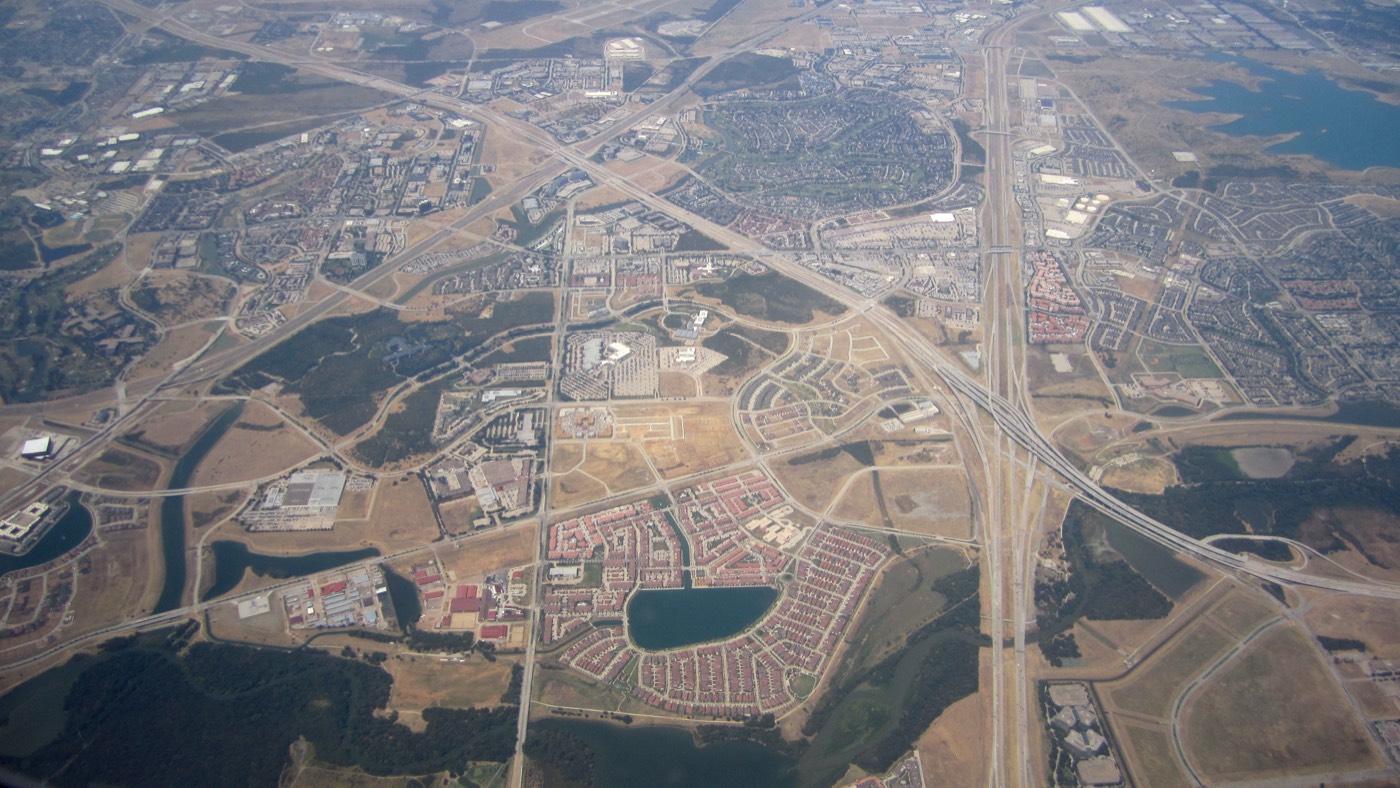
Irving sits on the western edge of Dallas, wrapped around the southern flank of Dallas/Fort Worth International Airport. For most of its history it was a quiet railroad and farming town. That changed in the 1970s, when a single family ranch was reimagined as one of America’s first master-planned business communities.
Today Irving is one of the most diverse cities in Texas, roughly a quarter Asian by population. Its centre of gravity is Las Colinas, a district of canals, glass towers and corporate campuses that drew the companies, and eventually the workers, who would reshape the city.
How It Became Indian
A ranch becomes a corporate city
Until the early 1970s the land west of Dallas was the Carpenter family’s Hackberry Creek Ranch. In 1973 Ben H. Carpenter unveiled a plan to turn thousands of acres of pasture into Las Colinas, Spanish for “the hills.” At its heart he placed a 125-acre man-made lake, Lake Carolyn, named for his sister.
The timing was deliberate. Dallas/Fort Worth International Airport opened in 1974 on Irving’s doorstep, and Carpenter built his city to feed off it. Within seven years more than 130 corporate firms had moved in. By the time the bronze Mustangs of Las Colinas were unveiled at Williams Square in 1984, Irving had quietly become a headquarters town.
That corporate base is the reason an Indian community took root here rather than somewhere else. The firms that filled Las Colinas needed engineers and technologists, and the supply of them was increasingly arriving from Hyderabad, Chennai and Ahmedabad.
The professionals arrive
The first Indians to settle around Dallas in significant numbers came in the 1960s and 1970s as doctors, academics and engineers, part of the wave opened by the Immigration and Nationality Act of 1965. They were a scattered, professional population, not yet a neighbourhood, much as the early arrivals were in Indian Cupertino and the older eastern hub of Indian Edison.
What turned them into a community was a temple. A group of devotees formed a temple society in 1981 and held their first Satyanarayana Puja in December 1982. An early attempt to build in Parker County, east of Plano, collapsed amid local opposition to the architecture and the religion, and the society sold the land back at a loss.
In June 1988 they bought property in Irving instead, and found a more welcoming home. The temple operation moved from a borrowed house in Plano to Irving that November, and on 28 April 1991 the Ekta Mandir was formally inaugurated with the installation of Maha Lakshmi. It is the older anchor of Hindu DFW, predating the grand temples that would later rise to the north.
What the temple did was give a dispersed professional population a fixed point. Over the following decades shrines were added one by one, to Ganesh, Ram, Durga, Ayyappan, Venkateshwara, Shiva, Hanuman and others, until the pantheon covered the whole subcontinent. A community medical clinic and cultural halls grew up alongside the worship space. The building’s slow expansion was a kind of census in stone, each addition marking a community that kept arriving and kept staying.
The IT decade
The real surge came with the technology economy of the late 1990s and 2000s. Information-technology firms in Las Colinas and nearby Richardson, the corridor known as the Telecom Corridor, recruited heavily through the H-1B visa programme, and Indians took a large share of those visas nationally.
Many arrived young, single and on contract, sharing flats in the apartment complexes that ring Las Colinas and Valley Ranch. They were close to work, close to the airport for the long flights home, and close to a temple and a growing cluster of grocers and restaurants. Word travelled back to Andhra Pradesh, Telangana and Tamil Nadu, and the chain pulled more.
The apartment-dense neighbourhoods near Las Colinas and Valley Ranch were well suited to this kind of arrival. They were affordable by the standards of the corridor, walkable to the bus lines and DART rail that fed the towers, and within a short drive of a temple and a row of grocers. A single contractor could land, find a room and a tiffin within a week, and be at a desk in a Las Colinas office park the following Monday.
By the 2010s Irving had passed from a place where Indians worked into a place where Indian families lived, raised children and stayed. The bachelors of the late 1990s had married, sponsored parents, bought houses and enrolled children in the local schools. The community that had started with a few dozen devotees in a rented house now numbered in the tens of thousands, and it had grown its own calendar of festivals, classes and cultural events around the temple on North Britain Road.
The Landmarks
DFW Hindu Temple (Ekta Mandir), 1605 North Britain Road. The oldest major Hindu temple in the metroplex, inaugurated in 1991 after the community’s first site fell through. Its shrines were added over decades, from Maha Lakshmi to Venkateshwara, Shiva and Hanuman, and the campus grew to include cultural halls and a community medical clinic. For many Irving families it is where weddings, naming ceremonies and festivals happen.
Patel Brothers, 1009 West Rochelle Road. The Irving outpost of the national Indian grocery chain, the everyday pantry for the surrounding community. Alongside lentils and spices in bulk it keeps a small farmers’ market with hard-to-find produce, the kind of vegetables that turn a Texas kitchen into a South Indian one.
Taj Chaat House, 1057 West Rochelle Road. A vegetarian institution a few doors from Patel Brothers, serving the street-food snacks of the subcontinent: chaat, dosas, pav bhaji. It is the sort of unglamorous strip-mall spot that diaspora families return to for years, and that food writers eventually discover.
Bombay Sweets & Snacks. A long-running sweets and snacks shop in Irving’s Indian food cluster, the place families turn to for boxes of mithai at Diwali, weddings and the festivals that punctuate the calendar.
The North MacArthur Boulevard corridor. Not a single address but a stretch of shopping plazas thick with Indian restaurants and grocers, from O’Desi Aroma to Southern Spice. It is the commercial spine of Indian Irving, where the strip-mall geography of suburban Texas has been quietly converted to subcontinental use.
Karya Siddhi Hanuman Temple, 12030 Independence Parkway, Frisco. Inaugurated in 2015 north of Irving, this 34,000-square-foot temple draws worshippers from Irving, Coppell and Arlington as well as Frisco. Its presence marks the way the community’s centre of gravity has begun to shift north even as Irving remains the historic core.
The Mustangs of Las Colinas, Williams Square. Not an Indian landmark, but the symbol of the district that made the community possible. The bronze herd, unveiled in 1984, sits at the centre of the corporate city whose towers first drew Indian engineers to Irving.
Where They Came From
Irving’s Indians are overwhelmingly a South Indian and western Indian story shaped by the technology trade. The largest groups trace to the Telugu-speaking states of Andhra Pradesh and Telangana, particularly the engineering and IT talent of greater Hyderabad, alongside Tamil families from Chennai and Tamil Nadu.
Gujarati families, many in business and hospitality, form another visible strand, and the temple’s broad pantheon reflects a community that pulled from many regions rather than one. The same Gujarati and Telugu currents shaped the Indian communities of Sugar Land and the Mahatma Gandhi District down in Houston. What unites them is less a single home state than a single pathway: the H-1B visa, the IT contract and the corporate campus.
That pathway explains the demographic shape of Irving’s Indian community. It skews professional, often arriving in their twenties and thirties, with the airport that built Las Colinas doubling as the door home.
Irving Today
By the most recent census estimates Irving is home to the largest Indian population of any city in Texas, more than forty thousand residents, edging out the newer and wealthier suburbs to the north. The community is no longer young and transient. It owns homes, runs businesses and sends children through the Irving and Coppell schools.
Yet Irving sits at an interesting moment. The newer money, and many newer arrivals, have moved on to the master-planned subdivisions of Indian Frisco and Indian Plano, where some neighbourhoods are now majority Indian. Irving has become the older sibling: less flashy, more established, the place where the metroplex’s Hindu and Indian institutional life began.
The shift north is partly a story of money and space. The newer suburbs offer larger houses, top-rated school districts and the kind of clean-sheet master planning that lets a community build its own subdivisions. Irving, older and more mixed, cannot offer the same. But it offers history, and a density of everyday Indian life that the newer suburbs are still acquiring.
What remains in Irving is the heart of the thing. The 1991 temple still rings its bell each morning. The grocers on Rochelle Road and MacArthur Boulevard still fill on weekends, and the smell of frying samosas drifts across strip-mall car parks that could be anywhere in suburban Texas. For a community that arrived to build other people’s software, Irving is the place where Indians in Texas first built something of their own.
Frequently Asked Questions
How many Indians live in Irving, Texas?
Recent American Community Survey estimates put Irving’s Indian population at more than 41,000, around 16 percent of the city. That makes the Indians in Irving the largest such community of any single city in Texas, ahead of Frisco and Plano.
Why did so many Indians settle in Irving?
The Las Colinas business district, planned in the 1970s and filled with corporate headquarters and technology firms, recruited heavily through the H-1B visa programme. Indian engineers and IT professionals came for those jobs and settled nearby, close to the campuses and to Dallas/Fort Worth airport.
What is the DFW Hindu Temple in Irving?
The DFW Hindu Temple, or Ekta Mandir, at 1605 North Britain Road, is the oldest major Hindu temple in the Dallas-Fort Worth area, inaugurated on 28 April 1991. It serves as the spiritual and cultural centre for much of the region’s Hindu community and houses shrines to many deities.
Where is the best Indian food in Irving?
The cluster around West Rochelle Road, including Patel Brothers and the vegetarian Taj Chaat House, and the North MacArthur Boulevard corridor are the heart of Indian Irving’s food scene, ranging from street-food chaat to South Indian dosas and boxes of mithai.
What regions of India are most represented in Irving?
The community is largely Telugu-speaking, with roots in Andhra Pradesh and Telangana, especially greater Hyderabad, alongside Tamil families from Chennai and a visible Gujarati presence. The common thread is the technology industry that drew them.
How does Irving compare to Frisco and Plano for Indian families?
Irving is the older and more established community, where the metroplex’s Indian and Hindu institutions first took root. Frisco and Plano, further north, are newer and wealthier, with some neighbourhoods now majority Indian, and have drawn many recent arrivals away from Irving.
If your family’s story passed through Irving, or any of the places Indians have made home in America, Atlas of Home can trace that journey. From a temple society’s first puja in a borrowed Plano house, to a shrine on North Britain Road, to wherever you are now.