
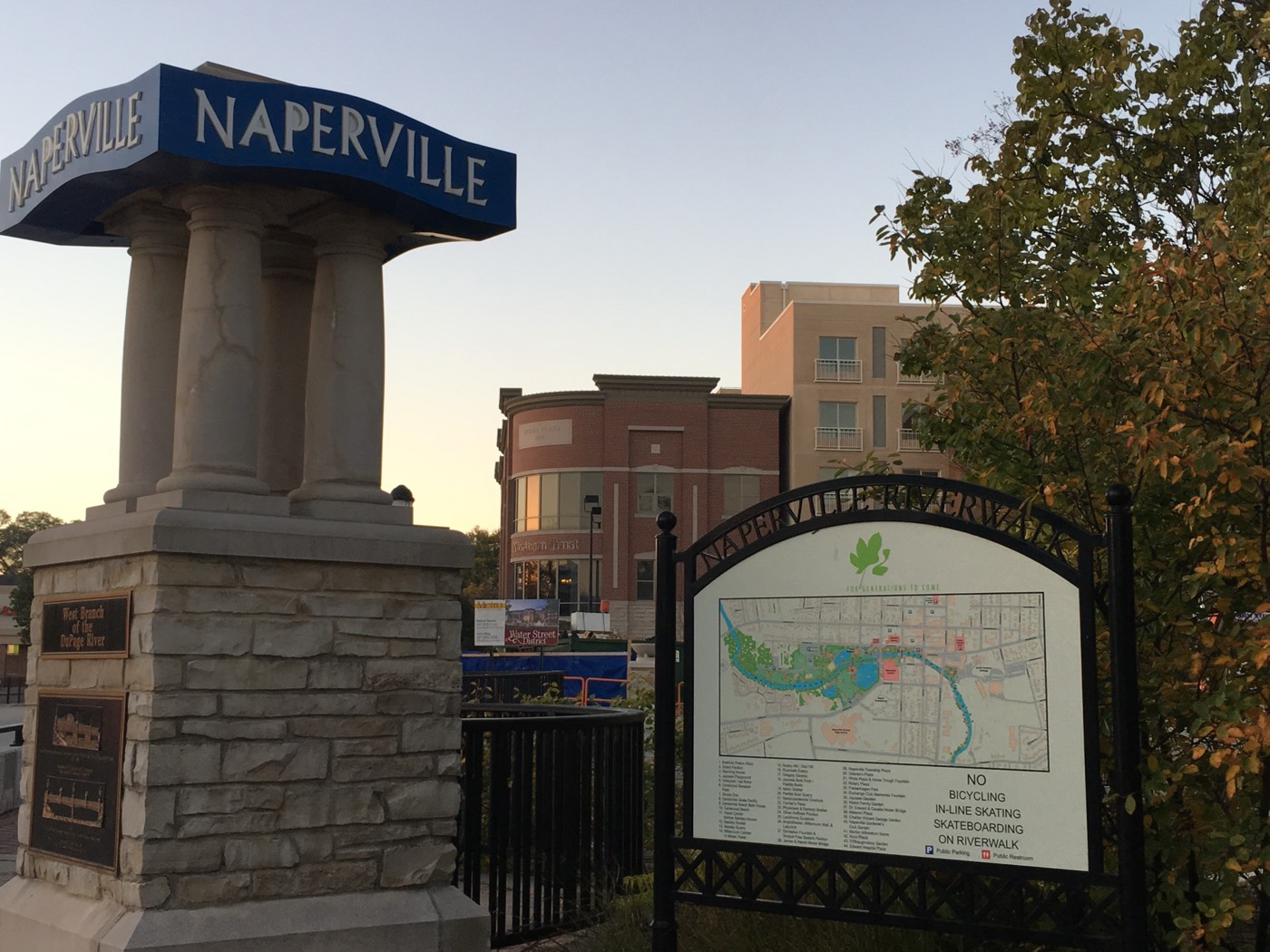
Drive south on Route 59 through Naperville on a Saturday morning and the suburb tells on itself. The cars in the Mall of India car park are German and Japanese, the number plates from the best school catchments in DuPage County, and inside the food court the smell of dosa batter hits before you reach the door. The Indians in Naperville did not arrive poor and crowd into a tenement. They arrived with degrees, took the IT and finance jobs along the corporate corridor, and bought houses in one of the most expensive suburbs in Illinois. This is what the second act of the Indian American story looks like.
The Place
Naperville sits about 28 miles west of downtown Chicago, straddling DuPage and Will counties along the West Branch of the DuPage River. Joseph Naper laid out the first plat in 1842, and the town became the county seat when DuPage County was created. For most of its life it was a quiet mill and farming settlement.
That changed after the Second World War. From the late 1950s the western suburbs filled with research and corporate science: Argonne National Laboratory, Fermilab nearby, the Amoco Research Center, and AT&T Bell Laboratories all landed in or around Naperville. The town became a place where people with advanced degrees came to work.
Today Naperville has roughly 154,000 residents and turns up near the top of every “best places to live” list. It ranked third in Illinois on U.S. News & World Report’s 2025-26 survey and 76th in the country. Two highly rated school systems, Naperville Community Unit District 203 and Indian Prairie District 204, plus Edward Hospital and a walkable Riverwalk downtown, made it exactly the kind of suburb a striving immigrant professional dreams about.
How It Became Indian
The Devon Avenue years
The Indian story in metropolitan Chicago did not begin in Naperville. It began on Devon Avenue, the 15-block stretch on the North Side that became Chicago’s Little India. India Sari Palace opened there in 1973, the first South Asian business on the street. Patel Brothers, now a national grocery chain, opened its first shop on Devon in 1974.
The people who built Devon were the first wave unlocked by the Immigration and Naturalisation Act of 1965, which finally let skilled Indians enter in numbers. Many were doctors, engineers and students who arrived alone, found their feet in the city, and shopped on Devon for the saris, spices and sweets that home required.
The move to the suburbs
Prosperity in this community has always pointed outward from the city. As Indian families grew established through the 1980s and 1990s, they did what middle-class Chicago has always done. They followed the good schools and the new jobs west into DuPage County.
Devon stayed, but its role shifted. By the early 2000s it had become a place families drove in to shop and eat before heading back to the suburbs. Viral Shah, who helps organise Naperville’s Indian Independence Day parade, put it plainly when he told reporters that Devon Avenue today is purely nostalgic. The living, growing community had moved out to towns like his.
The tech corridor pull
The second great wave came on H-1B visas through the 1990s and 2000s, the pipeline that carried Indian IT workers into the American economy. Naperville and neighbouring Aurora sat right on the corporate and technology corridor of the western suburbs, full of the finance, consulting and software employers these workers staffed.
A family could land a job near the East-West Tollway, enrol children in District 203 or 204, and find a Patel Brothers a short drive away. The result compounded year on year. Naperville now has the second-largest Indian population of any city in Illinois. The pattern echoes other suburban professional enclaves Indians built across the country, from Edison, New Jersey to Plano, Texas, and the tech towns like Cupertino, California.
The Landmarks
Mall of India, 776 South Route 59. The single clearest statement of the community’s arrival. The sprawling complex sets out to channel the cultural and culinary legacy of Devon Avenue under one suburban roof, with a roughly 25,000-square-foot grocery, retail units, and a food court of stalls including Dosa Village and Surya Tiffins. It also hosts the Swadeshi Mela trade fair. Where Devon was a streetscape stitched together over decades, the Mall of India is that idea purpose-built for a suburb that prefers everything under cover and near the car.
Patel Brothers and the Route 59 grocery cluster. The Naperville grocery scene mirrors the one Devon Avenue pioneered. Indiaco operates inside the Mall of India at 776 South Route 59, and Masalas ‘N More sits a little further down at 1355 South Route 59. For tens of thousands of families these are the everyday anchors, the places you go for atta, fresh curry leaves and the specific brand of pickle a grandmother insists on.
BAPS Shri Swaminarayan Mandir, Bartlett. This belongs to nearby Bartlett, not Naperville itself, but no account of Indian life in the western suburbs can leave it out. Opened on 7 August 2004, it is the largest traditional Hindu temple in the United States, hand-carved from Italian marble and Turkish limestone by around 2,000 craftsmen in India before being assembled here. The congregation that built it began in 1972 as a handful of devotees meeting in Chicago homes. It is the spiritual centre of gravity for Gujarati families across the whole region.
Sri Venkateswara Swami (Balaji) Temple, 1145 West Sullivan Road, Aurora. Just over Naperville’s western edge, this temple was built in 1986 and is the most prominent in the immediate area. Dedicated to Lord Venkateswara, a form of Vishnu, it draws the South Indian community in particular and runs a cafeteria serving vegetarian South Indian food alongside its festival calendar. For Telugu and Tamil families, Aurora’s Balaji temple is the constant.
The Ogden Avenue restaurant strip. The other Indian commercial axis runs along Ogden Avenue. Tandoori Affaire works out of 1224 West Ogden Avenue, and the grocery and takeaway trade extends along the same road. Shree Restaurant, up at 1550 North Route 59, narrows the focus further with Gujarati and Rajasthani cuisine, the regional thali cooking that a generic curry house never serves.
Rotary Hill Park and the India Day parade. Every August the Indian Community Outreach stages a free India Day parade and celebration in Naperville, with a colourful procession, a food court, dancing and a Bollywood headline act, drawing thousands to Rotary Hill near the Riverwalk. It is the day the community stops being a scattering of households and becomes visibly a public part of Naperville.
The cricket grounds. Cricket is the quiet tell of an Indian suburb, and Naperville has the pitches to prove it, including grounds off North Aurora Road and on Book Road, run through the Naperville Park District cricket league. At nearby Granger Middle School the youth cricket club has at points been almost entirely made up of students of Indian descent. The sport is how the second generation keeps a thread back to a country many have only visited.
Where They Came From
Naperville’s Indians are not from one place, and that is the point. The community is layered by language and region in a way that maps onto the industries that drew people here.
Gujarati families form the backbone of the older mercantile and professional wave, the same community that built Patel Brothers and fills the BAPS mandir in Bartlett. Telugu and Tamil families from the south arrived heavily on the technology wave, which is why Aurora’s Balaji temple and the dosa stalls do such steady trade. Punjabi and other North Indian professionals round out the mix across medicine, finance and engineering.
Almost all of them passed, directly or in spirit, through Chicago first, much as Indian communities elsewhere clustered first in a single street before fanning out, the way Jackson Heights in Queens seeded the wider New York diaspora. The grandparents shopped on Devon Avenue. The parents bought in DuPage County. The specific home villages and districts vary enormously, but the route into Naperville was nearly always the same: arrive skilled, work the corridor, chase the schools.
Naperville Today
Naperville is home to around 20,000 residents of Indian origin, the largest Indian population of any Illinois city after Chicago itself. In a suburb of 154,000 that is impossible to miss, and the figure understates the cultural weight, because it does not count Aurora, Bolingbrook and the other towns that share the same temples and shops.
The clearest evidence is in the schools. Indian Prairie District 204, which serves parts of Naperville and Aurora, is now around 39 percent Asian across its student body. A district named for the prairie that the first European settlers ploughed is now educating the children of the most recent arrivals, and they make up a larger share than any other group.
This is not a fading enclave like so many of the old urban diaspora streets. It is a community at full strength: temples packed for festivals, a mall built to serve it, an India Day parade that shuts down a park, cricket leagues fielding teams every weekend. Devon Avenue gave Chicago its Little India. Naperville is what the next chapter looks like once the children of Devon could afford the best schools in the state.
If anything threatens it, it is the same force that built it. The community rests heavily on the H-1B pipeline and the corporate jobs of the corridor, and tighter visa rules or a cooling tech economy would be felt here first. For now, though, Naperville is one of the great success stories of Indian America, hidden in plain sight behind manicured lawns and top-ranked report cards.
Frequently Asked Questions
Why did Indians settle in Naperville?
Indian professionals followed jobs and schools. Naperville sits on the western suburbs’ corporate and technology corridor, employing the IT, finance and medical workers who arrived from the 1990s onward, and it has two of the most highly rated public school districts in Illinois, District 203 and District 204.
How many Indians live in Naperville?
Roughly 20,000 residents of Indian origin, which is the second-largest Indian population of any city in Illinois after Chicago. They make up a significant share of the suburb’s large Asian American community of more than a fifth of the population.
Where do Indians shop and eat in Naperville?
The two main hubs are Route 59 and Ogden Avenue. The Mall of India at 776 South Route 59 houses an Indiaco grocery and a food court, while restaurants like Tandoori Affaire on Ogden Avenue and Shree Restaurant on Route 59, which serves Gujarati and Rajasthani food, anchor the dining scene.
Is there a Hindu temple in Naperville?
The largest temples are just outside the city. The Sri Venkateswara Swami (Balaji) Temple in neighbouring Aurora, built in 1986, serves the immediate area, and the vast BAPS Shri Swaminarayan Mandir in Bartlett, opened in 2004, is the largest traditional Hindu temple in the United States and draws families from across the western suburbs.
Where did Naperville’s Indian community come from?
Most passed through Chicago first, where the community grew up around Devon Avenue’s Little India from the early 1970s. Regionally they are a mix of Gujarati, Telugu, Tamil and Punjabi families, broadly tracking the mercantile and professional waves and the later technology wave of H-1B workers.
Does Naperville celebrate Indian festivals?
Yes. The Indian Community Outreach runs a free India Day parade and celebration each August at Rotary Hill Park, with a procession, food court and Bollywood performers, and Diwali concerts and events are held at venues like The Matrix Club on Route 59.
If your family’s story passed through Naperville, or any of the places Indians have made home in America, Atlas of Home can trace that journey. From a village in Gujarat or a town in Andhra, to a house off Route 59 and a temple in Bartlett, to wherever you are now.