
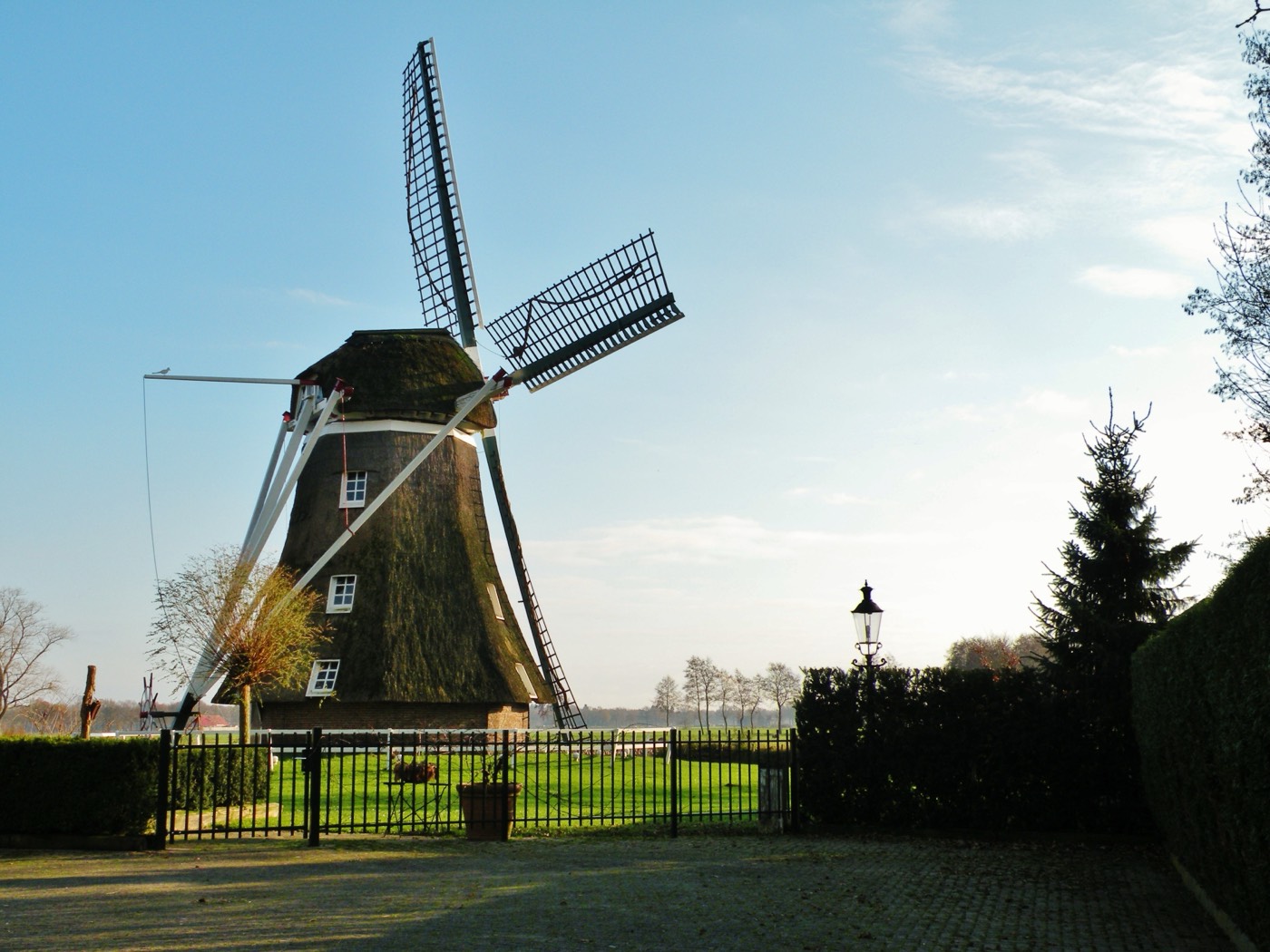
The Mulder surname is Dutch, and it means miller. It is the northern and eastern form of a name that in Holland proper is spelled Molenaar, and it belongs to the man who ground the village grain.
What Does the Surname Mulder Mean?
Mulder is a Dutch occupational surname meaning “miller”, the older northern and eastern equivalent of modern Dutch molenaar. It descends from Middle Dutch words for a mill keeper, which trace back through Latin molina, a mill, to the verb molere, to grind.
The d in the middle is not original. The word began closer to molenaer, contracted to mulner in northern speech, then acquired an intruding d between the consonants, the same Dutch habit that puts a d into kelder and donder. Linguists call it epenthesis, and Dutch name scholars treat that inserted d as the feature marking Mulder out as specifically Dutch rather than German.
A smaller German line exists alongside it, from Middle High German mulde, a wooden trough, giving a name for the man who made them. For families out of the Netherlands, the miller reading is the one that applies.
None of this makes Mulder unusual. It makes it typical, which is the more interesting fact. After the smith, the miller was the other indispensable craftsman in the European village, and his trade became a surname independently in almost every language that had mills: Miller, Muller, Melnyk, Molnar, Molinari, Molina, Meunier, Mlynarz. Mulder is the Dutch member of that set.
Where the Mulder Name Comes From
Mulder comes from the north and east of the Netherlands: Drenthe, Overijssel, Groningen and the Frisian borderlands. It is thin on the ground in the southern provinces, and close to absent in Belgium, where only a few hundred bearers are recorded.
The village and its mill
A rural Dutch parish had one working mill and one man running it, and that is what made the name useful. Calling a neighbour Jan de Mulder identified him to the whole district, because there was no second candidate, and a job that specific hardened into an inherited name faster than a nickname ever could.
Mulder or Molenaar: a real regional tell
If your family says Mulder, the odds are strongly that they came from the north or east. If they say Molenaar, the odds are strongly that they came from the west.
Dutch name scholarship has measured this precisely. In the 1947 census Mulder had close to 25,000 bearers, over 4,000 in Groningen alone, and stood as the second most frequent surname in the whole province of Drenthe. Molenaar, with roughly 6,600 bearers, drew more than half its total from North and South Holland. Meulenaar was a Frisian rarity of about thirty people, and Muller, some 5,500 strong, was scattered, a fifth of them in Amsterdam.
The tightest concentration of all is Staphorst in Overijssel, where by 2007 roughly one resident in forty-three carried the name. Cross the German border and the trade name reappears as Moller and Muller, which is no coincidence: the eastern provinces and the Low Saxon lands shared a dialect continuum long before they shared a frontier. Nationally the name grew from 24,745 bearers in 1947 to 36,207 in 2007, twelfth most common in the country.
1811 and the paper trail
Most Dutch families acquired a fixed, registered surname under the Napoleonic administration in 1811. Mulder families in the north invented nothing at that desk: they wrote down a working name their neighbours had used for generations. The mechanics of that registration, and the famous stories about defiant Dutchmen choosing joke names, are covered on our page for the De Vries surname.
Spelling Variants and Related Names
The core Dutch variants are Mulder, Mulders, Mulderij, De Mulder and Smulders, alongside the western equivalents Molenaar, Meulenaar, Meuleman, Muller and Millenaar. Smulders contracts des mulders, “the miller’s”, and belongs mainly to Brabant and Limburg.
Flemish and southern branches often carry a particle: De Mulder, Den Mulder. That small word is an enduring nuisance, because the Netherlands and Belgium alphabetise it differently and American clerks alphabetised it by neither rule. Families have lost decades of records to it. We explain the tussenvoegsel problem in full, and how to search around it, on our page for the De Boer surname.
Outside Dutch the cognates are numerous rather than similar: English Miller, German Muller, Danish Moller, French Meunier and Dumoulin, Italian Molinari, Spanish Molinero, Hungarian Molnar, Greek Mylonas, Polish Mlynarz, Ukrainian Melnyk. They are translations of one another, not variants of one another, and a Mulder is no more related to a Molnar than any two millers anywhere are related.
The Mulders in America
Most American Mulders descend from the Dutch Reformed emigration that began in 1846 and 1847, when congregations that had seceded from the state church left for the American Midwest as whole communities, led by their ministers.
Albertus van Raalte took his people to western Michigan and founded Holland in 1847; Hendrik Scholte took his to Marion County, Iowa, and founded Pella the same year. Those two settlements seeded everything after. Grand Rapids became the urban capital of Dutch America, pulling families off the farms and into furniture factories. When Pella filled up its surplus moved to northwest Iowa and founded Orange City and Sioux Center. A later current reached the Nooksack valley of Washington, where Lynden became a dairy town run largely by Dutch families.
The name held together well there. Those settlements were dense and endogamous, and the Christian Reformed Church kept Dutch in the pulpit into the twentieth century, so a Mulder in Sioux Center in 1910 had little pressure to become anything else.
Elsewhere the pressure was real. Standard reference works on American surnames record that Miller absorbed cognates from across Europe, naming Dutch Mulder and Molenaar explicitly among them. The parallel to Haddad becoming Smith holds, and for the same reason: an occupational name has a ready-made English twin, and translation is the path of least resistance outside an enclave. How many families made the switch cannot be quantified. There is no count, only the pattern, so a family that suspects it should hunt the change down in naturalisation papers and census runs rather than assume it.
In the 2010 US Census, 92.59 per cent of Mulder bearers self-identified as white, 2.58 per cent as Black, 2.17 per cent as Hispanic and 1.5 per cent as two or more races. Those are boxes ticked in 2010, not a measure of descent, but the profile fits a name that entered through nineteenth-century northern European farm migration and stayed in the communities it arrived in.
Notable People Named Mulder
Gerardus Johannes Mulder (1802 to 1880) was a Dutch chemist, born in Utrecht and later professor there. In an 1838 paper on the composition of animal substances he introduced the term protein, at the suggestion of the Swedish chemist Jons Jacob Berzelius.
Arnold Mulder (1885 to 1959) was born on a farm in Holland Township, Michigan, to Dutch immigrant parents. He edited the Holland City News and then the Holland Sentinel, wrote five novels about small-town Dutch America starting with The Dominie of Harlem in 1913, and published Americans from Holland in 1947.
Connie Mulder (1925 to 1988) was a South African cabinet minister whose career ended in the Information Scandal of the late 1970s, a reminder that Dutch surnames travelled south as well as west.
Mark Mulder (born 1977) is an American left-handed pitcher, a two-time All-Star, and one of the Oakland Athletics arms that defined the club’s early 2000s run before he moved to the St Louis Cardinals.
Michel and Ronald Mulder (both born 1986) are Dutch twin speed skaters. At Sochi in 2014 Michel won the 500 metres by a hundredth of a second and Ronald took bronze in the same race. Karen Mulder (born 1969), from Vlaardingen, was one of the defining faces of the supermodel era.
The best-known Mulder of all is not real. Chris Carter named FBI agent Fox Mulder in The X-Files after his own mother’s maiden name, which is how a northern Dutch miller’s name became one of the most recognisable surnames on 1990s television.
How Common Is Mulder Today?
Mulder ranks 4,822nd in the United States, carried by 7,317 Americans at the 2010 Census. In the Netherlands it ranks twelfth, with over 36,000 bearers.
| US rank (2010 Census) | #4,822 |
|---|---|
| Americans with the name | 7,317 |
| Origin | Dutch (occupational) |
| Meaning | “Miller”, the northern and eastern Dutch form of molenaar |
That gap is informative. Dutch emigration to America was modest next to the German or Irish waves and it concentrated in a handful of counties, so a name that is everywhere in Drenthe is a local name in Michigan and Iowa and rare elsewhere.
Frequently Asked Questions
What does the surname Mulder mean?
Mulder means “miller”. It is the northern and eastern Dutch form of molenaar, from Middle Dutch words for a mill keeper and ultimately from Latin molina, a mill. It is an occupational surname, taken from the job an ancestor did.
Is Mulder Dutch or German?
Mulder is Dutch. A German line does exist, from Middle High German mulde meaning a wooden trough, but it is much smaller. The inserted d that distinguishes Mulder from German Muller is a Dutch sound change, and the name’s heaviest concentrations are all in the Netherlands.
Where does the Mulder family come from?
From the north and east of the Netherlands: Drenthe, Overijssel, Groningen and the Frisian borderlands. There is no single Mulder family. The name arose separately in every district with a mill, so unrelated Mulder lines are the rule, not the exception.
How common is the surname Mulder?
In the United States it ranks 4,822nd, with 7,317 bearers in the 2010 Census. In the Netherlands it is the twelfth most common surname, held by more than 36,000 people, and in Staphorst it is carried by over two per cent of the town.
Is there a Mulder family crest or coat of arms?
No. In every established heraldic tradition arms are granted to an individual and pass to that person’s direct descendants, never to everyone sharing a surname. Since Mulder arose independently in dozens of unconnected villages, a single “Mulder crest” could not exist even in principle. Sites selling one are selling a decoration, not a lineage.
Did Mulder families change their name to Miller in America?
Some did. Reference works on American surnames record that Miller absorbed Dutch Mulder and Molenaar along with cognates from many other languages, because the English translation was so obvious. Inside the Dutch colonies of Michigan and Iowa the original spelling usually survived; families who settled away from those communities were the likelier ones to change.
If your family carries the Mulder name, its route from the Netherlands to America is traceable. Atlas of Home can follow it from a mill in Drenthe or Overijssel to wherever your family landed, and to wherever you are now.