
The Choi surname is Korean, written 최 in hangul and 崔 in hanja, a character meaning high or towering, most often of a mountain. It is the fourth most common family name in Korea, carried by roughly 2.3 million South Koreans.
What Does the Surname Choi Mean?
Choi means “lofty” or “towering”, from the hanja 崔, a character built from 山 (mountain) sitting above 隹 (a short-tailed bird), and used in classical Chinese of a high, steep peak. Korean tradition also glosses the character as one who presides over the land and the mountain.
One caution. Korean surnames were adopted as Chinese-style characters by aristocratic families from roughly the Silla period onward, so the meaning of 崔 describes the character, not the family. No Choi ancestor was named for living on a mountain the way an English Hill was.
The same character is a Chinese surname, read Cui, traced to a descendant of the ruling house of Jin who was granted the town of Cui in what is now Shandong. The Cui clans of Qinghe and Boling were among the great aristocratic lineages of Tang China. Korean Chois and Chinese Cuis share a character and a sound. They are not one family.
Where the Choi Name Comes From
Choi comes from Korea, and more precisely from a set of named ancestral seats. Korean families do not simply carry a surname, they carry a surname plus a bon-gwan (본관), the town their line claims as its origin. There are around 160 recorded Choi bon-gwan.
If the bon-gwan system is new to you, our page on the Kim surname explains it in full, along with the old prohibition on marrying within your own clan seat and the 1909 registration law that fixed Korean surnames in writing. What follows is what makes the Choi seats distinct.
Gyeongju: the Silla Line
The Gyeongju Choi are by far the largest branch, numbering 945,005 people in the 2015 South Korean census. Their claimed apical ancestor is Choe Chiwon (857 to sometime after 908), and behind him the Samguk Sagi traces the line to Sobeoldori of Goheochon, headman of one of the six villages that came together to found Silla.
Choe Chiwon is the reason this branch carries such weight. Sent to Tang China as a boy, he passed the Tang imperial examination and served there before returning to Silla, and his collection Gyewon Pilgyeong survives as one of the oldest Korean literary works we have. For a Korean family, having a documented ninth-century scholar at the head of the genealogy is about as prestigious as it gets.
Gyeongju also produced the family Koreans still call the Choe Bujatjip, the rich Choe house. From the seventeenth century they held their fortune for some twelve generations and roughly three hundred years, governed by six house rules: take no office above the junior jinsa degree, never accumulate more than ten thousand seok of rice, and let nobody within a hundred li starve. Of the roughly three thousand seok harvested each year, a third went to travellers and a third to neighbours in need.
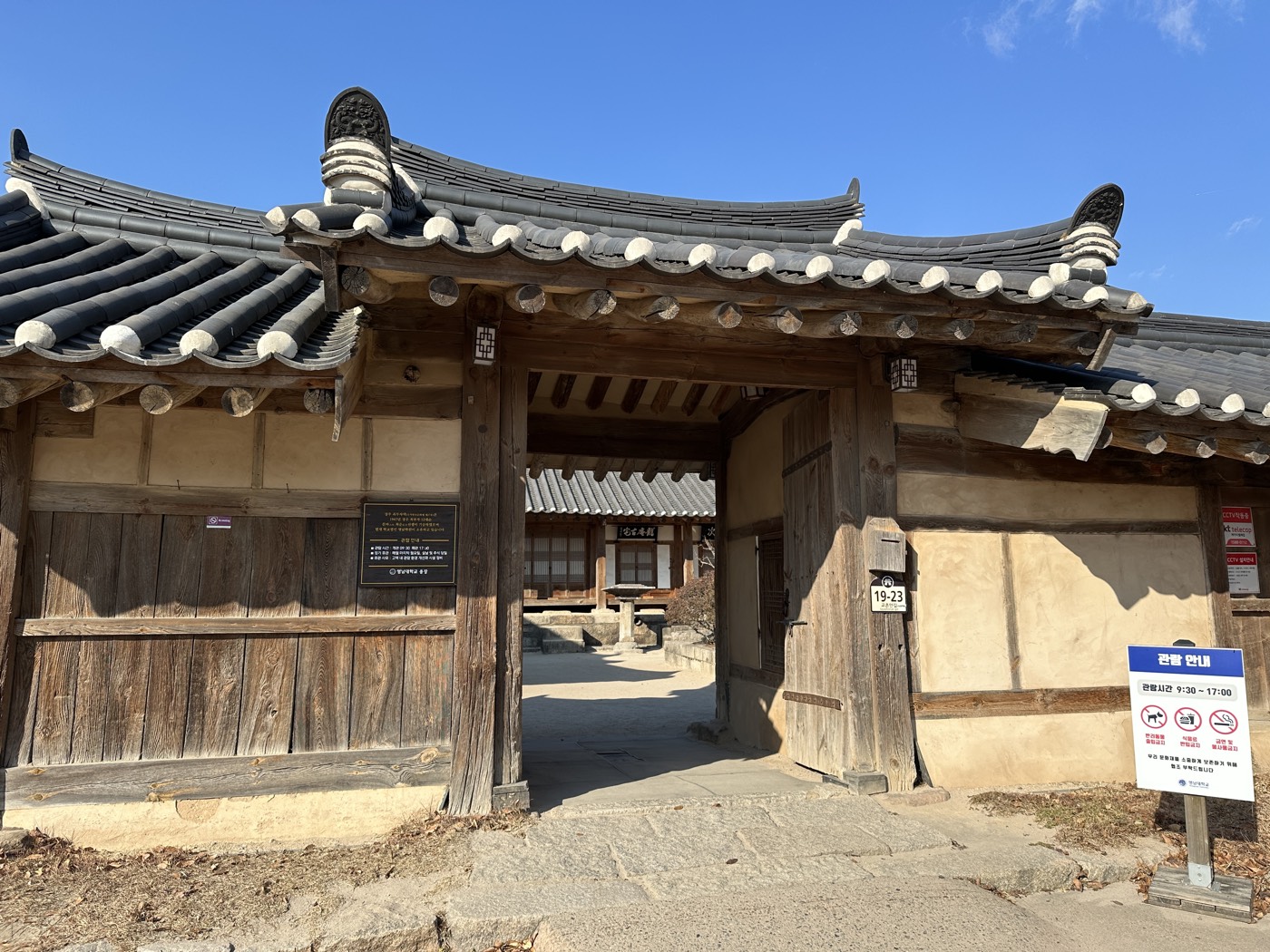
The last head of the house, Choe Jun (1884 to 1970), funded the independence movement under Japanese rule and then, after liberation, gave the entire three-hundred-year estate away to found the college that became Yeungnam University. The family compound at Gyochon village in Gyeongju is preserved today as National Folklore Cultural Heritage.
Haeju, Jeonju and Gangneung
The Haeju Choe, seated in what is now North Korea, claim Choe Chung (984 to 1068), the Goryeo chancellor who founded the School of Nine Studies in Kaegyeong and was nicknamed the Confucius of Korea for putting private education within reach of the examination classes.
The Jeonju Choe, seated in North Jeolla, are not a single descent at all but several lines under one seat, the largest reckoned from Choe Sun-jak in the reign of King Munjong of Goryeo. The Gangneung Choi, around 510,000 strong and the 51st largest clan in South Korea in 2001, are frankly three separate families sharing a place name, with three different founding ancestors. Same seat, same surname, no common ancestor.
The Chois Who Became Tsoi
A genuinely distinct branch sits outside Korea altogether. Koreans had been settling the Russian Far East since the 1860s, and in the autumn of 1937 Stalin deported the entire community, around 172,000 people, to Kazakhstan and Uzbekistan on the pretext that they might harbour Japanese spies. It was the first time in Soviet history that a whole ethnic group was moved purely on grounds of ethnicity.
Their descendants call themselves Koryo-saram, and their Chois are Tsoi or Tsoy, from the Cyrillic Цой. The best known is Viktor Tsoi (1962 to 1990), frontman of the Leningrad band Kino and the most important figure in Soviet rock, whose Korean line went back to Kimchaek in what is now North Korea. If your family name is Tsoi, you are a Choi by a Russian road.
Spelling Variants and Related Names
Choi is the dominant English spelling but it is not phonetic. Korean 최 is closer to “chwe”, a single syllable ending in a “we” glide, and the “oi” spelling misleads almost every English speaker who meets it.
The spellings you will encounter:
- Choi: the traditional ad hoc romanisation, used on the overwhelming majority of passports and in almost all Korean American families.
- Choe: the official Revised Romanisation of Korean, adopted by South Korea in 2000.
- Ch’oe: the McCune-Reischauer form, published in 1939 and still standard in academic writing and library catalogues, which is why historians write Ch’oe Ch’iwon.
- Chwe: rare, and the closest to the actual sound.
- Tsoi, Tsoy, Choi in Cyrillic as Цой: the Koryo-saram form across the former Soviet Union.
- Cui: the Mandarin reading of the shared character 崔. In Cantonese, Hokkien and Teochew it is Chui.
So why does the official system say Choe while nearly everyone writes Choi? Because Revised Romanisation was never applied retroactively to personal names. South Korea explicitly left surname spellings to the bearer, and by 2000 millions already had Choi in a passport and a school record. Established spellings won, roughly 99 per cent of the time. Choe is correct and Choi is what exists.
The Chois in America
Chois arrived in America in three distinct waves: a small first group of plantation labourers recruited to Hawaii from 1903, war brides and adoptees after 1953, and then the great post-1965 migration once the Immigration and Nationality Act lifted the national origins quotas.
That third wave built the Korean America most Chois belong to. In Los Angeles the name runs deep through Korean Glendale and up into the San Fernando Valley at Porter Ranch, while the eastern San Gabriel Valley suburbs, Walnut above all, drew families out of the city as they prospered.
On the east coast the Choi story runs through Bergen County, where Paramus anchors one of the densest Korean settlements outside Korea, and in the south through the research triangle towns of North Carolina, including Cary.
Of the 50,786 Americans recorded with the name in 2010, 96.09 per cent self-identified as Asian or Pacific Islander, 1.57 per cent as white and 1.49 per cent as two or more races. Those are self-identification proportions from a census form, not a measure of ancestry, but they tell you how recent and how concentrated this migration is.
Notable People Named Choi
Choe Chiwon (857 to after 908), the Silla scholar and poet who passed the Tang imperial examination and stands at the head of the Gyeongju Choi genealogy.
Choe Chung (984 to 1068), Goryeo chancellor, founder of the School of Nine Studies and the ancestor claimed by the Haeju Choe.
Choe Chungheon (1149 to 1219), the general who seized power in 1196 and founded a military regime that ruled Goryeo from behind the throne for sixty years, through four kings, without ever taking the crown.
Choe Jun (1884 to 1970), last head of the Gyeongju rich house, independence financier, and the man who gave a three-hundred-year fortune away to found a university.
Viktor Tsoi (1962 to 1990), Koryo-saram singer and leader of Kino, still the most revered rock musician across the former Soviet Union.
Roy Choi (born 1970), born in Seoul and raised in Los Angeles, whose Kogi taco truck launched the gourmet food truck movement in 2008 and made him Food & Wine‘s Best New Chef in 2010.
How Common Is Choi Today?
Choi ranks 674th among American surnames, with 50,786 bearers recorded in the 2010 US Census. In South Korea it is the fourth most common name of all, held by about 4.7 per cent of the population.
| US rank (2010 Census) | #674 |
|---|---|
| Americans with the name | 50,786 |
| Origin | Korean (최 / 崔) |
| Meaning | High, lofty, towering |
Enormous at home, modest abroad: Korean emigration to the United States is largely a story of the last sixty years.
Frequently Asked Questions
What does the surname Choi mean?
Choi is written 崔, a character meaning high or towering, especially of a mountain, formed from 山 (mountain) over 隹 (bird). Korean tradition also reads it as one who oversees the land and the mountain. It describes the character, not an ancestor’s home.
Is Choi Korean or Chinese?
Choi is Korean. The character 崔 is shared with the Chinese surname Cui, one of the great Tang aristocratic lineages, and Korean families adopted Chinese-style characters for their names. Sharing the character does not mean sharing descent.
Where does the Choi family come from?
From Korea, and specifically from one of around 160 bon-gwan or ancestral seats. The largest by far is Gyeongju in North Gyeongsang, the old Silla capital, followed by Haeju, Jeonju and Gangneung.
How common is the surname Choi?
Choi is the fourth most common surname in South Korea, carried by roughly 2.3 million people. In the United States it ranked 674th in the 2010 Census with 50,786 bearers.
Is there a Choi family crest or coat of arms?
No. Heraldic arms are granted to individuals and pass to their direct descendants, never to everyone who shares a surname, and Korea has no heraldic tradition of that kind in the first place. Any site selling you a Choi crest is selling a decoration, not a lineage. What Korean families actually keep is the jokbo, the printed genealogy, and that is the real document.
Why is Choi spelled Choe in official Korean romanisation?
Choe is the Revised Romanisation, adopted by South Korea in 2000, and it maps the hangul 최 more accurately. But the reform was never applied to personal names, so millions of people kept the older Choi spelling already in their passports. Both are the same name.
If your family carries the Choi name, its route from Korea to America is traceable. Atlas of Home can follow it from the bon-gwan your line claims, whether Gyeongju, Haeju, Jeonju or Gangneung, to wherever your family landed, and to wherever you are now.