
The Khoury surname means “the priest”, and it belongs to one of the oldest Christian populations on earth: the Arabic-speaking churches of Lebanon, Syria, Palestine and Jordan. If your family carries it, your line almost certainly runs back to a village clergyman.
What Does the Surname Khoury Mean?
Khoury means “priest” in Levantine Arabic, from khūrī (خوري). It is a hereditary occupational name, borne by families descended from a Christian parish priest, and it is found almost exclusively among Arab Christians.
Trace the word further back and it leaves Arabic entirely. Most etymologists take khūrī through Syriac and Aramaic to the Greek chōrepískopos, the “country bishop” who served rural congregations on a bishop’s behalf. A rival derivation links it instead to the Latin curia, or to French curé, from curatus, “one charged with the care of souls”. Both routes end in the same place, a man responsible for a parish, and the question of which is correct remains genuinely open.
The reason the name spread so widely lies in church law. The Eastern churches of the Levant, Antiochian Greek Orthodox, Melkite Greek Catholic, Syriac Orthodox and Maronite, all ordain married men to the parish priesthood. A priest therefore had children, those children were known in the village as the priest’s family, and within a generation or two the title had hardened into a surname.
That mechanism is not unique to the Arab world. The Greek surname Papadopoulos, literally “son of the priest”, was created the same way in the same Orthodox communion, a few hundred miles west. Khoury is its Arabic counterpart, and the two names are cousins in logic if not in blood.
Where the Khoury Name Comes From
The Khoury name comes from the Levant: Lebanon above all, then Syria, Palestine and Jordan. It is not the name of a single clan or village. It arose independently in hundreds of separate Christian parishes, which is why unrelated Khoury families are the rule rather than the exception.
Mount Lebanon and the Holy Valley
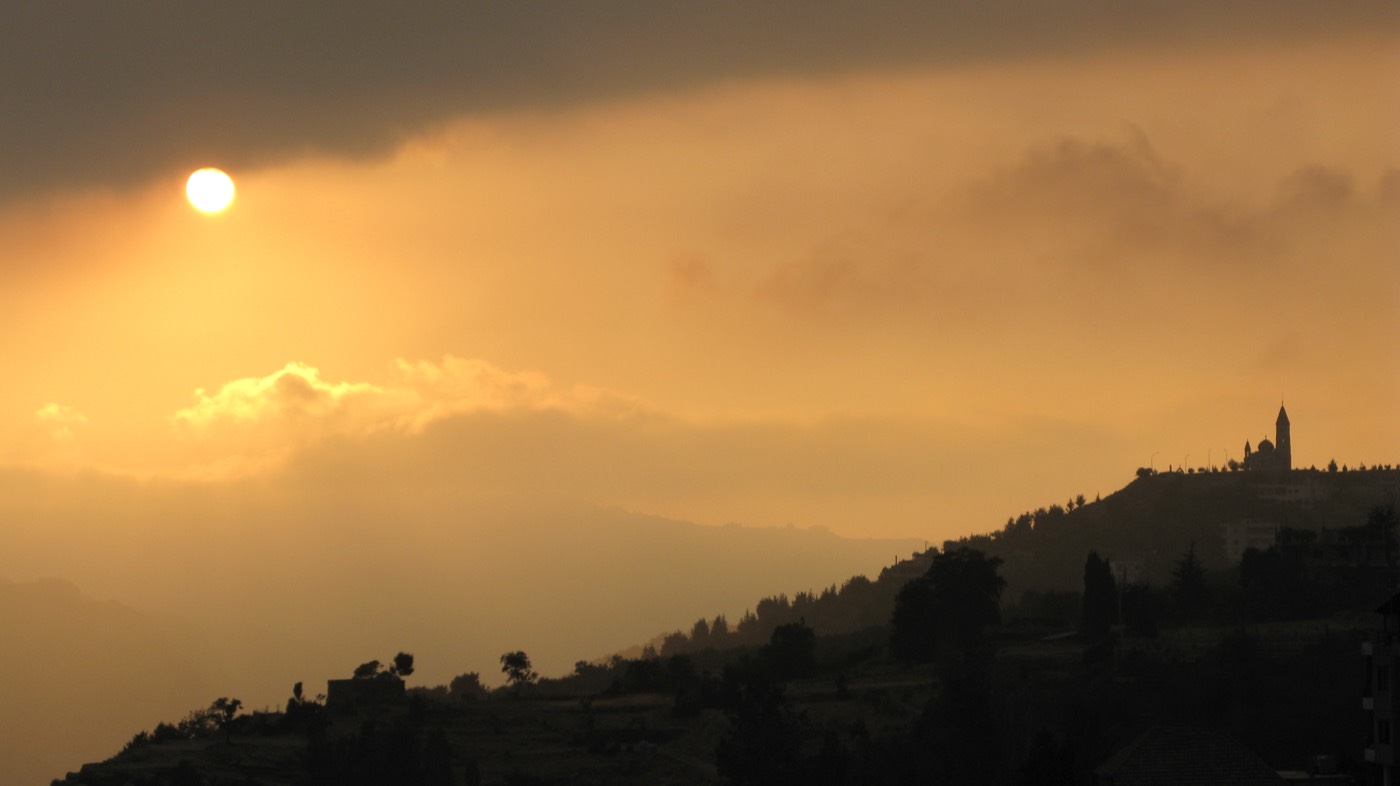
Lebanon remains the name’s centre of gravity, with roughly one person in every 554 carrying it. The mountain villages above Tripoli and Byblos, and above all the Qadisha Valley, sheltered Maronite monasteries and married parish clergy for well over a millennium. Bsharri, Hadchit, Ehden and the hamlets along the gorge each had their khoury, and each could produce a Khoury family.
Antioch, Damascus and the Syrian towns
West of the Anti-Lebanon range the name belongs mainly to the Antiochian Greek Orthodox and Melkite communities: Damascus, Homs, Hama, Aleppo and the Christian villages of Wadi al-Nasara, the Valley of the Christians. Syria still counts around 7,200 bearers.
Palestine and Jordan
Khoury is one of the most recognisable Palestinian Christian surnames, concentrated in Jerusalem, Bethlehem, Ramallah, Nazareth and Haifa. Modern Israel records nearly 8,800 bearers, almost all of them Palestinian Christians. In Jordan the name clusters in Fuheis, Madaba and Salt.
Spelling Variants and Related Names
Khoury, Khouri, Koury, Coury, El-Khoury and Corey are all the same Arabic word. Arabic has no fixed Latin spelling, so every version depends on which language the clerk who wrote it down happened to speak.
The base form is خوري, and with the definite article الخوري, al-Khūrī, “the priest”. That article is the first great fork in the road. In some families it fused permanently to the name, giving El Khoury, Elkhoury, El-Khouri and Al-Khoury. In others it was treated as a detachable word and simply dropped, leaving the bare Khoury. The same household could go both ways in the space of two documents.
The second fork is French. Lebanon and Syria were under French Mandate from 1920, and French orthography writes the “oo” sound as ou. That is the whole reason the standard Lebanese spelling is Khoury and not Khuri: it was set on Mandate-era identity papers and passports and never moved. English-speaking transcribers, working from the same sound, produced Khuri, Khoori and Khoory instead. The Frenchified branch also gives Houry, where the guttural kh has been smoothed away entirely, and Khourie or Kourie in families who passed through francophone Africa.
The third fork is American. English has no kh, and immigration and naturalisation clerks flattened it to a hard C or K. That is where Koury, Kouri, Coury, Couri, Kory, Korey, Cory and Corey come from, along with Coorey and Courey. Latin America, which took in enormous Lebanese and Syrian migration, produced its own set: Curi, Cury, Juri, Jury, Eljure, Aljure and the Brazilian Xuri, where Portuguese x carries the sound.
None of these is more authentic than another. A Koury in Ohio and an El Khoury in Beirut may be first cousins.
The Khourys in America
Khoury families arrived in America in two main waves: Ottoman Syrians from Mount Lebanon between the 1880s and the 1924 immigration cuts, and Lebanese, Syrian and Palestinian Christians displaced by the wars of 1948, 1967 and 1975 onwards.
The first wave landed at New York and settled in the boarding houses and dry goods shops of Little Syria on lower Manhattan’s Washington Street, then fanned out along peddling routes into the Midwest and the South. Detroit’s car plants drew thousands, and their descendants moved outward across the twentieth century into the Lebanese community in Troy and the older Catholic and Orthodox parishes of Grosse Pointe.
Texas took a large share through the Gulf ports, and Houston’s Lebanese community still supports Maronite and Antiochian Orthodox churches founded by those families. Later arrivals, many of them professionals leaving the Lebanese civil war, concentrated around Washington DC in Vienna, Virginia, and on the West Coast in San Diego.
One thing worth clearing up, because families ask about it constantly. Some Levantine immigrants did translate their surnames into English: Haddad, “blacksmith”, commonly became Smith, Ashshi became Cook, Yusuf became Joseph. Khoury families, on the available evidence, did not become “Priest”. They kept the sound and surrendered the spelling instead. The Nobel laureate Elias James Corey is the clearest case: his Lebanese Greek Orthodox family in Methuen, Massachusetts, turned Khoury into Corey and kept it.
Notable People Named Khoury
Bechara El Khoury (1890 to 1964) was the first president of independent Lebanon, serving from 1943 to 1952. A lawyer under the French Mandate, he co-authored the 1943 National Pact that set the terms of Lebanese independence.
Elias Khoury (1948 to 2024) was Lebanon’s most celebrated novelist of his generation. Born into a Beirut Christian family, he wrote Gate of the Sun, the great novel of Palestinian exile, and edited the literary supplement of An-Nahar.
Callie Khouri (born 1957) won the Academy Award for Best Original Screenplay for Thelma & Louise in 1992 and later created the television series Nashville. Her father’s family were Lebanese Maronites.
Elias James Corey (born 1928) received the 1990 Nobel Prize in Chemistry for retrosynthetic analysis, the method that underpins modern drug synthesis. He was born to Lebanese Greek Orthodox immigrants whose name had been Khoury.
Vénus Khoury-Ghata (1937 to 2026) was a Lebanese-French poet and novelist, a major figure in francophone Arab literature and a winner of the Prix Goncourt de la Poésie.
Makram Khoury (born 1945) is a Palestinian actor born in Jerusalem, the first Arab and the youngest artist ever to receive the Israel Prize, and a familiar face in film and on the London stage.
How Common Is Khoury Today?
Khoury ranks 5,980th among American surnames, with 5,753 people recorded in the 2010 US Census. Worldwide the figure is closer to 62,000, and the name is far more concentrated abroad than at home.
| US rank (2010 Census) | #5,980 |
|---|---|
| Americans with the name | 5,753 |
| Origin | Levantine Arabic (Lebanon, Syria, Palestine, Jordan) |
| Meaning | “The priest” |
The American figure badly understates the true number, because it counts only the Khoury spelling. Add Khouri, Koury, Coury, Kouri, El Khoury and Corey and the real total is several times larger.
Frequently Asked Questions
What does the surname Khoury mean?
Khoury means “priest” in Levantine Arabic, specifically a Christian parish priest. The word probably reaches Arabic from Greek chōrepískopos, “country bishop”, by way of Syriac, though some scholars prefer a Latin route through curia.
Is Khoury Lebanese or Syrian?
Both, and Palestinian and Jordanian too. Lebanon has the highest concentration of bearers, but the name is native across the whole Levant and belongs to Arab Christians in all four countries, not to any one nationality.
Where does the Khoury family come from?
There is no single Khoury family. The name arose separately in hundreds of Christian parishes from Mount Lebanon to Jerusalem, so two Khoury families are usually unrelated unless a documented paper trail connects them.
How common is the surname Khoury?
It is the 5,980th most common surname in the United States, held by 5,753 people at the 2010 Census, and around 9,000th worldwide. In Lebanon roughly one person in 554 carries it, making it one of the country’s best known Christian names.
Is there a Khoury family crest or coat of arms?
No. In every serious heraldic tradition, arms are granted to an individual and pass to their direct descendants, never to everyone who happens to share a surname. Levantine Christian families had no such tradition at all. Any site selling you a “Khoury family crest” is selling a decoration, not a lineage.
Does the name mean my ancestor was actually a priest?
Very probably yes, at some point. Because the Eastern churches ordain married men, a priest’s descendants took his title as their surname. What the name cannot tell you is which priest, or when, since the same thing happened independently in village after village.
If your family carries the Khoury name, its route from the Levant to America is traceable. Atlas of Home can follow it from a mountain parish in Lebanon, Syria or Palestine to wherever your family landed, and to wherever you are now.