
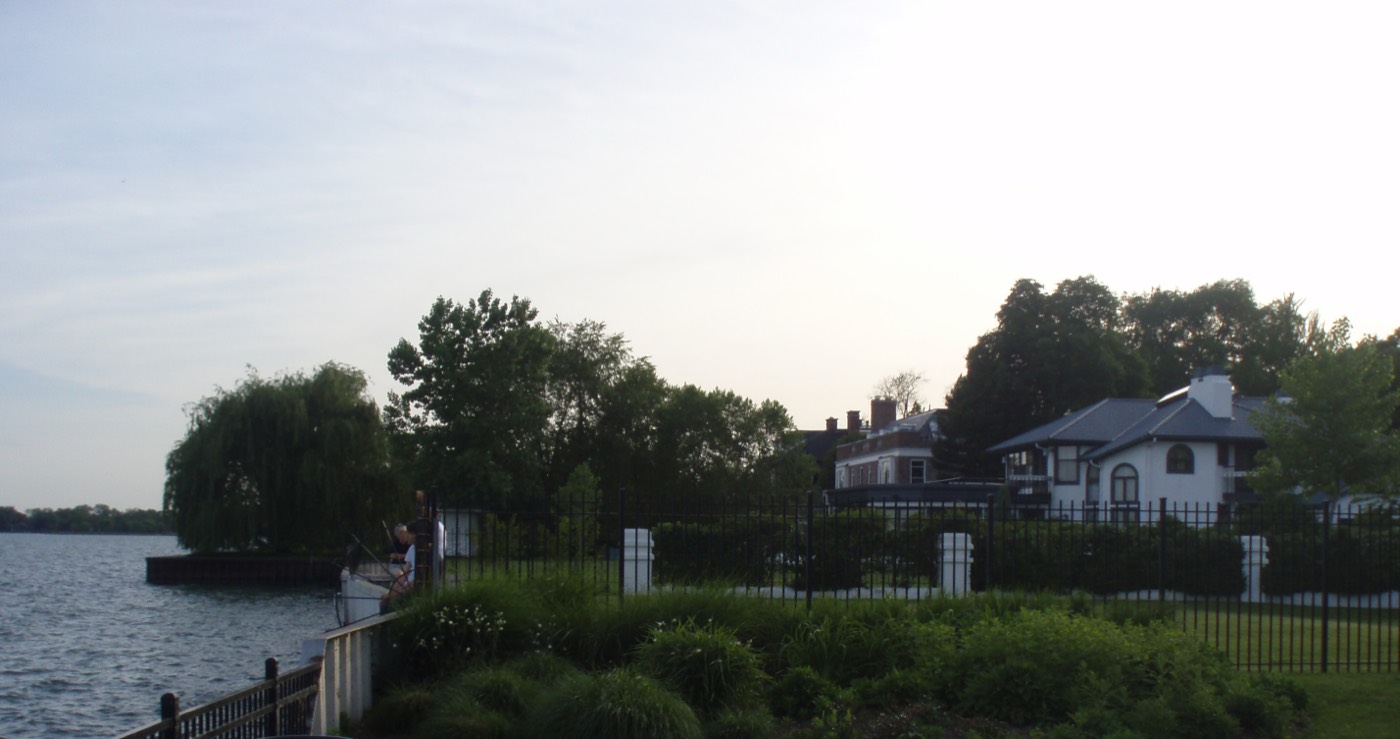
Drive the length of Lake Shore Road on a clear morning and the houses seem to belong to another century: gated Tudors, Cotswold stone, lawns that run unbroken to the water of Lake St. Clair. Among the families behind those doors are Lebanese in Grosse Pointe whose grandparents arrived in Detroit with a few words of English and a steamer trunk, and who climbed, within two or three generations, from the east-side immigrant streets into the most guarded address in Michigan.
The Place
Grosse Pointe is not one town but five, sitting shoulder to shoulder on the lake just east of Detroit: Grosse Pointe Park, Grosse Pointe, Grosse Pointe Farms, Grosse Pointe Woods, and Grosse Pointe Shores. Together “the Pointes” hold roughly 46,000 people across about 10.4 square miles.
The land began as French ribbon farms in the 1750s, narrow strips reaching back from the shore. By the 1850s wealthy Detroiters were building summer estates here, and after 1900 the automobile barons turned it into a year-round preserve.
It remains one of the most affluent communities in the Midwest, defined by the water, the old money, and a quiet insistence on belonging that newcomers once had to earn.
How It Became Lebanese
The Lebanese did not arrive in Grosse Pointe. They arrived in Detroit, decades earlier, and worked their way east along Jefferson Avenue until the lake stopped them.
The first boats, 1880 to 1916
Lebanese Christians began reaching Detroit in the 1880s, part of the great migration out of Mount Lebanon while it was still a province of the Ottoman Empire. They came from specific villages, not a generic homeland: Hasroun, Serhel, Tourza, Zahle, and the mountain districts of Kesrwan and Metn, names that would echo for a century in Detroit social clubs.
The earliest arrivals were often single men who peddled notions and linens door to door across the growing city, sleeping in boarding houses and sending wages home. As soon as they could, they sent for wives, brothers, and cousins from the same village, and the boarding houses gave way to family flats clustered within walking distance of the new churches.
They settled first on Detroit’s near east side, around the streets that fed into Congress and Lafayette. The community organised quickly around its churches. On April 30, 1916, St. Maron Maronite Catholic Church was dedicated at 1555 East Congress Street, the first Maronite parish in the city.
That same winter, on January 30, 1916, Orthodox families organised the St. George Syrian Orthodox Society of Detroit, the seed of what would become one of the most influential Antiochian Orthodox parishes in America. A Melkite congregation followed in 1929, gathering near Charlevoix and McDougall.
The shopkeepers and the doctors
The first generation peddled dry goods, ran groceries, and stitched in the garment trade. The second went to school. Detroit’s Catholic high schools and the medical and law programmes at the University of Detroit and Wayne State turned the children of pedlars into physicians, attorneys, and dentists.
This is the quiet engine of the Grosse Pointe story. The Lebanese here are overwhelmingly a professional class: doctors with practices near Bon Secours and St. John hospitals, lawyers downtown, family-business owners who supplied the auto industry rather than worked its lines.
It is a different community from the one that defined the Lebanese in Dearborn, the working-class, largely Muslim hub on the other side of Detroit. The east-side families were Christian, mercantile, and aimed, from the start, at assimilation.
Moving up the avenue, 1945 onward
After the Second World War, the prosperous east-side families did what prosperous American families everywhere were doing: they moved out. The natural path ran north-east along Jefferson Avenue, the spine that carried them out of the old enclaves toward the lake.
For most, the first stop was St. Clair Shores and the Macomb suburbs, where land was cheap and parishes could rebuild. The most successful kept going, into Grosse Pointe itself, where the lakefront and the school district signalled arrival.
That last step was deliberate. A house in the Pointes was not just shelter, it was a statement that a family of pedlars and grocers had become indistinguishable from the executives and surgeons who had always lived on the lake.
The move was not always welcomed. In 1960 the Pointes were exposed running a notorious screening system: realtors scored would-be buyers on a points scale weighing race, religion, nationality, and occupation, with Southern Europeans, Jews, and “Near Easterners” all marked down. Lebanese families who bought in did so by being, in the language of the day, the right kind of professional, and by being persistent.
Two communities, one lake
By the 1980s and 1990s the centre of Lebanese Christian institutional life had drifted past the Pointes and into Macomb County, where land allowed for big new churches. St. George moved to Troy in 1994. The Maronites of St. Maron eventually anchored St. Sharbel parish, which by the 2010s had settled in Clinton Township. The Melkite Our Lady of Redemption relocated to Warren.
So the Grosse Pointe Lebanese live in a kind of bracket: their homes in the Pointes, their grandest churches a short drive north. On a Sunday a Grosse Pointe surgeon may still cross into Macomb to light a candle in the parish his grandfather helped fund.
The Landmarks
St. Maron Maronite Catholic Church, 1555 East Congress Street, Detroit. Dedicated in 1916, this was the mother church of Detroit’s Maronites and the spiritual address that the east-side families carried with them as they moved up the avenue. Many Grosse Pointe families still trace their baptisms here.
St. George Antiochian Orthodox Church (now in Troy). Organised in Detroit in 1916 as the St. George Syrian Orthodox Society, it became one of the most consequential parishes in American Orthodoxy, a place where future archbishops were formed, before relocating north in 1994 to follow its scattering congregation.
The Village, Kercheval Avenue from Neff to Cadieux, Grosse Pointe. The shared downtown of all five Pointes, three blocks of shops, salons, and restaurants. It is where the community does its ordinary business, and where Lebanese-owned practices and firms keep offices above the storefronts.
The Hill, Kercheval Avenue, Grosse Pointe Farms. A single elegant block of the finest restaurants in the Pointes, a jazz bar, a jeweller, and the wealth managers and realtors who serve old and new money alike. It is the unofficial business club of the lakeshore.
Edsel and Eleanor Ford House, 1100 Lake Shore Road, Grosse Pointe Shores. The Cotswold-style mansion Albert Kahn built for Edsel Ford on Gaukler Pointe, completed in the late 1920s. It is the emblem of the wealth the Lebanese families measured themselves against, and eventually joined.
Grosse Pointe War Memorial (Alger House), 32 Lake Shore Road, Grosse Pointe Farms. The 1910 Italian Renaissance villa built for Russell A. Alger Jr., now the lakeshore’s civic living room, hosting weddings, galas, and the community fundraisers where Lebanese physicians and lawyers sit on the boards.
Grosse Pointe South High School, 11 Grosse Pointe Boulevard, Grosse Pointe Farms. The flagship public school whose reputation drew so many families. For the second and third generations, getting a child into South was as much a marker of arrival as buying the house itself.
Where They Came From
The roots run almost entirely to Mount Lebanon, the Christian highland that produced the bulk of Lebanon’s emigrants. Detroit’s families came from a recognisable cluster of villages: Hasroun and Serhel in the north, Tourza, the Bekaa town of Zahle, and the central districts of Kesrwan and Metn.
They left for the usual reasons: Ottoman taxation and conscription, the collapse of the silk economy, and, after 1915, the famine that killed perhaps a third of Mount Lebanon’s population. America promised work and, for Christians who had lived as a minority, a place where their faith was no liability.
What is striking is how village identity survived the crossing. For decades the social clubs of Detroit were organised by hometown, so that a man was not simply Lebanese but a son of Hasroun, and marriages, business partnerships, and church donations often followed those village lines.
Grosse Pointe Today
The Lebanese presence in the Pointes today is largely invisible to outsiders, which is exactly how the community would describe its success. There is no Lebanese quarter, no strip of Arabic signage. There are surnames, on law-firm letterheads, on hospital directories, on the donor walls of the War Memorial and the parish halls.
Many in the third and fourth generations have assimilated so thoroughly that Lebanese identity has become a Sunday matter and a kitchen matter: the drive north to Mass, the kibbeh and tabbouleh at a holiday table, a grandmother’s Arabic that the grandchildren no longer speak.
It is a quieter heritage than the one across town, and it is genuinely a Grosse Pointe one, woven into the affluence rather than set apart from it. The same arc runs through the other lakeshore and north-suburban enclaves where these families landed, from the Lebanese of Bloomfield Hills to the Lebanese of West Bloomfield and the Lebanese of Birmingham, each a slightly different version of the same climb out of the old Detroit streets.
Frequently Asked Questions
Are there many Lebanese in Grosse Pointe?
The Lebanese in Grosse Pointe are a small but established presence, concentrated among professional families rather than forming a visible neighbourhood. Most are Christian, descended from the east-side Detroit immigrant community that moved north-east up Jefferson Avenue after the Second World War.
What is the difference between the Lebanese in Grosse Pointe and in Dearborn?
They are largely two different communities. Dearborn’s Lebanese are predominantly Muslim and working-class, centred on the auto plants, while the Lebanese in Grosse Pointe are overwhelmingly Christian and professional, doctors, lawyers, and business owners who assimilated into one of Michigan’s wealthiest suburbs.
What religion are the Lebanese Christians near Grosse Pointe?
Most belong to one of three Eastern churches: the Maronite Catholic Church, the Melkite Greek Catholic Church, or the Antiochian Orthodox Church. Their historic Detroit parishes, including St. Maron and St. George, have largely relocated north into Macomb County and Troy.
When did Lebanese families first come to Detroit?
The first Lebanese Christians reached Detroit in the 1880s, emigrating from Mount Lebanon during the late Ottoman period. By 1916 the community had founded both St. Maron Maronite Church and the St. George Syrian Orthodox Society on the city’s east side.
Why did Lebanese families move to Grosse Pointe?
As they prospered in trade and the professions, the east-side families followed the postwar suburban migration north-east along Jefferson Avenue. Grosse Pointe, with its lakefront and esteemed schools, represented the summit of that climb, even though the community faced the Pointes’ notorious buyer-screening system into the 1960s.
Where can you find Lebanese food and church life near Grosse Pointe?
Lebanese restaurants and Middle Eastern grocers cluster just north and west of the Pointes, while the major Maronite, Melkite, and Orthodox parishes now sit in Macomb County and Troy. Many Grosse Pointe families still make the short drive to the parishes their grandparents founded.
If your family’s story passed through Grosse Pointe, or any of the places Lebanese have made home in America, Atlas of Home can trace that journey. From a village in Mount Lebanon to a parish on Detroit’s east side, to a house above Lake St. Clair, to wherever you are now.