
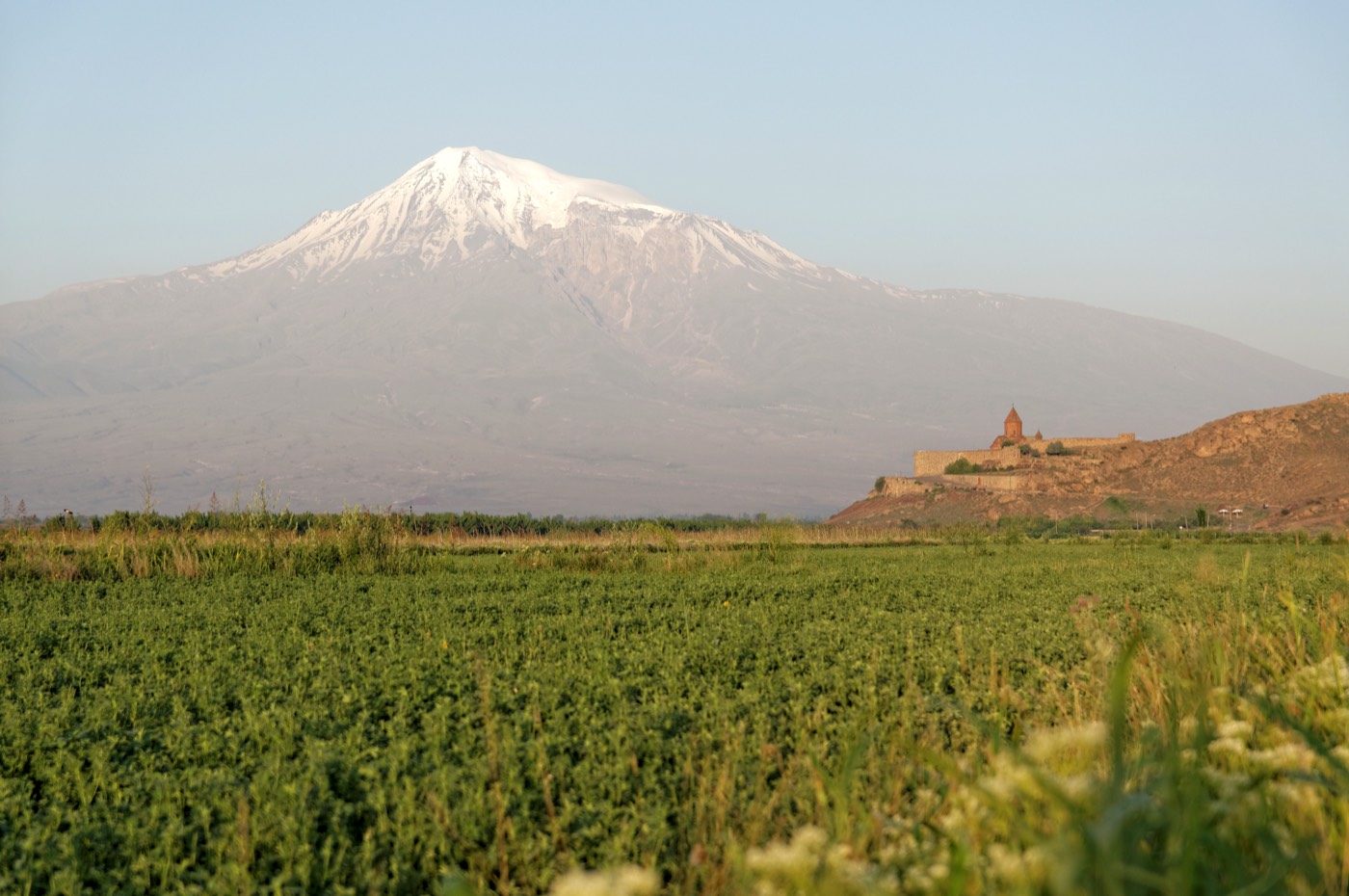
The Grigoryan surname means “of the family of Grigor”, the Armenian form of Gregory, and it belongs to the Armenian highland. It is the most common family name in the Republic of Armenia today.
What Does the Surname Grigoryan Mean?
Grigoryan means “descended from Grigor”, the Armenian equivalent of Gregory. It is a patronymic: the personal name Grigor plus the Armenian suffix -yan, which marks family descent, so the whole name reads roughly as “Grigor’s people”.
Grigor itself is not originally Armenian. It travelled into the language from Greek Gregorios, built on gregoros, meaning watchful or vigilant, from a verb meaning to keep awake. Christian Greek gave it a second layer: the watchman who stays alert for the return of Christ. Armenians took it up early and completely.
The suffix is the part that makes the name unmistakably Armenian. In classical and Western Armenian orthography it is written -եան and transliterated -ian. Soviet Armenia’s orthographic reform respelled it -յան, which comes into English as -yan. The sound barely changed. The spelling changed a great deal, and that difference does real historical work, as you will see below.
So Grigoryan is not an occupation, not a place, and not a nickname. It is the plainest kind of surname there is: somebody’s father was called Grigor, and the family kept it.
Where the Grigoryan Name Comes From
Grigoryan comes from the Armenian highland, the plateau that spans the modern Republic of Armenia and the historic Armenian provinces of eastern Anatolia. It is not the property of a single clan or village. It arose independently, many times over, wherever a man named Grigor had descendants.
A saint’s name, repeated across a nation
The reason the name is everywhere is one man. Grigor Lusavorich, known in English as Saint Gregory the Illuminator, lived roughly from 257 to 331 and is remembered as the founder and first head of the Armenian Apostolic Church.
Tradition holds that King Trdat III had him thrown into a pit at Khor Virap, on the Ararat plain, where he survived for years on bread lowered by a sympathetic widow. He was brought out, the king was converted, and in 301 Armenia became the first state in the world to adopt Christianity officially.
After that, Grigor was not simply a popular name in Armenia. It was the name, given generation after generation in every province, in every class, for more than a millennium and a half. Multiply that by a patronymic naming system and the result is inevitable.
When Armenian surnames became hereditary
Armenia’s great noble houses, the nakharar dynasties such as the Mamikonian, Artsruni and Bagratuni, carried fixed hereditary names from antiquity. Ordinary families did not. For most Armenians a patronymic simply described your father, and it changed with every generation.
Hereditary surnames spread among the wider population much later, as Ottoman and Russian imperial administrations began registering, taxing and conscripting people by household. A patronymic that had been temporary froze into a permanent family name. That is the moment when thousands of unrelated households became Grigoryans at once.
The Ter- families and other branches
Some Grigoryans carry an extra element in front. Ter, in Western Armenian Der, means “lord”, and it is a hereditary honorific borne by the descendants of married priests of the Armenian Apostolic Church. A Ter-Grigoryan family is signalling clerical ancestry, not aristocracy.
The custom went further than a prefix. The children of a married priest would often take the father’s name in religion as their surname, so a priest ordained as Ter Grigor could turn an entire branch into Ter-Grigoryans in a single generation.
Spelling Variants and Related Names
The main variants are Grigoryan, Grigorian, Krikorian, Kerkorian and Grigoryants. All descend from the same root name, Grigor, and the differences record dialect, orthography and which empire’s clerk wrote the name down.
Grigoryan (Գրիգորյան) is the Eastern Armenian form in reformed Soviet orthography. This is the spelling of the Republic of Armenia, of Nagorno-Karabakh, and of families who emigrated from Soviet or post-Soviet Armenia.
Grigorian is the same name in the older -ian transliteration. It is common among Iranian Armenians, among Russian Armenians, and among American families whose paperwork was filled out before the Soviet spelling reform reached them.
Krikorian and Kirkorian are the Western Armenian forms. Western Armenian shifted the voiced consonants of the classical language, so Grigor becomes Krikor. The same shift produces Bedrosian beside Petrosyan and Kevorkian beside Gevorgyan. Krikorian is found mainly in the United States, France and the Levant, exactly where Ottoman Armenians resettled.
Kerkorian is a further Anglicised step from Kirkor, and it is the form the Las Vegas financier and philanthropist Kirk Kerkorian carried.
Grigoryants (Գրիգորյանց) uses the older genitive plural ending -eants, preserved especially in Karabakh and in Russian registration as Григорьянц. Grigoryev, Grigorov and similar forms are the Slavic cousins of the same root rather than Armenian surnames.
Add the traditional orthography Գրիգորեան, the Ter-Grigoryan and Der-Krikorian branches, and the doubled-s French transliterations, and one Armenian family name has produced a dozen headstone spellings across four continents.
The Grigoryans in America
Grigoryans reached America in three main waves: Ottoman Armenians fleeing the massacres of the 1890s, survivors of the 1915 genocide, and Soviet and post-Soviet Armenians from the 1970s onward. The first two waves spelt the name Grigorian or Krikorian. The last spells it Grigoryan.
The first real mass arrival followed the Hamidian massacres of 1894 to 1896. Roughly 5,500 Armenians left Ottoman territory for the United States between 1891 and 1895, and many thousands more in the years immediately after, most of them landing at Ellis Island, which had opened in 1892.
They went where the work was. New England’s mills and machine shops absorbed thousands, and Armenian congregations took root in Watertown, Massachusetts, still one of the oldest Armenian centres in the country, and in the jewellery and textile district of Providence, Rhode Island. Others followed the foundries west into the industrial towns of the upper Midwest, including Racine, Wisconsin.
A different group went to the land. The vineyards and orchards of California’s San Joaquin Valley reminded Armenian farmers of home, and Fresno became the first great Armenian agricultural settlement in the United States.
The -yan spelling arrived much later, and it arrived by air. Soviet Armenians began leaving in numbers in the 1970s, the exodus accelerated after the catastrophic Spitak earthquake of December 1988, and it became a flood after the Soviet Union collapsed in 1991.
Almost all of them went to Los Angeles County. Glendale became the centre of gravity, and around it a chain of Armenian districts filled out across the city: Little Armenia in East Hollywood, then North Hollywood, Tujunga in the foothills, and the quieter Valley streets of Sherman Oaks.
This is why the American picture looks lopsided. The Grigorians have been here for over a century and are thoroughly assimilated. The Grigoryans, spelt with the Soviet -yan, are mostly a first or second generation American family, and their census numbers are still climbing. For the wider story see Armenian Americans.
Notable People Named Grigoryan
Gegham Grigoryan (1951 to 2016) was an Armenian operatic tenor with a major international career, invited to Vilnius in 1980 and later a fixture of the Russian operatic stage.
Asmik Grigorian (born 1981) is one of the outstanding sopranos of her generation. Born in Vilnius to Gegham Grigoryan and the Lithuanian soprano Irena Milkeviciute, she was named Best Newcomer at the International Opera Awards in 2016 and has since sung at La Scala and Salzburg.
Slava Grigoryan (born 1976) and Leonard Grigoryan are classical guitarists whose family emigrated from Armenia to Melbourne. Performing as the Grigoryan Brothers, they have won multiple ARIA Awards and toured internationally since 2003.
Marat Grigorian (born 1991) is an Armenian-Belgian kickboxer, a former Glory lightweight world champion and one of the most decorated strikers of the past decade.
Sergei Grigoryants (1941 to 2023) was a Soviet dissident, journalist and literary critic who was imprisoned for his samizdat publishing and went on to found the Glasnost press club.
Hambarsoom Grigorian (1893 to 1975) was an Iranian-Armenian composer, born in Tabriz and died in Tehran, and the founder and director of the Komitas choir.
How Common Is Grigoryan Today?
Grigoryan is the most common surname in Armenia, borne by roughly 84,000 people there, but in the United States the -yan spelling is still comparatively rare: it ranks #15,210 with 1,937 bearers in the 2010 Census.
The gap is entirely a matter of timing. American Armenian families who arrived before the Second World War registered as Grigorian or Krikorian, and those spellings are counted separately. Grigoryan with a y is essentially the post-Soviet arrival, and the 2010 figure catches that community while it was still young in America.
| US rank (2010 Census) | #15210 |
|---|---|
| Americans with the name | 1937 |
| Origin | Armenian |
| Meaning | Descended from Grigor (Gregory), “watchful” |
Frequently Asked Questions
What does the surname Grigoryan mean?
Grigoryan means “of the family of Grigor”, the Armenian form of Gregory. The suffix -yan, written -ian in Western Armenian, marks descent, and Grigor comes from Greek Gregorios, meaning watchful or vigilant.
Is Grigoryan Armenian or Russian?
Grigoryan is Armenian. The confusion arises because many Grigoryans lived under Russian and then Soviet rule, and Russian records often rendered the name Григорян or Григорьянц. The Slavic surnames Grigoryev and Grigorov share the same Christian root but are separate names.
Where does the Grigoryan family come from?
From the Armenian highland, covering the modern Republic of Armenia, Nagorno-Karabakh and the historic Armenian provinces of eastern Anatolia. There is no single ancestral village, because the name formed independently in countless households descended from a man called Grigor.
How common is the surname Grigoryan?
It is the single most common surname in Armenia, held by around 84,000 people. In the United States it ranked #15,210 in the 2010 Census with 1,937 bearers, a figure that undercounts the family because older arrivals are recorded as Grigorian or Krikorian.
Is there a Grigoryan family crest or coat of arms?
No. In every heraldic tradition, arms are granted to individuals and pass to their direct descendants, never to everyone who happens to share a surname. There has never been a coat of arms belonging to all Grigoryans, and Armenian commoner families did not bear arms at all. Any website selling you a “Grigoryan family crest” is selling a decoration, not a lineage.
What is the difference between Grigoryan and Grigorian?
They are the same name in two spellings. Grigoryan reflects Eastern Armenian in reformed Soviet orthography and usually indicates a family from Armenia itself, while Grigorian reflects the older -ian transliteration used by Iranian, Russian and pre-1920s American Armenians. The Western Armenian form of the same name is Krikorian.
If your family carries the Grigoryan name, its route from the Armenian highland to America is traceable. Atlas of Home can follow it from the plain below Ararat to whichever mill town or Los Angeles street your family landed on, and to wherever you are now.