
The vines start a few minutes past the last stoplight. Drive any direction out of downtown Fresno and the city gives way to raisin trays drying in the September sun, fig orchards, melon fields running flat to the foothills. To the Armenian families who stepped off the train here in the 1880s, this valley looked like a memory. The heat, the brown summer hills, the irrigation ditches, the smell of cut grapes: it was the land they had farmed for centuries in the old country, set down again on the far side of the world.
They had crossed an ocean and a continent to find a place that looked like the one they had lost. Then they planted it, and it made them, and it nearly broke them, and they planted it again. The story of the Armenians in Fresno is the story of a valley built anew by people the rest of the city, for a long time, did not want.
Fresno: The Place
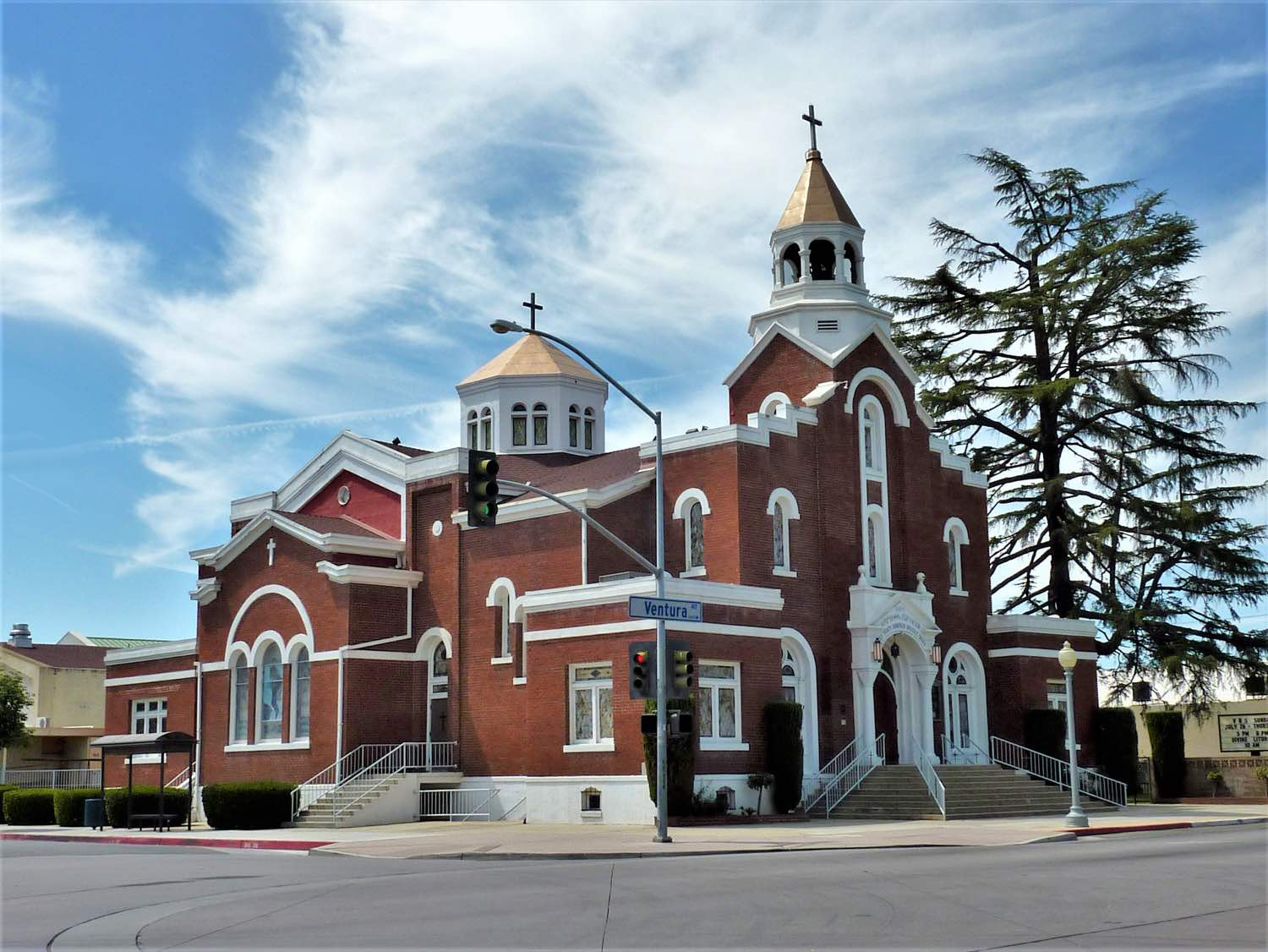
Fresno sits at the center of California’s San Joaquin Valley, the southern half of the great Central Valley that runs up the spine of the state. It is flat, hot, and irrigated, ringed by farmland and reachable from the coast through the Coast Ranges or from the south up Highway 99. This is the same valley that drew other Old World farming peoples to its fields, including the Basque sheepherders who settled an hour south in Bakersfield. The historic Armenian district lies just southeast of downtown, a grid of modest brick and clapboard houses around Ventura Street, walking distance from the courthouse and the old rail line.
How Fresno Became the Armenian Capital of the West
Before the Armenians
Fresno was barely a town when the Armenians arrived. Founded in 1872 as a stop on the Central Pacific Railroad, it was a dusty grid of new lots in the middle of wheat country, a place still deciding what it would grow. The Yokuts had lived in the valley for thousands of years before that. The German, Scandinavian, and Anglo-American settlers who came with the railroad were the ones holding the deeds, and they would hold them, in many neighborhoods, with a fierce exclusivity for the next seventy years.
What the valley had was sun and water and cheap land waiting for someone who knew how to coax fruit from dry ground. That someone was about to come from Anatolia.
The Armenians Arrive
In the autumn of 1881, two brothers named Hagop and Garabed Seropian arrived in Fresno carrying letters of recommendation from the American Congregational Church and almost no English. They were from Marsovan, an Armenian town in the Ottoman interior, and they had come because America’s missionaries in their homeland spoke of a valley in California that grew grapes. They found it, and it looked like home.
The Seropians started as grocers, then turned to packing dried fruit, and their packing house was among the first to ship Fresno figs and oranges to the markets of the East. What mattered more than the business was the mail. The brothers wrote letters back to Marsovan, and the letters did what letters always do in a migration: they pulled. In 1883 some forty Armenian families left Marsovan for Fresno. The Markarians, the Bedrosians, the Shahamirians followed close behind.
Then the killing started, and the trickle became a flood. The Hamidian massacres of 1895 and 1896 sent thousands of Armenians fleeing the Ottoman Empire, and many of them already knew exactly where to go. By 1894 Fresno had a few hundred Armenians. Over the following two decades the number climbed toward ten thousand, the great majority of all the Armenians in California, almost all of them clustered in and around the small downtown district that the rest of the city had begun to call Armenian Town.
Fresno at Its Peak
By the early twentieth century the Armenians were not just in the valley. They were the valley’s engine. They had arrived knowing vines and orchards, and Fresno’s economy ran on exactly that. In 1902 Henry Markarian was called the largest fig grower in the United States. By 1930 Armenians owned roughly 40 percent of the raisin acreage in Fresno County and made up about a quarter of its growers, a staggering share for a community that had been penniless newcomers a generation before.
The most famous of them was Krikor Arakelian, who landed in the valley in 1895 as a boy of twelve with nothing. He started with forty acres and expanded only as far as his own credit would carry him, and in 1911 his family produced ten percent of all the melons grown in America. The papers called him the Melon King. He built the Mission Bell Winery in Madera, controlled a fortune by the 1940s, and proved a point that the whole community was making in the soil: give us the land and we will make it bloom.
Armenian Town itself filled in around the churches. Grocers, coffeehouses, a newspaper, a baking company, brick homes built between 1890 and 1908, all packed into the blocks below the courthouse. It was a working neighborhood, not a showpiece, and it was the heart of Armenian life west of the Mississippi.
The Change
Here is the part Fresno was slow to admit. The same city that depended on Armenian farmers spent decades treating Armenians as unwelcome. Property deeds in the prestigious neighborhoods, Fig Garden among them, carried restrictive covenants that named Armenians outright alongside other groups barred from owning or occupying homes. The wording was explicit and ugly. Some Fresno businesses posted signs reading “No Dogs or Armenians.” Children were taunted with slurs in the schoolyards.
The hostility was measured as well as felt. A survey conducted around 1930 found that a clear majority of non-Armenians in Fresno said they would not hire Armenians, would not accept them as neighbors, and would not let their children play together. The prosperity in the vineyards and the prejudice in the deeds existed side by side, and the second did not yield easily to the first.
What broke the pattern was time, education, and the slow erosion of the covenants after the courts stopped enforcing them in the late 1940s. The grandchildren of the packing-house Armenians became doctors and lawyers and professors. They moved north into the neighborhoods that had once been closed to them, and old Armenian Town, drained of its families, was cut and hollowed by mid-century redevelopment. The community survived. The neighborhood, for a long time, did not.
The Landmarks of Armenian Town
Holy Trinity Armenian Apostolic Church, 2226 Ventura Street. The parish was established on April 1, 1900, at the corner of F and Monterey Streets, only the second Armenian church built in America, after the first rose among the Armenians of Massachusetts. The first wooden building burned in the great downtown fire of July 9, 1913. The red-brick church that replaced it, designed by architect L. K. Cone and consecrated in December 1914, was the first Armenian church in the United States raised in the traditional architecture of the homeland, with its conical domes and pointed arches. It was placed on the National Register of Historic Places in 1986 and still holds services today.
First Armenian Presbyterian Church, Ventura and M Streets. Chartered on July 25, 1897, by forty immigrants from Marsovan, it is the oldest Armenian church of any denomination in the United States. Its first pastor was a former American missionary who had served in Bitlis and spoke fluent Armenian. A boy named William Saroyan attended here in his youth, and the congregation, well past its 125th anniversary, has never stopped meeting.
The David of Sassoun statue, Courthouse Park, near Tulare and Van Ness. The people of Armenian descent of the San Joaquin Valley gave this monument to Fresno County on August 11, 1970. Sculpted by Varaz Samuelian, whose parents were genocide survivors and who was a close friend of Saroyan, the towering copper figure shows the folk hero David astride his rearing horse, sword raised. It stands for justice and defiance, planted in front of the seat of county government.
Valley Lahvosh Baking Company, 502 M Street. A master baker named Gazair Saghatelian, newly arrived from Moush in historic Armenia, founded this bakery in 1922 to make the bread of home. His peda loaf and his crackerbread, the lahvosh, fed the neighborhood and then the country. The business passed from his daughter Janet to her daughter Agnes, marked its hundredth year in 2022, and still bakes in the old district.
Ararat Armenian Cemetery, 1925 West Belmont Avenue. The founding generation rests here, the Seropian brothers among them, alongside an unknown martyr of the death marches and later sons of the community. It is the quiet ground that holds the people who turned a railroad town into an Armenian capital. A separate Fresno cemetery is also the resting place of Soghomon Tehlirian, the survivor who lived out his last years in California and died in 1960.
The Armenian Genocide Centennial Monument, Fresno State, Maple Mall. Unveiled on April 23, 2015, and designed by Fresno architect Paul Halajian, the memorial of nine inward-facing pillars beneath a broken halo was the first Armenian genocide monument built on any American college campus. It sits at the heart of a university whose Armenian Studies Program, founded in 1977, has become one of the field’s anchors in the United States.
Where the Fresno Armenians Came From
The first families came from one place above all others: Marsovan, in the north-central Ottoman interior, the home village of the Seropian brothers who started the chain. For the first two decades, to be a Fresno Armenian very often meant to have Marsovan cousins, because the migration moved along family lines, one letter at a time.
The genocide widened the map. The refugees who poured in after 1915 came from Bitlis, the birthplace of William Saroyan’s parents, and from Moush, Van, Kharpert, Erzerum, and the other Armenian provinces of eastern Anatolia that were emptied of their people. They chose Fresno for the same reason the Seropians had: the valley grew what they knew, and their countrymen were already there. The result was a community gathered from across historic Armenia and re-rooted in a single California county.
Fresno Today
Fresno is still the most Armenian city in the American West, and you can taste it before you can see it. Peda bread and lahvosh fill the bakery shelves, the churches keep their feast days, and fourth-generation farming families still work ground their great-grandparents cleared. The Armenian name on the produce label, the law office, the school board is so ordinary now that it is easy to forget how hard the welcome once was. Many of the children who left here joined the larger Armenian-American world in places like the dense Armenian community of Glendale, but the valley remains the place it all began.
Old Armenian Town, long the casualty of redevelopment, is coming back in pieces. A cluster of the original houses on M Street, some built before 1910 and two of them lost to a 2020 fire, was restored and reopened as homes in June 2024. Larger plans for the district include an appellate courthouse and, fittingly, an Armenian museum, so that the neighborhood that made the community will tell its own story.
The clearest legacy is the one carved in stone and copper. Saroyan turned this valley into literature, set his fictional town of Ithaca squarely over the real Fresno, won an Academy Award, declined a Pulitzer, and asked that half his ashes rest in Fresno and half in Yerevan, a man split between two homelands to the end. The grandchildren of the survivors did not just endure here. They planted a valley, named it, and made it theirs.
Frequently Asked Questions
Why did Armenians settle in Fresno?
The first Armenians in Fresno, the Seropian brothers, came in 1881 because American missionaries in the Ottoman Empire described a California valley that grew grapes and figs like the old country. The San Joaquin Valley’s hot, dry, irrigated farmland looked and worked like the land they had farmed for centuries, and they already knew how to make it produce. Their letters home set off a chain migration from the town of Marsovan.
Is Fresno still an Armenian city today?
Yes. Fresno remains the largest center of Armenian life in the American West, with active churches, peda and lahvosh bakeries, a major Armenian Studies program at Fresno State, and fourth-generation farming families. The historic Armenian Town district is being partially restored, including a block of original homes reopened in 2024.
What are the most famous Armenian landmarks in Fresno?
The best known are Holy Trinity Armenian Apostolic Church on Ventura Street, the first Armenian church in the United States built in traditional Armenian architecture, and the David of Sassoun statue in Courthouse Park. Other landmarks of the Armenians in Fresno include Valley Lahvosh Baking Company, founded in 1922, and the Armenian Genocide Centennial Monument at Fresno State.
Where did the Fresno Armenians come from?
The earliest families came from Marsovan in the north-central Ottoman Empire, the home of the Seropian brothers. After the genocide of 1915, survivors arrived from Bitlis, Moush, Van, Kharpert, and the other Armenian provinces of eastern Anatolia, gathering a community from across historic Armenia into one California valley.
When did Armenians first arrive in Fresno?
Armenians first arrived in Fresno in the autumn of 1881, when the brothers Hagop and Garabed Seropian settled in the young railroad town. Larger waves followed after the Hamidian massacres of 1895 to 1896 and again after the genocide, and by 1910 nearly ten thousand Armenians lived in and around the city.
If your family’s story passed through the vineyards of the San Joaquin Valley, through a brick church on Ventura Street or a packing house that shipped figs east, the names and dates are only the start of it. The rest is yours to trace.