
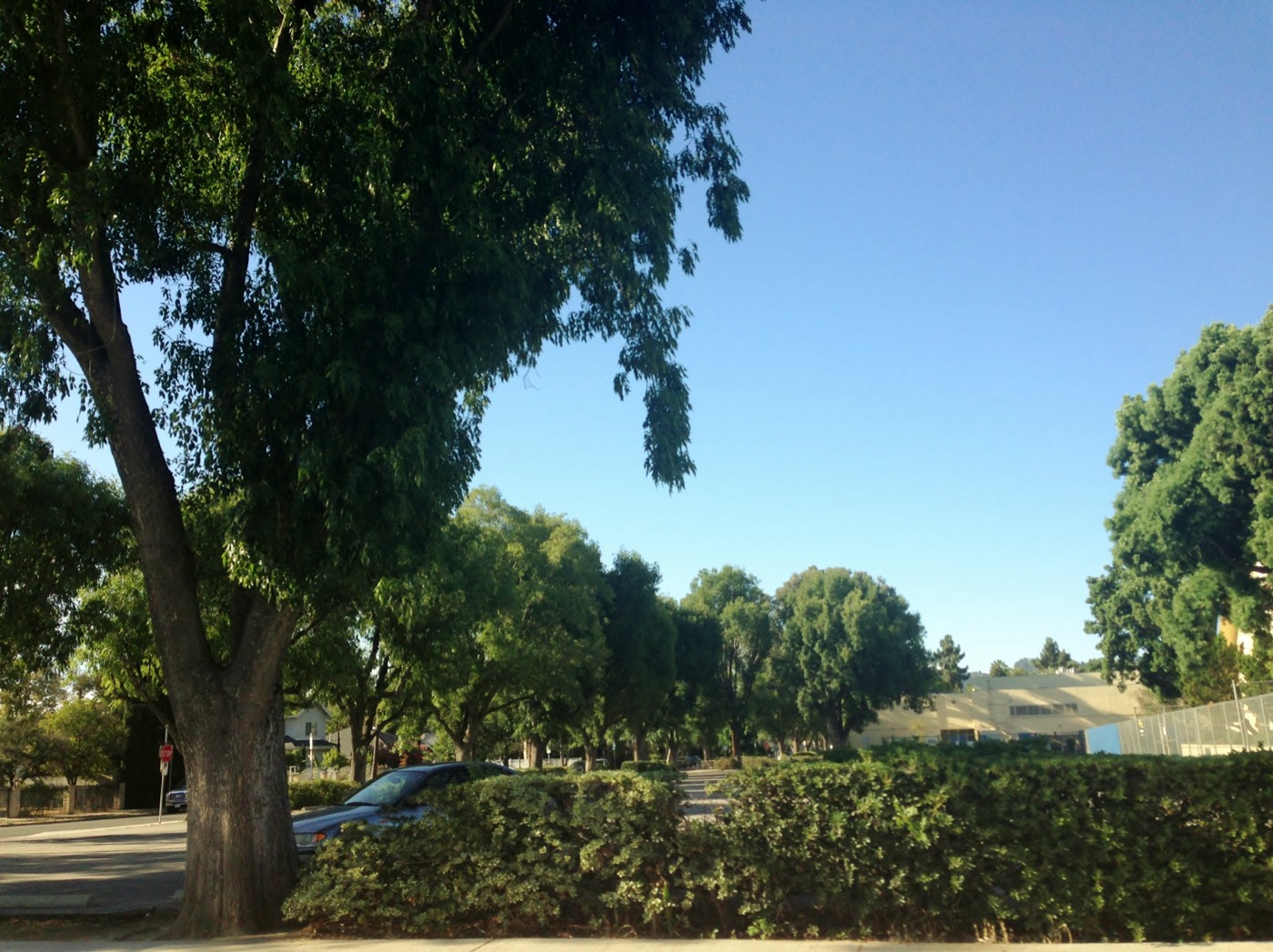
Drive west on Ventura Boulevard past the Sherman Oaks Galleria and the changes are quiet but unmistakable. A deli counter stacked with basturma and string cheese. A real estate office whose agents answer in Armenian and English without missing a beat. A schoolyard where the morning chatter carries the soft consonants of a language older than most of the city. The Armenians in Sherman Oaks did not arrive in a single wave or build a visible enclave the way Glendale did. They arrived as families with means, settled into the leafy streets south of the boulevard, and became neighbours.
The Place
Sherman Oaks sits in the southern San Fernando Valley, founded in 1927 when General Moses Hazeltine Sherman and his partners at the Los Angeles Suburban Homes Company subdivided a thousand acres of oak-dotted ranch land. It is bounded by Studio City to the east, Van Nuys to the north, Encino to the west, and the crest of the Santa Monica Mountains to the south, with the Los Angeles River tracing its lower edge.
The 101 and 405 freeways cross here, and Ventura Boulevard runs the length of it as the commercial spine. The hillside streets south of the boulevard hold some of the Valley’s most coveted homes, where the median price runs well past a million dollars.
It is, by any measure, an affluent place. That single fact explains a great deal about which Armenians chose it, and why.
How It Became Armenian
Armenians have lived in Los Angeles since around 1900, when the first survivors of massacres in the Ottoman Empire reached the city. By 1923 there were perhaps three thousand, most from Western Armenia, the historic provinces of what is now eastern Turkey. They clustered first in Hollywood, then later in Glendale, which would grow into the largest Armenian population anywhere outside Yerevan. (For the deeper history of Armenian Los Angeles, see the history of Armenian Americans in Los Angeles.)
Sherman Oaks was never that. It became Armenian later, and differently. The story here is not one of refugees crowding into cheap apartments but of established families moving up and moving west.
The Iranian-Armenian Arrival
The turning point was 1979. When the Iranian Revolution upended life in Tehran, Isfahan, and Tabriz, it sent a distinct community across the ocean: Iranian-Armenians, many of them merchants, engineers, doctors, and jewellers who had lived comfortably under the Shah. Roughly 9,500 Armenians arrived in Los Angeles in 1979 and 1980 alone.
This group was different from the genocide-era settlers. They were often multilingual, professionally credentialed, and arriving with capital intact or recoverable. Many had no interest in starting over in a tenement. They wanted good schools, safe streets, and a short drive to the synagogues, churches, and shops of relatives already in the Armenian community of Encino and Tarzana. Sherman Oaks fit perfectly.
The Soviet Wave
A second current arrived from a different direction. Beginning in August 1987, Soviet emigration visas opened, and Armenians left the Soviet republic in extraordinary numbers. By March 1988 some 2,000 had reached Los Angeles, with thousands more expected, in what observers called the single largest arrival of an ethnic group since the Vietnamese a decade earlier. At the peak, roughly nine in ten Armenians leaving the Soviet Union settled in Los Angeles.
Most of these newcomers landed first in Hollywood and Glendale, which were closer and cheaper. But as families found their footing, opened businesses, and educated their children, the more prosperous among them looked across the hills to the Valley. Sherman Oaks, with its top-rated schools and its quiet, became a destination for those who had made it.
A Pattern of Upward Movement
The Armenian story in Los Angeles has always carried a striking entrepreneurial streak. As far back as 1980, a quarter of Armenian men in the city worked as executives and professionals. By the mid-1990s the self-employment rate among Armenian managers and professionals topped 66 percent.
That drive showed in geography. Glendale and East Hollywood were where families landed; Encino, Tarzana, and Sherman Oaks were where they arrived once they had succeeded. The same upward arc shaped the Armenians of Granada Hills at the Valley’s northern edge. The Valley’s southern tier became a kind of Armenian aspiration made physical, the address you bought into when the business turned a profit and the children needed the better high school.
Sherman Oaks today reflects that. The community here is not loud or concentrated. It is woven into a neighbourhood that remains majority non-Hispanic white, where Armenian families are professionals, property owners, and parents of children at Dixie Canyon and Kester. The presence is real, but it announces itself in details rather than in signage.
The Landmarks
C&E Merdinian Armenian Evangelical School, 13330 Riverside Drive. The single most important Armenian institution physically rooted in Sherman Oaks. It opened on 13 September 1982 with thirteen students and four staff in borrowed Sunday-school classrooms, named for sisters Elise and Charlotte Merdinian. It bought its current Sherman Oaks campus before the 1986-87 year, serves preschool through eighth grade, and remains the only Armenian evangelical day school in the United States.
Cafe Areni, Sherman Oaks. A neighbourhood spot serving traditional Armenian and Russian fare, with fresh-made kebabs, soups, and salads. It is the kind of unflashy family kitchen that anchors a community without advertising it, the place where Soviet-era and Iranian-Armenian palates meet over the same plates.
Holy Martyrs Armenian Apostolic Church, 5300 White Oak Avenue, Encino. Just over the western line in Encino, this Western Prelacy parish has long served Armenian families across Sherman Oaks and the surrounding Valley. For many households south of Ventura, this is the church of christenings, weddings, and Sunday liturgy.
St. Peter Armenian Apostolic Church, 17231 Sherman Way, Van Nuys. A short drive north, St. Peter is part of the Western Diocese and a spiritual home for Valley Armenians, including many in Sherman Oaks who attend its services and feast-day gatherings.
Vahan and Anoush Chamlian Armenian School and Ferrahian, Encino. The Holy Martyrs Ferrahian High School in nearby Encino opened in 1964 as the first Armenian day school in the United States. It draws families from Sherman Oaks who want their children educated in Armenian language, history, and faith.
Tagdeli, Ventura Boulevard, Tarzana. A few miles west along the same boulevard, this Armenian deli has served the Valley since 1972 and is a designated Ventura Boulevard landmark. Its counters of baklava, dried fruit, and house-made wraps are a standing pantry for Armenian Sherman Oaks.
The Sherman Oaks Galleria, 15301 Ventura Boulevard. Not an Armenian institution, but the neighbourhood’s defining crossroads, opened in 1980 at Ventura and Sepulveda. For the families who arrived in that same decade, the Galleria was where their teenagers spent Saturdays, an ordinary American rite of passage that marked how thoroughly they had arrived.
Where They Came From
The Armenians of Sherman Oaks trace to two principal origins, layered over the older genocide-era foundation of Los Angeles Armenian life.
The first is Iran. The Iranian-Armenian community of Tehran, Isfahan’s New Julfa quarter, and Tabriz was centuries old and largely middle and upper class. The 1979 revolution drove many of them to Southern California, where their professional credentials and capital let them settle directly into affluent areas rather than working their way up. This is the dominant origin story for Sherman Oaks specifically.
The second is the former Soviet republic, modern Armenia itself, whose families left in the great waves of 1987-88 and again after independence in 1991. Most settled first in Glendale and Hollywood, with the more prosperous later moving into the Valley’s better neighbourhoods.
Smaller numbers carry roots in Lebanon, Syria, and the historic Western Armenian provinces, the threads that run through nearly every Los Angeles Armenian family tree.
Sherman Oaks Today
The Armenian community in Sherman Oaks is, in 2026, a settled one. It does not have a main street or a festival of its own the way Little Armenia and Glendale do. What it has instead is permanence: families two and three generations deep, homes owned outright, children who went from Merdinian or Dixie Canyon to UCLA and came back to raise their own.
The boundary with Encino and Tarzana matters here, because the real Armenian institutional weight, the churches and the older day schools, sits just over those lines, and Sherman Oaks families flow across them daily. The neighbourhood functions as the residential, prosperous end of a larger Valley Armenian world that includes its Persian neighbours in Sherman Oaks and the older, denser Armenian presence in Burbank to the east.
There is a generational shift underway, too. The Iranian-Armenians who fled Tehran in 1979 are grandparents now, and their grandchildren are American in a way the first arrivals never quite were, fluent in the slang of the Galleria food court, fluent also, at home, in the Armenian of their families. The language survives in kitchens and at Sunday school more than on the street. The faith holds at Holy Martyrs and St. Peter. The names survive on real estate signs and medical office doors up and down Ventura.
It is a quieter Armenian Los Angeles than the one tourists picture. No grand cathedral dominates a corner; no banner spans the street. But step into the right deli, or stand outside Merdinian at pickup time, and the community is unmistakably, durably present, exactly as a successful immigrant story is supposed to look once the striving is done.
Frequently Asked Questions
Are there many Armenians in Sherman Oaks?
Yes. Sherman Oaks lies within the eastern San Fernando Valley belt that is home to roughly 100,000 Armenian Americans, and the Armenians in Sherman Oaks form a notable, prosperous part of that wider community, even though the neighbourhood remains majority non-Hispanic white and has no formal Armenian quarter.
Why did Armenians settle in Sherman Oaks rather than Glendale?
Glendale drew the largest numbers, especially newer and working-class arrivals. Sherman Oaks attracted established and professional families, particularly Iranian-Armenians who came after 1979 with capital and credentials and could afford its homes and top-rated schools from the start.
What is the main Armenian institution in Sherman Oaks?
The C&E Merdinian Armenian Evangelical School at 13330 Riverside Drive, founded in 1982, is the most significant Armenian institution physically based in Sherman Oaks. It is the only Armenian evangelical day school in the United States.
Where do Armenians in Sherman Oaks worship?
Many attend Holy Martyrs Armenian Apostolic Church in neighbouring Encino or St. Peter Armenian Apostolic Church in Van Nuys, both a short drive away. The most prominent Armenian churches sit just over the Sherman Oaks line in adjacent Valley communities.
Are most Armenians in Sherman Oaks from Armenia or Iran?
The Armenians in Sherman Oaks come from two main origins: Iranian-Armenian families who left after the 1979 revolution, and Soviet and post-Soviet Armenians who emigrated from 1987 onward. The Iranian-Armenian thread is especially strong in this affluent part of the Valley.
Where can I find Armenian food in Sherman Oaks?
Cafe Areni in Sherman Oaks serves traditional Armenian and Russian dishes, and the long-running Tagdeli on Ventura Boulevard in nearby Tarzana, open since 1972, supplies baklava, wraps, and Armenian pantry goods to families across the area.
If your family’s story passed through Sherman Oaks, or any of the places Armenians have made home in America, Atlas of Home can trace that journey. From the New Julfa quarter of Isfahan or the streets of Yerevan, to the oak-lined hills above Ventura Boulevard, to wherever you are now.