
Drive south on 16th Street as the desert light goes gold and the walls begin to talk. A skeleton bride in a flowered crown, a Yaqui deer dancer mid leap, the Virgin of Guadalupe forty feet tall above a taqueria. This is Calle 16, and it is one of the clearest places to understand the Mexicans in Phoenix, a community older than the city’s streetlights and woven through almost every block of the modern Valley of the Sun.
The Place
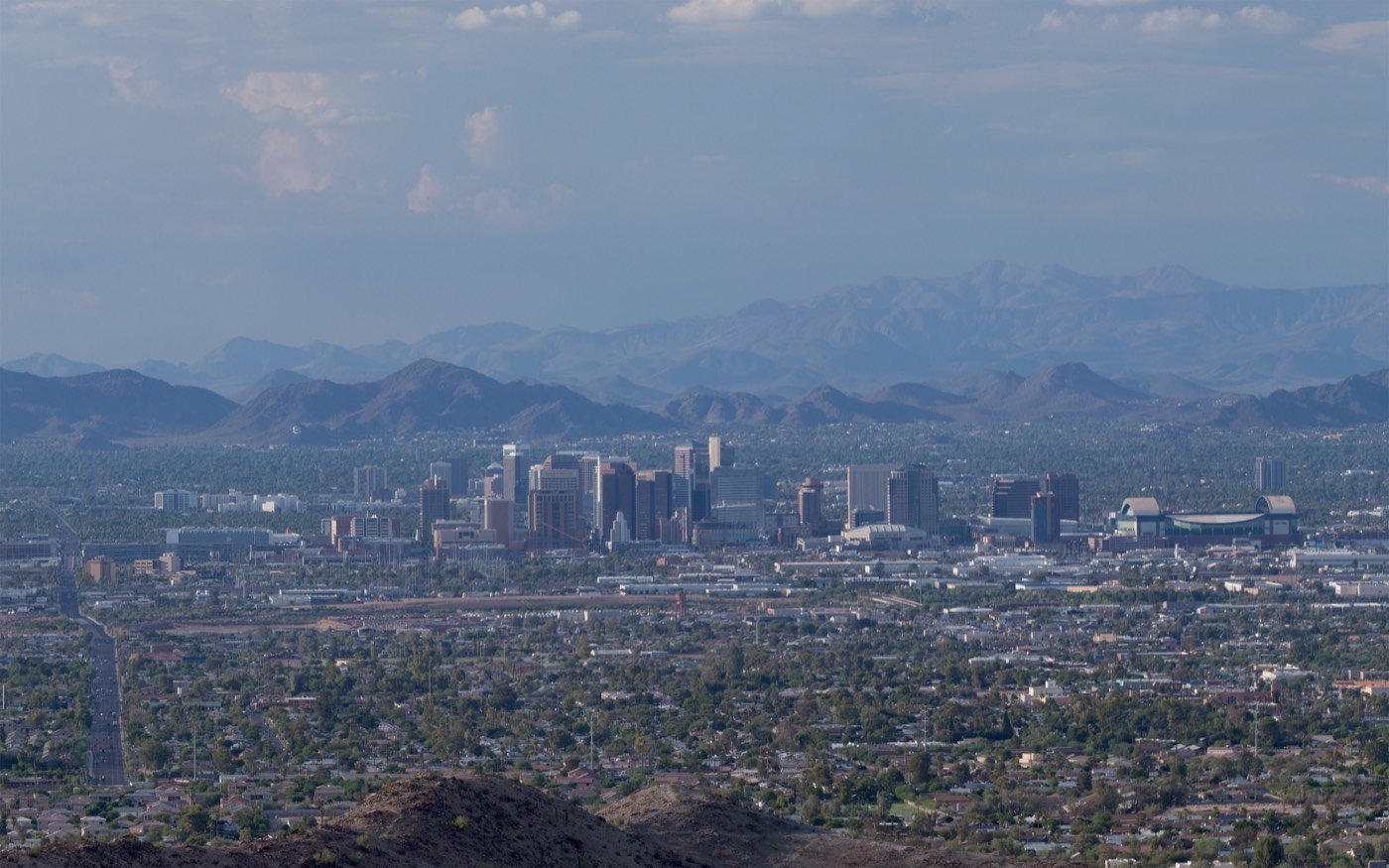
Phoenix sits in the Salt River Valley, ringed by South Mountain, Camelback and the long brown spine of the Estrella range. It is the fifth largest city in the United States, a sprawl of low neighbourhoods and freeways baked under a sun that runs past forty degrees Celsius for months on end. Its eastern suburbs have drawn other diasporas too, from the Indians in Gilbert to the Chinese in Chandler.
For most of its life Phoenix told a story about itself that left the Mexicans out. The truth runs the other way. The valley was farmed and irrigated by Mexican and Mexican American hands long before air conditioning made the place comfortable, and today Hispanic residents, the overwhelming majority of them of Mexican origin, are roughly equal in number to the city’s white population.
According to the 2020 census, Phoenix counted about 661,000 Hispanic residents, around 42.6 per cent of the city, of whom more than 607,000 were of Mexican origin. That single figure makes the Mexicans in Phoenix not a minority neighbourhood but a foundational half of the city itself.
How It Became Mexican
Before the city had a name
When the Anglo settlers arrived in the 1860s and 1870s to dig out the old Hohokam canals, Mexican labourers were already there. Sonoran families crossed a border that had only recently moved over their heads, after the Gadsden Purchase of 1854 transferred this stretch of desert from Mexico to the United States.
They worked the canals, the brickyards and the farms. By the early 1900s a string of barrios had formed on the south and west sides of the railroad tracks, the parts of town Anglo Phoenix did not want. The city’s own historic preservation record traces how these barrios formed and, in some cases, were later erased.
La Palestina and Grant Park
The oldest of these was the barrio that grew up around Grant Park, west of Central Avenue, known in its earliest years as La Palestina. It formed around 1915 and filled out through the 1920s and 1930s with families who built adobe houses, corner grocers and Catholic parishes.
By 1916 much of the land in the Grant Park area was held by Spanish surnamed owners. The barrio also pressed up against Phoenix’s small Chinatown, and the two communities lived close enough that Chinese grocers learned Spanish to serve their neighbours and the children played together in the dirt streets.
Friendly House and the work of settling in
In 1915 a settlement organisation called Friendly House opened in the Grant Park area to help newly arrived Mexican immigrants. Run for many years by the activist Carrie Gonzales, later led by figures such as the educator who came after her, it taught English and citizenship classes and offered the practical scaffolding of arrival.
Friendly House still operates more than a century later, one of the longest serving institutions of its kind in the city. It is a reminder that the Mexicans in Phoenix did not simply pass through. They put down roots and built the machinery to help the next family do the same.
Guadalupe, the town that fled north
South of the city, at the base of South Mountain between Phoenix and Tempe, sits a square mile of a place unlike anywhere else in the valley. Guadalupe was founded around the turn of the twentieth century by Yaqui people who had fled Sonora to escape persecution and forced relocation under the government of Porfirio Diaz.
Catholic and Presbyterian missionaries helped the new arrivals secure a legal townsite in 1914. Over the following decades Mexican immigrant families joined the Yaqui settlers, and by the 1960s the community was both Yaqui and Mexican, a single town named for the Virgin of Guadalupe, patron saint of Mexico.
Guadalupe incorporated as its own town in 1975 and remains stubbornly itself: low houses, a central plaza, and Easter ceremonies that blend Catholic ritual with Yaqui deer dancers in a tradition reaching back roughly three centuries. The town’s own history records this Yaqui founding in detail.
Bulldozers and the Golden Gate
Not every barrio survived. On the east side stood the Golden Gate Barrio, a tight Mexican American neighbourhood that the city razed under eminent domain through the 1970s and 1990s to expand Phoenix Sky Harbor International Airport.
Thousands of families were moved out. Almost nothing of the neighbourhood remains except Sacred Heart Church at 920 South 16th Street, founded in 1953 with the help of Father Albert Braun. For one weekend each December the displaced families return to the empty church for a homecoming Mass, a congregation gathering on the site of a neighbourhood that the maps no longer show.
From sequestered to citywide
For much of the twentieth century, segregation kept Phoenix’s Mexican American families clustered on the south and west sides. Schools, swimming pools and theatres practised their own quiet lines of exclusion well into the 1950s.
The lines eventually broke. Successive waves of migration from Mexico through the 1980s, 1990s and 2000s pushed Mexican families into Maryvale, into the west valley, and out across suburbs that had once been entirely Anglo. The 2010 law SB 1070, which authorised police to question immigration status, hardened politics and pride alike, and helped spark the cultural assertion you now see painted across 16th Street. The pattern echoes Mexican enclaves elsewhere, from the Mexicans in Santa Ana in southern California to the Mexicans in Dallas.
The Landmarks
Calle 16, 16th Street between Thomas and Roosevelt. This open air mural corridor was founded in 2012 by chef Silvana Salcido Esparza, owner of Barrio Cafe, as an act of community pride after SB 1070. Artists including Lalo Cota, Gennaro Garcia and Hugo Medina have covered the walls with deer dancers, calaveras and the Virgin of Guadalupe, turning a working class commercial strip into the visual heart of Mexican Phoenix.
Barrio Cafe, 2814 North 16th Street. Silvana Salcido Esparza opened this restaurant in 2002 and turned it into a national name for interior Mexican cooking far beyond the burrito. Daughter of Mexican immigrants, she has since opened sister locations on Grand Avenue and at Sky Harbor, but the original on 16th Street remains the anchor of the district she helped create.
The Original Carolina’s Mexican Food, 1202 East Mohave Street. Carolina Valenzuela started selling tortillas, burros and tamales out of her car, and by 1968 had a Phoenix institution. The family settled this Mohave Street location in 1986, where the paper thin flour tortillas still draw queues out the door for machaca and green chicken tamales.
Sacred Heart Church, 920 South 16th Street. Founded in 1953 by Father Albert Braun, this is the last building of the demolished Golden Gate Barrio. It stands alone amid airport land, and each December the scattered families of the old neighbourhood return for a homecoming Mass and tamales, keeping a vanished community alive one weekend a year.
Mercado de Guadalupe, Avenida del Yaqui and Calle Guadalupe, Guadalupe. An open air, Mexican style shopping complex of around 22,000 square feet in the heart of the little town. Around it sit the plaza, Our Lady of Guadalupe Catholic Church and the Yaqui temple, the spiritual centre where the Easter ceremonies unfold.
Mercado de los Cielos, 7611 West Thomas Road, Phoenix. In a former Mervyn’s department store on the west side, more than 200 small tenants sell everything from quinceanera dresses and religious icons to mariscos, tortas and aguas frescas. It is a bordertown plaza folded indoors, serving Maryvale’s Mexican immigrant families and a clientele that treats it as a town square.
The ASU Mercado, 502 East Monroe Street, downtown Phoenix. A cluster of Spanish colonial buildings raised in the 1980s as a Mexican themed marketplace, now part of Arizona State University’s downtown campus. Its tiled courtyards and bell towers are a small architectural insistence, in the city’s core, that Phoenix is a Mexican place.
Where They Came From
The deepest current runs from Sonora, the Mexican state directly across the border. Sonoran families crossed into the Salt River Valley before there was a fence to cross, drawn by the same desert agriculture and the same river they had always farmed. The Sonoran influence shows in the food: the flour tortilla, the carne asada, the cheese crisp, all hallmarks of northern Mexican cooking rather than the central Mexican kitchen.
The Yaqui who founded Guadalupe came from the Rio Yaqui in southern Sonora, fleeing a specific campaign of persecution rather than seeking work. Their arrival gave Phoenix a Mexican community with an indigenous spine, and the Easter ceremonies they carried north survive in Guadalupe to this day.
Later twentieth century migration broadened the map. Families arrived from Chihuahua, Sinaloa, Jalisco, Michoacan and the Mexican interior, joining the older Sonoran population and filling the west valley. The result is a community both very old and continually renewed, Sonoran at its foundation and pan Mexican in its present. The same Sonoran and central Mexican origins shaped Mexican communities across the southwest, from the Mexicans in San Antonio to the Mexicans in Houston.
Phoenix Today
Mexican Phoenix is no longer a set of barrios on the wrong side of the tracks. It is the city. Hispanic residents now roughly match the white population in number, and the children of Maryvale and south Phoenix run businesses, win council seats and teach in the schools their grandparents were once steered away from.
The culture is loud and public in a way it was not allowed to be for generations. The downtown Dia de los Muertos festival draws tens of thousands each November; the Mikiztli festival, the longest running of its kind in the city, fills a plaza with giant puppets, ballet folklorico and community altars. Calle 16’s murals are now a tourist stop, and Sonoran hot dog stands have become a regional signature exported as far as the food magazines.
It is not a finished story. Gentrification presses on the old central barrios, the politics of the border still cut close, and the memory of the Golden Gate bulldozers sits under the pride. But the Mexicans in Phoenix have stopped being a community that asks permission. They built the valley, and now they are visibly, audibly at home in it.
Frequently Asked Questions
How many Mexicans live in Phoenix?
The 2020 census counted about 661,000 Hispanic residents in the city of Phoenix, roughly 42.6 per cent of the population, and more than 607,000 of them were of Mexican origin. The Mexicans in Phoenix are now nearly equal in number to the city’s white population.
What is the oldest Mexican neighbourhood in Phoenix?
Grant Park, west of Central Avenue and known in its early years as La Palestina, is generally cited as the oldest barrio, forming around 1915. It is also home to Friendly House, a settlement organisation that has served Mexican immigrants since the same year.
Why is Calle 16 important to the Mexicans in Phoenix?
Calle 16 is an open air mural district along 16th Street, founded in 2012 by chef Silvana Salcido Esparza after Arizona passed the immigration law SB 1070. Its murals celebrate Mexican heritage and turned a working class strip into the cultural heart of Mexican Phoenix.
What happened to the Golden Gate Barrio?
The Golden Gate Barrio, a Mexican American neighbourhood on the east side, was demolished under eminent domain from the 1970s through the 1990s to expand Sky Harbor airport. Only Sacred Heart Church remains, and former residents return there each December for a homecoming Mass.
Is Guadalupe, Arizona a Mexican town?
Guadalupe is a small incorporated town between Phoenix and Tempe, founded around 1900 by Yaqui people from Sonora and later joined by Mexican immigrant families. Today it is both Yaqui and Mexican, named for the Virgin of Guadalupe and known for its Easter ceremonies.
Where can you find authentic Mexican food in Phoenix?
The 16th Street corridor around Barrio Cafe, the south side institution Carolina’s on Mohave Street, and the food stalls inside Mercado de los Cielos on West Thomas Road are all anchors. Sonoran style cooking, with its flour tortillas and carne asada, is the regional signature.
If your family’s story passed through Phoenix, or any of the places Mexicans have made home in America, Atlas of Home can trace that journey. From the canals of Sonora and the Rio Yaqui, to the barrios of Grant Park and the murals of Calle 16, to wherever you are now.