
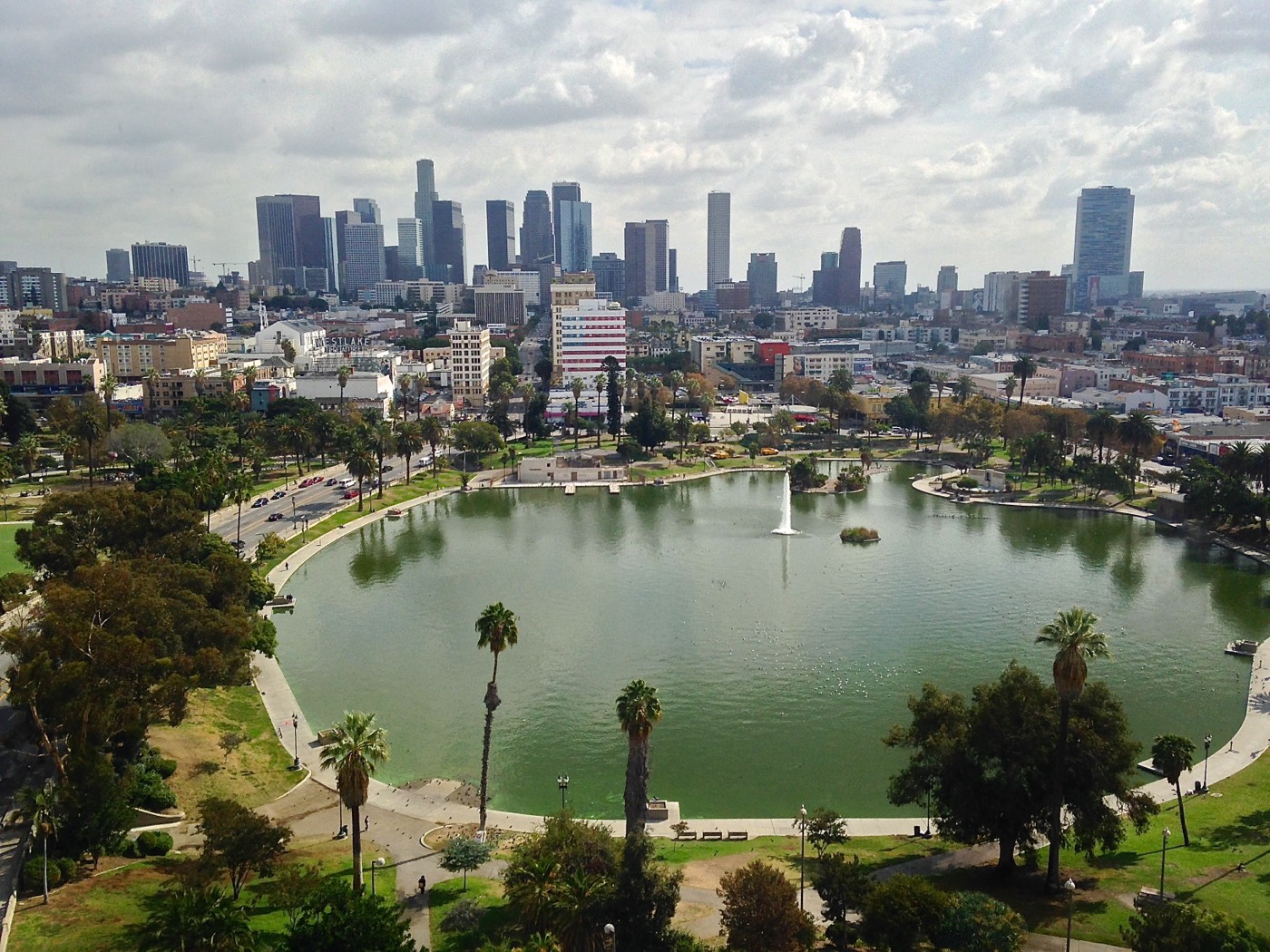
On any evening after five o’clock, the corner of Sixth Street and Bonnie Brae in Westlake fills with the smell of banana leaves steaming over portable burners. The vendors are Guatemalans in Los Angeles, many of them Maya, selling paches and rice tamales the way their mothers did in the highlands. A few blocks east, MacArthur Park’s lake catches the last of the light, and the downtown towers rise behind it. This is the heart of the largest Guatemalan community anywhere outside Guatemala.
The Place
Westlake and the adjacent Pico-Union sit just west of downtown Los Angeles, hemmed in by freeways and threaded by Alvarado Street, Sixth Street and Pico Boulevard. They are among the densest neighbourhoods in the western United States, blocks of pre-war apartment buildings, storefront churches and street markets.
MacArthur Park, with its lake and palm-lined walkways, anchors the district. It gave its name to a hit song and, for decades, to a reputation for hard luck. For Central Americans, though, it became something else: a landing place, a meeting ground, the closest thing to a town square.
This is not an affluent neighbourhood. It is a working-class entry point, and that is precisely why it matters. Generations of newcomers have passed through these blocks on their way into American life.
How It Became Guatemalan
The story of Guatemalans in Los Angeles is, more than anything, a story of war and the people who outran it.
The first arrivals
Central Americans began reaching Los Angeles in small numbers in the 1940s. They were a scattering of workers and students, not yet a community. For decades the Guatemalan presence in the city was modest and largely invisible, folded into the broader Latino population of a Mexican-majority city.
That changed with catastrophe at home.
The civil war and the great exodus
Guatemala’s civil war ground on from 1960 until peace accords were signed in 1996. Over those decades, the country’s military dictatorships waged a campaign of repression that fell hardest on the indigenous Maya highlands. More than 400,000 Guatemalans fled the country, the vast majority during the 1980s, when the violence reached its peak.
Many of them came north. Between 1980 and 1990 the Guatemalan population of Greater Los Angeles increased almost fivefold. By the 1990 census, roughly 159,000 Guatemalans lived in the metropolitan area, and they had concentrated, with the Salvadorans of MacArthur Park fleeing a parallel war, in Westlake and Pico-Union.
The pull factors were ordinary and powerful. Rents were low. The apartments were close to the garment factories and downtown service jobs that would take undocumented hands. And kinship did the rest: one cousin’s couch became a household, one household became a building, one building became a corridor of paisanos who spoke the same dialect and shopped at the same shops.
A Maya city within the city
What made the Guatemalan arrival distinct was who, exactly, was arriving. A large share were not Spanish-speaking ladinos but indigenous Maya, fleeing the army’s scorched-earth campaigns against highland villages. They spoke K’iche’, Mam, Kaqchikel and, in great numbers, Q’anjob’al.
The Q’anjob’al came in particular from the highland municipalities of Santa Eulalia, San Pedro Soloma and Santa Cruz Barillas in the department of Huehuetenango. They rebuilt their hometown ties in Los Angeles, holding the saint’s-day fiestas of their villages on Westlake sidewalks and in rented halls.
Scholars have described what emerged as a genuinely transnational community, with families living, in a sense, in two places at once. A man might spend his working week in a Los Angeles kitchen and remain, in identity and obligation, a citizen of Santa Eulalia.
Building institutions
Community organising followed the people. IXIM, named for the word for corn in most Mayan languages, was founded in 1986 as one of the first Maya organisations in the city. Maya Vision came later, established in 1998 by Mayan refugees to organise a displaced and multi-lingual community across the thirteen or more Maya groups represented in Los Angeles.
These groups did the unglamorous work of survival: interpreting at hospitals and courthouses for people whose first language was neither English nor Spanish, helping with asylum claims, keeping ceremonies alive. A younger collective, La Comunidad Ixim, has carried that identity into a second, US-raised generation. It is a pattern of immigrant institution-building familiar from the Cambodians of Modesto and the Cambodians of Stockton, other refugee communities who rebuilt homeland ties in California’s interior.
By the early 1990s, Guatemalans made up roughly 16 per cent of the local Latino population in the Westlake-Pico-Union area, no longer invisible but a defining presence on its commercial streets.
The Landmarks
MacArthur Park, 2230 West 6th Street. The lake and its surrounding lawns have served as the unofficial centre of Central American Los Angeles for forty years. It is where families picnic on Sundays, where vendors gather, and where the proposed Central American cultural district would anchor its gateways.
The Sixth and Bonnie Brae night market, Westlake. Each evening after five, Guatemalan cooks set up on the northeast corner selling tamales de arroz, paches of mashed potato, and pork and chicken tamales wrapped in banana leaves, sauced with tomato recados. Plates run a few dollars. It is the closest thing the community has to a highland market square.
Mi Cocinita Chapina, 1325 Venice Boulevard, Pico-Union. A neighbourhood kitchen known for the desayuno típico, the classic Guatemalan breakfast of eggs, black beans, fried plantains and queso fresco, alongside carne guisada beef stew. It is the sort of sit-down room where homesick diners order what their grandmothers cooked.
Amalia’s Restaurant, 4210 Beverly Boulevard. Just east of Westlake toward Koreatown, Amalia’s has long served Guatemalan seafood including sopa de mariscos thick with fish, shrimp, crab and mussels, a reminder that Guatemala has two coasts as well as its mountains.
Shucos LA, 753 East Jefferson Boulevard. Named for the shuco, the beloved Guatemalan street hot dog loaded with grilled meats, guacamole and shredded cabbage, this spot carries a piece of Guatemala City sidewalk culture into South Los Angeles. A second location operates in nearby Commerce.
El Sabor Auténtico de Xela, 21818 Devonshire Street, Chatsworth. Out in the San Fernando Valley, where Guatemalan families have spread from the old core, this restaurant is named for Xela, the highland city of Quetzaltenango, and is known for pepián, the rich, toasted-seed stew often called Guatemala’s national dish.
Puchica Guatemalan Bar & Grill, 4523 Sepulveda Boulevard, Sherman Oaks. A newer, more polished room serving tapado, the coconut-milk seafood stew of Guatemala’s Garífuna Caribbean coast, evidence that the cuisine is moving from the margins toward the mainstream of Los Angeles dining.
Where They Came From
Guatemalan Los Angeles is not from one place. It is from many, and that variety is the point.
A large stream came from the western highlands of Huehuetenango, El Quiché and Quetzaltenango, the Maya departments hit hardest by the war. From there came the Q’anjob’al of Santa Eulalia and Soloma, the K’iche’ and the Mam, people for whom Spanish itself was a second language learned on the journey north.
Others came from Guatemala City and the ladino lowlands, drawn less by terror than by the slow erosion of an economy that offered the young little future. After the 1996 peace accords, the character of migration shifted from political refugee to economic migrant, but the chain, once forged, kept pulling.
What knit them together in Los Angeles was the neighbourhood itself. In Westlake, a K’iche’ speaker from the mountains and a Spanish-speaking clerk from the capital became, for the first time, simply Guatemalans, paisanos in a foreign city.
Los Angeles Today
Los Angeles County is now home to roughly 280,000 people of Guatemalan origin, the largest Guatemalan population of any county in the United States and the largest concentration of Guatemalans anywhere outside Guatemala itself.
The community has spread far beyond its first blocks, into the San Fernando Valley, South Los Angeles and the suburbs, following work and cheaper rents. Guatemalan food has spread with it. Dishes once confined to a few Westlake counters, pepián, garnachas, tapado, shucos, now appear across the county, written up in the same food press that once ignored them.
The old core endures, and it is being recognised. In October 2024, Los Angeles councilmembers Eunisses Hernandez and Hugo Soto-Martinez introduced a motion to designate a Central American cultural district across Westlake, Pico-Union and parts of central Los Angeles, with ceremonial gateways planned near Alvarado Street and at Pico and Vermont. It would put official signage on a presence that has been real for forty years.
Westlake remains poor, crowded and contested by the pressures of a changing city. But on the corner of Sixth and Bonnie Brae, the burners are still lit, the banana leaves still steam, and the highlands of Guatemala still feel, for a moment, close at hand.
Frequently Asked Questions
Where do the Guatemalans in Los Angeles mainly live?
The historic centre of the Guatemalan community in Los Angeles is the Westlake and Pico-Union district just west of downtown, around MacArthur Park. From there, Guatemalan families have spread into the San Fernando Valley, South Los Angeles and the wider county.
Why did so many Guatemalans settle in Los Angeles?
Most arrived fleeing Guatemala’s civil war, which ran from 1960 to 1996 and fell hardest on the indigenous Maya highlands. Los Angeles offered cheap housing in Westlake, downtown jobs, and existing networks of relatives and neighbours from the same towns.
How many Guatemalans live in Los Angeles?
Los Angeles County is home to roughly 280,000 people of Guatemalan origin, according to recent U.S. Census estimates. That makes it the largest Guatemalan community of any county in the United States and the largest outside Guatemala itself.
What makes the Guatemalan community in Los Angeles distinctive?
A large share of the Guatemalans in Los Angeles are indigenous Maya, including many Q’anjob’al speakers from Huehuetenango. They have rebuilt highland village ties through organisations such as IXIM and Maya Vision and through hometown fiestas held on Westlake streets.
Where can you eat Guatemalan food in Los Angeles?
The street vendors at Sixth Street and Bonnie Brae in Westlake serve tamales and paches each evening. Sit-down options include Mi Cocinita Chapina in Pico-Union, Amalia’s near Koreatown, Shucos LA in South Los Angeles and El Sabor Auténtico de Xela in Chatsworth.
Is there an official Guatemalan or Central American district in Los Angeles?
In October 2024, Los Angeles councilmembers introduced a motion to designate a Central American cultural district covering Westlake, Pico-Union and parts of central Los Angeles, with ceremonial gateways planned near Alvarado Street and at Pico and Vermont. It would formally recognise a community that has shaped these blocks since the 1980s.
If your family’s story passed through Los Angeles, or any of the places Guatemalans have made home in America, Atlas of Home can trace that journey. From a highland village in Huehuetenango to a tamal stand on Bonnie Brae, to wherever you are now. The same threads run through the Guatemalans of Indiantown, Florida and the older European settlements like the Swedes of Kingsburg.