
On a wide lot off Grimes Avenue in West Modesto, where almond orchards once ran to the edge of town, a Buddhist temple now rises in stages. The Cambodians in Modesto, California built it the way they rebuilt everything else after the Killing Fields: slowly, with what they had, and with the certainty that some things are worth waiting for. The temple is not finished. Neither, in a sense, is the story of how Khmer refugees made a home in the flat heat of the San Joaquin Valley.
The Place
Modesto sits on the Tuolumne River in the northern San Joaquin Valley, about 94 miles southeast of San Francisco. The Central Pacific Railroad laid it out in 1870 and gave it a Spanish name meaning modesty, after a railway director declined to have the town named in his honour.
It grew up as a shipping point for fruit and nuts. Irrigation turned the surrounding flatland into some of the most productive farmland in the country, famous for almonds, walnuts, peaches and grapes. By 2023 the city held roughly 218,000 people, anchoring a metropolitan area of more than half a million.
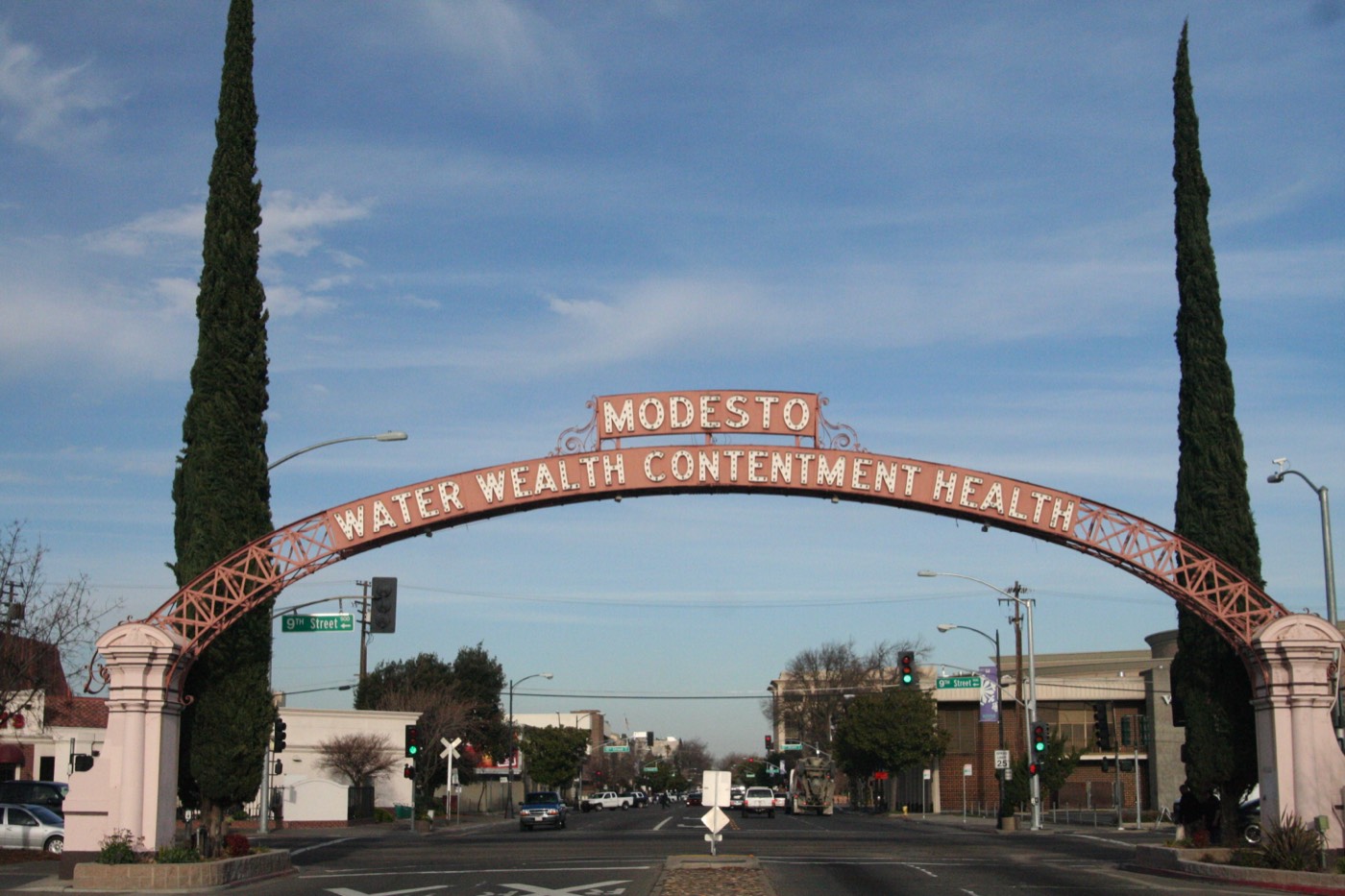
Downtown, at 9th and I Streets, the Modesto Arch still spells out the motto chosen in a 1911 contest: Water, Wealth, Contentment, Health. It is a farm town’s promise, and for a community that arrived with none of those things, it became something to work toward.
How It Became Cambodian
Modesto was never a wealthy place, and the Cambodians who came did not arrive chasing prosperity. They arrived because they had survived something that left them nowhere else to be.
The Killing Fields, and what came after
Between 1975 and 1979 the Khmer Rouge emptied Cambodia’s cities and turned the country into a forced labour camp. Somewhere between 1.5 and 2 million people died of execution, starvation and disease. The regime’s stated goal was a rural agrarian society sealed off from the modern world, and ordinary Cambodians paid for that fantasy with their families.
When the regime fell in 1979, survivors walked toward Thailand. They moved through a chain of border camps, the largest of them Khao-I-Dang, where international agencies registered some 160,000 refugees. Families waited there for months and years for a country to take them in.
The Refugee Act and the road to California
The Refugee Act of 1980 opened the door. Cambodians admitted from the Thai camps were scattered by resettlement agencies across dozens of American cities, often placed wherever a church or a sponsor could be found. Many landed first in cold, distant places with no Khmer neighbours and no familiar food.
What followed was a quiet second migration. Families who had been settled in the snow drifted toward California, and a striking number kept moving until they reached the Central Valley. The reason was plainer than policy. The flat, irrigated farmland of the San Joaquin Valley looked and worked like the rice country many of them had left behind.
Why the valley, and why Modesto
Stockton, an hour north, became the gravitational centre. It now holds the fifth-largest Cambodian population in the United States, and its temples and associations drew relatives and friends into the surrounding towns. Modesto, just down Highway 99, caught the overflow and then kept its own.
Southeast Asian refugees began putting down roots in Modesto in the early 1980s. Most came from rural backgrounds, with little English and skills that did not match an American labour market. The early years were hard: working poverty, high welfare dependence, and the slow grind of learning a new country from the bottom.
What held people in place was not opportunity so much as proximity. The valley offered farm and cannery work that did not require fluent English, cheap housing on the west side of town, and above all the presence of other Khmer families. Today around 4,000 Cambodians live in Stanislaus County, most of them Buddhist, and most of them with a connection to Modesto.
The community organised around the things refugees always organise around first: a place to pray, a place to buy fish sauce and lemongrass, and a calendar that still ran on the Khmer year. Those three needs built the neighbourhood you can drive through today.
The Landmarks
Modesto Cambodian Buddhist Society (Wat Khmer Modesto), 1528 and 1538 Grimes Avenue. The spiritual centre of Khmer Modesto sits on a 12.25-acre parcel on the city’s west side. The society, which took its current name in 2003, moved here in June 2008 from a cramped residential lot under an acre on Paradise Road. The full temple, with worship hall, monks’ residences, a school building, an athletic field and a meditation garden, is being built in stages as funds allow, a monument rising at the speed the community can afford.
The temple’s classical dance troupe, Grimes Avenue. With the society’s support, the Cambodian classical dance troupe grew from six beginners into roughly 40 trained dancers. In 2013 the society became a grantee of the Alliance for California Traditional Arts, receiving operating support and training over three years. The dancers carry an art form the Khmer Rouge nearly extinguished, and they perform it for children born in California who have never seen Cambodia.
Phnom Penh Market, 637 Paradise Road. Named for the capital so many families fled, this Cambodian grocer sits near the old temple site on Paradise Road and stocks the produce, sauces and dried goods that home cooking depends on. For a community whose food rarely appears on a restaurant menu, the market is where the cuisine actually survives.
Asian Market, 2425 McHenry Avenue. Thanh and Nai Vuong opened the original Asian Market in 1985 on Carver Road, one of the first Southeast Asian grocers to serve the refugees arriving in those years. Four decades on, the McHenry Avenue store still carries sacks of rice, fresh seafood and the seasonings of half a dozen Asian kitchens. It is a fixture of the immigrant generation’s everyday life.
West Modesto. The historically working-class district west of Highway 99 became the heart of Khmer settlement, the part of the city where housing was affordable and a refugee family could afford a first roof. The temple, the markets and many of the families cluster here, and the neighbourhood remains the geographic anchor of the community.
Cambodian New Year at the temple, mid-April. Each spring the Grimes Avenue temple grounds fill for Choul Chnam Thmey, the Khmer New Year, with traditional music, food and the dance troupe in costume. It is the one weekend a year when the half-built temple is unmistakably finished in spirit, if not in concrete.
The Modesto Arch, 9th and I Streets. Built in 1912 for 1,200 dollars and lit by nearly 700 bulbs, the downtown arch is not a Cambodian landmark at all. But its motto, Water, Wealth, Contentment, Health, names exactly what refugees from a drowned country came looking for, and what the second generation has largely found.
Where They Came From
The Cambodians of Modesto did not come from a single province, but the centre of gravity lies in the country’s rice belt. Many trace their families to Battambang, Cambodia’s agricultural heartland near the Thai border, and to the villages around Phnom Penh that the Khmer Rouge emptied in 1975.
They were, before the war, farmers and townspeople: people who knew flooded paddies, dry-season heat and the rhythm of a harvest. That background is exactly why the San Joaquin Valley felt liveable. The work was different, almonds rather than rice, but the land and the labour were legible in a way that a northern city never could be.
Almost none came directly. The path ran through the Thai border camps and a first American placement somewhere else, and only then to Modesto, drawn by relatives and by the older, larger Khmer community in nearby Stockton.
That same pattern of refugees settling where the farmland felt familiar shaped other valley communities, including the Hmong in Sacramento, California, who came out of Laos under similar circumstances and for similar reasons.
Modesto Today
The community that started in working poverty has, in the span of one generation, produced nurses, business owners and civic leaders. When fighting flared on the Cambodia-Thailand border in recent years, it was a Modesto nurse, Vunmara Kong, who organised a fundraiser for displaced families back home, raising thousands of dollars from valley Khmer who had never forgotten where they came from.
That instinct runs through a web of organisations across the valley. Groups such as the United Cambodian American Network, led by Sophy Reese, who was born in a refugee camp and arrived in the United States at age three in 1984, alongside the Khmer Aid Foundation and Khmer Harmony and Heritage, knit together a community that spans Modesto, Stockton and the towns between. Many of their leaders are the children of genocide survivors, raised on stories their parents could barely tell.
The work is not finished, and neither is the temple. Funding still comes a little at a time, and the elders who carry the memory of Cambodia are ageing out. The younger generation speaks English first and Khmer second, and the question of how much of the old country survives the move to the valley is an open one, asked quietly at every New Year.
But the answer, so far, is more than anyone in those Thai camps could have hoped. Forty dancers where there were six. A market where there was nothing. A temple, half-built, on twelve acres of valley land. Water, wealth, contentment, health: the old arch downtown was promising those things to farmers in 1912, and it turns out it meant them for refugees too.
Frequently Asked Questions
How many Cambodians live in Modesto?
Around 4,000 Cambodians live in Stanislaus County, most of them in and around Modesto, and most practising Buddhism. The wider Asian population of the city is about 7.7 percent. The Cambodians in Modesto, California are concentrated on the west side of town, near the temple and markets on Grimes Avenue and Paradise Road.
Why did Cambodian refugees settle in California’s Central Valley?
Most Cambodians in Modesto arrived in the early 1980s as refugees of the Khmer Rouge genocide, admitted under the Refugee Act of 1980 after years in Thai border camps. Many were first placed in colder, distant American cities and then moved west. The Central Valley’s flat, irrigated farmland resembled the rice country they had left, and farm and cannery work did not require fluent English.
Is there a Cambodian Buddhist temple in Modesto?
Yes. The Modesto Cambodian Buddhist Society, also known as Wat Khmer Modesto, occupies a 12.25-acre site at 1528 and 1538 Grimes Avenue in West Modesto. The society moved there in 2008 and is building the full temple complex in stages. It hosts Cambodian New Year each April and supports a classical Khmer dance troupe.
Where can you find Cambodian food and groceries in Modesto?
Phnom Penh Market at 637 Paradise Road is a Cambodian grocer stocking produce, sauces and dried goods for Khmer home cooking. The long-running Asian Market, opened in 1985 and now at 2425 McHenry Avenue, carries rice, seafood and seasonings for several Asian cuisines and has served the refugee community since its earliest years.
How is Modesto’s Cambodian community connected to Stockton?
The two are closely linked. Stockton, an hour north on Highway 99, holds the fifth-largest Cambodian population in the United States, and its temples and associations drew relatives into the surrounding towns, including Modesto. You can read more about the larger community in Cambodians in Stockton, California.
What other US cities have large Cambodian communities?
Beyond the Central Valley, the biggest Khmer communities in America are in Long Beach, California, and in the old mill cities of Massachusetts. See Cambodians in Long Beach, California, Cambodians in Lowell, Massachusetts, and Cambodians in Lynn, Massachusetts.
If your family’s story passed through Modesto, or any of the places Cambodians have made home in America, Atlas of Home can trace that journey. From the rice fields of Battambang and the camps along the Thai border, to a half-built temple on Grimes Avenue, to wherever you are now.