
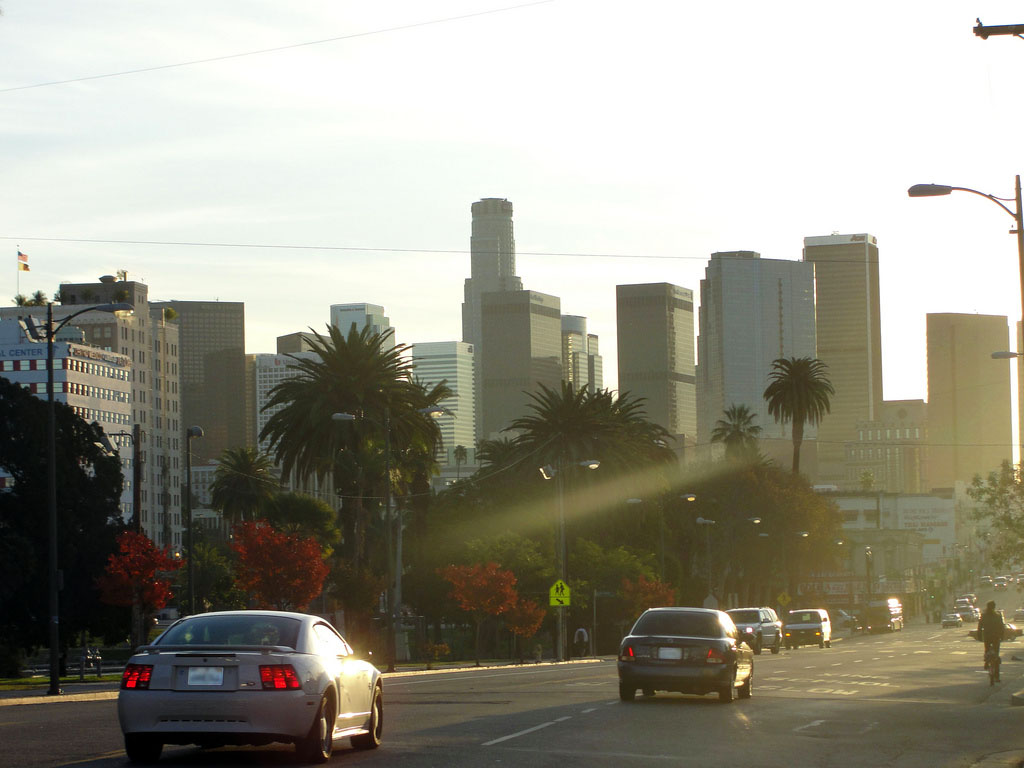
Saturday morning at Alvarado and 7th, the comales come out before the city is fully awake. Hands press masa into discs, slip in cheese and beans and chicharrón and the herbal green of loroco, then slap them onto hot steel until the edges brown.
A block north, the portrait of Archbishop Óscar Romero looks out from a parish window over the lake. On Vermont Avenue, the El Salvador Community Corridor sign rises off the freeway exit. This is the largest Salvadoran community outside El Salvador, and has been for forty years.
They call it Little San Salvador. You will not find that on any Metro map. Step off the Red Line at Westlake / MacArthur Park, walk west toward Vermont, and you are in a city that begins in San Miguel and ends a few blocks past Wilshire Boulevard.
MacArthur Park, The Place
MacArthur Park sits a mile west of downtown Los Angeles, inside the larger neighbourhood of Westlake. The park is a green strip cut in two by Wilshire Boulevard, with a spring-fed lake on the southern side and soccer fields on the northern side.
The Westlake / MacArthur Park Metro station, opened in 1993, serves the Red and Purple lines and brings tens of thousands of riders a day to Alvarado and Wilshire. South and west of the park, the Salvadoran storefronts thicken: pupuserías, panaderías, money-transfer windows, dental clinics with hand-painted signs.
How MacArthur Park Became Salvadoran
Before the Salvadorans
For its first half-century, MacArthur Park belonged to a different Los Angeles. The park was created in the 1880s out of a former city dump, originally called Westlake Park. By the early 20th century the surrounding streets were known as the Champs-Élysées of Los Angeles, lined with grand hotels and the homes of railroad money.
Then came the Jewish families. From the 1920s through the 1950s, Westlake was one of the centres of Jewish Los Angeles. Al Langer founded Langer’s Delicatessen on Alvarado in 1947, in a neighbourhood still half-Yiddish-speaking on a Sunday morning. On 7 May 1942, Westlake Park was renamed for General Douglas MacArthur, a piece of wartime branding pushed by William Randolph Hearst to vault the general toward the presidency.
The Jewish community largely moved west to Fairfax and Pico-Robertson after the war. Mexican families took their place through the 1950s and 1960s. By the 1970s Westlake was a working-class Mexican-American neighbourhood with a Central American minority that still numbered in the low thousands.
The Salvadorans Arrive
That changed almost overnight. The Salvadoran Civil War began in 1979 and lasted until the peace accords of January 1992. It killed roughly 75,000 people and displaced a quarter of the country. Of the million or so Salvadorans who fled, around half came to the United States, and the largest single share landed in Los Angeles.
They came because Los Angeles already had a small Salvadoran presence. From World War I onward, Salvadorans had followed the coffee shipping lines into the Port of Los Angeles. By 1980 there were perhaps 30,000 Salvadorans in LA County. Within a decade that number had risen tenfold.
Most new arrivals ended up in Westlake and the adjacent Pico-Union neighbourhood. Rooming-house rents were cheap, jobs in garment factories and downtown kitchens were within walking distance, and a Spanish-speaking refugee could disappear into the crowd.
The legal welcome was thin. The Reagan administration backed the Salvadoran government in the civil war and refused to classify the people fleeing it as refugees. Conceding refugee status would have meant admitting the regime was killing its own citizens.
Most Salvadorans who arrived in the 1980s entered without documents. The protection they did receive came piecemeal: a 1990 law granting limited temporary status, the ABC settlement allowing asylum reapplications, and finally, after the catastrophic earthquakes of January and February 2001, a formal Temporary Protected Status designation. TPS has been renewed, threatened, and renewed again under three administrations.
The Central American Resource Center, CARECEN, was founded in Westlake in 1983 by Salvadoran refugees and human rights lawyers. It became the legal and political anchor of the neighbourhood. In 1984, its members went on a 15-day hunger strike outside the federal building downtown to protest the Reagan-era deportations of Salvadorans into an active war.
MacArthur Park at Its Peak
By the early 1990s, the blocks around the park were one of the densest immigrant neighbourhoods in the United States. Westlake’s density passed 38,000 people per square mile, comparable to parts of Manhattan, in a city otherwise built for cars.
The commercial life was almost entirely Central American by then. Pupuserías opened on Alvarado, on 7th Street, on Vermont. Botánicas sold candles printed with the face of Archbishop Romero next to ones marked San Judas Tadeo. Travel agencies ran Friday-night couriers carrying envelopes of cash to families in Sonsonate, Santa Ana, San Vicente, La Unión.
The street vendors, mostly Salvadoran and Guatemalan women, set up tarps along the perimeter of the park and around the Metro station. They sold sliced fruit with chile, atol de elote, pupusas off propane griddles. They were operating informally, largely outside the permitting system, which would matter later.
The park itself was contested ground. After 1985 it filled with drugs and prostitution, and as many as thirty murders happened in or near it in 1990 alone. The lake was drained that year for Red Line tunnel construction beneath Wilshire; when it was refilled in 1993, stolen handguns came up from the bottom.
And in those same years, the mara that would become the most-feared name in the neighbourhood was being assembled inside it. Mara Salvatrucha, MS-13, began in the late 1970s and early 1980s as a small group of Salvadoran teenagers in Pico-Union and Westlake. Many had fled the war with their families. Some had been combatants or children of combatants.
They were not accepted by the older Mexican-American gangs of central LA, and formed their own crew partly for protection. By the late 1980s, MS-13 had become a violent street gang, and soon a multinational one. United States deportation policy in the 1990s sent thousands of members back to a postwar El Salvador that had no capacity to absorb them, where the gang mutated and rebounded transnationally.
That strand of the neighbourhood’s history deserves to be told honestly. It has also too often been used to flatten a community of teachers, cleaners, cooks, deacons, and garment workers into a single sensational headline. The vast majority of LA County’s half-million Salvadorans had nothing to do with any of it.
The Change
The 1992 peace accords ended the war but not the migration. Most Salvadorans in MacArthur Park stayed. They raised US-citizen children, bought small businesses, and sent the remittances that today make up nearly a quarter of El Salvador’s economy.
What did change was the surrounding city. From the mid-2000s, downtown Los Angeles began a slow revival, then Koreatown to the west exploded with new bars and restaurants. By the late 2010s, the rent pressure on Westlake had become severe.
Salvadoran families began dispersing: to the southern parts of LA, to the San Fernando Valley, out to the Inland Empire. Around half a million Salvadoran-Americans now live in greater Los Angeles, but only a fraction within walking distance of the park.
Then came January 2025. After a mass shooting near the lake, the city installed fencing along Alvarado Street and around the Metro station, displacing dozens of long-established street vendors. The fences were still up months later. For many longtime residents, it felt like the latest in a sequence of decisions that treat the neighbourhood as a problem to manage rather than a community to support.
The Landmarks of Salvadoran MacArthur Park
The Monsignor Óscar A. Romero Plaza, MacArthur Park (Wilshire side). A 6.5-foot bronze statue of the assassinated archbishop, made in El Salvador by sculptor Joaquin Serrano and installed in November 2013. The plaza is ringed with volcanic rock, a reference to the volcanoes of El Salvador, and the benches carry quotations from Romero’s homilies. When Pope Francis canonised Romero in October 2018, Salvadorans placed candles and roses at the base of the statue.
El Salvador Community Corridor, Vermont Avenue between Adams Boulevard and Wilshire. Officially designated in 2012 by the California Legislature through Assembly Concurrent Resolution 126, this stretch of Vermont was the first Salvadoran-named district in Los Angeles. More than 150 Salvadoran restaurants, panaderías, agencies, and shops fall inside it. In 2019, the community raised funds for the brown freeway-exit signs reading “El Salvador Community Corridor” off the 10.
CARECEN, 2845 West 7th Street. Founded in 1983 by Salvadoran refugees and immigration lawyers, the Central American Resource Center has been the legal and political home of the neighbourhood for forty years. CARECEN runs immigration clinics, day-labourer organising, TPS renewal drives, and youth programs. It has been the institution most responsible for translating war-displacement into US immigration policy.
Langer’s Delicatessen, 704 South Alvarado Street. Not Salvadoran, but central to how this neighbourhood layers. Founded in 1947 by Al Langer when MacArthur Park was Jewish, Langer’s has refused to move through every demographic turn since. Its #19 pastrami sandwich is still served by the same family, three generations on, in the middle of the largest Salvadoran neighbourhood in the United States.
Mama’s Hot Tamales Café (closed 2011), 2124 West 7th Street. Founded in 2001 by the community organiser Sandi “Mama” Romero with the Episcopal Diocese of Los Angeles, Mama’s was a café that doubled as a training kitchen for the Central American women selling tamales and pupusas on the sidewalks around the park. Romero mentored hundreds of vendors through the health-code maze before closing at the end of 2011. The replacement is informal: every block has its own Mama’s now.
Sarita’s Pupusería, Grand Central Market, 317 South Broadway. A short walk east of MacArthur Park, Sara Clark opened Sarita’s in Grand Central Market in 1998. She had arrived from El Salvador during the war, worked as an employee in another stall, and eventually bought the space on installment. Sarita’s is now in its third decade, with the menu still anchored on hand-pressed pupusas of loroco, revueltas, and frijol con queso.
The Westlake / MacArthur Park Metro Station, Alvarado and Wilshire. Opened in 1993, the station is the front door of the neighbourhood. For a generation of Salvadoran arrivals it was the first piece of LA they saw after a Greyhound from the border. The plaza above carried the densest street-vending economy in the city until the 2025 fencing.
Where the LA Salvadorans Came From
El Salvador is a small country, about the size of New Jersey, divided into fourteen departments. The Salvadorans of MacArthur Park came from all of them, but certain regions sent disproportionately many.
The capital, San Salvador, sent professionals, students, and political refugees who fled the death-squad period of 1979 to 1983. The eastern departments of San Miguel, La Unión, and Usulután sent farmworkers and rural families whose villages were emptied by the army’s counter-insurgency campaigns.
The northern department of Chalatenango, the site of some of the heaviest fighting, sent entire extended families. The western coffee departments of Santa Ana and Sonsonate sent agricultural workers whose harvests collapsed when the war disrupted the picking seasons.
Chain migration did the rest. One cousin in Pico-Union pulled the next across, then a sister, then a parent, then a neighbour. By the mid-1990s, certain villages had more of their population in Los Angeles than at home. Remittances paid for rebuilt houses, school fees, baptisms, and funerals four thousand kilometres south.
MacArthur Park Today
MacArthur Park in 2026 is no longer the dense Salvadoran enclave it was in 1995, but it is not gone, either. The El Salvador Community Corridor still runs the length of Vermont. The Romero statue still stands by the lake. On a Sunday morning the comales still come out before the city is fully awake.
What has changed is the geography. The community is no longer concentrated in a few square blocks. Salvadoran families have spread south to Huntington Park and South Gate, north into the San Fernando Valley, east into the Inland Empire. The Salvadoran imprint is now metropolitan, not neighbourhood.
And the neighbourhood itself has layered again. Mexican families remained through every wave. Guatemalan and Honduran families arrived alongside the Salvadorans and stayed. More recent arrivals from Oaxaca, from the Quiché highlands, and from Venezuela have moved into the same rooming houses that took in war refugees forty years ago. The pupusería griddle keeps going.
Frequently Asked Questions
Why did Salvadorans settle in MacArthur Park?
Salvadorans settled in MacArthur Park and the adjacent Pico-Union neighbourhood during the 1980s because the area offered cheap rooming-house rents, walking-distance jobs in downtown garment factories and kitchens, an existing small Salvadoran community that dated to the 1920s, and the anonymity that mattered for refugees entering the United States without documents during the Salvadoran Civil War.
Is MacArthur Park still Salvadoran today?
MacArthur Park is still a Salvadoran cultural and commercial centre, with the El Salvador Community Corridor on Vermont Avenue, the Óscar Romero statue in the park, and dozens of pupuserías and panaderías. But many Salvadoran families have dispersed to South LA, the San Fernando Valley, and the Inland Empire under gentrification pressure since the 2010s. The Salvadoran population of greater Los Angeles remains the largest in the United States.
What are the most famous Salvadoran landmarks in MacArthur Park?
The most famous Salvadoran landmarks in MacArthur Park are the Óscar Romero Plaza and statue inside the park, the El Salvador Community Corridor along Vermont Avenue between Adams and Wilshire, and CARECEN (the Central American Resource Center) on West 7th Street, founded by Salvadoran refugees in 1983.
Where in El Salvador did the MacArthur Park Salvadorans come from?
The Salvadorans of MacArthur Park came from across El Salvador, but disproportionately from the capital San Salvador, the eastern departments of San Miguel, La Unión, and Usulután, the war-torn northern department of Chalatenango, and the western coffee regions of Santa Ana and Sonsonate. Most arrived as refugees of the Salvadoran Civil War of 1979 to 1992.
When did Salvadorans first arrive in MacArthur Park?
A small Salvadoran community has existed in central Los Angeles since the years after World War I, when shipping lines brought coffee workers to the Port of Los Angeles. The mass arrival came in the 1980s during the Salvadoran Civil War, when about half a million Salvadorans fled to the United States and the largest share of them settled in the Westlake and Pico-Union neighbourhoods around MacArthur Park.
If your family’s story passed through MacArthur Park, or anywhere the Salvadoran community made a home, Atlas of Home can trace that journey. From Sonsonate, San Miguel, or Chalatenango, to Alvarado Street, to wherever you are now.