
For about forty years, if you walked the lower blocks of the French Quarter you could close your eyes and believe you were in Palermo. The Italians in New Orleans, almost all of them Sicilian, ran the corner groceries, hauled the fruit off the steamships at the wharves, and filled the pews of St Mary’s for Mass said in their own language. The neighbourhood even earned a nickname: Little Palermo.
The Place
New Orleans is the old Creole capital of the Gulf South, a port city wrapped in a bend of the Mississippi River where French, Spanish, African and Caribbean cultures collided long before any Italian arrived. The French Quarter, the original colonial grid laid out in 1718, sits at its heart, a dense neighbourhood of shotgun cottages, courtyards and balconies that today draws millions of visitors a year.
But the Quarter was not always a tourist district. For decades it was a working immigrant slum, cheap and crowded, the kind of place a newcomer with little money could find a room and a job. By the early twentieth century the people filling those rooms were overwhelmingly Sicilian.
The lower Quarter, the blocks nearest the French Market and the river docks, became their world. That is where this story is anchored.
How It Became Italian
The lemon boats, 1830s onward
The first Italians came to New Orleans on the lemons. Sicily exported citrus, and from the 1830s a trade route ran between Palermo and the port of New Orleans, the only place in the United States with direct, regular sailings to the island. The story of that Sicilian migration to New Orleans is unlike that of any other American city. Crews and small merchants drifted in with the cargo, and a handful stayed.
This was a trickle, not a flood. Before the Civil War the Italian presence in the city was modest, though substantial enough that a mutual aid society, the Societa Italiana di Mutua Beneficenza, was organised as early as 1843.
The Sicilian surge, 1884 to 1924
The real wave began in the 1880s. Sicily in those decades was wracked by poverty, failing harvests and political upheaval, and the established shipping line to New Orleans made the Crescent City a natural destination. By September 1881 three steamships a month were running between New Orleans and Sicily, with passage advertised at forty dollars a head.
Between roughly 1884 and 1924, an estimated 290,000 Italian immigrants, the overwhelming majority of them Sicilian, came through the port of New Orleans. Not all stayed, but enough did to transform the lower Quarter. The 1910 census recorded that the French Quarter was around 80 per cent people of Italian descent.
Fruit, groceries and the docks
The newcomers built their living around food and the river. They dominated the fruit trade, working the stalls of the French Market and the Poydras Market, unloading produce at the wharves, and importing bananas and other fruit from Central America. The Vaccaro brothers, Sicilian immigrants, founded what became Standard Fruit, one of the great banana companies of the Americas.
At street level the community was built on the corner grocery. Sicilian families opened so many small mom-and-pop groceries across the Quarter that the type became a New Orleans institution. One of them, opened by Salvatore Lupo in 1906, would give the city one of its signature dishes.
The lynching of 1891
Prosperity did not buy acceptance. In October 1890 the city’s police chief, David Hennessy, was assassinated, and suspicion fell immediately on the Sicilians. A group of Italian men were arrested and tried, and when the trials ended in acquittals and mistrials, the response was murder.
On 14 March 1891 a mob of thousands stormed the Old Parish Prison and killed eleven Italian men. Among the dead were fruit peddlers Antonio Bagnetto, Antonio Marchesi and Antonio Scaffidi, the cobbler Pietro Monasterio, and the fruit importer Joseph Macheca. It was the largest mass lynching in American history, and it triggered a diplomatic crisis that briefly severed relations between Italy and the United States.
The episode is also remembered as one of the first times the word “mafia” appeared in American print, a slander that would shadow the community for generations. In 2019 the mayor of New Orleans issued a formal apology to the city’s Italian Americans for the killings.
From the Quarter to the suburbs
As families found their footing they did what immigrant communities everywhere do. They moved up and out. Through the mid twentieth century, Italian American households left the cramped lower Quarter for Mid-City, the lakefront, and the suburbs of Jefferson Parish and the North Shore.
The concentration dissolved, but the institutions and the memory did not. By the time the Quarter had become a tourist quarter rather than a Sicilian one, the city’s Italian heritage had spread into every corner of metropolitan New Orleans. Theirs was one of several immigrant currents that reshaped the lower Mississippi delta, alongside the Islenos in St Bernard Parish and the Cajuns in Lafayette.
The Landmarks
Central Grocery, 923 Decatur Street. Salvatore Lupo, a Sicilian immigrant, opened this Italian grocery in 1906 in the heart of Little Palermo, and here he invented the muffuletta. Farmers and dockworkers would buy a round loaf of muffuletto bread, cold cuts, cheese and olive salad and eat them separately, until Lupo had the idea of stacking everything into one sandwich. Hurricane Ida wrecked the building in 2021; the shop reopened on Decatur Street in December 2024.
St Mary’s Italian Church, 1100 Chartres Street. Built in 1845 within the old Ursuline Convent complex, this chapel became the spiritual home of the Sicilian immigrants in the lower Quarter. It served as the Archdiocese’s official Italian parish, with Mass offered in Italian, and was widely known simply as St Mary’s Italian Church.
Angelo Brocato, 214 North Carrollton Avenue. Angelo Brocato, born in Cefalu and trained as a boy in a Palermo ice cream shop, opened his first parlour on Ursulines Street in the Quarter in 1905. Three generations later the family still makes Sicilian gelato, cannoli and cookies, now from its Mid-City storefront, where it moved in 1978.
The Piazza d’Italia, Lafayette and Commerce Streets. Completed in 1978 to a design by the postmodern architect Charles Moore, this public plaza is an explicit monument to the city’s Italian Americans. Moore inlaid the pavement with a map of Italy centred on Sicily, the island from which most of the city’s Italian families came. After decades of decay it was fully restored by 2004.
American Italian Cultural Center, 537 South Peters Street. Sitting in the Warehouse District beside the Piazza d’Italia, this non-profit centre and museum tells the story of Italian immigration to Louisiana, from arrival to legacy. It holds archives, hosts heritage events, and serves as the institutional anchor for the community’s history.
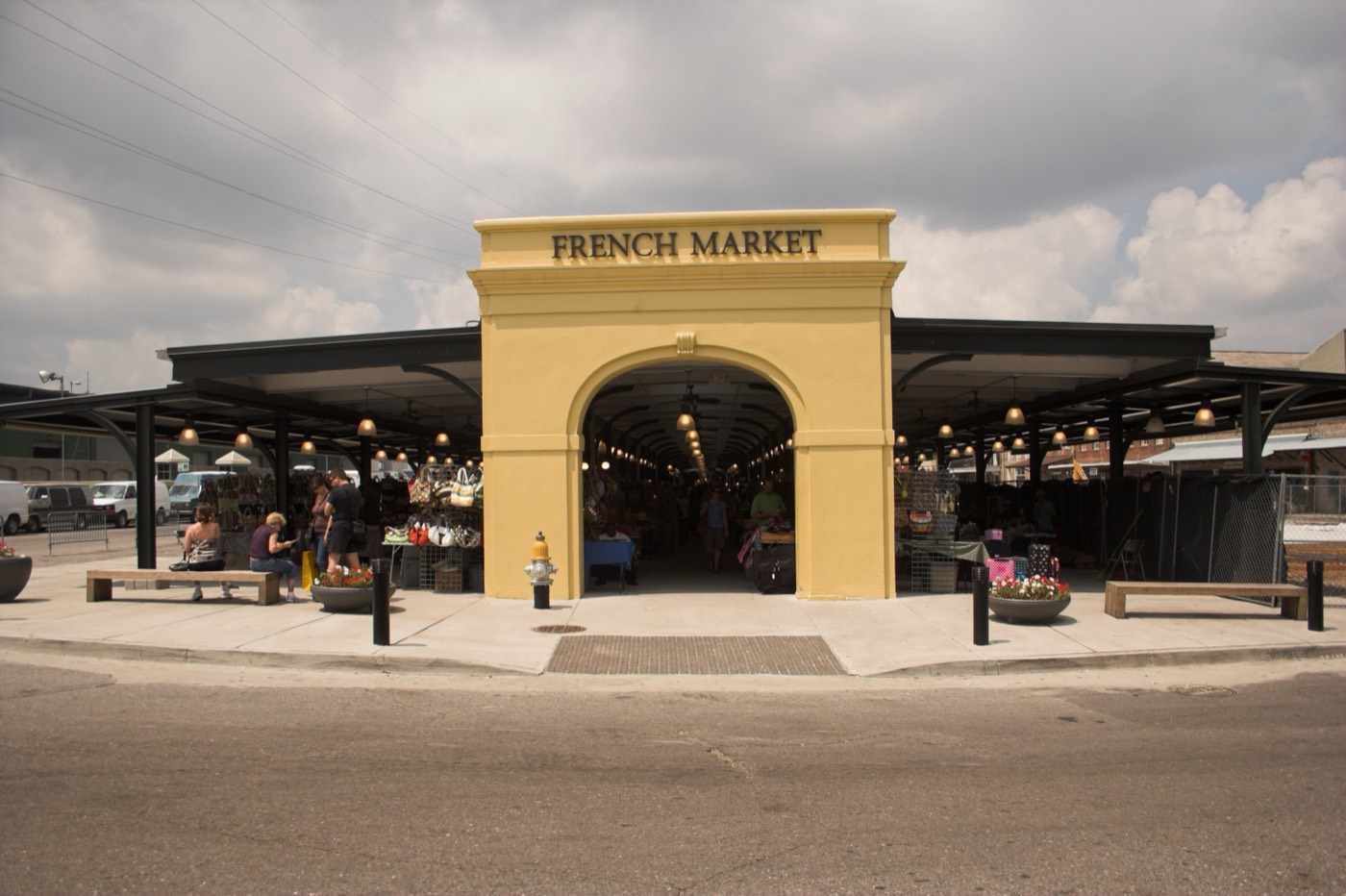
The French Market, along Decatur and North Peters Streets. The Sicilian fruit sellers were so numerous in this old riverfront market that Italian farmers and vendors became one of its defining presences. The stalls here were where many immigrant families earned their first dollars in America, selling produce hauled up from the docks.
St Joseph altars, French Quarter and across the city. Each March, Sicilian families build elaborate three-tiered altars heaped with bread, cookies and fava beans in thanks to St Joseph, a tradition rooted in a medieval Sicilian famine. The custom arrived with the immigrants around the turn of the twentieth century and remains one of the city’s most distinctive religious folk traditions.
Where They Came From
This was a Sicilian migration above all. Cefalu, a small coastal town east of Palermo, sent so many families that a direct line runs from its narrow streets to New Orleans neighbourhoods to this day. The island of Ustica, off the Sicilian coast, sent enough people that its emigrants founded the San Bartolomeo Society in 1879, long among the oldest Italian American societies in the city.
Not everyone who was called Sicilian thought of themselves that way. Families from Contessa Entellina were Arbereshe, descendants of Albanians who had settled in Sicily in the fifteenth century. They kept their Byzantine Catholic rite and their own identity, and in 1886 founded the Societa Italiana di Beneficenza Contessa Entellina in New Orleans, whose membership to this day includes only descendants of that one village.
What pulled them across the Atlantic was the same thing that pulled the lemon boats: the established shipping link. Where most southern Italians sailed to New York, Sicilians had a direct road to Louisiana, and chain migration did the rest, one cousin and one paesano writing home until a whole village had reassembled on the banks of the Mississippi. The same chain-migration pattern shaped the Italians in Niagara Falls, New York and the Italians in Schenectady, New York, where single Italian towns transplanted themselves almost whole.
New Orleans Today
There is no Little Palermo any more. The lower Quarter that was once 80 per cent Italian is now galleries, guesthouses and bars, and people of Italian heritage are spread through Mid-City, Metairie, Kenner and the North Shore rather than concentrated in any one place. Roughly 300,000 people in the metropolitan area identify as being of Italian descent, the largest European ancestry group in the region.
The heritage survives loudest in food and ritual. The muffuletta is on menus across the city, Angelo Brocato still scoops gelato in Mid-City, and Central Grocery reopened its Decatur Street counter in late 2024 after Hurricane Ida. Each March the St Joseph altars rise in churches, halls and homes, and the Italian American St Joseph Society, founded in 1970, parades through the Quarter on the saint’s feast day.
What changed is concentration, not continuity. The community that once crowded a few blocks now stretches across an entire metropolitan area, but it still gathers at the altar table in March and still claims the muffuletta as its own. For a diaspora that arrived on fruit boats and was met with a lynching, that endurance is its own quiet monument. The same Italian thread runs through other communities the Atlas has traced, from the Italians in Springfield, Massachusetts to the Italians in Reading, Pennsylvania.
Frequently Asked Questions
Why are so many Italians in New Orleans Sicilian?
The Italians in New Orleans are overwhelmingly Sicilian because of the lemon and citrus trade, which created a direct shipping route between Palermo and the port of New Orleans from the 1830s. When mass emigration began in the 1880s, that established link made Louisiana the natural destination for Sicilians, while most other southern Italians sailed to New York.
What was Little Palermo?
Little Palermo was the nickname for the lower French Quarter, where Sicilian immigrants concentrated in the late nineteenth and early twentieth centuries. By the 1910 census the Quarter was roughly 80 per cent people of Italian descent, packed with Sicilian groceries, fruit stalls and corner shops.
Where was the muffuletta invented?
The muffuletta was created at Central Grocery, 923 Decatur Street, by the Sicilian immigrant Salvatore Lupo in 1906. He combined the round muffuletto bread, cold cuts, cheese and olive salad that his customers usually bought separately into a single sandwich. Central Grocery reopened in December 2024 after damage from Hurricane Ida.
What happened in the 1891 lynching?
After the 1890 assassination of police chief David Hennessy, blame fell on the city’s Sicilians. When trials ended without convictions, a mob stormed the Old Parish Prison on 14 March 1891 and killed eleven Italian men, the largest mass lynching in American history. New Orleans issued a formal apology in 2019.
What are St Joseph altars?
St Joseph altars are three-tiered displays of bread, cookies, fava beans and other food built each March in thanks to St Joseph. The tradition came to New Orleans with Sicilian immigrants around 1900 and remains one of the city’s most distinctive folk customs, with the altars open to visitors who receive blessed bread and a lucky fava bean.
Where do Italians in New Orleans live now?
There is no longer a single Italian neighbourhood. The Italians in New Orleans dispersed from the French Quarter into Mid-City, Metairie, Kenner and the North Shore through the twentieth century. Around 300,000 people in the metro area now identify as Italian, the largest European ancestry group in the region.
If your family’s story passed through New Orleans, or any of the places Italians have made home in America, Atlas of Home can trace that journey. From a lemon boat out of Palermo to a corner grocery in the lower French Quarter, to wherever you are now.