
The first sound is Spanish, but not the Spanish of New Orleans menus or Miami radio. It is older, slower, salted with words for marsh grass and muskrat pelts that no dictionary records. For more than two centuries, families named Perez, Nunez, Gonzales, and Estopinal have sung it across the bayous southeast of the city, where the land thins into water and the water runs out at a dead end the old people called el fin del mundo, the end of the world.
They are the Islenos in St. Bernard Parish, descendants of poor farmers and fishermen shipped from the Canary Islands in the 1770s to hold Louisiana for the Spanish crown. The empire is long gone. Their language is nearly gone. The people are still here.
St. Bernard Parish: The Place
St. Bernard Parish unrolls southeast of New Orleans along the Mississippi River’s last miles, a flat wedge of cypress swamp, brackish marsh, and open Gulf water. Bayou Terre-aux-Boeufs and Bayou la Loutre thread the lower parish, lined with fishing camps and modest raised houses. The old Spanish settlements cluster along the San Bernardo Byway, with the fishing villages of Delacroix, Reggio, Shell Beach, and Yscloskey strung out toward the coast. A single highway, Louisiana 300, runs down to Delacroix and simply stops at the water.
How St. Bernard Became Los Islenos
Before the Islenos
This was wet, half-made country long before Europeans drew it on a map. The Chitimacha and other Native peoples fished and hunted the marshes, and bands of the Houma later moved through the lower parish. French colonists carved the first plantations along Bayou Terre-aux-Boeufs in the early 1700s, raising cattle and indigo on the natural levees. When Spain took Louisiana from France in 1763, it inherited a thinly held colony with a dangerous frontier and almost no one to defend it.
The Islenos Arrive
The answer came from a chain of volcanic islands off the coast of Africa. Bernardo de Galvez, the energetic young Spanish governor of Louisiana, needed soldiers and settlers who could hold the approaches to New Orleans against the British. Between 1778 and 1783, Spain recruited Canary Islanders, many of them fleeing drought and ruined harvests, and packed them onto ships bound for the Gulf. The first vessel, the Santisimo Sacramento, sailed in July 1778, and others soon followed.
Roughly two thousand of these islenos, literally “islanders,” reached Louisiana. Galvez settled them in four places chosen to guard the city: Galveztown, Barataria, Valenzuela on Bayou Lafourche, and San Bernardo along Bayou Terre-aux-Boeufs. The St. Bernard settlement took shape on land that Galvez’s brother-in-law, Pierre Philippe de Marigny, handed to the Spanish king for the purpose. The settlers came from across the archipelago, from Tenerife and Gran Canaria, Lanzarote, La Gomera, and La Palma, carrying their Catholicism, their farming habits, and their songs.
It was a brutal beginning. Floods washed out crops, fevers killed the weak, and the marsh refused to behave like the dry fields of home. Galveztown and Barataria failed and emptied within a generation. Valenzuela slowly blended into the surrounding Acadian world, the same culture that produced the Cajuns of Lafayette, and lost its Spanish. Only San Bernardo, deep in its isolated bayous, kept its name and its identity. It is the sole one of the four still recognizably Isleno today.
St. Bernard at Its Peak
The Islenos survived by reading the marsh better than anyone. They farmed the high ground, gathered Spanish moss, and above all they trapped. When knee-length fur coats became fashionable across America in the 1920s, Louisiana pelts commanded top prices, and the muskrat marshes of St. Bernard turned into something like gold fields. Whole families moved into trapping camps each winter, paddling pirogues up shallow bayous to run their lines, then carrying bundles of pelts back to “the island” to sell.
That sudden money drew predators of another kind. In 1926, a violent struggle over who controlled the marshland leases, remembered locally as the Trappers’ War, pitted Isleno trappers against politicians led by the notorious Plaquemines boss Leander Perez. The fur boom faded, but the water provided. Islenos turned to commercial fishing, shrimping, and oystering, hauling catch to New Orleans markets and supplying restaurants in neighborhoods like the one built by the Creoles of Treme. By the mid-twentieth century the villages “down the road,” as people said, ran on shrimp boats and oyster luggers instead of trap lines.
Through all of it, the community stayed knit together by Spanish, the Catholic calendar, and the decima. These were ten-line ballads, sung a cappella in Spanish, often sharp and satirical, that recorded a good harvest, a famous storm, a neighbor’s foolishness. Sung at home and at gatherings, they were a living newspaper set to melody, passed mouth to mouth for two hundred years.
The Change
The marsh that made the Islenos also began to dissolve beneath them. Oil and gas canals, the deepening of shipping channels, and the slow starvation of the delta of its river sediment ate the wetlands acre by acre, leaving the villages more exposed to the Gulf with every passing decade. Storms that the land once absorbed now arrived with the open sea at their back.
Hurricane Betsy drowned the lower parish in 1965. Forty years later, Hurricane Katrina pushed a wall of water through the Mississippi River Gulf Outlet and over the levees, and in 2005 the storm flooded very nearly every structure in St. Bernard Parish. The parish population collapsed from around 67,000 before the storm to roughly 16,000 the next year. Many of the old fishing families in Delacroix, Shell Beach, and Yscloskey lost everything, and some never came back.
The Landmarks of St. Bernard
St. Bernard Catholic Church (2805 Bayou Road, St. Bernard). Established in 1785 as the first church parish below New Orleans, with its first permanent building begun in 1787 at the heart of the Isleno settlements, it has christened, married, and buried islanders for nearly 240 years. Father Mariano Brunete ministered to the first colonists here, and their descendants still fill the pews. The adjoining cemetery, one of the oldest in Louisiana, holds the original settlers in its ground.
Los Islenos Museum Complex (1357 Bayou Road, St. Bernard). The centerpiece is a brick-between-posts Creole cottage built around 1840, opened as a museum in 1980 to hold the community’s tools, photographs, decoy carvings, and family records. The grounds have grown into a 22-acre complex of relocated cottages and outbuildings that anchor the parish’s Spanish memory. It is the place schoolchildren come to hear what their great-grandparents sounded like.
Delacroix Island (end of Louisiana Highway 300). Founded by Canary Islander colonists in 1783 and called simply “the Island” or La Isla, this was long the beating heart of Isleno culture, the village where Spanish survived longest and the decimas were sung loudest. Its trappers and shrimpers made it famous, and it gave the community its most celebrated voice. Battered by Betsy and all but erased by Katrina, it is a sliver of houses on stilts today, but the boats still go out.
The Blessing of the Fleet (Delacroix and the lower bayous). Each year a Catholic priest boards a boat and motors down the bayou to bless the shrimp and oyster fleet for a safe and bountiful season, the vessels trailing behind in a slow procession. The ritual fuses the islanders’ Spanish Catholicism with the working life that has fed them for generations. It is faith and a fishing economy moving on the same water.
Reggio and Shell Beach (lower St. Bernard, along Bayou la Loutre). Reggio, once known by the Canarian name Bencheque, and the fishing landing at Shell Beach mark the deeper marsh where Islenos pushed out to work the richest waters. These hamlets sent generations of men into the Gulf for shrimp and oysters. They sit at the front line of Louisiana’s vanishing coast, holding on where the map keeps shrinking.
Terre-aux-Boeufs Cemetery (along Bayou Road, St. Bernard). Spanish surnames crowd the weathered tombs here, generations of Nunez, Perez, Gonzales, and Estopinal laid to rest above the waterline in the island fashion. The names read like a roll call of the original settlements. To walk it is to read the whole migration in stone.
Where the St. Bernard Islenos Came From
The Islenos trace their roots to the Canary Islands, the Spanish archipelago off the northwest coast of Africa that Castile had colonized in the 1400s. The recruits of the 1770s came from across the seven main islands, with many drawn from Tenerife and Gran Canaria and others from Lanzarote, La Gomera, and La Palma. Genealogists have linked particular St. Bernard families back to specific island towns, including the wine country around Icod de los Vinos on Tenerife.
They left because the islands could be unforgiving. Drought, failed crops, and recurring hardship pushed poor farming and fishing families to gamble on a Spanish king’s offer of land and a fresh start across the Atlantic. They were islanders before they ever saw Louisiana, people who already knew how to live where the sea sets the terms, which is perhaps why the marsh never quite beat them.
St. Bernard Today
The dialect is in its last hours. Isleno Spanish, which descends straight from eighteenth-century Canarian speech and ranks among the oldest continuously spoken Spanish anywhere in the United States, far predating later waves like the Spanish of Ybor City, now lives almost entirely in the memories of a few elderly residents. When Irvan “Puco” Perez of Delacroix, a trapper and duck-decoy carver who became a National Endowment for the Arts National Heritage Fellow in 1991, died in 2008, the chain of master decima singers effectively went with him. No children are learning it now.
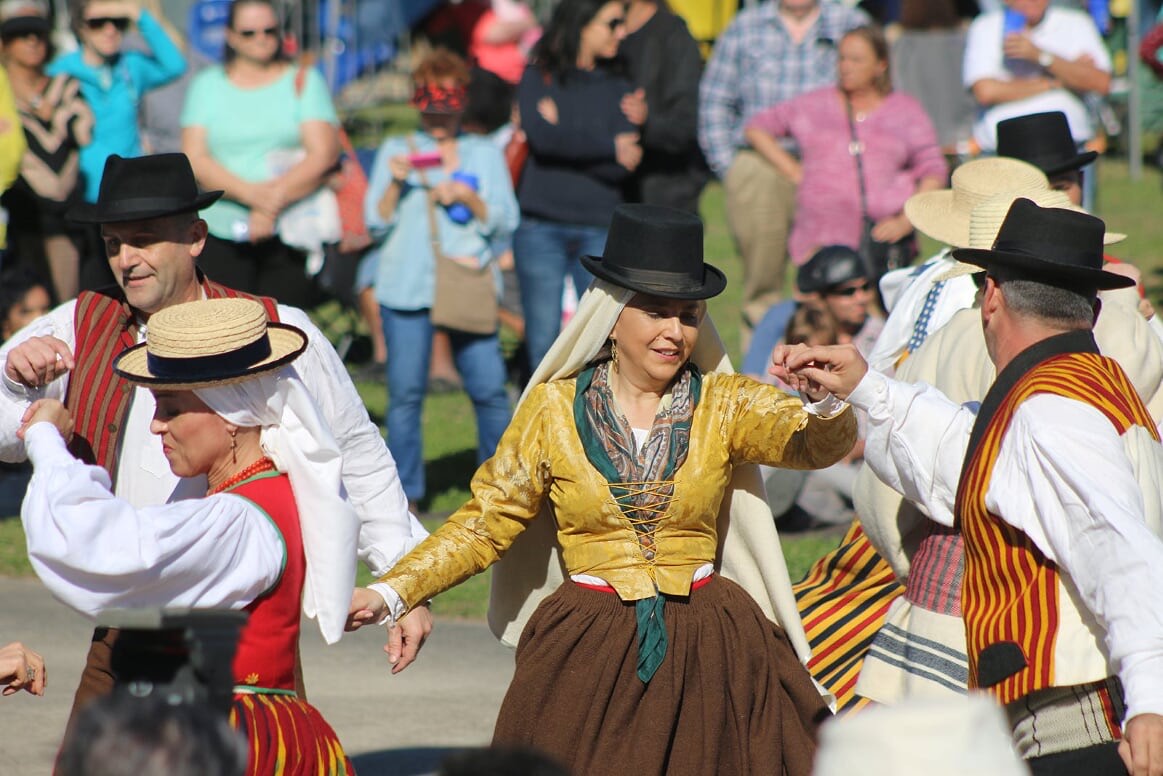
And yet the community is not mourning so much as adapting, the way it always has. The Los Islenos Heritage and Cultural Society, founded in 1976, keeps the museum, records the elders, teaches the songs, and runs the annual Los Islenos Fiesta every March, an event that in 2026 marked its fiftieth year. Each spring a folkloric group flies in from the Canary Islands to dance in striped sashes and broad hats, and the festival draws bigger crowds than the dwindling number of fluent speakers could ever fill. Spain’s island government has cultivated the tie, treating St. Bernard as a long-lost cousin across the ocean.
Down the bayous, the fishing families endure, pressed by hurricanes, by the slow drowning of the coast, and by the lingering blow of the 2005 BP-era and storm shocks to the seafood economy. They rebuilt after Katrina because leaving was unthinkable, and the shrimp boats still leave the dock before dawn. The Spanish words may be passing out of daily speech, but the people who carried them across an ocean two and a half centuries ago are still on the water their ancestors chose, and still calling it home.
Frequently Asked Questions
Why did the Islenos settle in St. Bernard Parish?
The Islenos in St. Bernard Parish were Canary Islanders recruited by Spanish governor Bernardo de Galvez between 1778 and 1783 to populate and defend Louisiana against the British. He placed them at San Bernardo, along Bayou Terre-aux-Boeufs, as one of four settlements guarding the approaches to New Orleans. The isolated marsh that made the spot strategic also helped the community keep its identity for two centuries.
Is St. Bernard Parish still Isleno today?
Yes, in heritage and family lines, though far less in daily language. Thousands of parish residents descend from the original Canary Islander settlers, and surnames like Perez, Nunez, and Estopinal remain common. The Isleno Spanish dialect is now spoken fluently by only a handful of elders, but the culture is actively kept alive through the museum and the annual fiesta.
What are the most famous Isleno landmarks in St. Bernard?
The best known are the Los Islenos Museum Complex on Bayou Road and St. Bernard Catholic Church, established in 1785. Delacroix Island, the historic heart of Isleno fishing culture at the end of Highway 300, is another touchstone, along with the old Terre-aux-Boeufs Cemetery where the first settlers are buried.
Where did the St. Bernard Islenos come from?
They came from the Canary Islands, the Spanish archipelago off the coast of northwest Africa, arriving in Louisiana between 1778 and 1783. Most families originated on Tenerife and Gran Canaria, with others from Lanzarote, La Gomera, and La Palma. Many left to escape drought and failed harvests at home.
When did the Islenos in St. Bernard Parish first arrive?
The first Islenos in St. Bernard Parish arrived beginning in 1778, when the ship Santisimo Sacramento sailed from the Canary Islands, with migration continuing through 1783. The San Bernardo settlement on Bayou Terre-aux-Boeufs took shape from 1779. It is the only one of the four original Spanish settlements to keep its name and Isleno identity into the present.
If your family’s story passed through the marshes of St. Bernard, through a fishing camp on Delacroix or a pew at St. Bernard Catholic Church, the names and dates are waiting to be traced back across the water to a small island town.