
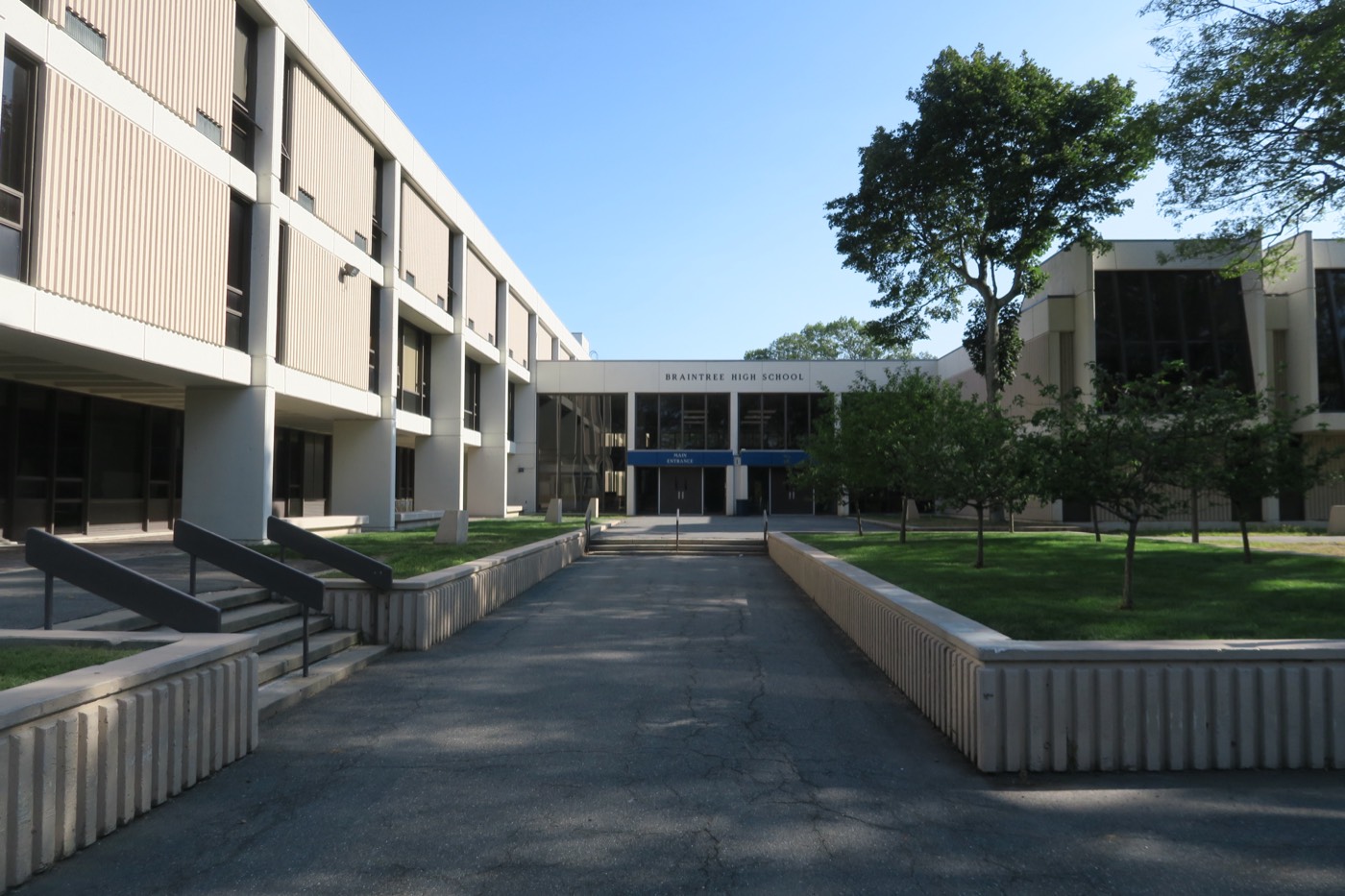
Drive south out of Boston on the Red Line, past the granite ledges and the salt marsh, and you reach a town where nearly half the households trace a line back to Ireland. The Irish in Braintree, Massachusetts are not a story of arrival so much as a story of settling in for good. By the most-cited census figures, Braintree has ranked as the second most Irish town in the entire United States, with roughly 46 percent of residents claiming Irish ancestry. That is not a neighbourhood within a town. That is the town.
The Place
Braintree sits on Boston’s South Shore, eleven miles below the city, where the old Plymouth road meets the harbour’s southern reach. It was incorporated in 1640 on land first called Mount Wollaston, and it took its name from Braintree in Essex, England. Over the centuries it shed pieces of itself: Quincy and Randolph both began as Braintree ground.
Today it is a town of about 39,000, governed since 2007 as a city, anchored by the Red Line terminus at Braintree Station and the vast South Shore Plaza. It is comfortable, leafy, and, by ancestry, one of the most Irish places in America.
How It Became Irish
Braintree did not start Irish. For two centuries it was a Yankee farming and milling town, the kind of place that produced John Adams and John Quincy Adams just over the line in what became Quincy. The Irish came to Braintree the way they came to most of industrial New England: for work.
Iron, granite, and the first factories
The land itself made the early economy. Bog iron was found here, and ironworks among the first in the American colonies were established in 1644. Excellent granite lay in the ledges, and the Granite Railway, built in 1826 in the part of old Braintree that became Quincy, was one of the earliest railways in the country.
By the nineteenth century the South Shore had turned to boots and shoes. South Braintree filled with shoe factories, and those factories needed hands. Irish labourers, many of them refugees from the Great Famine and the hard decades after, took the work that built the town’s manufacturing base.
A foreign-born town by 1900
The numbers tell the change plainly. By 1900 Braintree’s population had reached 5,981, and of those, 1,250 were foreign-born. That is more than one in five residents born outside the United States, in a town that a generation earlier had been overwhelmingly Yankee. The Irish were a large share of that newcomer population, drawn by the shoe factories of South Braintree and the trades that supplied them.
It is in this industrial South Braintree that the town’s name entered the national record for a darker reason. On 15 April 1920, a paymaster and a guard for the Slater and Morrill Shoe Company were robbed and shot dead on Pearl Street, carrying a payroll of more than 15,000 dollars. The arrests of Nicola Sacco and Bartolomeo Vanzetti, two Italian immigrant anarchists, led to a trial that became a global cause. The crime’s central figures were Italian-American, but its setting was the immigrant shoe district that the earlier wave had helped build.
The parishes take root
For Irish Catholics, the parish was the first institution of belonging, and Braintree’s Catholic life grew with the community. Saint Francis of Assisi parish was established in 1903 to serve the growing Catholic population of the town. Saint Thomas More parish followed in 1938, and Saint Clare in the post-war years, so that by mid-century a Catholic family in any corner of Braintree had a church within reach.
Those parishes were Irish in their congregations and, for decades, in their priests. They ran the schools, the sodalities, and the Saint Patrick’s suppers that knit the town’s families together. The Catholic and the Irish identities of Braintree grew up entwined across the twentieth century.
The Irish Riviera and the great move south
The decisive transformation came after the Second World War. Boston’s Irish had spent generations packed into Charlestown, Dorchester, and South Boston, the dense triple-decker wards where the famine generation first landed. As servicemen came home and mortgages became reachable, those families looked south.
They found the South Shore, a stretch of suburb and coastline that came to be called the Irish Riviera. Returning GIs from Dorchester, South Boston, and Hyde Park moved out through the 1950s and 1960s to towns like Braintree, Milton, and Marshfield, trading the old neighbourhood for a lawn and a driveway while keeping the parish, the politics, and the accent.
Braintree, sitting at the very head of the South Shore where the highways and the Red Line meet, caught a heavy share of that migration. It was close enough to commute into the city’s union jobs, civil service, and trades, and far enough out to feel like a fresh start. By the time the census measured it, the town had become one of the most concentrated pockets of Irish ancestry anywhere in the country.
The Landmarks
Saint Francis of Assisi, 856 Washington Street. Founded in 1903, this is the elder of Braintree’s Catholic parishes, raised to serve a town whose Catholic population was growing faster than its old churches could hold. For more than a century it has been a centre of Irish-Catholic family life, and in recent years it has been grouped with Saint Clare and Saint Thomas More as the local parishes consolidated.
Saint Thomas More Parish, 8 Hawthorn Road. Established in 1938 in the residential heart of the town, Saint Thomas More carried the parish network into Braintree’s growing neighbourhoods between the wars. Its school, hall, and Sunday calendar anchored a generation of Irish-American families, and it remains part of the cluster of parishes that succeeded the standalone churches of mid-century.
Thayer Public Library, John F. Kennedy Memorial Drive. The original Thayer library was built in 1874 in Renaissance style, the gift of General Sylvanus Thayer, the Braintree-born father of West Point. The library it became sits on a street named for John F. Kennedy, the South Shore’s most famous son of Irish stock, a small civic coincidence that says a good deal about whose town this became.
Braintree Town Hall, 1 John F. Kennedy Memorial Drive. Completed in 1913 in red brick and cast stone, the Georgian-style town hall is the seat of a community that has long sent Irish-American families into local office, the police and fire departments, and the trades. Its address, like the library’s, carries the Kennedy name through the civic centre of the town.
South Braintree Square, Pearl Street area. The old shoe-factory district is where the Irish working town took shape, and where the Slater and Morrill payroll murders of 1920 put Braintree into the world’s newspapers. The squat brick mill buildings and the rail line tell the story of why the Irish came here: not for the coast, but for the factory floor.
South Shore Plaza, 250 Granite Street. Opened in 1961 as an open-air shopping centre and enclosed in 1976, the plaza grew into one of the largest malls in New England. It is the commercial heart of the post-war suburb the Irish built, the place where the families who left Dorchester for a lawn did their Saturday shopping for two generations.
Irish Cultural Centre of Greater Boston, 200 New Boston Drive, Canton. A short drive west of Braintree, the centre opened on its Canton campus in 1989 as the gathering place for the South Shore’s Irish. With its athletic fields, music sessions, ceili dancing, and pub, it is where Braintree families go for the heritage that the parish once carried alone.
Where They Came From
The Irish who built Braintree came in two great pulses, and from overlapping parts of Ireland. The first were the famine and post-famine immigrants of the mid and late nineteenth century, who landed in Boston and took the shoe-factory and labouring work of South Braintree. Like most of Boston’s Irish, they came heavily from the hard-hit counties of the west and southwest, Galway, Mayo, Cork, and Kerry among them, where the potato failure fell hardest.
The second pulse was internal: the post-war move south out of Boston’s Irish wards. These were not immigrants but the American-born grandchildren and great-grandchildren of the famine generation, leaving Dorchester, South Boston, and Charlestown for the suburbs. They carried their county loyalties and parish habits with them, and they reassembled the old neighbourhood’s social world on the South Shore.
The result is a town whose Irishness is less about recent arrival than about deep settlement. Braintree’s Irish are mostly third, fourth, and fifth generation, which is precisely why the ancestry figure runs so high: whole streets of families who never married out of the heritage, never left the region, and never stopped calling themselves Irish.
Braintree Today
Modern Braintree wears its Irishness quietly. There is no Gaeltacht quarter and no single Irish high street, because the heritage is not concentrated in a block or a parish but spread evenly through a comfortable suburb of nearly 40,000. The Irish here are the firefighters, the teachers, the contractors, and the city councillors, woven so thoroughly into the town that they are simply the town.
The institutions have shifted. The standalone parishes of the twentieth century have been clustered and merged as Mass attendance fell and the Archdiocese reorganised, so that Saint Francis, Saint Clare, and Saint Thomas More now operate together rather than as separate centres of gravity. For the music, the dancing, and the explicit celebration of heritage, families increasingly drive to the Irish Cultural Centre in nearby Canton rather than to a local hall.
What endures is the demography and the memory. Braintree remains one of the most Irish-by-ancestry towns in America, a fact rooted in the shoe factories of the 1800s and sealed by the post-war flight from the city. It sits in a constellation of South Shore towns, from Scituate and Milton to neighbouring Quincy, that together make up the Irish Riviera, and where Quincy’s own story now includes a large Chinese community alongside the Irish. For the families whose roots run from a famine ship to a Pearl Street factory to a Braintree split-level, the town is less a place they moved to than the place they finally stayed.
Frequently Asked Questions
How Irish is Braintree, Massachusetts?
By the most-cited American Community Survey figures, roughly 46 percent of Braintree residents claim Irish ancestry, and the town has ranked as the second most Irish in the United States, just behind Scituate. The Irish in Braintree are not a minority neighbourhood but a plurality of the whole town.
Why did so many Irish settle in Braintree?
The Irish first came in the nineteenth century for work in the shoe factories of South Braintree and the granite and iron trades of the South Shore. A second, much larger wave arrived after the Second World War, when Irish-American families left Boston neighbourhoods like Dorchester and South Boston for the suburbs, and Braintree, at the head of the South Shore, drew many of them.
What is the Irish Riviera?
The Irish Riviera is the nickname for Boston’s South Shore, the string of suburban and coastal towns that filled with Irish-American families moving out of the city after the Second World War. Braintree, Milton, Quincy, Scituate, and Marshfield are all part of it, and several rank among the most Irish towns in the country.
Which Catholic parishes served the Irish in Braintree?
Saint Francis of Assisi, founded in 1903, is the oldest, followed by Saint Thomas More in 1938 and Saint Clare in the post-war years. These parishes were the social and spiritual centre of Irish-Catholic life in Braintree, and they have since been clustered together as the Archdiocese reorganised local churches.
What was the Sacco and Vanzetti case’s connection to Braintree?
On 15 April 1920, a paymaster and a guard for the Slater and Morrill Shoe Company were robbed and killed on Pearl Street in South Braintree. The arrest of Italian immigrants Nicola Sacco and Bartolomeo Vanzetti led to one of the most famous and contested trials in American history, set in the heart of Braintree’s immigrant shoe district.
Where can Braintree’s Irish community celebrate its heritage today?
Many families gather at the Irish Cultural Centre of Greater Boston in nearby Canton, which opened in 1989 and offers Irish music, ceili dancing, sport, and a pub. Locally, the Catholic parishes and the town’s long Saint Patrick’s traditions continue to mark the Irish identity that runs through Braintree.
If your family’s story passed through Braintree, or any of the places the Irish have made home in America, Atlas of Home can trace that journey. From a famine-era county in the west of Ireland to a shoe factory on Pearl Street, to a South Shore street where they finally stayed, to wherever you are now.