
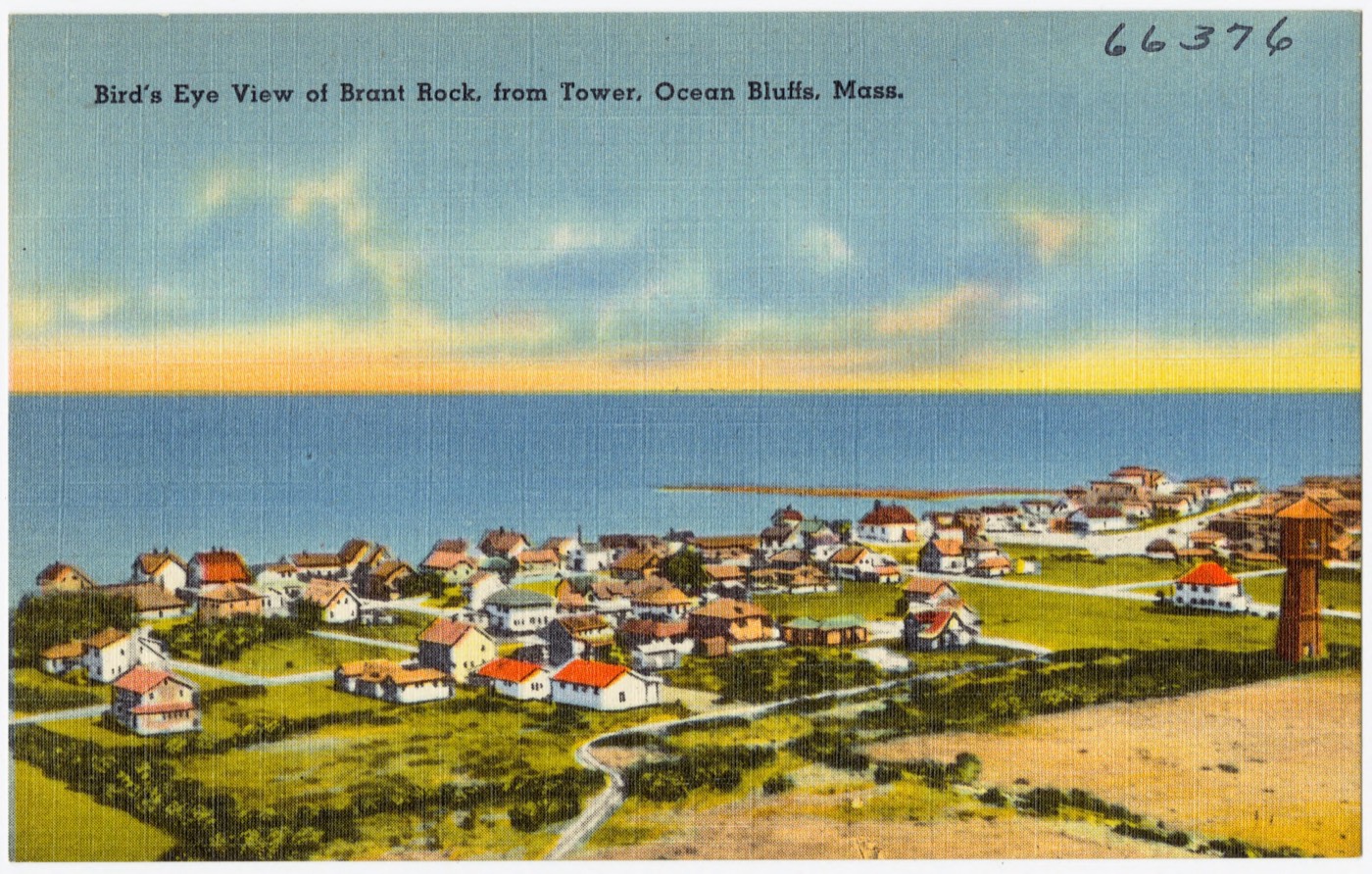
On a March morning at Brant Rock, the Atlantic spits cold spray over the seawall while runners in green singlets stream past the shuttered summer cottages. This is the Irish in Marshfield, Massachusetts, a coastal town where nearly half the residents trace a line back to Cork, Galway or Mayo, and where the seawater itself once paid the rent. The accent is South Boston softened by salt air. The surnames on the war memorials read like a Dublin phone book.
The Place
Marshfield sits on the Massachusetts South Shore, roughly thirty miles below Boston, where Cape Cod Bay meets the open Atlantic. The town was settled in 1632 and incorporated on 1 March 1640, long before any Irishman thought of crossing the water. Its motto, carved into the civic seal, is simply “Home of Daniel Webster.”
It is a town of beaches more than a single centre: Rexhame, Fieldston, Ocean Bluff, Brant Rock and Green Harbor each have their own character and their own parking battles in July. Marshfield spans nearly thirty-two square miles, including a rare barrier beach moraine, one of only two on the east coast of the United States.
By the 2020 census the population stood at 25,825, with a median home value approaching $890,000. It is an affluent place now, but its Irishness was built on something far humbler than real estate.
How It Became Irish
To understand the Irish in Marshfield you have to start with a senator, a seaweed and a ship.
Webster’s plea, 1847
Marshfield’s most famous resident was Daniel Webster, the orator and statesman who served as a United States senator and as Secretary of State to three presidents before his death in 1852. His farm and estate sat in the town that still calls itself his home.
In February 1847, as reports of the Great Famine reached America, Webster lent his voice to the relief effort. “The calamities of Ireland have been heard and read throughout the country,” he declared, “and have touched all American hearts.” That sympathy was not abstract. Boston organised, and the response left from just up the coast.
On 28 March 1847, the warship USS Jamestown sailed from the Charlestown Navy Yard for Cork, carrying corn not cannon. She arrived on 12 April with some 800 tons of supplies, the first American aid ship of the Famine. Her captain was Robert Bennet Forbes, a China trade merchant from neighbouring Milton, another town the Irish would later make their own. The New England Relief Committee, Catholics and Protestants working side by side, gathered roughly $150,000 of the $300,000 Boston sent to Ireland that year.
The mossers
The aid travelled east; the people travelled west. In the worst year of the Famine, 1847, around 7,000 Irish passengers landed at Boston, with many more coming ashore at the smaller ports strung along the South Shore. They arrived hungry and broke, and they took the work that was going: fishing, domestic service, and the strange harvest that would define this coast.
That harvest was Irish moss. In the late 1840s an Irish immigrant named Daniel Ward, sailing off Boston, recognised the red algae beneath the surface as carrageen, the same seaweed gathered on the rocks at home. Ward settled at Scituate, the next town up, and abandoned fishing to rake moss from the sea and dry it for sale.
Word travelled. Around a hundred Irish families came to work the moss beds, wading the cold shallows with long rakes, spreading the weed to bleach on the beaches. It was brutal, seasonal, low-status labour, and it was theirs, a trade the Smithsonian has called the foundation of the most Irish town in America. The trade tied the Irish of the South Shore to a single stretch of shoreline running from Scituate down through Marshfield, a bond you can read about along the Irish heritage of neighbouring Scituate.
The parish takes root
For decades the Catholic Irish of Marshfield had no church of their own. Through the 1920s and 1930s they travelled to St Mary’s in Scituate or to the summer mission of St Theresa’s at Humarock. By the early 1940s nearly 300 families were crowding into St Theresa’s chapel.
In 1944 the Archdiocese appointed Reverend Edmund Moran to serve Marshfield Hills. Judging Humarock too remote for a year-round parish, Father Moran settled on a barn on Route 3A that had been an antique shop run by W. Torrey Little. He named the new parish St Christine, after the patron saint of his late mother, the only parish in the Archdiocese to carry that name. St Christine’s still stands at 1295 Main Street, the spiritual anchor of Catholic Marshfield.
The post-war wave
The decisive change came after 1945. Returning GIs from the dense Irish wards of Boston, from South Boston, Hyde Park and Dorchester, looked south for space, lawns and ocean air. Through the 1950s and 1960s they bought into the South Shore in numbers, and the towns nearest the water filled up fastest.
The Irish with money or political clout took the houses on the spits of land near the sea: Marshfield, Scituate, Cohasset. The “Irish Riviera” was born of this migration, a half-affectionate, half-mocking nickname for a coast where the second and third generations finally had the means to summer where their great-grandparents had once raked moss to survive. That same upward, outward movement of the urban Irish reshaped affluent suburbs far beyond Massachusetts, from the Irish enclaves of Rockaway, New Jersey to the old Irish families of Greenwich, Connecticut.
The Landmarks
St Christine’s Parish, 1295 Main Street (Route 3A). Founded in 1944 in a converted antique-shop barn, it remains the heart of Catholic Marshfield. The unusual dedication, the only St Christine parish in the Boston Archdiocese, is a small monument to one priest’s devotion to his mother.
The Bailey, an Irish pub, 278 Ocean Street. Opened in 2010 and repeatedly voted among the best bars on the South Shore, The Bailey runs a full Irish breakfast at weekends and hosts ceili music nights. It is the closest thing Marshfield has to a parish hall with a beer licence.
Brant Rock, off Ocean Street. The tight grid of summer cottages and the long seawall here form the postcard image of working-class Irish Marshfield. Generations summered in these small houses, and the esplanade still fills with families on warm evenings.
Daniel Webster Estate and Heritage Center, 238 Webster Street. The home of the senator whose 1847 voice helped rally American Famine relief. The site preserves the memory of a man whose name is bound up, however indirectly, with why the Irish came to feel welcome on this coast.
Haddad’s Ocean Cafe, 1149 Ocean Street, Green Harbor. A long-standing anchor of the southern beach community, known for honest seafood at fair prices. It is the kind of place where the summer regulars are greeted by name across decades.
Rexhame Beach, Standish Street. The broad barrier beach and its dunes are where Marshfield families have spent their summers for a century. The moraine behind it is a geological rarity; the cookouts on it are a local institution.
South Shore Irish Heritage Trail. A regional route stitching together the Famine and mossing story across Marshfield, Scituate and their neighbours, anchored by the Maritime and Irish Mossing Museum in Scituate’s Benjamin James House, built in 1739.
Where They Came From
The Irish who built Marshfield came overwhelmingly from the west and south of Ireland: Cork, Kerry, Galway and Mayo, the counties hit hardest by the Famine and the evictions that followed. They arrived first as Famine refugees at Boston in the late 1840s, then through the steady chain migration that linked specific Irish parishes to specific Boston neighbourhoods for a century.
The second wave came not from Ireland but from Boston itself. The grandchildren of Famine immigrants, raised in the triple-deckers of South Boston and Dorchester, carried their parishes and their politics down Route 3 to the shore. Marshfield’s Irishness is therefore doubly inherited: from the old country, and from the urban Irish core of Boston that emptied southward after the war.
The numbers tell the story. By recent census tabulations Marshfield consistently ranks among the most Irish towns in the most Irish state in America, with somewhere between 44 and 47 percent of residents claiming Irish ancestry, a figure that places it within a point or two of neighbouring Scituate at the very top of the national list.
Marshfield Today
Marshfield wears its heritage lightly and loudly at once. For fifty weeks of the year it is an affluent commuter town of good schools and high home prices, its Irishness folded quietly into family names and Sunday Mass. Then March arrives.
The South Shore’s St Patrick’s season now centres on the Scituate parade, held on a Sunday in March and grown into the third largest in Massachusetts behind South Boston and Holyoke. Marshfield’s own contribution is America’s Most Irish Road Race, run in mid-March to benefit the Marshfield Education Foundation, where runners, walkers and the occasional crawler pour down to the beach.
What endures is not nostalgia but continuity. The pubs are real pubs, the parish is a working parish, the road race fills every spring, and the names on the youth hockey rosters are the same names that appear on the Famine-era ship manifests. The Irish in Marshfield did not preserve a museum culture. They simply kept living it, by the same cold sea that first gave them a reason to stay.
Frequently Asked Questions
How Irish is Marshfield, Massachusetts?
Marshfield is one of the most Irish towns in the United States. Depending on the census tabulation, between roughly 44 and 47 percent of residents claim Irish ancestry, placing the Irish in Marshfield within a point or two of neighbouring Scituate at the top of the national rankings.
Why is the South Shore called the Irish Riviera?
The nickname describes the coastal towns south of Boston, especially Scituate, Marshfield, Cohasset and Hingham, where Irish-American families settled in large numbers. It captures the moment after the Second World War when the Boston Irish gained the means to summer and live by the sea.
How did the Irish first come to Marshfield?
Irish immigrants began arriving on the South Shore during the Great Famine of the late 1840s, landing at Boston and the smaller coastal ports. Many found work harvesting Irish moss, a red seaweed, which tied the early Irish in Marshfield to this exact stretch of coast.
What is the connection between Daniel Webster and Ireland?
Daniel Webster, Marshfield’s most famous resident, used his voice as a senator in February 1847 to back American relief for Famine-stricken Ireland, saying the calamities of Ireland had touched all American hearts. Boston soon sent the USS Jamestown to Cork with corn for the starving.
Is there an Irish pub in Marshfield?
Yes. The Bailey, an Irish pub at 278 Ocean Street, opened in 2010 and is regularly named among the best bars on the South Shore. It serves a traditional Irish breakfast at weekends and hosts live ceili music.
When are the Irish festivals in Marshfield?
The big season is March. America’s Most Irish Road Race runs in Marshfield in mid-March, while the region’s main St Patrick’s parade takes place in nearby Scituate on a Sunday that month, now the third largest such parade in Massachusetts.
If your family’s story passed through Marshfield, or any of the places the Irish have made home in America, Atlas of Home can trace that journey. From a Famine ship into Boston Harbour, to a mosser’s cottage at Brant Rock, to wherever you are now.