
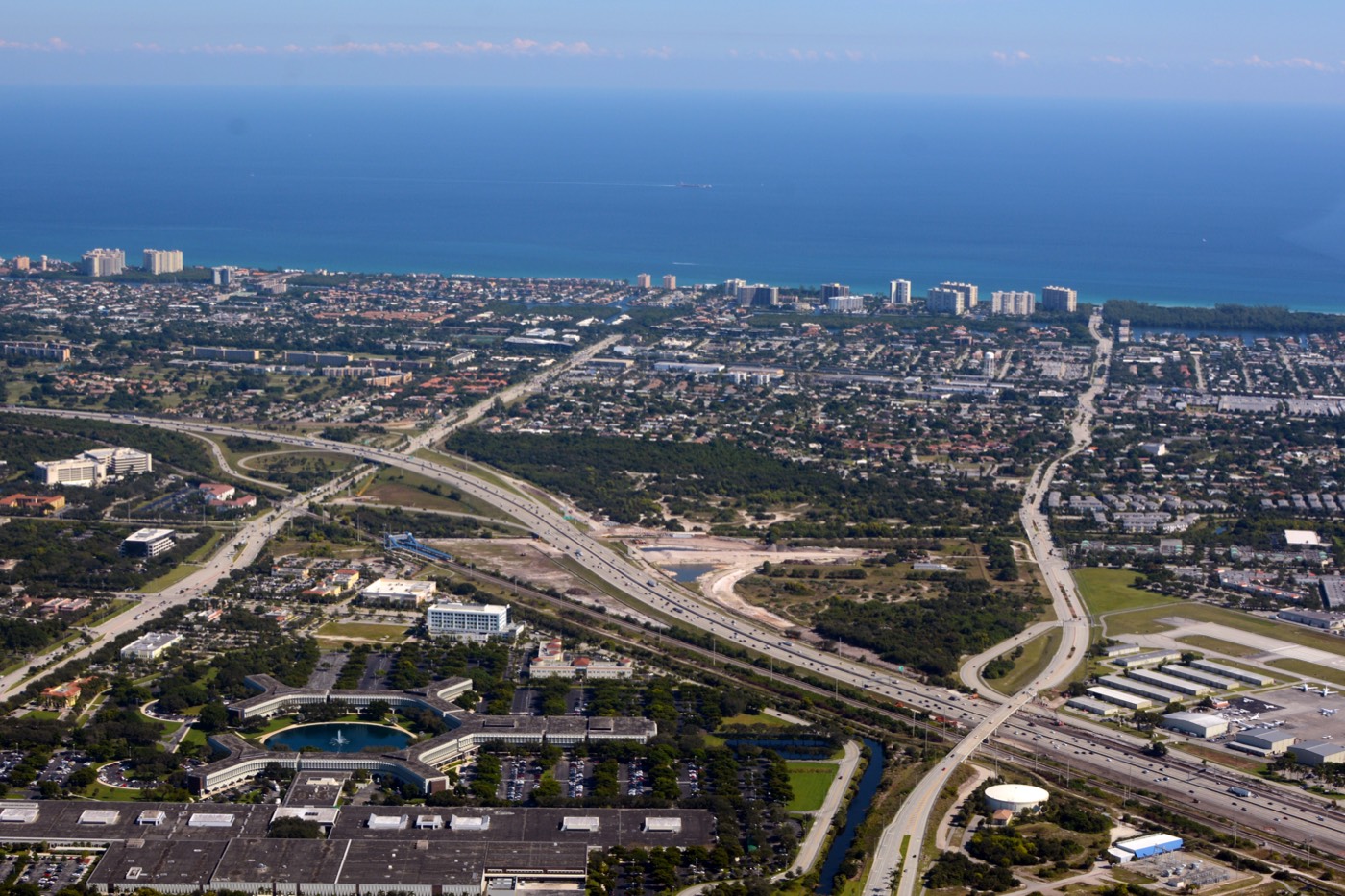
Drive west on Glades Road past the Town Center mall and the strip plazas begin to speak two languages. A falafel counter advertises its specials in Hebrew. A kosher market stocks Israeli yoghurt and Bamba snacks beside the deli case. The Israelis in Boca Raton, Florida did not arrive all at once, but over four decades they turned a planned resort city into one of the most comfortable places in America to live a life that still runs partly on Tel Aviv time.
The Place
Boca Raton sits in southern Palm Beach County, on the Atlantic coast roughly halfway between West Palm Beach and Fort Lauderdale. It is a city of manicured country clubs, gated developments and low pastel buildings, almost all of them built since the Second World War.
The name is old, taken from Spanish charts, but the city is new money. Its reputation for affluence is not an accident: it was planned that way, deliberately, by men who wanted to build prestige into the street grid itself.
Today around 100,000 people live within the city limits, with hundreds of thousands more in the unincorporated suburbs to the west that everyone still calls Boca. It is one of the wealthiest corners of South Florida, and one of the most Jewish, which is much of the reason Israelis ended up here.
How It Became Israeli
To understand why Israelis settled in Boca Raton, you have to understand why anyone with money settled here at all. The city was engineered for it.
A city built for prestige
Boca Raton was incorporated in June 1925, at the height of the Florida land boom. The city almost immediately hired the architect Addison Mizner, who had already reshaped Palm Beach in his signature Mediterranean Revival style of arches, barrel-tile roofs and courtyards.
Mizner’s vision for Boca Raton was a Spanish-Italian fantasy town with grand hotels and golf courses, financed by backers including Irving Berlin and W. K. Vanderbilt II. The boom collapsed before most of it was built, but the centrepiece survived: the 1926 Cloister Inn, the hotel now known as The Boca Raton.
The real transformation came after the Second World War. In 1956 the industrialist Arthur Vining Davis, former chairman of Alcoa, bought the Boca Raton Hotel and Club along with a mile of beach and thousands of acres inland. His company, Arvida, an acronym of his own name, pioneered the gated planned community in Boca Raton.
Arvida built the Royal Palm Yacht and Country Club, Boca West and Broken Sound, burying utility lines underground and selling an idea of the good life. Between 1965 and 1980 the city’s population tripled. By the time the Town Center mall opened on Glades Road in August 1980, Boca Raton had become a byword for moneyed suburban comfort.
The Jewish foundation
Israelis did not arrive into a vacuum. They arrived into one of the densest Jewish settlements in the United States, and that foundation was laid first.
South Palm Beach County drew enormous numbers of Jewish retirees and families from the north-east through the 1970s and 1980s. By the 2020s, surveys placed the Jewish share of greater Boca Raton among the highest of any American city, with tens of thousands of Jewish residents, more than a dozen synagogues, dozens of kosher establishments and a cluster of Jewish day schools. The deeper roots of that settlement are traced in the history of the Jews in South Florida.
For an Israeli weighing where to land in America, this mattered enormously. Hebrew schools, kosher groceries, synagogues across every denomination and a community that already understood the rhythm of the Jewish calendar meant the hardest parts of emigrating were already solved.
The Israeli arrival
Israeli emigration to the United States grew steadily from the 1970s onward. The largest concentrations settled in New York, California, New Jersey and Florida, and within Florida the pull was toward the Jewish heartland of the south-east coast.
The earliest South Florida Israeli enclaves formed further south, in the Miami and Hollywood areas, where roughly ten thousand Israelis are estimated to live. Boca Raton drew the wave that wanted what the city itself was built to sell: space, schools, golf and quiet.
The arrivals fell into recognisable types. Retirees who had done well in Israel and wanted warm winters near family. Business owners and professionals, many in technology, finance and medicine, who could run companies across time zones. And younger families chasing the same suburban calm that drew everyone else to Boca, with the bonus of Hebrew already in the air.
What gave the community a distinctly Israeli character, rather than simply a Jewish one, was the everyday Hebrew. Israeli expats tend to keep the language at home and to seek out other Israelis through synagogues, community centres and informal networks. In Boca that network had somewhere to gather. Organisations such as the Israeli-American Council, active across South Florida, gave the secular, Hebrew-speaking expat a cultural home distinct from the synagogue.
The result, by the 2010s, was a corridor of West Boca strip plazas along Glades Road where the menus, the music and the small talk at the counter often ran in Hebrew first and English second.
The Landmarks
Aroma Market, 9200 Glades Road. A glatt kosher market and caterer that has become a default stop for the Israeli household. The shelves carry an abundance of Israeli products alongside homemade soups, salads, breads and hot prepared foods, the kind of place where a transplant can assemble a Shabbat table that tastes like home.
Boca Grill, 8903 Glades Road. A glatt kosher Israeli grill tucked into a Glades Road plaza near the corner of Lyons Road. Closed on Saturdays, it serves the staples that anchor any Israeli kitchen: falafel, Israeli salad, baba ganoush and grilled meats, the unfussy food of a Tel Aviv lunch counter.
DVASH, 8208 Glades Road. An Israeli-Mediterranean restaurant on the same corridor, run by Hebrew-speaking owners and built around Middle Eastern flavours. It is not certified kosher, which is itself telling: it serves the secular Israeli expat who wants the food and the language without the religious framework.
The Grove Kosher Market. A glatt kosher supermarket certified by the Orthodox Rabbinical Board of Broward and Palm Beach Counties, one of the larger kosher groceries serving the wider community and another fixed point in the West Boca Jewish and Israeli food map.
Florida Atlantic University, 777 Glades Road. The city’s public university, founded in 1961 and opened in 1964 by President Lyndon Johnson, today enrolling more than 30,000 students. Its Boca campus has hosted Israeli cultural events, including an Israeli culture shuk run with the campus pro-Israel student group, and houses a Florida-Israel institute focused on academic and research ties.
Mizner Park, 327 Plaza Real. Boca Raton’s mixed-use downtown centre, opened in 1991 on the site of a failed enclosed mall and now the city’s cultural heart, with shops, restaurants, an amphitheatre and apartments. It is where the wider community, Israeli families included, comes to walk, eat and gather on a warm evening.
The Boca Raton, 501 East Camino Real. The descendant of Mizner’s 1926 Cloister Inn, the pink Mediterranean Revival landmark that started the city’s reputation for luxury. It is the symbol of the prestige that Boca was built to project, the backdrop against which the more recent Israeli story has played out.
Where They Came From
The Israelis of Boca Raton come, by definition, from Israel, but the migration is best understood as a second move rather than a first. Many had already left Israel for elsewhere in the United States, often New York, New Jersey or the northern cities, before heading south for the climate, the lower taxes and the established Jewish life.
They span Israel’s own internal diversity. There are Ashkenazi and Sephardi families, secular Tel Avivians and observant households, alongside Israelis whose own parents had come to Israel from the former Soviet Union, North Africa or the Arab world. South Florida’s Jewish population has long absorbed immigrants from those same origins, which made the blend feel familiar.
The common thread is not a single hometown but a stage of life and a level of means. Boca rewards arrivals who can afford it, and the Israelis who chose it tended to be the ones for whom a country club suburb, rather than a dense urban enclave, was the point.
Boca Raton Today
The Israeli presence in Boca Raton is real but woven into a larger Jewish fabric rather than concentrated in a single visible quarter. There is no Israeli main street the way some cities have a Chinatown or a Little Havana. The evidence is quieter: the Hebrew on a plaza sign, the accent at the deli counter, the children switching between languages in a synagogue car park.
That diffusion is partly the nature of Boca itself. This is a city of gated communities and shopping centres rather than walkable old neighbourhoods, so community gathers at the market, the school and the synagogue rather than on a corner. For families used to the density of Israel, it is a trade: more space and calm, less street life.
What is unmistakable is comfort. A Hebrew-speaking family can buy groceries, eat out, school their children, worship and socialise without the constant translation that defines so much of immigrant life elsewhere. The Israelis here joined communities like the Israelis in Pico-Robertson in Los Angeles and the Israelis in Tenafly, New Jersey in proving that the American Israeli story is increasingly a suburban one. It echoes the broader Jewish settlement of the area documented among the Jews of Boca Raton and nearby Parkland, just as other South Florida communities, from the Cubans in Doral to Boca’s own Brazilian community, have remade their corners of the map. For the Israeli in Boca Raton, the city built for prestige turned out to be, almost incidentally, a remarkably easy place to remain Israeli.
Frequently Asked Questions
How many Israelis live in Boca Raton?
There is no precise published count of Israelis in Boca Raton specifically. Florida is one of the four largest Israeli-American enclaves in the country, and roughly ten thousand Israelis are estimated to live in the broader Miami and Hollywood areas to the south, with a further share in the affluent Boca corridor.
Why did Israelis settle in Boca Raton, Florida?
The Israelis in Boca Raton, Florida were drawn by the same things as other affluent newcomers: warm weather, low taxes, golf and gated comfort. Crucially, Boca already had one of the densest Jewish communities in America, with Hebrew schools, kosher groceries and synagogues that made emigrating far easier.
Where do you hear Hebrew in Boca Raton?
The clearest concentration is along the Glades Road corridor in West Boca, where kosher and Israeli businesses cluster in strip plazas. Markets such as Aroma Market and restaurants like Boca Grill and DVASH serve Hebrew-speaking customers, and signage in the area often appears in Hebrew.
Is Boca Raton a Jewish city?
Boca Raton has one of the highest concentrations of Jewish residents of any American city, with surveys placing the Jewish share of the population very high and tens of thousands of Jewish residents. The Israeli community is one distinct, Hebrew-speaking strand within that much larger Jewish population.
What made Boca Raton so affluent?
Boca Raton was deliberately planned for prestige, first by the architect Addison Mizner in the 1920s and then by the Arvida Corporation after the Second World War, which pioneered gated planned communities and country clubs. Between 1965 and 1980 its population tripled as wealthy newcomers arrived.
Where are the best Israeli restaurants and markets in Boca Raton?
The main Israeli and kosher food destinations sit along Glades Road in West Boca. Aroma Market at 9200 Glades Road stocks Israeli products and prepared foods, Boca Grill at 8903 Glades Road serves glatt kosher Israeli grill fare, and DVASH at 8208 Glades Road offers Israeli-Mediterranean dining.
If your family’s story passed through Boca Raton, or any of the places Israelis have made home in America, Atlas of Home can trace that journey. From a flat in Tel Aviv to a plaza on Glades Road, to wherever you are now.