
Drive east on the Bruckner, past the point where the Bronx stops feeling like a borough and starts feeling like a coastline, and you arrive somewhere that does not behave the way the rest of the city does. The Italians in Throgs Neck did not build a Little Italy here. They built a hometown. Streets of one and two family houses run down toward the water, a pork store still slices prosciutto by the quarter pound, and on Sunday morning a Mass is offered in Italian on Otis Avenue, the way it has been for the better part of a century.
The Place
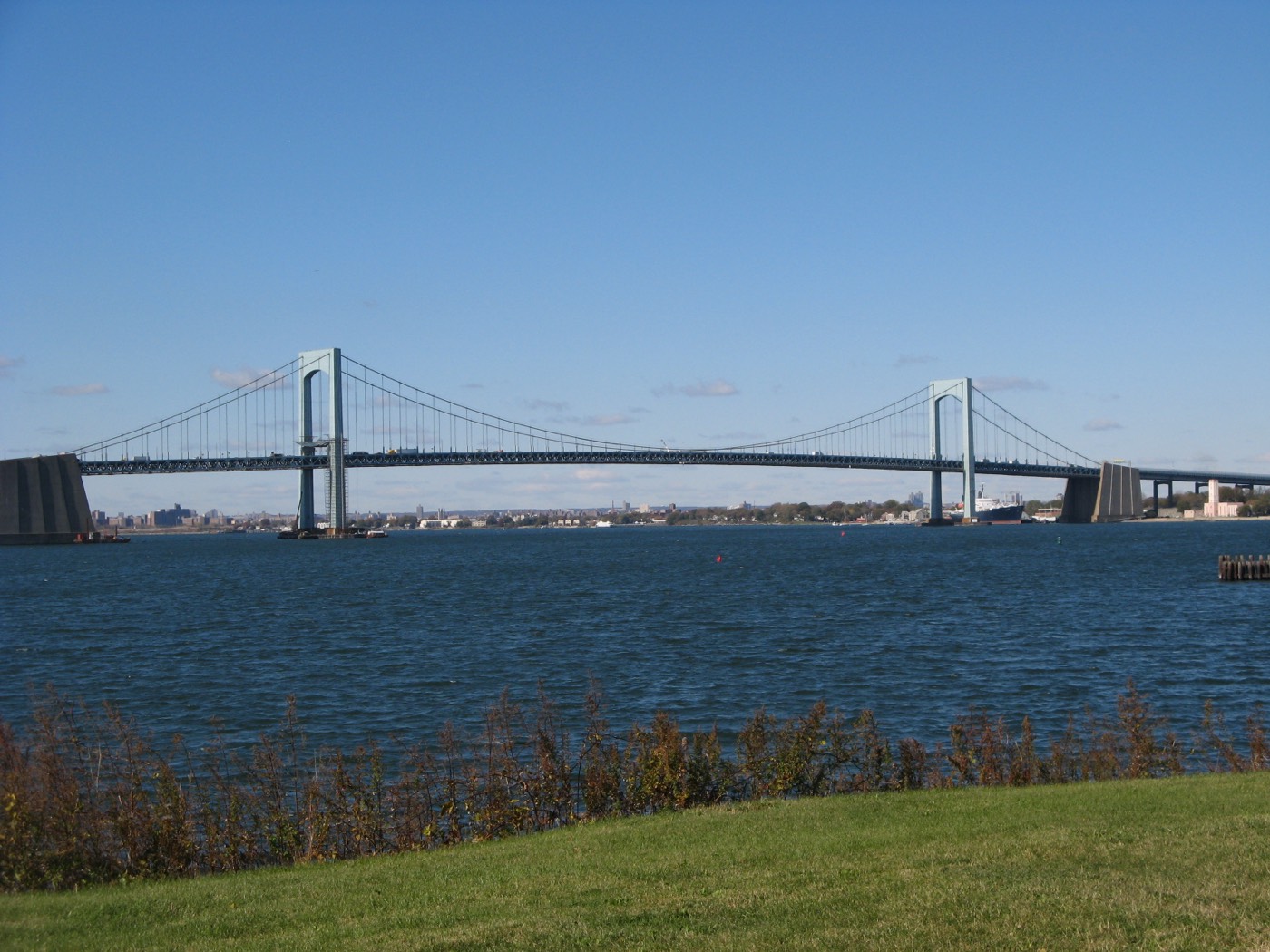
Throgs Neck is a peninsula at the far eastern edge of the Bronx, a finger of land that pushes out between the East River and Long Island Sound. It is the spot where the borough narrows to the crossing carried by the Throgs Neck Bridge, the silver span that ties this corner of New York to Bayside, Queens.
It does not read like the Bronx of the popular imagination. Here the blocks are low, the lots have gardens, and the salt air comes off the Sound. The neighbourhood has long been one of the most stable in the borough, anchored by homeowners who stayed put while other districts churned.
And it is its own world, distinct from the Italian Bronx most outsiders know. This is not Arthur Avenue, the dense market street of the Italians of the Belmont section. Throgs Neck is quieter, residential, and tilted toward the water.
How It Became Italian
The peninsula carries the name of an Englishman. John Throckmorton obtained a licence to settle here on 2 October 1642, and the place has worn some version of his name ever since. For the next two centuries the land passed through Dutch, British and then American hands, mostly as farmland and grand waterfront estates.
From farmland to a fort
The first wave of newcomers arrived to build something military. Between 1833 and 1856, masons and labourers raised Fort Schuyler at the very tip of the peninsula, part of the coastal defences thrown up after the War of 1812. Many of those workers were Irish, and they were the first immigrant families to settle the Neck in numbers.
The fort guarded the eastern approach to the harbour but never fired a shot in anger. It closed as an active army post in 1932 and found a second life that still shapes the neighbourhood, a story we will return to. The fort and its peninsula are documented in detail by the Fort Schuyler historical record.
The Italians arrive
The Italian chapter opens with the new century. After the Bronx was folded into Greater New York in 1898, transit lines reached eastward and the old estates were carved up. Italian farmers and tradesmen came out from the crowded tenement districts of Manhattan and the South Bronx, drawn by land they could actually afford and air they could actually breathe.
In the 1920s the large estates were subdivided in earnest, broken into smaller row homes and dense bungalow lots. A family that had been three flights up in East Harlem could now own a brick house with a strip of yard, walk to the water, and plant a fig tree that would have to be wrapped in burlap every winter to survive.
The parishes that organised everything
As elsewhere in Italian America, the Catholic parish was the institution that turned arriving families into a community. Throgs Neck got two of them within a year of each other.
St Benedict’s held its first Sunday Mass on 8 April 1923, with an estimated five hundred worshippers crowding into a pair of prefab army barracks near what is now Bruckner Boulevard. The parish was established that month by Benedictine monks from Collegeville, Minnesota, and by September 1925 its school had organised 263 pupils into the first five grades.
St Frances de Chantal began even more modestly, in a tent pitched at Meagher and Lawton Avenues where the first Mass was said in July 1922. Cardinal Patrick Hayes formally established the parish in 1927, the church was completed and its school opened in 1930.
The postwar settling
After the Second World War the neighbourhood filled in for good. Returning veterans and middle-class families, many of them Italian alongside Irish and Jewish neighbours, bought the small homes and pushed the parishes to capacity.
Through the 1950s, 1960s and 1970s, while much of the Bronx suffered disinvestment and decline, Throgs Neck held. A deep base of homeowners and active civic groups kept the blocks intact. The Italian families who had arrived with nothing now ran the delis, sat on the parish councils, and sent their children to St Benedict and St Frances de Chantal.
The Landmarks
St Benedict’s Church, 2969 Otis Avenue. The Italian spiritual heart of the Neck. Founded by Benedictine monks in 1923 and built out in its present form after 1955, the parish still serves the descendants of the Irish and Italian families who raised it. It is one of the few churches in the city that has kept a Sunday Mass in Italian, offered at eight in the morning for those who still want to hear the old language.
St Frances de Chantal Church, 190 Hollywood Avenue. The other anchor parish, born in a tent in 1922 and now housed in a striking Brutalist church completed in 1970 at the corner of Harding and Hollywood Avenues. Its parish school, opened in 1930, has educated generations of Throgs Neck children, plenty of them with surnames ending in vowels.
Fort Schuyler and SUNY Maritime College, 6 Pennyfield Avenue. The granite fort at the peninsula’s tip never saw battle. Restored by Depression-era work crews in the 1930s, it became the campus of the State University of New York Maritime College, the oldest school of its kind in the country, founded in 1874. Its waterfront, training ship and the surrounding green of Fort Schuyler give the Neck its postcard.
The Throgs Neck Bridge. The span that gave the neighbourhood its national name carries traffic between the Bronx and Queens across the mouth of the East River. From the shore at Fort Schuyler it frames the whole peninsula, and for residents it is both a landmark and a constant low hum of the city beyond.
The pork stores and bakeries of East Tremont Avenue. The commercial spine of Italian Throgs Neck runs along East Tremont. Here you find the delis, bakeries and pork stores that still sell fresh mozzarella, sausage and semolina bread, the everyday infrastructure of an Italian kitchen. Cousin’s Pizza at 3579 East Tremont Avenue is a neighbourhood fixture that has expanded into its own bakery turning out lobster tails, sfogliatelle and rum babas.
Preston High School, 2780 Schurz Avenue. The Catholic girls’ high school sits in the former Havemeyer-Huntington mansion on the waterfront, a grand old estate house repurposed for the children of the neighbourhood. It is a reminder that the small homes of Throgs Neck were built in the shadow of the gilded estates the Italians eventually inherited.
Silver Beach and the bungalow colonies. Along the Sound, the cottages of Silver Beach Gardens began as a summer colony of waterfront bungalows. Italian and Irish families turned many of them into year-round homes, creating one of the most unusual residential pockets in all of New York City, a co-operative village of small houses on a private shore.
Where They Came From
The Italians who settled the eastern Bronx came overwhelmingly from the Mezzogiorno, the south. Families traced their roots to Campania around Naples, to Calabria and Sicily, and to the towns of Puglia and Basilicata, the same regions that fed the great Italian migration to New York between the 1880s and the 1920s.
Many did not arrive in Throgs Neck directly. They came first to the tenements of East Harlem, Mulberry Street or the South Bronx, then moved out to the Neck once they had saved enough for a down payment. The peninsula was a step up and out, a place to own rather than rent.
That pattern, of arriving poor in the dense city and then carrying the savings outward to a house near the water, is the same story that built the Italian community across the river in Whitestone and the Italians of Howard Beach on the Queens shoreline.
Throgs Neck Today
The numbers tell an honest story. Throgs Neck is no longer majority Italian, and in much of the wider neighbourhood Puerto Rican and Dominican families now form the largest groups. Italian ancestry sits in the mid-teens by percentage in the eastern and north-western pockets, lower across the area as a whole, and the long Latino and Albanian presence here is real and growing.
But the Italian imprint has not faded so much as settled in. The parishes still stand, the Italian Mass is still said at St Benedict’s, and the pork stores and bakeries on East Tremont still draw customers who learned to shop there from their grandmothers. The fig trees still get wrapped each winter.
It is also, quietly, an expensive place now. Median home prices have climbed well past eight hundred thousand dollars, and waterfront properties trade higher still. The grandchildren of the bricklayers and grocers who came out for cheap land are sitting on some of the most valuable real estate in the Bronx, a peninsula that the rest of the city has finally noticed.
Frequently Asked Questions
Are there still Italians in Throgs Neck, Bronx?
Yes. While the wider neighbourhood is now plurality Latino, Italian ancestry remains strong in the eastern and north-western sections, where it sits in the mid-teens by percentage. The Italian presence is most visible in the parishes, the pork stores and bakeries on East Tremont Avenue, and the long-settled homeowning families.
Why did Italians settle in Throgs Neck?
After transit lines reached the eastern Bronx in the early 1900s, Italian farmers and tradesmen moved out from crowded districts like East Harlem and the South Bronx. They were drawn by affordable land, the chance to own a home rather than rent, and the open waterfront air. The Italians in Throgs Neck built a residential community of one and two family houses rather than a market district.
How is Throgs Neck different from Arthur Avenue?
Arthur Avenue, in the Belmont section, is a dense commercial market street, the most famous Italian shopping district in the Bronx. Throgs Neck is residential and waterfront, a neighbourhood of homes rather than a destination of shops. The two are several miles and a very different feeling apart.
What are the Italian churches in Throgs Neck?
The two anchor Catholic parishes are St Benedict’s on Otis Avenue, founded in 1923 and still offering a Sunday Mass in Italian, and St Frances de Chantal on Hollywood Avenue, established in 1927. Both run parish schools that have educated generations of the neighbourhood’s children.
What is Fort Schuyler in Throgs Neck?
Fort Schuyler is a stone coastal fort built between 1833 and 1856 at the tip of the peninsula. It closed as an army post in 1932 and now houses SUNY Maritime College, the oldest maritime academy in the United States, founded in 1874.
Where do you shop for Italian food in Throgs Neck?
East Tremont Avenue is the commercial spine, lined with Italian delis, bakeries and pork stores selling fresh mozzarella, sausage, semolina bread and pastries. Longtime spots like Cousin’s Pizza, at 3579 East Tremont Avenue, anchor the strip and have expanded into full Italian bakeries.
If your family’s story passed through Throgs Neck, or any of the places Italians have made home in America, Atlas of Home can trace that journey. From a town in Campania or Calabria, to a brick house by the Sound with a fig tree in the yard, to wherever you are now.