
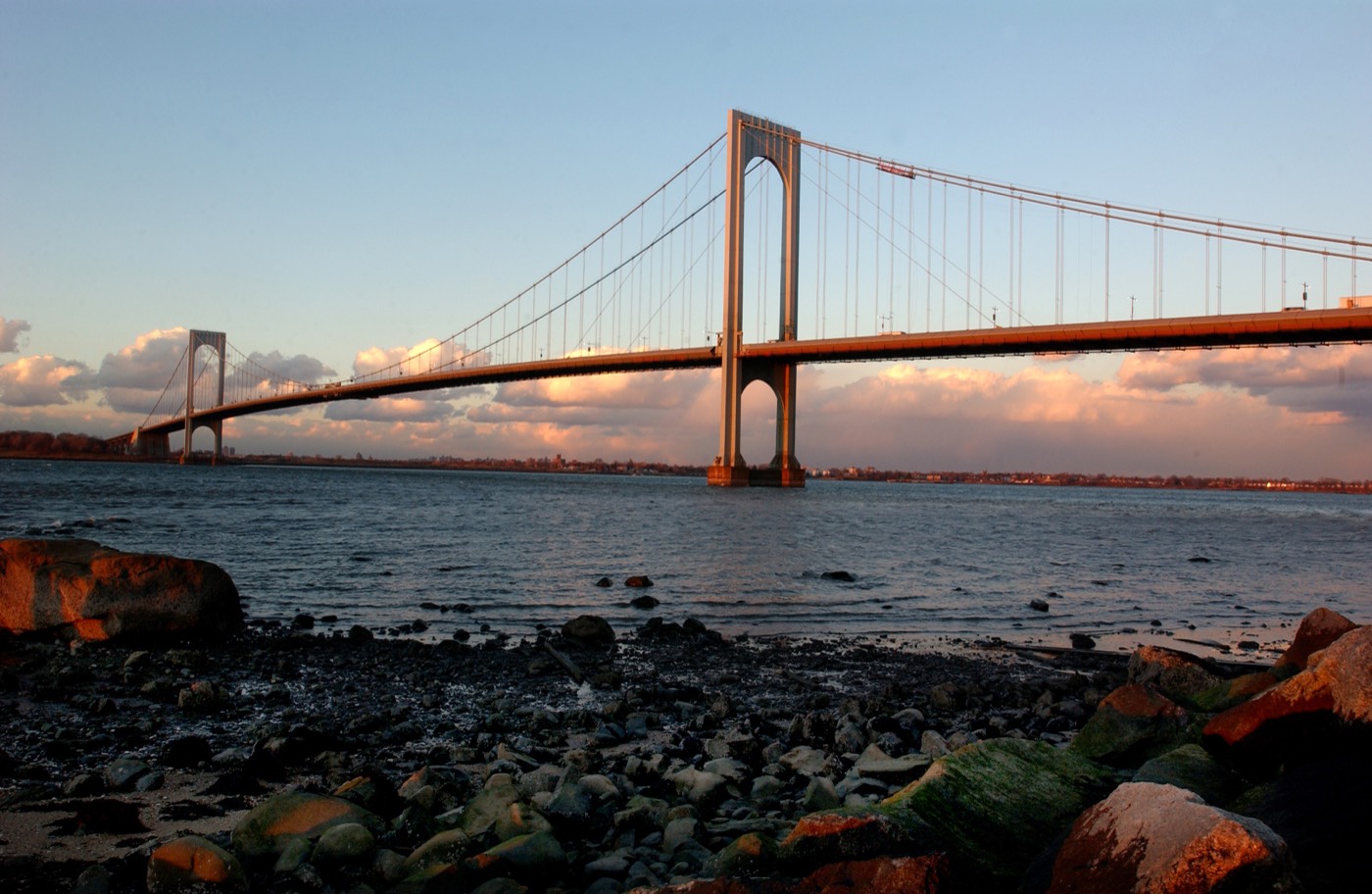
Drive north on Francis Lewis Boulevard until the street tips toward the water, and you reach the part of Queens where the Bronx-Whitestone Bridge hangs over the East River like a grey harp. This is Whitestone, and the Italians in Whitestone, Queens did not arrive here by accident. They came looking for a one-family house with a driveway and a patch of grass, a Sunday parish, and a deli that still slices its own prosciutto. For three generations they have found all three.
The Place
Whitestone sits in the far northeast corner of Queens, bounded by the East River to the north, Flushing and 25th Avenue to the south, College Point to the west, and Francis Lewis Boulevard to the east. The Dutch named it for a white limestone boulder that once lay along the shore, and the streets still carry that older New York in their names: Clintonville, after Governor DeWitt Clinton, and Powell’s Cove, after a colonial landowner.
It is low and green by city standards, a place of detached houses, driveways, and back gardens rather than apartment towers. The opening of the Bronx-Whitestone Bridge in 1939 stitched the neighbourhood to the wider region without ever urbanising it. Whitestone stayed quiet, residential, and unhurried, which is precisely why families came.
How It Became Italian
Whitestone’s Italian story is a story of leaving somewhere else. The first great Italian neighbourhoods of New York were crowded tenement districts: the Little Italy of East Harlem, the streets of the South Bronx, the lower Manhattan blocks around Mulberry Street. Whitestone was the reward at the end of a generation of saving.
The tenement years and the urge to leave
By the early twentieth century, hundreds of thousands of Italian immigrants had packed into Manhattan and the Bronx. The Little Italy of East Harlem alone held one of the largest Italian populations in the country. Families lived in railroad flats, several to a floor, the men working construction, the docks, the trades, the women piecing garments at home.
The dream, repeated in kitchen after kitchen, was a house of one’s own. Not a rented floor in a tenement, but four walls with your name on the deed and a tomato garden out back. Whitestone, with its single-family lots and its quiet, was exactly the shape of that dream. The same hunger sent other families to the old Italian heart of Arthur Avenue in the Bronx and, later, out toward the water in Howard Beach in southern Queens.
The post-war exodus
After the Second World War, the old Italian quarters began to empty. In the 1950s and 1960s, large sections of Italian Harlem were cleared for urban renewal, and the population that had defined those blocks scattered. Families moved north into the Bronx, east into Queens, and outward into the suburbs of New York and New Jersey. Some settled in Throgs Neck in the Bronx, just across the water from Whitestone, while others reached for the leafier Westchester edges of Pelham and Eastchester. The pattern was the same everywhere: out of the tenement, into a house.
Whitestone caught a steady stream of them. It was reachable, after 1939, by the Bronx-Whitestone Bridge from the Bronx neighbourhoods many of them were leaving, and from East Harlem it was a manageable trip across the boroughs. For a family trading a fourth-floor walk-up for a brick semi-detached near the water, the distance was small and the change was everything.
Building the parish life
Italian Whitestone grew around its Catholic churches, as Italian neighbourhoods always have. St. Luke’s Roman Catholic Church on Clintonville Street and Holy Trinity on 143rd Street became the anchors of the community, the places where children were baptised, married, and mourned, where feast days punctuated the calendar and the parish school taught the next generation.
This was not the Italy of the old country recreated street for street, the way Arthur Avenue or Mulberry Street had been. It was something newer: a suburban-feeling, homeowning Italian-American world, where the heritage lived in the kitchen, the parish, and the deli rather than in a dense ethnic main street. In that, Whitestone had more in common with Italian Massapequa on Long Island than with the crowded blocks the families had left behind.
Becoming the majority
By the late twentieth century the count had quietly become a plurality, then near to a majority of named ancestry. Self-reported Italian ancestry in Whitestone runs far above the city average. Italian is the single largest ancestry group in the neighbourhood, well ahead of the Irish, Greek, and German families who settled alongside them. The neighbourhood had become, in the unofficial geography of New York’s Italians, one of the addresses you moved to once you had made it.
From the 1960s through the 1990s the change was gentle. A few Greek, Korean, and Chinese households arrived, but the core stayed put: Italian and Irish families who owned their homes and stayed for decades. Whitestone was prized precisely for that continuity.
The Landmarks
St. Luke’s Roman Catholic Church, 16-34 Clintonville Street. The spiritual centre of Italian Whitestone, with its parish school just beside it. For families across the neighbourhood, St. Luke’s has marked the milestones, from First Communions in white dresses to the funeral Masses that gather four generations in one set of pews.
Holy Trinity Roman Catholic Church, 14-51 143rd Street. The neighbourhood’s second great parish, anchoring the eastern stretch toward Francis Lewis Boulevard. Holy Trinity Catholic Academy keeps the parish school tradition alive, the kind of place where the family name on the class list goes back to a grandparent.
Sergimmo Salumeria, 150-39 14th Avenue. A salumeria selling handmade fresh mozzarella and imported Italian specialities, run by a family that came from Torretta, outside Palermo in Sicily. It is the kind of counter where the mozzarella is made on the premises and the prosciutto is sliced to order, the everyday Italy of Whitestone.
Cascarino’s Brick Oven Pizzeria and Ristorante, 152-59 10th Avenue. Opened in 1998, a brick-oven, wood-fired pizzeria that became enough of a local institution to spawn a second branch in nearby Bayside. On a Friday night it fills with the neighbourhood, three generations at one table.
Francis Lewis Boulevard. The eastern spine of the neighbourhood and its commercial artery, named for the Declaration of Independence signer whose estate this once was. Along its length and the side streets that feed it sit the pizzerias, delis, and bakeries that make the Italian Whitestone of daily life.
The Bronx-Whitestone Bridge. Opened in 1939 and once the fourth-longest suspension bridge in the world, the bridge is the neighbourhood’s signature on the skyline. For the families who crossed it leaving the Bronx, it is also a kind of personal landmark, the literal bridge between the old life and the house by the water.
Whitestone’s waterfront streets. The lanes that run down toward the East River and Long Island Sound hold the one-family homes that were the whole point of moving here. Quiet, leafy, and steps from the water, they are the physical form of the immigrant dream that drew Italians north.
Where They Came From
The Italians of Whitestone trace back through New York’s older Italian quarters before they trace back to Italy. Their immediate origin was the Bronx and East Harlem, the tenement neighbourhoods that received the great immigration waves and then released their children outward after the war.
Behind that lies the south of Italy and Sicily, the regions that sent the overwhelming majority of New York’s Italians: Campania, Calabria, Puglia, and the Sicilian towns. The Sergimmo family’s roots in Torretta near Palermo are a single, documented thread in a much larger weave of southern Italian origin that runs through almost every old Whitestone family.
They came for the reasons their parents and grandparents had crossed the Atlantic: land, security, and a name on a deed. Whitestone offered the American version of the southern Italian ideal, a house with a garden, near the church, within reach of family.
Whitestone Today
Whitestone remains one of the most Italian neighbourhoods in New York, but it is no longer only Italian. Since 2000, Chinese, Korean, Indian, and Filipino families have moved in, drawn by the same things the Italians wanted: good schools, owned homes, and a quiet corner of the city. The neighbourhood is more mixed than it was, and more interesting for it.
The Italian presence holds, though, in the places that matter. The parishes still fill. The salumeria still makes mozzarella by hand. The pizzerias still draw the families who grew up here and the grown children who drive back for a slice. Some of the old pork stores have closed, the way they have across the city, but the texture of Italian daily life survives in Whitestone more than in most of New York.
What endures most is the house itself. The thing the grandparents crossed a bridge to get, a one-family home near the water with a garden out back, is still standing, still owned, often still in the family. In a city that tears itself down and rebuilds constantly, that continuity is Whitestone’s quiet achievement.
Frequently Asked Questions
Why did Italians move to Whitestone, Queens?
The Italians in Whitestone, Queens largely came from the older Italian neighbourhoods of the Bronx and East Harlem after the Second World War. As Italian Harlem was cleared for urban renewal in the 1950s and 1960s, families sought single-family homes with gardens, and Whitestone’s quiet residential streets near the water offered exactly that.
What percentage of Whitestone is Italian?
Italian is the largest ancestry group in Whitestone. Self-reported Italian ancestry in the neighbourhood runs far above the New York City average, with roughly a third or more of residents claiming Italian heritage, ahead of Irish, Greek, and German ancestry.
Which Catholic churches serve Italian families in Whitestone?
The two main parishes are St. Luke’s Roman Catholic Church at 16-34 Clintonville Street and Holy Trinity Roman Catholic Church at 14-51 143rd Street. Both run parish schools and have anchored the Italian community in Whitestone for generations.
Where can you find Italian food in Whitestone?
Sergimmo Salumeria at 150-39 14th Avenue makes handmade fresh mozzarella and sells imported Italian specialities, and Cascarino’s Brick Oven Pizzeria and Ristorante at 152-59 10th Avenue, open since 1998, is a long-standing local favourite. Pizzerias, delis, and bakeries cluster along Francis Lewis Boulevard.
What is the Bronx-Whitestone Bridge’s connection to the neighbourhood?
The Bronx-Whitestone Bridge opened in 1939 and connected Whitestone directly to the Bronx neighbourhoods many Italian families would later leave. For families crossing it from the Bronx in search of a house by the water, the bridge became the literal link between the tenement past and the suburban dream.
Is Whitestone still an Italian neighbourhood?
Yes, Whitestone remains one of the most Italian neighbourhoods in New York, though it has grown more diverse since 2000 with Chinese, Korean, Indian, and Filipino families moving in. The Catholic parishes, the salumeria, and the family-owned homes keep the Italian character of Whitestone strong.
If your family’s story passed through Whitestone, or any of the places Italians have made home in America, Atlas of Home can trace that journey. From the tenements of East Harlem and the Bronx, to a one-family house by the East River, to wherever you are now.