
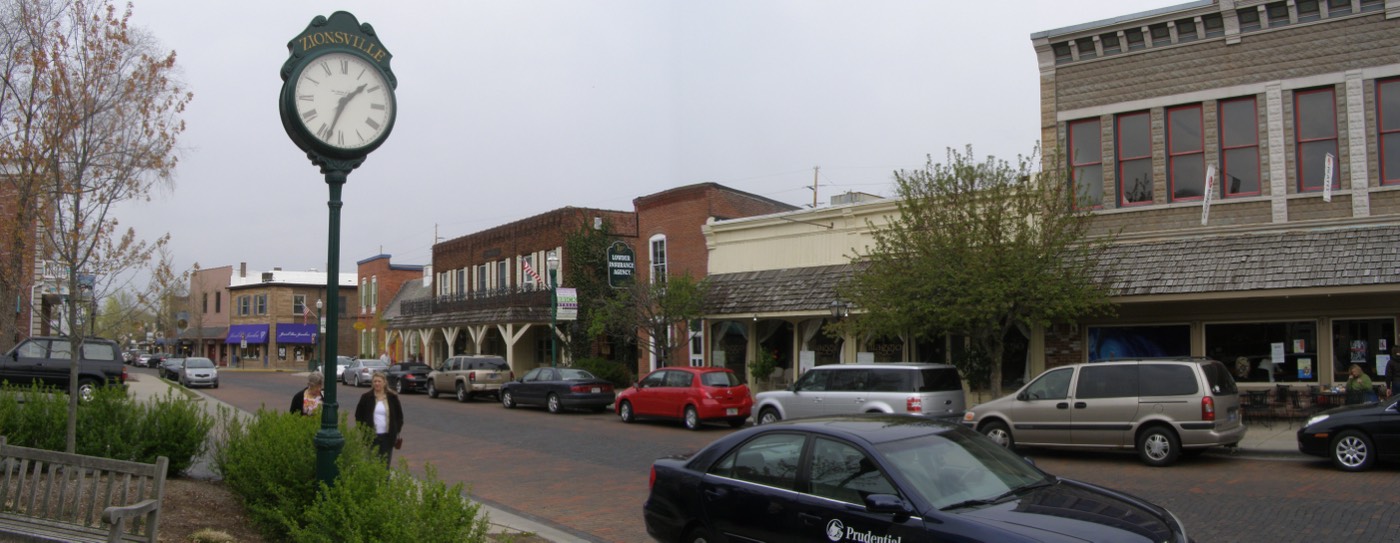
On a Saturday in autumn, the brick-paved length of Main Street in Zionsville fills with families browsing the boutiques, and among them, more and more often, are the Indians of Zionsville: parents pushing strollers past the old depot, teenagers carrying boba, grandparents who flew in from Hyderabad for a long visit. The village looks like a film set of small-town America. The people walking through it increasingly came from somewhere else.
The Place
Zionsville sits in the south-eastern corner of Boone County, roughly twenty miles north-west of downtown Indianapolis. It was platted in 1852 along the Indianapolis, Cincinnati and Lafayette Railroad and named for William Zion, a Lebanon businessman who helped bring the depot but never lived there.
What survives from that era is the thing residents love most: a brick-paved Main Street lined with preserved nineteenth-century storefronts, a village core wrapped in more than 800 acres of parks. Around that small historic heart, a far larger modern town has grown.
It is one of the wealthiest places in Indiana. The median household income runs above $170,000, and the schools rank at or near the top of the state. That combination, old-village charm plus new-money schools, is exactly what has drawn a particular kind of newcomer.
How It Became Indian
The Indian presence in Zionsville is not the story of a single ship or a single year. It is the slow accumulation of professionals who came to central Indiana for work and then, when it was time to choose where their children would grow up, chose the town with the best schools they could find.
The pharma and science corridor
Indianapolis is a life-sciences city. Eli Lilly, founded there in 1876, is its defining employer, and the metro has spent decades building an ecosystem of pharmaceutical, agricultural and animal-health research around it.
Out of that ecosystem grew DowElanco, a 1989 joint venture between Dow Chemical and Eli Lilly that became Dow AgroSciences and, eventually, Corteva Agriscience, which established its global headquarters in Indianapolis in 2022. In 2023 the federal government designated Indiana a tech hub called Heartland Bioworks, anchored on exactly this cluster of Lilly, Corteva and Elanco.
Industries like these run on chemists, engineers, statisticians and data scientists, and a meaningful share of that talent has arrived from India over the past three decades. India is the second most common birthplace among Indiana’s foreign-born residents, after Mexico, with tens of thousands of people. Many of them landed first in apartments closer to the labs, then began looking north-west for a house and a school district.
The school migration
For many Indian families in the Indianapolis area, the decision to move to Zionsville was, at heart, a decision about Zionsville Community Schools. The district consistently ranks among the top handful in Indiana. Zionsville Community High School has placed near the top of the state’s rankings for years, and Pleasant View Elementary has been rated the number-one elementary school in Indiana.
For households that crossed an ocean partly so their children could compete academically, that ranking is not a detail. It is the whole argument. Word travelled through workplaces and WhatsApp groups: if you can afford Zionsville, send your kids to Zionsville.
So the migration compounded on itself. One engineer at a Lilly or Corteva campus bought a house near a top-rated elementary, told a colleague, and the colleague followed. Affluent suburbs grow their immigrant communities this way, one trusted recommendation at a time, the same dynamic that built the Indian community in Dublin, Ohio and the Indian families of Mason, Ohio, both Midwestern suburbs chosen above all for their schools.
Spilling into Whitestown and Anson
As demand outran the older parts of Zionsville, families pushed into the newer subdivisions on the town’s western and southern edges, and into neighbouring Whitestown, the fastest-growing municipality in Indiana. Whitestown’s population grew more than 700 percent between 2000 and 2020.
Much of that growth clusters around Anson, a master-planned, mixed-use development begun in 2005 that filled the corridor between Zionsville and the interstate with new homes, superstores and shopping. For a young Indian family priced into a tight market, an Anson-area house with a Zionsville or Whitestown address offered new construction, good schools and neighbours who were also figuring out a new country.
Whitestown leaned into it. In 2015 its town council unanimously passed a resolution promoting diversity and inclusion, among the first Indiana communities to do so, an unusual gesture for a small town that had just discovered how quickly it was changing.
A community that organises itself
What knits these scattered subdivisions together is not a single neighbourhood but a calendar. Diwali gatherings, Holi colour throws in spring, Telugu and Tamil and Gujarati association events, temple festivals and weekend language classes give families a reason to find one another across the metro’s north-west arc.
The Indian families of Zionsville are not a single bloc. They are Telugu speakers from Andhra and Telangana, Gujaratis, Tamils, Hindi-speaking north Indians and others, drawn together less by a shared mother tongue than by a shared situation: skilled, recent, raising American children in a very good school district.
The Landmarks
Desi Chowrastha, 7107 Whitestown Parkway, Zionsville. An Indian eatery on the parkway that threads Zionsville into Whitestown, serving Irani chai, dum biryani, live chaat and dosa in the street-food style of Hyderabad and the south. For families who miss the noise and steam of an Indian roadside stand, the name itself, chowrastha, the crossroads, is a small homecoming.
Hindu Temple of Central Indiana, 3350 North German Church Road, Indianapolis. The oldest Hindu temple in Indiana, opened in 2006 on the metro’s east side. A $10 million expansion in 2015 added an 11,000-square-foot worship hall with seventeen shrines and a main tower rising nearly 100 feet. It is a long drive from Zionsville, which says something true: the community’s homes spread west while its central temple stood east, so the faithful learned to cross the whole city for a festival.
Patel Brothers, 6302 East 82nd Street, Indianapolis. The national Indian grocery chain that, for many families, is the first stop after a move. Lentils, atta, fresh curry leaves, mango pulp by the case and a puja aisle. There is a second Indianapolis location on West 38th Street, and a run to either is a standing weekend errand for Zionsville households.
Zionsville Community High School. The reason a great many of these families chose the town at all. Ranked among the very top high schools in Indiana for a decade, it is the institution that turned a string of job offers into a settlement, the place where Indian-American teenagers run for student council and crowd the AP courses.
Pleasant View Elementary School, Zionsville. Rated the number-one elementary school in Indiana, the kind of statistic that travels through immigrant networks faster than any advertisement. For parents who measure a town by its youngest classrooms, this is the headline.
The Anson development, Whitestown. The master-planned corridor of new homes and retail, begun in 2005, that absorbed much of the overflow when older Zionsville filled up. Many of the area’s newest Indian arrivals bought their first American house here, on streets where half the neighbours are also newcomers.
Main Street, Zionsville. The brick-paved historic core, with its boutiques, parks and small-town festivals. It is the postcard that sold the town, and on weekends it is where Indian families and their neighbours mingle in the most ordinary way: at the ice-cream window, at the farmers’ market, on the green.
Where They Came From
The Indians who settled around Zionsville came overwhelmingly through work and education rather than through any older chain of family migration. They are first-generation professionals: people who earned degrees in India or arrived for graduate school, took jobs in pharmaceuticals, agriculture, software, engineering and medicine, and built lives in central Indiana.
The largest thread is Telugu, from Andhra Pradesh and Telangana, mirroring the broader pattern of Indian tech and pharma migration to the American Midwest, visible too among the Indian community of Novi, Michigan. Alongside them are Gujaratis, Tamils, and Hindi-speaking families from across the north.
What they share is not a single home region but a single decision point. They arrived for a job, weighed where to raise children, and let the school rankings of Boone County make the choice. The origin story of Indian Zionsville is written less in the geography of India than in the spreadsheet of a relocating family.
Zionsville Today
Today Asians make up around 4.3 percent of Zionsville’s roughly 32,000 to 34,000 residents, a higher share than Indiana as a whole, and Indians are a large part of that count. The number understates the everyday reality, because the community spills across the line into Whitestown and the unincorporated subdivisions between them, and because it skews young, concentrated in the families with school-age children.
It is an honest, undramatic kind of belonging. There is no Indian commercial strip in Zionsville the way there is in the established Indian enclaves of suburban Chicago or Dallas. The grocery runs and the big temple still mean a drive across the metro. What the town offers instead is the thing the families came for: quiet streets, excellent schools and a brick Main Street that does not much care where you were born.
That is the trade Indian Zionsville made, and most who made it would make it again. They gave up the density and convenience of a bigger desi hub for a top-ranked classroom and a safe cul-de-sac. The community they built is dispersed and professional, held together by festivals, temple weekends and the schools that drew them in the first place.
Frequently Asked Questions
How many Indians live in Zionsville, Indiana?
Asian residents make up about 4.3 percent of Zionsville’s population of roughly 32,000 to 34,000, which is around 1,370 people, and Indians are a significant portion of that group. The figure understates the wider community, which spreads into neighbouring Whitestown and the subdivisions between the two towns.
Why did Indians settle in Zionsville?
Most Indians in Zionsville came to central Indiana for work in pharmaceuticals, agriculture, engineering, software and medicine, anchored by employers like Eli Lilly and Corteva Agriscience. They then chose Zionsville specifically for its schools, which rank among the very best in Indiana.
What languages do Indian families in Zionsville speak?
The community is mixed, with a large Telugu-speaking population from Andhra Pradesh and Telangana, alongside Gujarati, Tamil and Hindi-speaking families. Many households are bilingual, raising children who speak English at school and a mother tongue at home.
Is there a Hindu temple near Zionsville?
The Hindu Temple of Central Indiana, the oldest Hindu temple in the state, opened in 2006 and sits at 3350 North German Church Road on the east side of Indianapolis. It is a notable drive from Zionsville, so attending festivals there means crossing much of the metro.
Where do Indian families in Zionsville buy groceries and eat?
Desi Chowrastha at 7107 Whitestown Parkway serves South Indian and Hyderabadi street food close to home, while Patel Brothers, with Indianapolis locations on East 82nd Street and West 38th Street, is the standard weekend stop for Indian groceries and puja supplies.
What makes Zionsville attractive to Indian professionals?
Indians in Zionsville are drawn by the combination of top-ranked schools, including a high school and an elementary school that rank among the best in Indiana, with safe neighbourhoods and proximity to the Indianapolis life-sciences job market. It is a place chosen for the next generation as much as the current one.
If your family’s story passed through Zionsville, or any of the places Indians have made home in America, Atlas of Home can trace that journey. From a graduate degree and a first job in the Indianapolis life-sciences corridor, to a brick Main Street and a top-ranked classroom in Boone County, to wherever you are now.