
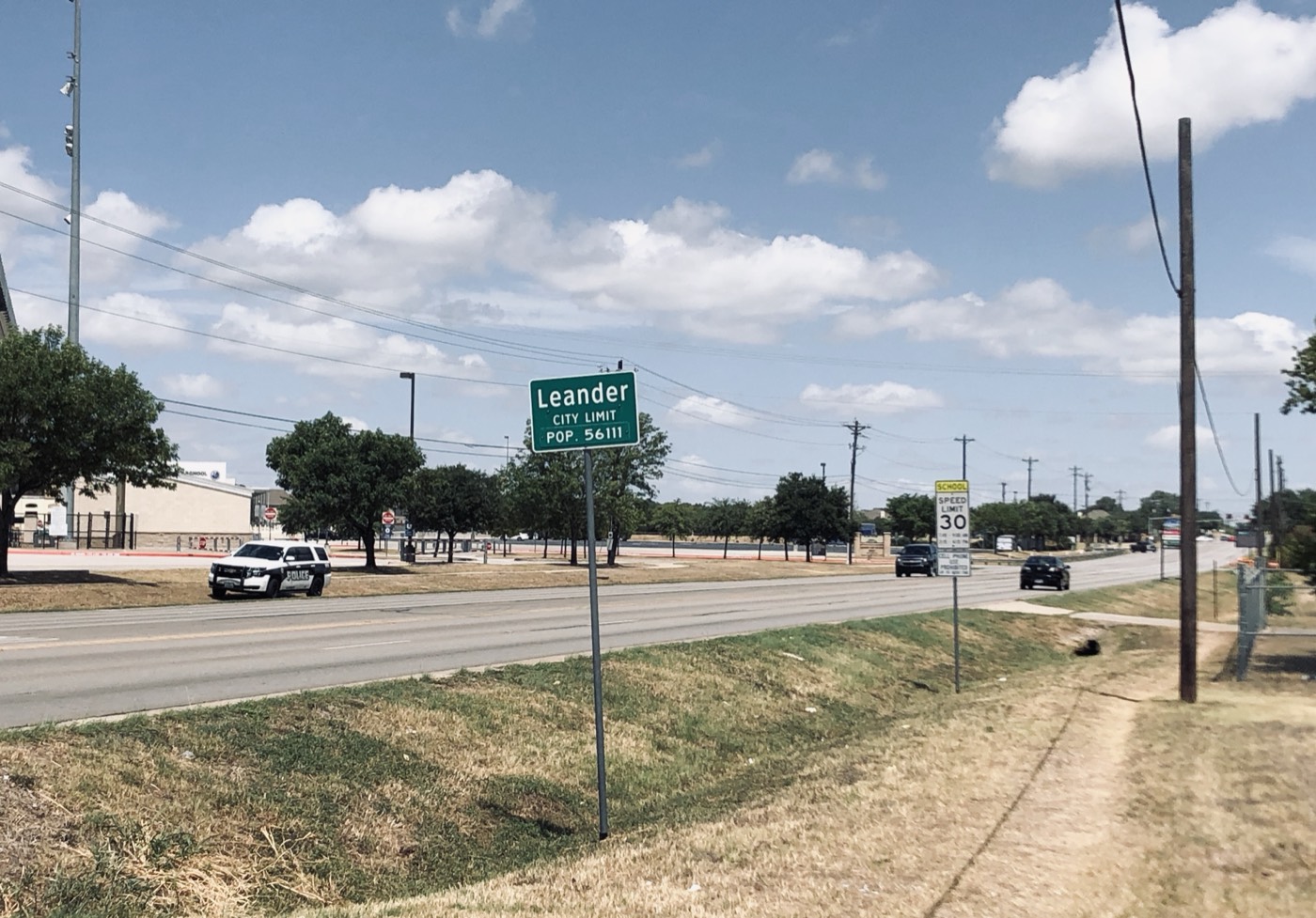
Drive north out of Austin on the 183A toll road and the Hill Country opens up into something newer: rooflines that did not exist a decade ago, schools with fresh paint, and a Saturday morning queue outside an Indian grocer that smells of cardamom and frying mustard seed. The Indians in Leander, Texas did not inherit an old neighbourhood. They built one, almost overnight, on land that was cattle pasture inside living memory.
The Place
Leander sits roughly 22 miles northwest of downtown Austin, straddling Williamson and Travis Counties, five miles west of Georgetown. It was established in 1882 on land sold by the Austin and Northwestern Railroad and named for Leander “Catfish” Brown, a railroad official who helped finish the line.
For more than a century it stayed small, a farming stop on the rail. Then the suburbs of Austin caught up with it. Between 2018 and 2019 Leander was the fastest-growing city in the United States, and its population leapt from 26,521 in 2010 to 59,202 in 2020.
That growth brought a new kind of resident. By the 2020 census Leander was about 10 percent Asian, a figure almost unimaginable for a Central Texas railroad town a generation earlier.
How It Became Indian
The Indian story in Leander is really the story of greater Austin’s transformation into a chip-making and software capital, and of families pushing outward in search of bigger houses and better schools than the inner suburbs could still afford.
The Austin tech corridor moves north
For decades the centre of gravity for Austin’s Indian engineers was south and central: Dell in Round Rock, the chip fabs and software campuses scattered around the city. Williamson County became, in the words of local boosters, a technology superhighway, with Dell’s world headquarters in the centre and major employers spreading east and west across the county.
Apple’s vast campus rose on the northwest side, off Parmer Lane, drawing thousands of engineers and operations staff within easy reach of the northern suburbs. NXP Semiconductors ran two fabs in Austin and announced a multibillion-dollar expansion. The map of where a software engineer or a process technician might work kept tilting northward.
For an Indian engineer arriving on an H-1B visa, the calculation was simple. The jobs clustered in a ring around the northern half of the metro, the commutes from the older inner suburbs were getting longer, and the new building was happening up the toll road in Leander. Where the work went, the families followed.
Cedar Park fills, then spills
The first Indian families in this corridor largely settled in Cedar Park and Round Rock, the established suburbs just to the south and east. Those towns built the first temples, the first grocers, the first Saturday Carnatic music classes. You can trace that earlier wave in the histories of the Indians in Cedar Park and the Indians in Round Rock.
But Cedar Park filled in. Lots grew scarce and prices climbed. Leander, immediately to the north along the same 183A corridor, still had open land and builders willing to put up four and five bedroom houses at prices a young dual-income family could reach.
Schools as the deciding factor
For most of these families the deciding factor was Leander Independent School District. The district built a reputation for STEM and robotics, and its high schools rank among the strongest in the Austin area. Vandegrift High School, inside the district, consistently sits near the top of regional STEM rankings.
That reputation travels fast within Indian professional networks. A family weighing a move compares STAAR scores and Advanced Placement offerings the way an earlier generation compared commute times. Leander ISD’s record made the new subdivisions an easy sell, and word spread household to household, cousin to cousin.
The MetroRail and the daily geography
Leander also anchors the northern end of Capital Metro’s Red Line. The Leander Station park-and-ride, with hundreds of parking spaces, gives commuters a rail link toward downtown Austin, one more reason a family could live this far out and still reach a central office.
Samsung and the next chapter
The newest pull is to the east. In Taylor, also in Williamson County, Samsung committed at least 17 billion dollars to an advanced semiconductor fab, with operations ramping up in 2026. For the Indian engineers and technicians drawn to that project, Leander sits within a reasonable drive, and the subdivisions kept filling as the fab rose.
Each of these threads, Apple to the west, Dell in the centre, Samsung to the east, runs through the same set of northwest suburbs. Leander, late to fill, became the place where the overflow landed.
The Landmarks
India Bazaar, 14300 Ronald Reagan Blvd, Building 5, Leander. A full Indian and international grocery in a new shell building on Ronald Reagan Boulevard, stocking fresh produce, dals, spices and the familiar brands a homesick kitchen needs. Its arrival was a marker: a chain that follows demand does not open in a town until the demand is unmistakable.
Bawarchi, 15881 Ronald Reagan Blvd, Leander. Known for its biryani and dosa, with Hyderabadi dum biryanis in chicken, goat, paneer and vegetable. On weekends the dining room fills with families who have just come from grocery runs and temple visits along the same road.
House of Chettinad, serving Leander and the wider Austin area. A South Indian kitchen built around Chettinad cuisine, the fiery cooking of Tamil Nadu, with biryanis, curries, dosas and grilled meats. It speaks to how specific the community has become: not just Indian food, but regional Indian food for diners who know the difference.
Sri Venkateswara Temple of Austin, 2509 W New Hope Dr, Cedar Park. Just south of Leander, this Balaji temple shares a nine-acre site with the Sri Shirdi Sai Baba Temple. For many Leander families it is the nearest place to mark a birthday with an archana or to bring a newborn for a first blessing.
Hare Krishna Temple of Austin, 1003 Adventure Ln, Cedar Park. A short drive from Leander’s southern subdivisions, it offers kirtan, festival meals and a steady rhythm of worship that anchors the week for devotee families.
Radha Madhav Dham, 400 Barsana Rd, Austin. Set on more than 200 acres in the hills southwest of the city, it is the oldest Hindu temple in Texas and among the largest temple complexes in the Western Hemisphere. The drive is long from Leander, but for a major festival or a pilgrimage it remains the region’s grandest destination.
Lakewood Park, Leander. Home to the Leander Diwali Festival, organised by the Brahm Foundation, which bills itself as one of the largest open Diwali celebrations in Texas, with stage performances, dozens of food and craft vendors, and an evening light show. For one autumn afternoon the city’s newest residents take over a public park and make it unmistakably their own.
Where They Came From
The Indians filling Leander’s subdivisions come overwhelmingly through the professional and student visa pipeline rather than older family-chain migration. They are software engineers, semiconductor process engineers, data and product people, and the spouses and children who follow them.
The regional origins skew toward the source states of India’s tech workforce. Telugu speakers from Andhra Pradesh and Telangana are a large presence, which helps explain the prominence of Hyderabadi biryani and South Indian kitchens along Ronald Reagan Boulevard. Tamil, Kannada and North Indian Hindi-belt families round out the mix.
Many arrived first elsewhere in the United States, on a campus in the Midwest or a first job in another tech hub, before an Austin offer brought them to Texas. Leander, with its new houses and strong schools, became the place to finally put down roots once the green card or the second promotion made it feel permanent.
It is a pattern visible across the Texas suburbs that have absorbed Indian professionals over the past decade. The families tend to be young, with children in primary and middle school, and the parents in their thirties and forties at the centre of their careers. That demographic shapes everything from the weekend Carnatic and Bharatanatyam classes to the cricket pickup games that appear on suburban fields once the Texas heat eases in the evening.
Leander Today
Leander remains, on paper, a fast-growing suburb where the largest groups are still White and Hispanic residents, and where the Indian share, while rising, is a minority within a 10 percent Asian population. This is not a Devon Avenue or a Mahatma Gandhi District. It is something newer and quieter: an Indian community woven into ordinary subdivisions rather than concentrated on a single commercial strip.
What gives it away is the supporting cast that has grown up to serve it. The grocer on Ronald Reagan, the biryani houses, the temples a few miles south, the Diwali festival that takes over a public park. These are the institutions a community builds when it intends to stay.
The honest picture is of a place still being made. Some families will move on as Samsung’s Taylor fab reshapes the eastern county, or as children leave for college. But the schools, the jobs and the houses that drew them are not going anywhere, and neither, for now, are they. The story of Indians in Frisco up in the Dallas suburbs, and of the older, denser Indian community of Houston’s Mahatma Gandhi District, suggests where a place like Leander may be heading.
Frequently Asked Questions
How large is the Indian community in Leander, Texas?
Leander was roughly 10 percent Asian at the 2020 census, with Indians a growing share of that group rather than a measured majority. The community is still young and dispersed across new subdivisions, but its grocers, restaurants and festivals point to a substantial and rising Indian presence.
Why did Indians move to Leander rather than Austin proper?
The pull was newer, more affordable family houses and the strong, STEM-focused Leander ISD, all within reach of the tech jobs ringing Williamson County. As nearby Cedar Park and Round Rock filled in, Leander offered the open land and school quality young Indian professional families were looking for.
Where do the Indians in Leander, Texas work?
Most work in the Austin-area technology economy: Apple’s northwest campus, NXP’s Austin fabs, Dell in Round Rock, and increasingly Samsung’s new semiconductor fab in nearby Taylor. The roles run from software and data to semiconductor process engineering.
Are there Indian grocery stores and restaurants in Leander?
Yes. India Bazaar opened a full grocery on Ronald Reagan Boulevard, and restaurants such as Bawarchi and House of Chettinad serve biryani, dosa and regional South Indian dishes. The corridor along Ronald Reagan has become the everyday hub for Indian Leander.
Where is the nearest Hindu temple to Leander?
The closest temples are just south in Cedar Park: the Sri Venkateswara (Balaji) Temple and the adjoining Sri Shirdi Sai Baba Temple on West New Hope Drive, plus the Hare Krishna Temple of Austin. The larger Radha Madhav Dham sits southwest of Austin for major festivals and pilgrimage.
Does Leander celebrate Diwali?
It does. The Leander Diwali Festival, organised by the Brahm Foundation at Lakewood Park, is billed as one of the largest open Diwali celebrations in Texas, with performances, food and craft vendors and an evening light show that fills the park each autumn.
If your family’s story passed through Leander, or any of the places Indians have made home in America, Atlas of Home can trace that journey. From a hometown in Telangana or Tamil Nadu to a new-build street off Ronald Reagan Boulevard, to wherever you are now.