
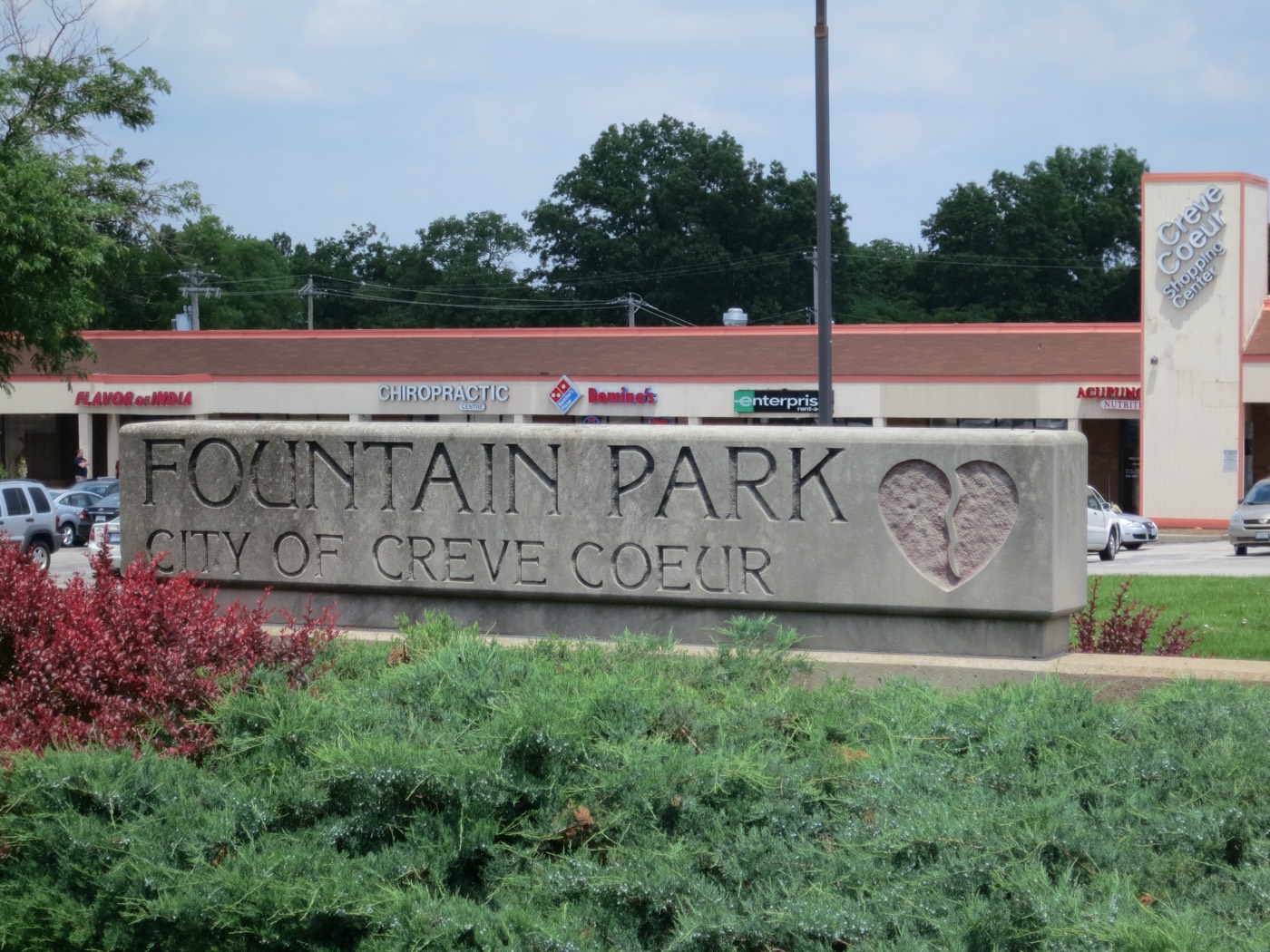
Drive west on Ladue Road past the fountains and the old-growth oaks, and somewhere around Spoede the synagogues begin to appear. A modernist sanctuary by a famous architect. A Conservative congregation with a deli down the road. A community centre on a campus named for a single family. The Jews in Creve Coeur, Missouri did not arrive here all at once. They walked west across St. Louis for a hundred and fifty years, and this quiet, affluent suburb in the middle of the county is where the largest share of them finally settled.
The Place
Creve Coeur sits in the geographic centre of St. Louis County, about fifteen miles west of the Gateway Arch. The name is French for “broken heart,” tied to a local legend about a heartbroken Native American woman and the oxbow lake that bears the same name. The city was incorporated in 1949 and recorded 18,834 residents in the 2020 census.
It is one of the wealthier municipalities in the region, with a median household income near $94,852 and the third-highest assessed property value of any city in St. Louis County. Bayer, the former Monsanto headquarters, sits here, as do Mercy Hospital and the Donald Danforth Plant Science Center.
None of that is why the suburb matters to Jewish St. Louis. It matters because of what lines its central roads: the synagogues, the schools, the kosher counters, and a 50-acre campus that functions as the community’s living room.
How It Became Jewish
To understand why the Jews in Creve Coeur ended up here, you have to follow a slow westward march that began on the riverfront and never really stopped.
The near north side, then west
The first Jewish settlement in St. Louis was not in any suburb. It was a dense, immigrant quarter on the near north side, roughly between Cass Avenue and Delmar Boulevard, spreading inland from the river. By 1855, two German Jewish congregations, Emanu El and B’nai B’rith, merged to form B’nai El, building the first synagogue in the city on Sixth Street. By 1900 around 40,000 Jews lived in St. Louis.
As families prospered, they moved west, the way nearly every American Jewish community has moved away from its first port of entry. First to Jefferson Avenue, then to Grand, then into the Central West End by the 1940s.
University City, the great middle chapter
The next stop was the one St. Louis Jews still talk about: University City, the streetcar suburb just over the city line, anchored by Delmar Boulevard. For much of the twentieth century “U. City” was the heart of Jewish St. Louis. Synagogues, delis, bakeries, and the old Jewish Community Centre all clustered there, and the neighbourhood remains home to a large Orthodox community and roughly 18 per cent of the area’s Jewish households today, counted together with neighbouring Clayton.
That deep history is why a place like University City still echoes in conversations about every newer Jewish suburb, in the same way the Jews in Skokie, Illinois grew out of older Chicago neighbourhoods further east. The institutions did not vanish from U. City. They simply began opening second homes further west.
The push past Lindbergh
The decisive move came in the 1950s and 1960s, when several of the city’s oldest congregations followed their members out to St. Louis County. The pattern is almost a template for postwar American Jewry, the same suburban arc you can trace among the Jews in Scarsdale, New York or the Jews in Boca Raton, Florida.
Reform’s Temple Israel, founded back in 1886, built a striking new home at Spoede and Ladue roads in Creve Coeur in 1962. Traditional Congregation, formed in 1966, became the first synagogue west of Lindbergh Boulevard in West County. The Conservative Congregation B’nai Amoona, established in 1882, had already moved its sanctuary to Creve Coeur in 1949 and opened a larger building on South Mason Road in 1986.
By the time the dust settled, Creve Coeur and its immediate neighbours held the institutional centre of gravity. A 2024 community study found that about 24 per cent of Jewish households in greater St. Louis now live in the Creve Coeur area, the single largest concentration in the region.
The campus that anchored it
What turned a cluster of synagogues into a true centre was the Millstone Campus, a roughly 50-acre property in Creve Coeur that became the home of the Jewish Community Center and the Jewish Federation of St. Louis. With the JCC, the Federation, a mikvah overseen by the Vaad Hoeir, and a Holocaust museum all on or beside the same campus, families had a reason to orient their whole week around this stretch of the county. The schools and groceries followed.
The Landmarks
Congregation Temple Israel, 1 Rabbi Alvan D. Rubin Drive. This Reform congregation, founded in 1886, has occupied its Creve Coeur campus at Spoede and Ladue since 1962. The modernist sanctuary, with its dual-hexagon plan and capacity for 2,200 worshippers at the High Holidays, was designed by St. Louis architect Gyo Obata of HOK. It is the most architecturally famous synagogue in the county.
Congregation B’nai Amoona, 324 South Mason Road. Founded in 1882 by members who split from an Orthodox congregation, B’nai Amoona became one of St. Louis’s leading Conservative synagogues. Its earlier Trinity Avenue building is on the National Register of Historic Places; the current home on South Mason Road was completed in 1986, a few hundred yards from the day school that shares the street.
The J, Staenberg Family Complex, 2 Millstone Campus Drive. The Jewish Community Center’s main building sits on the I. E. Millstone Campus and functions as the community’s hub: fitness, early childhood, day camp, theatre, and gathering space. For families across West County, “the J” is shorthand for where everyone ends up.
Jewish Federation of St. Louis, 12 Millstone Campus Drive. The Federation’s home on the campus, long known as the Kopolow Building and rededicated as the Kaplan Feldman Complex, is the organisational heart of Jewish St. Louis, coordinating fundraising, social services, and the community studies that map exactly where everyone lives.
Saul Mirowitz Jewish Community School, 348 South Mason Road. A pluralistic K-8 day school sitting directly across from B’nai Amoona, Mirowitz draws families who want a Jewish education alongside the strong public options of the Ladue and Parkway districts. Its location on South Mason makes that block one of the densest stretches of Jewish institutional life in the county.
Simon Kohn’s, 10401 Old Olive Street Road. For more than six decades Kohn’s was the region’s only free-standing full-service kosher grocery, butchery, and deli, under the supervision of the Vaad Hoeir. Generations bought brisket and corned beef here before holidays. Its closure after 63 years was front-page news in the Jewish Light, a reminder of how much a single deli can hold for a community.
Traditional Congregation, Creve Coeur. Organised in 1966, Traditional Congregation has the distinction of being the first synagogue west of Lindbergh Boulevard, an early flag planted in West County that signalled where the community was heading.
Where They Came From
The deepest layer of Jewish Creve Coeur is German. The congregations that anchor the suburb, Temple Israel and the early Reform institutions, trace back to the German Jewish immigrants who built St. Louis Jewry in the mid-1800s and who founded the first synagogue on Sixth Street in 1855.
A second wave, Eastern European Jews from the Russian Empire and Poland arriving around the turn of the twentieth century, settled the near north side and gave rise to the Orthodox and Conservative congregations, B’nai Amoona among them, that later moved west.
The crucial point is that almost no one came to Creve Coeur directly from abroad. They came from University City and Clayton, from Olivette and the Central West End, each generation buying a little further out the Ladue Road corridor until the centre of the community sat in the middle of the county.
Creve Coeur Today
Creve Coeur is not a Jewish town the way an Orthodox enclave like the Jews in Borough Park, Brooklyn defines a neighbourhood. It is an affluent, mixed American suburb where the single largest Jewish concentration in the region happens to live, and where the community’s most important institutions happen to stand.
Walk South Mason Road on a weekday morning and the rhythm is unmistakable: children arriving at Mirowitz, cars turning into B’nai Amoona, the Millstone Campus filling up. The synagogues here are large, multi-generational, and well established. The kosher landscape is thinner than it once was, with Kohn’s gone and supervision now spread across a few smaller operators, a shift the community feels keenly.
There is also a counter-current worth naming. The same studies that put a quarter of Jewish households in Creve Coeur also record younger adults drifting back toward the city, to Forest Park, the Central West End, and Tower Grove. The westward march of a century may finally be slowing. For now, though, the heart of Jewish St. Louis still beats along Ladue Road, exactly where the congregations planted it.
Frequently Asked Questions
Why do so many Jews live in Creve Coeur, Missouri?
The Jews in Creve Coeur are the product of a long westward migration across St. Louis, from the near north side to University City and Clayton and finally into West County. A 2024 community study found roughly 24 per cent of the area’s Jewish households now live in the Creve Coeur area, the largest single concentration in the region, drawn by synagogues, schools, and the Millstone Campus.
What synagogues are in Creve Coeur?
Creve Coeur is home to Reform’s Temple Israel (at Spoede and Ladue since 1962), the Conservative Congregation B’nai Amoona (on South Mason Road), and Traditional Congregation, the first synagogue built west of Lindbergh Boulevard. Several other congregations sit just beyond its borders in neighbouring suburbs.
What is the Millstone Campus?
The I. E. Millstone Campus is a roughly 50-acre property in Creve Coeur that houses the Jewish Community Center’s Staenberg Family Complex, the Jewish Federation of St. Louis, a community mikvah, and a Holocaust museum nearby. It is the institutional centre of Jewish life for the entire metro area.
How did the St. Louis Jewish community end up in the suburbs?
Like many American Jewish communities, St. Louis Jewry moved steadily away from its first immigrant quarter. Families left the near north side for Jefferson and Grand avenues, then the Central West End and University City, then pushed past Lindbergh Boulevard into Creve Coeur and West County during the postwar decades.
Is there kosher food in Creve Coeur?
For more than 60 years Simon Kohn’s on Old Olive Street Road was St. Louis’s only free-standing full-service kosher grocery and deli. After its closure, kosher supervision in the area continued through the Vaad Hoeir and a handful of smaller operators, though the loss of Kohn’s was deeply felt.
What is the relationship between Creve Coeur and University City?
University City was the earlier heart of Jewish St. Louis and remains home to a large Orthodox community. Many of the congregations and families now in Creve Coeur came directly from University City and Clayton, making the two suburbs successive chapters in the same westward story rather than rivals.
If your family’s story passed through Creve Coeur, or any of the places Jews have made home in America, Atlas of Home can trace that journey. From the German and Eastern European congregations of old St. Louis, to a sanctuary at Spoede and Ladue, to wherever you are now.