
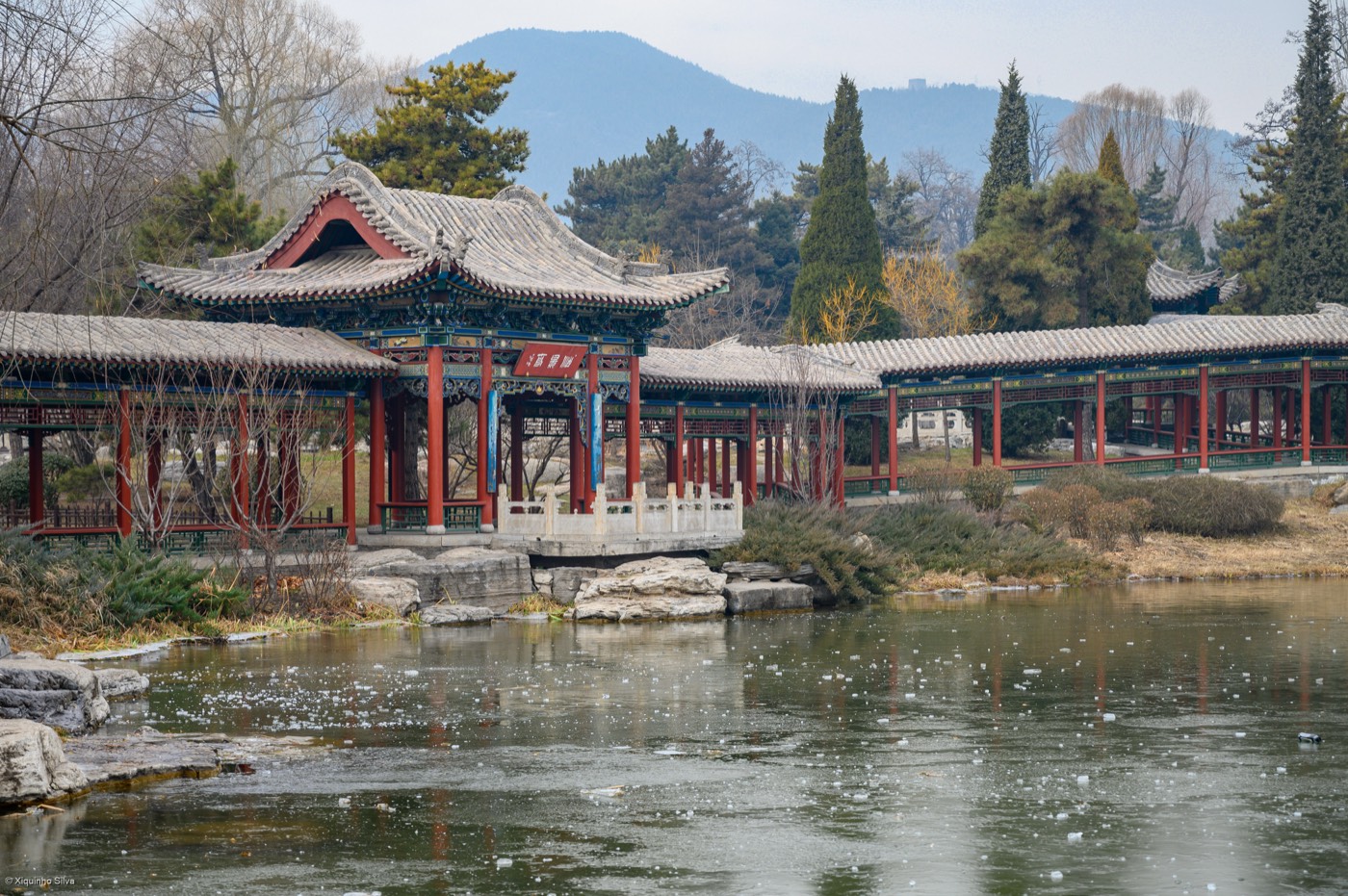
The Wang surname means king. Written 王 in Chinese, it is the most common surname on earth, and its oldest lineages belong to the royal houses of northern China, not the Cantonese south that most Chinese American families came from.
What Does the Surname Wang Mean?
Wang means “king”. It is the Mandarin pinyin spelling of 王, the character for a monarch, and it is carried by roughly 100 million people in mainland China, more than any other surname in the world.
The character is four strokes: three horizontal lines crossed by one vertical. The classical gloss in Xu Shen’s Shuowen Jiezi, around 100 AD, reads the three lines as heaven, earth and humanity and the vertical as the ruler who joins them. It is a lovely explanation and a late one. Palaeographers reading the oracle bone forms see the blade of a great axe, the weapon that stood for the power to execute.
A Wang family is not claiming that an ancestor ruled. The name records a relationship to a throne, usually a lost one, and that explains almost everything that follows.
Where the Wang Name Comes From
The Wang name comes from northern and central China, above all Shanxi, Shandong and Henan. Its two most celebrated lineages are the Wang clan of Taiyuan in Shanxi and the Langya Wang of Shandong.
Prince Jin and the Zhou Royal House
The best known descent claim runs to Crown Prince Jin, son of King Ling of Zhou, who died around 545 BC. Jin is said to have opposed his father’s plan to dam the Gu and Luo rivers, to have been reduced to commoner status for saying so, and to have left descendants known as the king’s family, wangjia, and in time simply as Wang. His son Zongjing settled at Taiyuan, and seventeen generations later the tradition names two brothers, Wang Yuan and Wang Wei, as founders of the Langya and Taiyuan branches.
Read that as inherited lineage tradition rather than documented genealogy. It survives in clan books compiled centuries after the events, and what it reliably records is what Wang families have believed about themselves, which is a historical fact of a different kind.
The Great Clans
The Langya Wang, founded around 207 BC, became the most powerful non-imperial family of the Eastern Jin, so dominant that “the Wang and the Xie” was shorthand for aristocracy itself. The calligrapher Wang Xizhi was born into it. The Taiyuan Wang were their northern equals, and both supplied chancellors to the Tang.
Why There Are So Many Wangs
One prince cannot account for 100 million people, and the tradition never claimed he did. The name grew by a pattern that repeated for two thousand years: when a royal house fell, its descendants kept the word for king as their name. So there are Wangs traced to the Ji house of Zhou, to the Gui line said to descend from the sage-king Shun, to the fallen Shang and to the deposed royal family of Qi, along with non-Han families granted the name under later dynasties.
Wang is therefore not one family that grew large. It is a category many unrelated families entered independently, which is why two Wang lines may share nothing beyond the reason their ancestors reached for the word.
Spelling Variants and Related Names
The character 王 has never changed. Only the way each Chinese dialect says it and each clerk wrote it down. It is Wang in Mandarin, Wong in Cantonese and Hakka, Ong in Hokkien, Heng in Teochew, Uong in Gan, Wung in Shanghainese and Waang in some older transcriptions.
Wang and Wong Are the Same Name
If your family spells the name Wang, your Cantonese cousins almost certainly spell it Wong, and nothing separates you but dialect.
Going the other way is harder. Wong collapses two unrelated characters, 王 and 黃, meaning yellow, which are exact homophones in Cantonese, and 黃 is much the more common in Guangdong, so most American Wongs turn out to be Huang rather than Wang. Our page on the Wong surname sets out how to establish which character a family carries, and that step comes first.
A Wang in pinyin has no such ambiguity, because Mandarin keeps 王 and 黃 plainly apart. Why one Chinese character produces a dozen English spellings is worked through on our Chen surname page.
Vang: Two Different Names
Vang is listed as a romanisation of 王, and it is also, separately, one of the eighteen clans of the Hmong. These are not the same thing.
The Hmong Vang, written Vaj in the Romanised Popular Alphabet, belongs to the Hmong clan system, with its own lineage rules, funeral rites and marriage prohibitions. 王 is the character conventionally attached to Vaj in Chinese writing, but that is a labelling convention, not descent from Taiyuan. Most American Vangs are Hmong who came as refugees from Laos after 1975, and numbered 48,036 at the 2010 Census, ranking the name 726th.
Wang is also, unrelatedly, a Norwegian, Danish and German surname from an old Norse word for a meadow.
Korean, Vietnamese and Japanese Cognates
In Korean, 王 is 왕, Wang, the surname of the Goryeo royal house founded by Wang Geon in 918. When Goryeo fell in 1392 many bearers changed their name to escape Joseon persecution, which is why the surname is scarce in Korea today. In Vietnamese the character is Vương, and in Japanese Ō.
The Wangs in America
Wangs arrived late, and they arrived with degrees. Nineteenth century Chinese migration to California came almost entirely from the Cantonese counties of the Pearl River Delta, where 王 is uncommon, so the gold rush and railroad generations produced very few Wangs.
The name came instead through universities. An Wang landed in 1945 on a training programme and never left, and after the revolution of 1949 thousands of Chinese students in America simply stayed. From the 1960s Taiwanese graduate students arrived in numbers, and most did not go home.
The 1965 Immigration Act then swept away the national origins quotas and opened preference categories for professionals. In 1979 the United States and the People’s Republic normalised relations, and mainland students began arriving directly for the first time in thirty years, with the Chinese Student Protection Act of 1992 giving permanent residence to tens of thousands.
Because this was professional rather than labouring migration, its American map looks nothing like Chinatown’s. It follows research parks, corporate campuses and school districts.
Monterey Park in the San Gabriel Valley became the first suburb in the country with a Chinese majority, while nearby Walnut drew a heavily Taiwanese professional population and, outside Sacramento, Folsom grew on semiconductor jobs.
The east coast repeats the logic around research employers. Chinese families in Princeton, New Jersey cluster around the university and the pharmaceutical corridor, and Northbrook on Chicago’s North Shore filled up on the strength of its schools.
Notable People Named Wang
Wang Xizhi (303 to 361), of the Langya clan, is regarded as the greatest calligrapher in Chinese history. His Preface to the Orchid Pavilion Gathering is the most copied piece of writing in the tradition, and the original has been lost since the Tang.
Wang Wei (699 to 761) was a Tang poet and painter whose landscape verse became the model for Chinese nature poetry.
Wang Yangming (1472 to 1529) was a Ming philosopher and general, known for the doctrine of the unity of knowledge and action, which shaped Confucian thought in Japan and Korea as much as China.
An Wang (1920 to 1990), born in Shanghai, reached America in 1945 and took a Harvard doctorate in three years. His work on magnetic core memory made early computing possible, and Wang Laboratories, which he founded in 1951, was one of the great American technology companies of the 1970s.
Vera Wang (born 1949) grew up in New York, competed as a figure skater, spent sixteen years at Vogue and opened her bridal house in 1990.
Yuja Wang (born 1987) left Beijing for the Curtis Institute as a teenager and is among the most celebrated pianists of her generation.
How Common Is Wang Today?
Wang ranked 282nd in the 2010 United States Census, with 109,883 Americans carrying the name.
| US rank (2010 Census) | #282 |
|---|---|
| Americans with the name | 109,883 |
| Origin | Chinese (王) |
| Meaning | “King” or “prince” |
That rank understates the name twice over. Millions of 王 bearers appear in American records as Wong, Ong, Heng or Vang, and the American Wangs are only two or three generations deep where the surnames above them have had centuries to multiply.
Of those bearers, 95.24 per cent identified as Asian or Pacific Islander in 2010, 2.59 per cent as white, 1.5 per cent as two or more races, 0.35 per cent as Hispanic and 0.29 per cent as Black. These are self-identification proportions recorded on census forms, not measures of ancestry. That 95.24 per cent is among the highest attached to any American surname, and the white share largely reflects the separate Scandinavian and German Wang.
Frequently Asked Questions
What does the surname Wang mean?
Wang means “king”. It is the Mandarin spelling of the Chinese character 王, taken up by families descended from royal houses that had lost their thrones and were known as the king’s family.
Are Wang and Wong the same surname?
Often, yes. Wong is the Cantonese spelling of 王, so a Wang and a Wong may carry the identical character. But Wong is also used for the unrelated 黃, meaning yellow, which is more common in Guangdong, so a Wong family must establish which character it holds first.
Where does the Wang family come from?
Northern and central China, particularly Shanxi, Shandong and Henan. The two most prestigious lineages are the Taiyuan Wang of Shanxi and the Langya Wang of Shandong, and both claim descent from the Zhou royal house.
How common is the surname Wang?
Wang ranked 282nd in the 2010 US Census with 109,883 bearers. Globally it is far larger: 王 is the most common surname in mainland China, with roughly 100 million bearers.
Is there a Wang family crest or coat of arms?
No. Heraldry grants arms to individuals and their direct descendants, never to everyone sharing a surname, and China has no heraldic tradition of that kind at all. Any site selling you a Wang crest is selling a decoration, not a lineage. What Chinese families do have is the zupu, the clan genealogy book, a real record of descent.
Is the Hmong surname Vang the same as Wang?
No. Vang is one of the eighteen Hmong clans, with its own lineage system and ritual obligations, and most American Vangs are Hmong refugees from Laos and their descendants. The character 王 was attached to the clan name in Chinese writing, but that is a convention, not shared descent.
If your family carries the Wang name, its route from China to America is traceable. Atlas of Home can follow it from a character on a headstone and a village in Shanxi or Shandong to wherever your family landed, and to wherever you are now.