
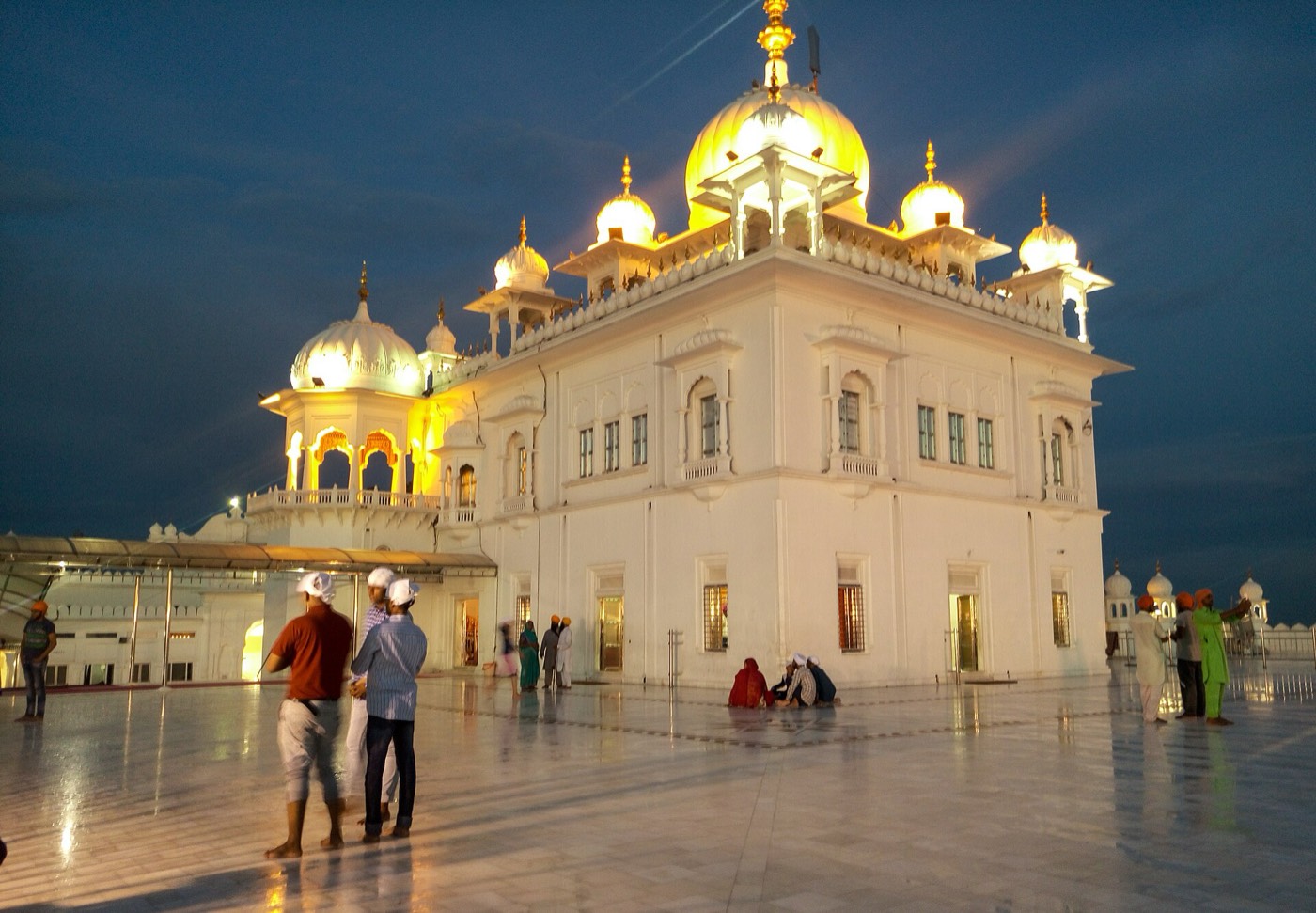
The Singh surname comes from the Sanskrit siṃha, meaning “lion”, and it belongs to the whole of northern India rather than to any one family. For millions of Sikhs it is not a family name at all.
What Does the Surname Singh Mean?
Singh means “lion”. It comes from the Sanskrit siṃha (सिंह), written ਸਿੰਘ in Gurmukhi, and carried the sense of a hero or eminent person long before anyone used it as a surname.
The etymology is not disputed. What is misunderstood is what the word is doing at the end of a name.
Most surnames are a lineage: they say these people descend from one another. Singh does not say that. It began as a title of honour and, for very many who carry it, still works as one.
Two people named Singh are, in the ordinary case, not related at all.
Where the Singh Name Comes From
Singh comes from northern India, and it arrived by two quite different routes: an older Rajput and Kshatriya warrior title, and a deliberate act of religious reform in 1699 that turned it into a name of belonging.
The warrior title, second century onward
Names ending in -simha appear very early: the sons of the Western Satrap ruler Rudradaman bore them in the second century CE, and Jayasimha of the Chalukya dynasty ruled around 500 CE.
Through the medieval centuries it spread among Hindu Kshatriya warriors and kings, the Paramaras in the tenth century, the Guhilots and Kachwahas in the twelfth, the Rathores later. By the sixteenth century Singh was common among Rajputs, marking a man as of the warrior order. So the name had some fifteen centuries as a Hindu martial title before Sikhism existed.
Anandpur, 1699
In 1699 at Anandpur, in the Himalayan foothills of what is now Punjab, Guru Gobind Singh founded the Khalsa. Every initiated Sikh man was to take the name Singh; every initiated woman, Kaur.
The point was abolition. Indian surnames announced caste, and caste announced rank. One shared name for all men and one for all women removed the marker the hierarchy ran on: a Brahmin and a leatherworker who took amrit walked out with the same name. The choice of a Rajput warrior title was not accidental either. It handed the dignity of the martial castes to everybody.
Why so many Sikhs use it as a middle name
Because Singh is universal, it identifies nobody. So many Sikh families place it in the middle and add a further name: a village, or a got (clan) name such as Gill, Sandhu, Dhaliwal, Grewal, Sidhu or Randhawa. The middle name is the covenant; the last name, where there is one, is the family.
That has an awkward consequence, since those trailing names are often the caste and clan markers 1699 set out to retire, a tension argued about openly within Sikh communities today.
Kaur, and why it is not simply the feminine of Singh
Kaur (ਕੌਰ) is usually glossed as “princess”, loosely as “lioness” to pair it with Singh, though nothing in the word means lioness. Scholars trace it either to Sanskrit kumari, a king’s daughter, or to the Rajput title kanwar, prince.
Its force is that a Sikh woman does not take her husband’s name. She is Kaur before marriage and Kaur after, sovereign in her own right, at a moment when almost no woman anywhere held a name independent of a father or husband.
Historians including J.S. Grewal and Doris Jakobsh caution that the evidence for a single 1699 origin is thinner than the popular account allows, and that Singh Sabha reformers in the late nineteenth century did much to fix Kaur as the universal female name, replacing older forms such as Devi and Bai.
Spelling Variants and Related Names
The Sanskrit root siṃha produced a family of names across India, differing by region and script rather than descent.
Script forms: ਸਿੰਘ (Gurmukhi, Punjabi), सिंह (Devanagari, Hindi), ꯁꯤꯡꯍ (Meitei, Manipur).
Regional variants: Sinha and Singha in Bihar and Bengal, Sinh and Simha in western and southern India, with Singhal and Sinham as related formations. Sri Lanka’s Sinhalese take their name from the same lion word.
Transliteration variants: colonial clerks and American immigration officers wrote Sing, Singgh and Sinhg into ship manifests, army rolls and land records. Anyone tracing a Punjabi ancestor through American records before 1950 should search all of them.
Outside Sikhism the name spread widely from the eighteenth century, taken up by Brahmin, Kayastha, Baniya and lower-caste families across the north, and in Bihar and Jharkhand it became firmly tied to local power. It is carried too by Hindus across Rajasthan, Uttar Pradesh and Haryana, by Nepalis, and by the Muslim Shin.
The name is now one of the most widely held on earth. Forebears places it around ninth globally, with roughly 35 million bearers in India alone.
The Singhs in America
The first Singhs in America were Punjabi farmers and labourers who reached the Pacific coast between about 1899 and 1910, some five thousand men, most of them Sikh, most intending to earn and go home.
They worked the lumber mills of Washington, the railroads, then the irrigated valleys of California. In 1912 the Pacific Coast Khalsa Diwan Society opened a gurdwara in Stockton, the first in the country and the centre of Punjabi American life for a generation. Out of that network came the Ghadar Party, founded in San Francisco in November 1913 to end British rule in India by force.
Then the door closed. In United States v. Bhagat Singh Thind, decided on 19 February 1923, the Supreme Court ruled that Indians were not “free white persons” and so could not naturalise. Thind was a Sikh from Punjab who had served in the United States Army in the First World War. Citizenships already granted were revoked, and since California’s 1913 Alien Land Law barred non-citizens from owning land, men who lost their papers lost their farms with them.
Anti-miscegenation law and the near-total absence of Punjabi women produced something unexpected. In the Imperial Valley on the Mexican border, Punjabi men married Mexican and Mexican American women, and over half of California’s Punjabi-Mexican households ended up there. The children were raised Catholic and Spanish-speaking, answering to names like Maria Jesusita Singh, with roti and tortillas on the same table.
The Luce-Celler Act of 1946 restored the right to naturalise. Dalip Singh Saund, an Imperial Valley lettuce farmer with a Berkeley doctorate in mathematics, became a citizen in 1949, a county judge in 1952, and in 1956 the first Asian American and first Sikh elected to Congress.
The Immigration and Nationality Act of 1965 changed the scale entirely. Punjabi farming families followed the old path into California’s Central Valley: the Sikh community of Yuba City, whose November Nagar Kirtan draws tens of thousands, and the Punjabi neighbourhoods of Fresno. Professional migration built Fremont’s Sikh community, the gurdwaras of Richmond Hill in Queens, and the families of Carteret, New Jersey, while Indian American suburbs from Hilliard, Ohio to Lexington, Massachusetts hold plenty of Singhs who are Hindu rather than Sikh.
In the 2010 Census, 82.77 per cent of Americans named Singh self-identified as Asian or Pacific Islander, 4.48 per cent as Black, 4.29 per cent as White and 2.5 per cent as Hispanic. Those are how people described themselves on one form, not a measure of ancestry, and the Black and Hispanic figures track real histories: Indian indentured labour in Guyana and the Caribbean, and the Punjabi-Mexican families of the Imperial Valley.
Notable People Named Singh
Maharaja Ranjit Singh (1780-1839) united the Sikh misls into an empire ruled from Lahore, keeping Punjab independent of the British until a decade after his death.
Bhagat Singh (1907-1931), the Indian revolutionary hanged by the British at twenty-three, remains one of the most recognisable figures of the independence movement.
Dalip Singh Saund (1899-1973) was the first Asian American, and first Sikh, elected to Congress, serving California’s Imperial Valley from 1957 to 1963.
Milkha Singh (1929-2021), the Flying Sikh, was a Partition orphan who became India’s greatest sprinter, fourth in the 400 metres at the 1960 Rome Olympics.
Manmohan Singh (1932-2024), the economist who opened India’s economy in 1991, was Prime Minister from 2004 to 2014, the first Sikh to hold the office.
Vijay Singh (b. 1963), born in Fiji to a family of Indian indentured labourers, won three golf majors and reached world number one in 2004.
How Common Is Singh Today?
Singh is the 260th most common surname in the United States, carried by 116,749 Americans in the 2010 Census, and roughly the ninth most common surname on earth.
| US rank (2010 Census) | #260 |
|---|---|
| Americans with the name | 116,749 |
| Origin | Indian, from Sanskrit siṃha via Punjabi and Hindi |
| Meaning | Lion |
The American count almost certainly understates it, because Singh is so often carried as a middle name that a census form never records.
Frequently Asked Questions
What does the surname Singh mean?
Singh means “lion”, from the Sanskrit siṃha. It began as a title of honour for warriors and kings rather than as a family name, carrying the sense of a hero or an eminent person.
Is Singh Sikh or Hindu?
Both. Singh was a Hindu Rajput and Kshatriya warrior title for well over a thousand years before Guru Gobind Singh gave it to all initiated Sikhs in 1699. It is carried today by Sikhs, by Hindus across northern India and Nepal, and by some Muslim communities.
Where does the Singh family come from?
There is no single Singh family. The name is concentrated in Punjab, Rajasthan, Uttar Pradesh, Bihar and Nepal, but two Singhs are usually unrelated. It marks belonging to a faith or a warrior order rather than descent, much as the Patel surname marks a community rather than a lineage.
How common is the surname Singh?
Around the ninth most common surname in the world, with some 35 million bearers in India alone. In the United States it ranks 260th, held by 116,749 people in the 2010 Census.
Is there a Singh family crest or coat of arms?
No. In every heraldic tradition arms are granted to an individual and pass to direct descendants, never to everyone sharing a surname. For Singh the idea is doubly hollow, since the name was created precisely to erase inherited rank. Anyone selling a Singh crest is selling a decoration.
Why do so many Sikhs use Singh as a middle name?
Because every Sikh man carries it, Singh distinguishes nobody, so families often keep it in the middle and add a village or clan name such as Gill, Sandhu or Dhaliwal. Some Sikhs argue this quietly reintroduces the caste markers 1699 was meant to abolish.
If your family carries the Singh name, its route from Punjab to America is traceable. Atlas of Home can follow it from the villages of the Doaba and the Malwa to the valleys of California, and to wherever you are now.