
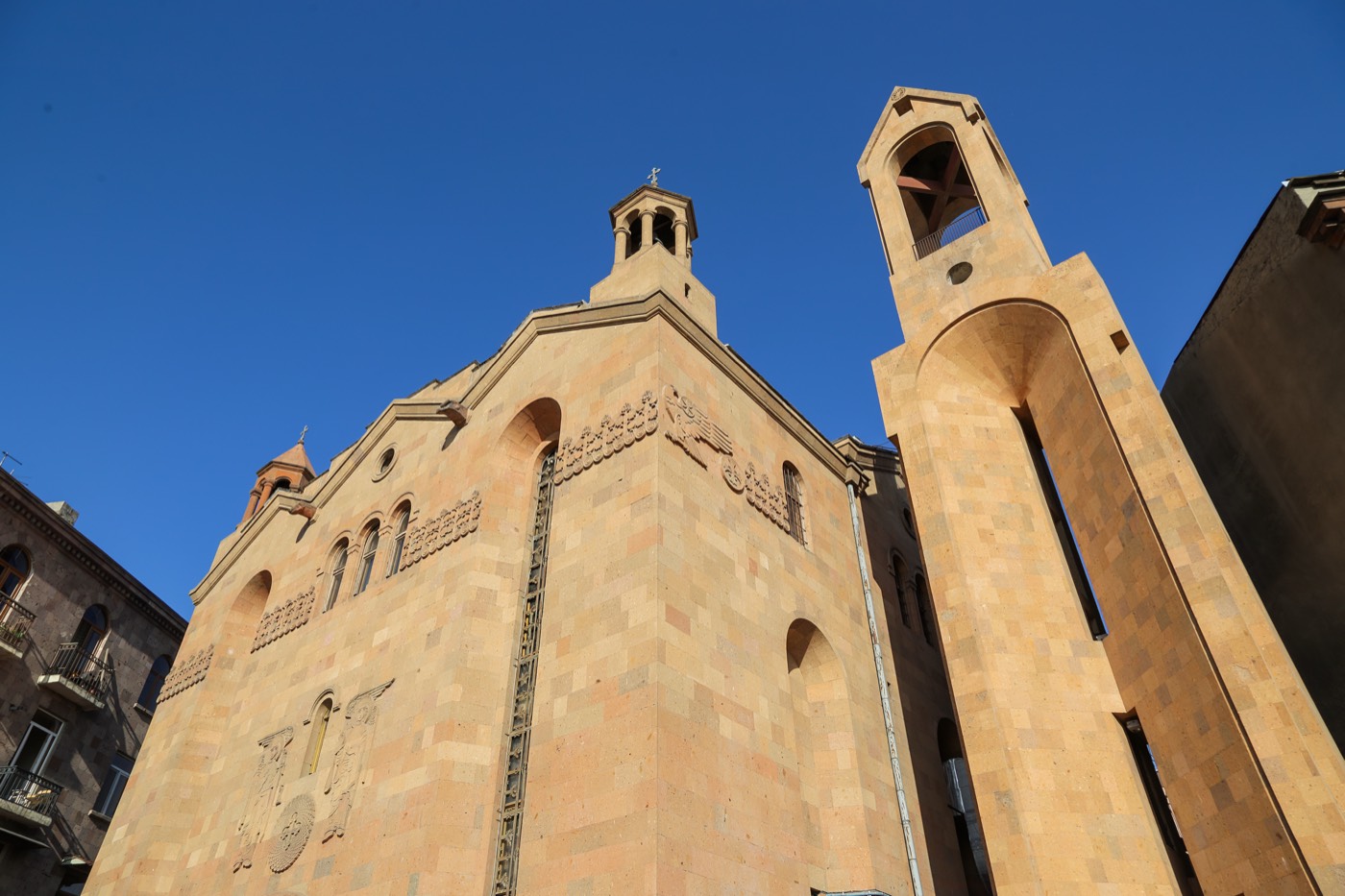
The Sarkisian surname is Armenian and means “son of Sarkis”, a given name carried for sixteen centuries in honour of Saint Sarkis, the soldier-martyr who is still one of the most beloved saints in Armenia.
What Does the Surname Sarkisian Mean?
Sarkisian means “son of Sarkis” or “descendant of Sarkis”. It is a patronymic surname built from the Armenian personal name Sarkis (Eastern Armenian: Sargis) plus the suffix -ian or -yan, which does the same work as the English -son.
Sarkis itself is the Armenian form of the Latin name Sergius, the name of an old Roman gens whose deeper meaning is uncertain. It reached Armenian not through Rome directly but through the church, attached to a saint.
So the name does not describe a trade, a place or a nickname. It records a father, and behind that father a saint’s day, a candle and a christening.
Where the Sarkisian Name Comes From
Sarkisian comes from the Armenian highlands: historic Armenia across what is now the Republic of Armenia and eastern Turkey, plus the Armenian communities of Persia, Cilicia and Constantinople. It is one of the commonest surnames in Armenia today, with Sargsyan held by roughly 82,000 people there, second only to Grigoryan.
Saint Sarkis, the reason the name exists
Almost every Sarkisian family traces back, at some remove, to a boy named after Surb Sarkis. He was a Cappadocian Greek general in Roman service under Constantine. When Julian the Apostate turned against Christians in the early 360s, Sarkis fled with his son Martiros first to Armenia and then into the Sasanian empire.
Shapur II gave him a command, then discovered his faith. Sarkis refused to take part in Zoroastrian rites and destroyed the furnishings of a fire temple. Shapur had Martiros killed in front of his father, beheaded fourteen soldiers who had been baptised alongside them, and finally executed Sarkis himself, in 362 or 363.
The Armenian Apostolic Church made him a favourite. His feast is moveable, falling somewhere between mid January and mid February depending on the date of Easter, and it is not a solemn occasion. Surb Sarkis is the patron of young people and of love. Unmarried girls traditionally eat a salted biscuit before bed and watch for the person who brings them water in a dream.
From given name to family name
Fixed hereditary surnames spread among ordinary Armenians relatively late, largely from the seventeenth century onward and only becoming universal under Ottoman and Russian administration in the nineteenth. A popular baptismal name like Sarkis therefore froze into a family name independently in hundreds of unrelated households.
This matters for anyone researching the name. Sarkisians are not a clan. Two Sarkisian families from neighbouring villages are usually not related at all, only named after the same saint.
The Armenian suffix
The -ian and -yan endings, and the older -yants and -ants forms, all mark descent. Our page on the Grigoryan surname goes through that suffix and the Eastern and Western Armenian divide in detail, so we will keep to what is specific to Sarkis here.
Spelling Variants and Related Names
The main variants are Sarkisian, Sarkissian, Sargsyan, Sarkisyan, Sarksyan, Sargsian, Serkisian and Serkissian, along with the shortened Serkis and Sarkis. In the Armenian alphabet the name is written Սարգսյան, and the given name is Սարգիս.
The useful thing is that the spelling is effectively a date and route stamp. It tells you when a family left the Armenian world and by which door.
- Sarkisian and Sarkissian are Western Armenian. They belong to families from the Ottoman lands who reached America, France, Lebanon, Syria or Egypt, mostly between the 1890s and the 1920s. Western Armenian pronunciation devoices the g, giving the hard k.
- Sargsyan is the Eastern Armenian and Soviet transliteration, standard in the Republic of Armenia. A Sargsyan in the United States usually arrived after the 1970s or after independence in 1991.
- Sarkisyan and Sarkisov are Russified forms, produced by Russian-language paperwork in the Caucasus and Central Asia.
- Serkisian, Serkis and Sarkis reflect Middle Eastern Armenian communities, particularly Iraq, Syria and Lebanon, and later shortening in English-speaking countries.
Related names built on the same saint include Sarkisyants, Sarkisov, Sarkisova and the compound Torsarkissian. Sarkis also survives as a standalone surname in Lebanon and Syria, where it can be Armenian or Arab Christian in origin, so the plain form alone does not prove Armenian descent.
The Sarkisians in America
Sarkisians came to America in two great movements: the Hamidian massacres of 1894 to 1896, and the Armenian Genocide of 1915. Between 1899 and 1931 roughly 81,700 Armenians entered the United States, most of them through Ellis Island.
The 1915 genocide, in which the Ottoman government deported and killed a large part of its Armenian population, is the reason there is a Western Armenian America at all. The Sarkisians who landed at New York in the years that followed were very often the only survivors of their household, children who arrived with a name and little else.
The earliest colony formed in Massachusetts, and the mill towns held it. Watertown became the anchor of Armenian New England, and the community later spread into the quieter streets of Belmont and out through greater Boston, where Sarkisian is still a common name on a church roll.
The other pole was California. Fresno drew Armenian farmers to the San Joaquin Valley from the 1880s, and the vineyards and fig orchards there carried Sarkisian families for generations.
Los Angeles came later and became the largest Armenian population outside Armenia. Sarkisians settled in Montebello, home to the Armenian Genocide Martyrs Monument of 1968, the oldest and largest genocide memorial in the United States, and across the San Fernando Valley in Encino and Granada Hills. Later arrivals from Soviet Armenia and Iran concentrated in Glendale and Burbank, which is where most Sargsyans in America live today.
Around 42 per cent of American Sarkisians live in California, with Massachusetts and Michigan next. The map of the surname is the map of the diaspora, almost exactly.
Notable People Named Sarkisian
Cher (born 1946) was born Cheryl Sarkisian in El Centro, California, and is usually recorded as Cherilyn. Her father, John Sarkisian, was an Armenian American truck driver, and her paternal grandparents survived the genocide. She remains the most famous bearer of the name in the world.
Serzh Sargsyan (born 1954) served as President of Armenia from 2008 to 2018 and briefly as prime minister, resigning during the protests of the 2018 Velvet Revolution.
Armen Sarkissian (born 1953), a theoretical physicist and former ambassador to the United Kingdom, was President of Armenia from 2018 to 2022. His Western Armenian spelling next to Serzh Sargsyan’s Eastern one is the split in miniature.
Sos Sargsyan (1929 to 2013) was one of the great Soviet Armenian stage and film actors, later founder of Yerevan’s Hamazgayin Theatre.
Steve Sarkisian (born 1974) is the American football head coach at the University of Texas, previously head coach at Washington and USC.
Andy Serkis (born 1964), the English actor behind Gollum and Caesar, descends from an Iraqi Armenian family whose name was Serkisian before it was shortened.
How Common Is Sarkisian Today?
Sarkisian ranked 15,871st in the 2010 United States Census, with 1,833 Americans carrying it. Counted with its variants, above all Sargsyan and Sarkissian, the name is far more numerous than that single figure suggests.
| US rank (2010 Census) | #15,871 |
|---|---|
| Americans with the name | 1,833 |
| Origin | Armenian |
| Meaning | Son of Sarkis, from Sergius, after Saint Sarkis the Warrior |
Outside the United States the surname appears in Iran, Greece, Cyprus, Canada, France, Lebanon and Syria, and in its Sargsyan form it is one of the two commonest surnames in Armenia itself.
Frequently Asked Questions
What does the surname Sarkisian mean?
It means “son of Sarkis”. Sarkis is the Armenian form of the Latin Sergius, popularised by Saint Sarkis the Warrior, and the -ian ending is the Armenian patronymic suffix meaning “descendant of”.
Is Sarkisian Armenian or Turkish?
Sarkisian is Armenian. Many bearers came from towns inside what is now Turkey, because that territory was historic Western Armenia before 1915, but the name itself is Armenian in language, form and religious origin.
Where does the Sarkisian family come from?
From the Armenian highlands, spanning the present Republic of Armenia and eastern Anatolia, with old communities in Persia, Cilicia and Constantinople. Because the name froze from a common baptismal name, separate Sarkisian families are usually unrelated.
How common is the surname Sarkisian?
It ranked 15,871st in the 2010 US Census with 1,833 bearers. In Armenia its Eastern form Sargsyan is held by around 82,000 people, making it the second most common surname in the country.
Is there a Sarkisian family crest or coat of arms?
No. In every serious heraldic tradition arms are granted to an individual and pass to direct descendants, never to everyone who shares a surname. Armenian heraldry belonged to noble houses such as the Bagratuni and Mamikonian, not to patronymics. Sites selling a “Sarkisian family crest” are selling a decoration, not a lineage.
Why do some families spell it Sargsyan and others Sarkisian?
Because of dialect and paperwork. Sarkisian and Sarkissian are Western Armenian spellings carried by Ottoman-era and genocide-era refugees, while Sargsyan is the Eastern Armenian and Soviet transliteration used in the Republic of Armenia. The spelling usually reveals when and from where a family emigrated.
If your family carries the Sarkisian name, its route from the Armenian highlands to America is traceable. Atlas of Home can follow it from the saint’s day it was christened on to whichever port it landed in, and to wherever you are now.