
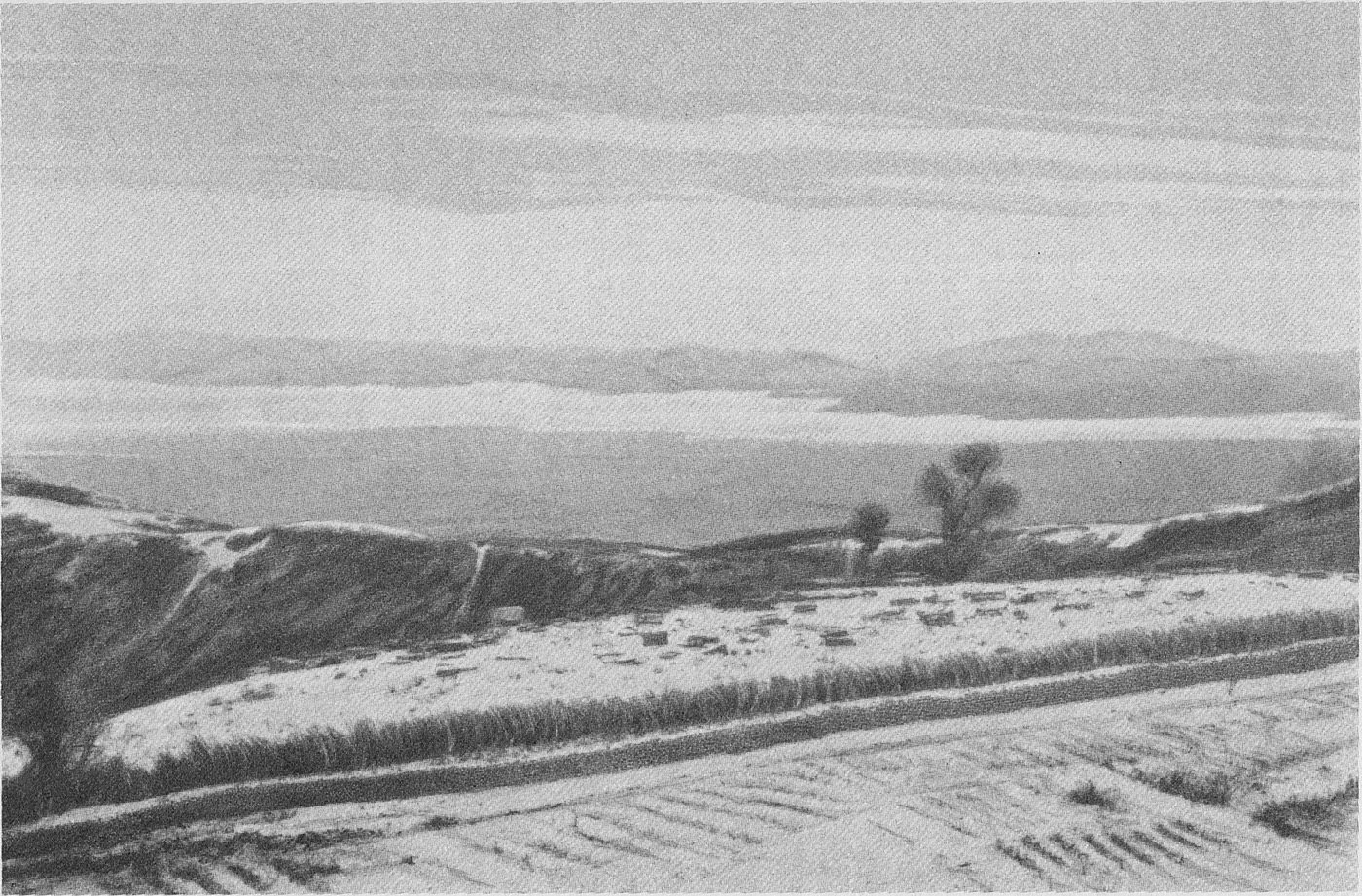
The Karapetyan surname is Armenian and means “son of Karapet”, a given name that translates as “the forerunner”. It is the Armenian name for John the Baptist, and it belongs to the highlands of Taron in historic Armenia.
What Does the Surname Karapetyan Mean?
Karapetyan means “son of Karapet”. Karapet is an Old Armenian word meaning forerunner or precursor, and it is the Armenian name for John the Baptist, the one who went ahead of Christ.
The ending carries the descent. The suffix written -յան in modern Eastern Armenian, and -եան in the classical orthography, comes from a Classical Armenian genitive marker meaning “of” or “descended from”. Attach it to a personal name and you have a patronymic: Karapet’s people.
The root word is native Armenian rather than borrowed. It does in Armenian what prodromos does in Greek, naming the man who runs ahead to announce someone greater. Armenian Christians used it as a title long before they used it as a name, and Surb Karapet, the Holy Forerunner, is how John the Baptist is known in the Armenian Apostolic Church to this day.
That puts Karapetyan in a specific and very Armenian category: the saint-name patronymic. It works exactly like the Sarkisian surname, built on Surb Sarkis, the warrior saint. Armenian families did not usually name sons after abstractions. They named them after a shrine.
Where the Karapetyan Name Comes From
The name comes from Armenia, and its devotional heart was Taron, the district around Mush in what is now eastern Turkey, where the monastery of Surb Karapet stood for roughly sixteen centuries.
The monastery above the Mush plain
Armenian tradition holds that Gregory the Illuminator founded the site in the early fourth century, clearing pagan ground to house relics of John the Baptist brought from Caesarea. The Mamikonian princes of Taron adopted the Forerunner as their patron and styled themselves his holy warriors.
By the twelfth century Surb Karapet was the seat of the Taron diocese, and it was reckoned the most important monastery in Western Armenia, second in the whole Armenian world only to Etchmiadzin. Pilgrims came year round. On the feast days the plain below filled with horse races, rope walkers and singing contests, and the wandering bards known as ashughs travelled there to have their gift blessed.
From given name to family name
Because of that devotion, Karapet became one of the commonest male names across the Armenian provinces. Hereditary surnames only became general among Armenians during the eighteenth and nineteenth centuries, as Russian and Ottoman administrations registered families by father’s name. A very popular given name therefore produced a very large surname, in thousands of unrelated households at once.
So Karapetyans are not one family. They are the descendants of a great many separate men called Karapet, most of them named for the same saint.
Two Armenias, one name
From 1828 the eastern Armenian lands sat under Russian rule and became, eventually, the Republic of Armenia. The western provinces, Taron among them, remained Ottoman. The two halves shared an alphabet and a church but drifted into two spoken standards, and that split is the single most useful thing to understand about this surname.
Spelling Variants and Related Names
Karapetyan, Karapetian and Garabedian are the same surname. What separates them is dialect and transliteration, not family and not origin.
In Armenian script the name is Կարապետյան in the modern Eastern orthography and Կարապետեան in the classical one used in the western diaspora. The letters are the same. The sounds are not.
Classical Armenian had three ranks of stop consonants. Western Armenian swapped two of them, so that the letter կ, classically k, is pronounced g, and the letter պ, classically p, is pronounced b. Eastern Armenian kept the classical values. One written word, two readings: a speaker in Yerevan says Karapet, and a speaker in Aleppo, Beirut or Fresno says Garabed.
The forms an English speaker is likely to meet:
- Karapetyan, Eastern Armenian, in the romanisation standardised in Soviet Armenia and kept by the Republic of Armenia. The usual spelling for families who arrived from Armenia after 1970.
- Karapetian, the same Eastern pronunciation in the older -ian romanisation used across Europe and America.
- Garabedian, Western Armenian, and by a wide margin the older American spelling. This is the form carried by descendants of the Ottoman provinces.
- Garabed and Karapet, the bare given name, used as a surname where no suffix was registered and still common as a forename.
- Karapetov and Karapetova, Russified, from households registered under Russian and Soviet administration in Georgia, Azerbaijan and Russia itself.
The choice between -yan and -ian is a transliteration convention rather than a difference in the name, and we look at it in more detail in the entry on the Grigoryan surname.
The Karapetyans in America
Karapetyans reached America in two distinct waves: Western Armenian survivors who fled the Ottoman Empire around 1915 and spelled the name Garabedian, and Eastern Armenians who left the Soviet Union and the new republic after 1970 and spelled it Karapetyan.
The first wave began with the massacres of the 1890s and became an exodus after 1915, when the Ottoman government deported and killed its Armenian population in a campaign now recognised as the Armenian genocide, with the dead usually estimated at around 1.5 million. Armenian life in Taron ended. Surb Karapet itself was besieged, its refugees killed, and the buildings burned.
Those who got out went to Syria, Lebanon, France and the United States. They clustered where there was work: the Hood Rubber factory drew hundreds of families to Watertown, Massachusetts, where Armenians made up nearly a tenth of the town by 1930, and the vineyards drew others to Fresno. Nearly every long-established Garabedian family in America traces back to that flight.
The second wave was Soviet and post-Soviet, accelerated by the 1988 Spitak earthquake and the hard decade that followed independence. Los Angeles took most of it, and Glendale became the centre of gravity, with the community spreading into Burbank, North Hollywood and up into Tujunga. If the name on the mailbox ends in -yan, this is usually the story behind it.
The 2010 census recorded how Karapetyans identified themselves rather than where they descend from, and 94.76 per cent selected white, with 3.97 per cent choosing two or more races. That near-uniform figure says more about the census form, which offers Armenians no category of their own, than about the families answering it.
Notable People Named Karapetyan
Shavarsh Karapetyan (born 1953), Soviet Armenian finswimmer and multiple world record holder. On 16 September 1976 he dived repeatedly into Yerevan Lake to pull passengers from a submerged trolleybus, saving twenty lives and wrecking his own athletic career in the process.
Paul Garabedian (1927 to 2010), American mathematician at NYU’s Courant Institute for fifty-one years, whose computations of shockless aerofoils reshaped modern aircraft design.
Charles Garabedian (1923 to 2016), American painter and a central figure in the Los Angeles art world, known for large mythological canvases made outside every prevailing fashion.
Karen Karapetyan (born 1963), Prime Minister of Armenia from 2016 to 2018.
Samvel Karapetyan (born 1965), Russian Armenian businessman and founder of the Tashir Group, and a large-scale funder of church and school restoration in Armenia.
Araksya Karapetyan (born 1982 in Leninakan, now Gyumri), co-anchor of Good Day LA on KTTV, and the first Armenian American anchor in mainstream Southern California television.
How Common Is Karapetyan Today?
Karapetyan ranked 20,910th in the 2010 United States census, held by 1,260 Americans. The Western Armenian spelling is the commoner one in America: Garabedian was recorded 1,879 times at rank 15,564, and Karapetian 556 times at 39,555, so the three main forms together account for roughly 3,700 people.
In the Republic of Armenia the picture reverses completely. There Karapetyan is one of the most frequent surnames in the country, in the same bracket as Grigoryan and Sargsyan.
| US rank (2010 Census) | #20,910 |
|---|---|
| Americans with the name | 1,260 |
| Origin | Armenian (patronymic) |
| Meaning | Son of Karapet, “the forerunner” |
Frequently Asked Questions
What does the surname Karapetyan mean?
It means “son of Karapet”. Karapet is Old Armenian for forerunner or precursor and is the Armenian name for John the Baptist, so the surname descends from a man named in that saint’s honour.
Is Karapetyan Armenian or Russian?
Armenian. The confusion arises because many Karapetyans lived under Russian and Soviet rule, and some families were registered with the Russian ending as Karapetov. The root and the suffix are both Armenian.
Where does the Karapetyan family come from?
From Armenia, with the name’s devotional centre in Taron, the district around Mush now in eastern Turkey. Bearers today come from both the Republic of Armenia and the western diaspora, which usually spells the name Garabedian.
How common is the surname Karapetyan?
It ranked 20,910th in the 2010 US census with 1,260 bearers, and the variants Garabedian and Karapetian add roughly 2,400 more. Inside Armenia it is one of the commonest surnames of all.
Is there a Karapetyan family crest or coat of arms?
No. In every serious heraldic tradition arms are granted to an individual and pass to direct descendants, never to everyone who shares a surname. Any site selling a “Karapetyan family crest” is selling a decoration, not a lineage, and Armenian heraldry in particular belonged to princely houses rather than to ordinary surnames.
Are Garabedian and Karapetyan really the same name?
Yes, letter for letter in Armenian script. Western Armenian pronounces the classical k as g and the classical p as b, so the identical written name is read Garabed in the diaspora and Karapet in Armenia. An American Garabedian family and an Armenian Karapetyan family carry the same surname.
If your family carries the Karapetyan name, its route from Armenia to America is traceable. Atlas of Home can follow it from the Mush plain and the shrine of the Forerunner to wherever your family landed, and to wherever you are now.