
The Campbell surname comes from the Scottish Gaelic cam beul, meaning “crooked mouth”, and its homeland is Argyll on Scotland’s west coast. It is also one of the commonest names in Ulster and in Jamaica, and that is not a coincidence.
What Does the Surname Campbell Mean?
Campbell means “crooked mouth”, from the Scottish Gaelic cam, meaning crooked or wry, joined to beul, meaning mouth. It began as a nickname for one man and hardened into a hereditary name after him.
Bynames of this kind were ordinary in Gaelic Scotland, not insults. Where half the men in a district were called Colin, the quickest way to tell them apart was to name a feature. The neighbouring surname Cameron works the same way, from cam shròn, “crooked nose”. The Gaelic form of the name is Caimbeul.
You will sometimes read that the name is really Norman French, from de campo bello, “of the beautiful field”. Set that aside. The historian W. F. Skene pointed out that no such family appears in the Domesday Book or the Battle Abbey roll, and scholarship has followed him since. The Latin form appears only in later documents, where a clerk has tidied a Gaelic nickname into something more respectable.
Where the Campbell Name Comes From
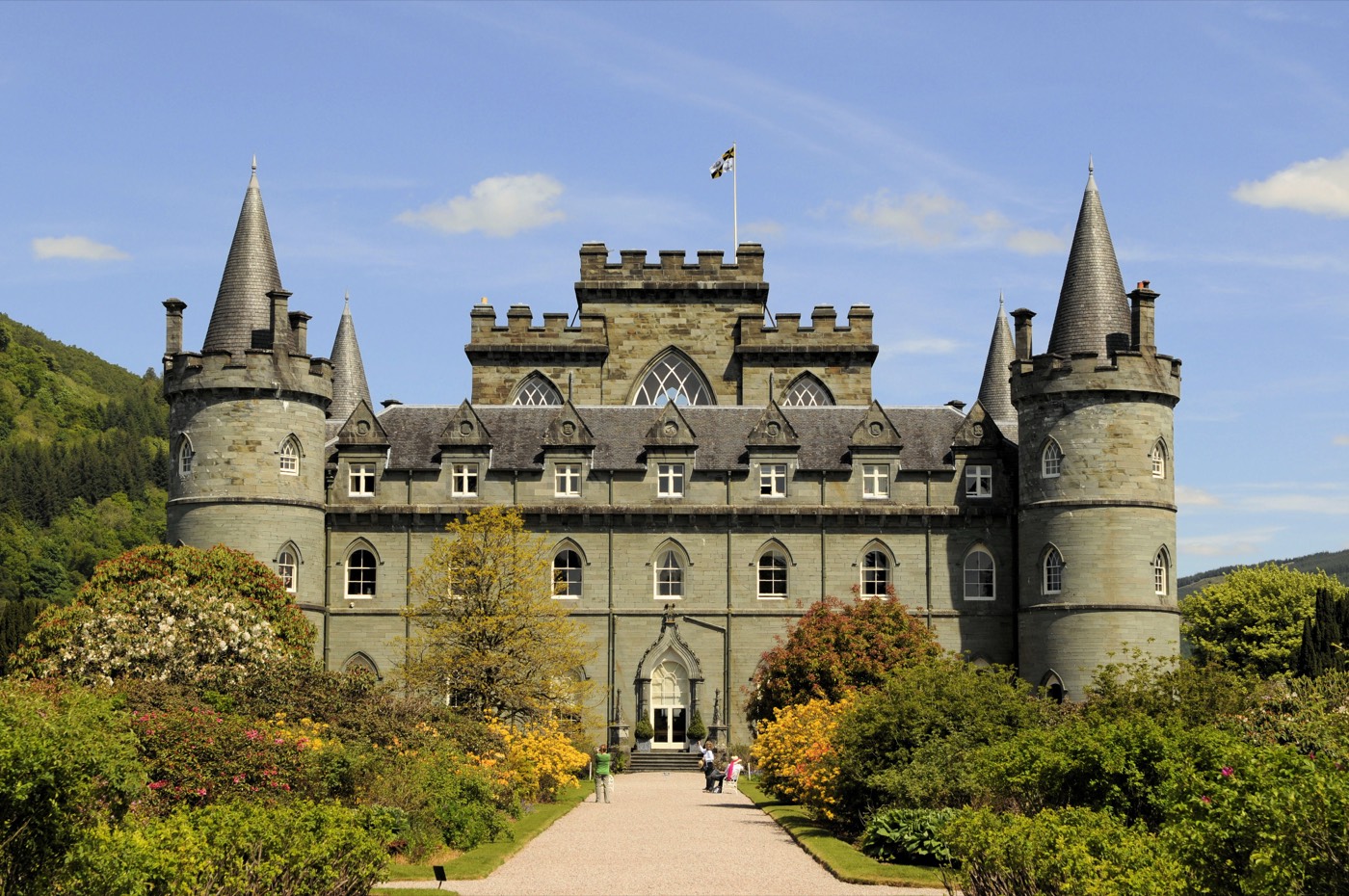
The Campbells come from Argyll, the sea-cut western edge of the Scottish Highlands, and specifically from the country around Loch Awe. The chief’s seat is Inveraray Castle on Loch Fyne.
The Lords of Loch Awe
The earliest Campbell whose life is well attested is Cailean Mòr Caimbeul, “Great Colin”, knighted in the reign of Alexander III and killed in 1296 fighting the MacDougalls of Lorne in the hills between Loch Awe and the sea. His importance lies in the title rather than the battle: every chief of Clan Campbell since has been called MacCailein Mòr, “son of Great Colin”, and the present Duke of Argyll is addressed that way still.
Where the family stood before him is disputed. Clan tradition claims descent from the Britons of Strathclyde and, further back, from a legendary Arthur. Modern scholarship, notably W. D. H. Sellar’s “The Earliest Campbells: Norman, Briton or Gael?”, finds them thoroughly Gaelic by the thirteenth century.
The Rise of the House of Argyll
Between roughly 1200 and 1500 the Campbells went from one Argyll kindred among many to one of the most powerful families in Scotland. They backed Robert the Bruce early and were rewarded for it: the earldom of Argyll came in 1457, the dukedom in 1701.
Their advantage was office as much as land. Campbells held sheriffships and royal commissions, which let them expand legally at the expense of the MacDougalls and the MacGregors. That is why the name carries a political charge in Highland memory that most surnames do not.
Glencoe, 1692
On 13 February 1692 soldiers of the Earl of Argyll’s Regiment of Foot, quartered on the MacDonalds of Glencoe for a fortnight and received as guests, turned on their hosts at dawn. Estimates differ, but between thirty and forty died in the massacre, and others of exposure after fleeing into the snow.
The detachment was led by Captain Robert Campbell of Glenlyon and the regiment was Argyll’s, which is why the name stuck to the event. The orders came from the government, drafted through Sir John Dalrymple, Master of Stair, to make an example of a clan that had been late in swearing allegiance. Most of the soldiers were not Campbells. A commission of inquiry in 1695 blamed Stair, and nobody was punished.
Spelling Variants and Related Names
The common variants are Campbel, Cambell, Camble, Campell and Cammell, with Caimbeul as the Scottish Gaelic form. Early records often drop the p altogether and read simply Cambel, which is closer to the Gaelic.
Several Argyll families were pulled into the Campbell orbit as the clan grew, and some of their descendants took the chief’s name outright. MacArthur and MacIver are the two most often named, and MacTavish has long been counted among the associated families.
The Irish Campbells
Ireland complicates the picture. The Mac Cathmhaoil of the Clogher valley in County Tyrone were a leading family of the Cenél Fearadhaigh, one of the septs supporting the O’Neills. Their name means “son of Cathmhaol”, roughly “battle chief”, and has no connection to Argyll at all.
It was anglicised in a spray of directions: MacCawell, McCowell, Caulfield, Callwell, McCall, Camphill. In many districts it simply became Campbell, that being the nearest familiar name to hand. In Donegal, a good number of Campbell families trace instead to Scottish gallowglass, Hebridean soldiers who served the O’Donnells from the fourteenth century. Three origins, one spelling, and Irish surname studies have long been picking them apart.
The Campbells in America
Most American Campbells descend from one of two eighteenth-century movements: Scots-Irish Presbyterians leaving Ulster for Pennsylvania and the southern backcountry, or Highlanders sailing from Argyll to North Carolina. The Ulster route accounts for the larger share.
Argyll and Antrim are separated by a short crossing, and Campbells were among the Scots who settled in Ulster from the Plantation period onward. Antrim, Down, Tyrone, Derry and Armagh carry heavy concentrations of the name still. From 1717 rising rents, bad harvests and the legal disabilities placed on Presbyterians pushed those families out through Belfast and Derry towards Philadelphia. The Great Wagon Road carried them down the Shenandoah Valley into the Carolina backcountry and through the Cumberland Gap into Tennessee and Kentucky. Campbell counties in three of those states are the residue.
The Highland route was narrower. In September 1739 the Argyll Colony, roughly 350 people from Islay, Gigha and Kintyre, landed at the mouth of the Cape Fear and moved upriver into Bladen County. By the 1770s Highland Scots were a third of the population there, enough for the district to be called the Valley of the Scots, and the Scottish settlements of the Cape Fear region in North Carolina remain the largest Highland settlement ever made outside Scotland.
A later, industrial wave brought Scottish weavers and thread makers to American mill towns. The Scots of Kearny, New Jersey are the clearest surviving example.
The Jamaican Campbells
Campbell is one of the most common surnames in Jamaica, and the great majority of Jamaican Campbells are Black Jamaicans. The reason is documented.
Scots were heavily over-represented among Jamaica’s planters, attorneys and overseers through the eighteenth century, to the point that Scottish surnames dominate the island’s records. Colonel John Campbell of Inveraray, born in 1673, survived the collapse of the Darien venture in Panama and settled instead at Black River in St Elizabeth in 1700. He prospered and drew other Argyll men after him.
Enslaved people on Scottish-owned estates were registered under the surnames of the men who owned them, and when slavery ended between 1834 and 1838 those names stayed, being by then the only names on record.
Twentieth-century migration carried it onward again, to Britain from the Windrush years and to the United States after 1965, which is why the name is so familiar in the Jamaican community of Flatbush, Brooklyn, in Wakefield in the Bronx, among the Jamaicans of Hartford, Connecticut, and across South Florida in neighbourhoods such as Lauderhill.
Notable People Named Campbell
Sir Henry Campbell-Bannerman (1836-1908) was Prime Minister of the United Kingdom from 1905 to 1908. Born Henry Campbell in Glasgow, he added the second name under an uncle’s will.
Alexander Campbell (1788-1866) was born near Ballymena in County Antrim and emigrated in 1809. A leading figure of the Restoration Movement on the American frontier, he founded Bethany College in what is now West Virginia, tracing the Ulster Presbyterian route into America almost exactly.
Joseph Campbell (1904-1987) was the American writer on comparative mythology whose The Hero with a Thousand Faces (1949) reshaped how a generation of novelists and film-makers thought about story.
Glen Campbell (1936-2017), who recorded “Wichita Lineman”, was born in Billstown, Arkansas, into exactly the sort of Scots-Irish backcountry family described above.
Naomi Campbell (born 1970) is the British model and businesswoman, born in south London to a mother of Jamaican descent, and her surname carries the Jamaican strand of this history straight into the present.
How Common Is Campbell Today?
Campbell is the 47th most common surname in the United States, carried by 386,157 Americans at the 2010 Census. It is roughly seventh in Scotland and third in Northern Ireland.
In Jamaica it sits among the very commonest names on the island, different counts placing it first or a close fourth. Jamaica has a higher proportion of Scottish surnames than anywhere outside Scotland, and Campbell is the emblem of that.
| US rank (2010 Census) | #47 |
|---|---|
| Americans with the name | 386,157 |
| Origin | Scottish (Gaelic), with large Ulster and Jamaican branches |
| Meaning | “Crooked mouth”, from Gaelic cam beul |
Frequently Asked Questions
What does the surname Campbell mean?
Campbell means “crooked mouth”, from the Scottish Gaelic cam (crooked or wry) and beul (mouth). It began as a nickname for one individual in medieval Argyll and became hereditary in his family. The Gaelic form is Caimbeul.
Is Campbell Scottish or Irish?
Both, for different reasons. The Argyll surname is Scottish Gaelic, but Campbell is also the standard anglicisation of the Irish Mac Cathmhaoil of County Tyrone, a separate Gaelic family, and many Ulster Campbells descend from Scots who settled in Ireland. Only documents, not the spelling, can tell you which you are.
Where does the Campbell family come from?
Clan Campbell’s homeland is Argyll in the western Scottish Highlands, centred on Loch Awe and later Inveraray, still the seat of the Duke of Argyll. Ulster Campbells are concentrated in Antrim, Down, Tyrone, Derry and Donegal.
How common is the surname Campbell?
Campbell ranked 47th in the United States at the 2010 Census, with 386,157 bearers. It is around seventh in Scotland, third in Northern Ireland, and among the top few in Jamaica.
Is there a Campbell family crest or coat of arms?
No. In Scottish heraldry, regulated by the Court of the Lord Lyon, arms are granted to a named individual and pass to specific descendants, never to everyone who shares a surname. The Duke of Argyll has arms as chief, and Campbells may wear a clan crest badge to show allegiance to him, but that is not the same as owning arms. Any site selling you “the Campbell family crest” is selling a decoration, not a lineage.
Why is Campbell such a common surname in Jamaica?
Because Scots were disproportionately represented among Jamaica’s eighteenth-century planters and estate managers, and enslaved people were registered under their owners’ surnames. Those names remained after emancipation in the 1830s. Colonel John Campbell of Inveraray, who settled at Black River in 1700, drew the first wave of Argyll men over.
If your family carries the Campbell name, its route from Argyll to America is traceable. Atlas of Home can follow it from the shores of Loch Awe through Ulster, the Cape Fear or the Jamaican parishes to wherever your family landed, and to wherever you are now.