
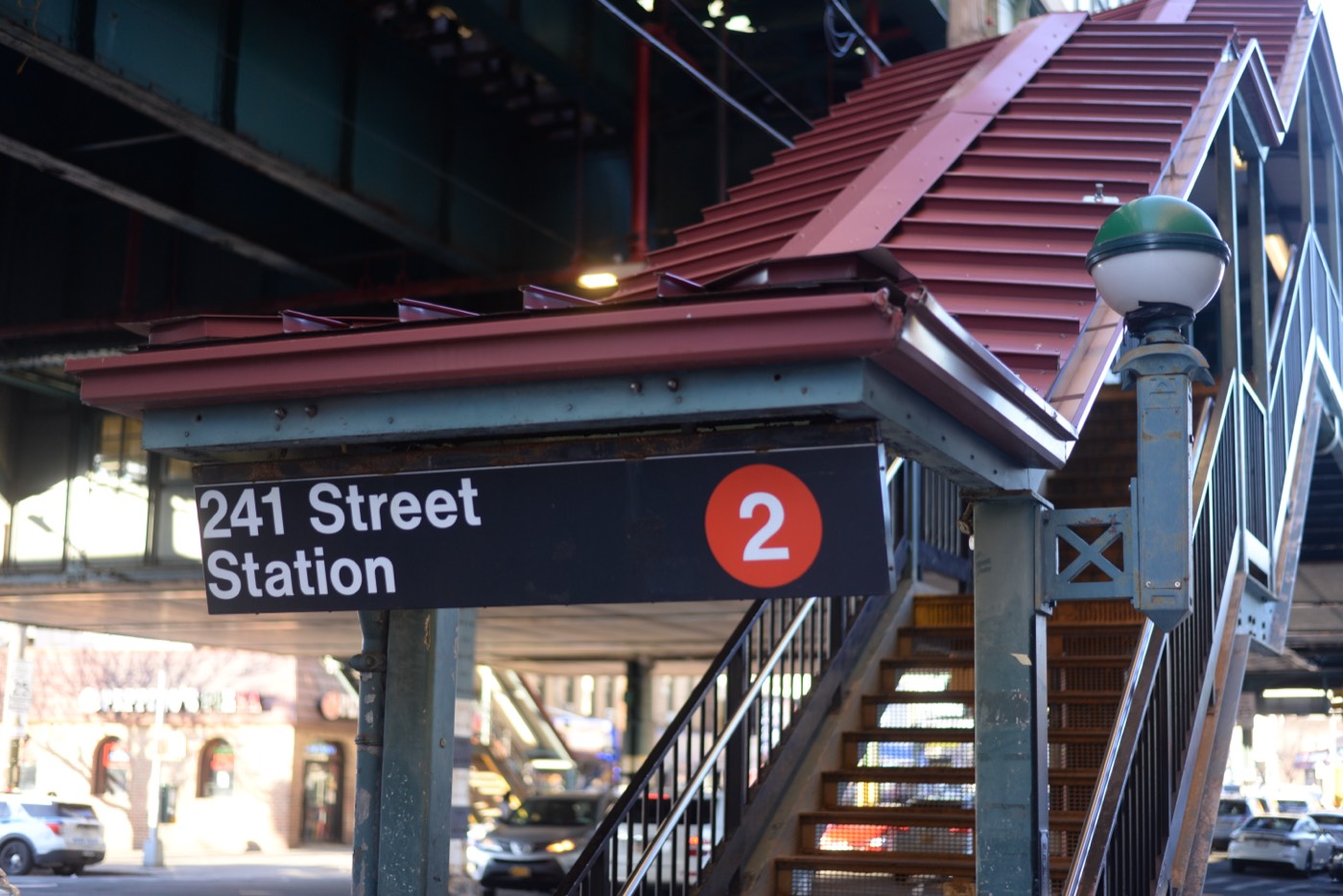
The 2 train ends here. It climbs the length of the Bronx on iron legs and stops at East 241st Street, where the platform runs out and Westchester begins. Step down into that particular shade the elevated makes at midday and you are standing in one of the largest Jamaican neighbourhoods in the United States. The Jamaicans in Wakefield did not arrive to a welcome. They arrived to a place other people were leaving, and they bought it.
The Place
Wakefield is the northernmost neighbourhood in the Bronx, bounded by the Westchester County line, East 222nd Street to the south and the Bronx River Parkway to the west. Cross the top of it and White Plains Road becomes West 1st Street in Mount Vernon without a sign to mark the change.
It is a neighbourhood of two-family brick houses, driveways and small front gardens, which in New York terms is close to a suburb that never left. The housing stock is why everything else happened.
Down its spine runs White Plains Road, laid out in 1863 and now carrying the elevated IRT tracks above a mile of bakeries, barbers, phone-card shops, storefront churches and takeaway counters.
How It Became Jamaican
The Village Named After Virginia
Wakefield takes its name from the Virginia plantation where George Washington was born. It became a village on 8 August 1889, absorbing the older settlement of Washingtonville, and New York City annexed it six years later, in 1895.
For most of the twentieth century it was Irish and Italian. Mount Saint Michael Academy, the all-male Catholic school on the northern edge, still carries that inheritance, as does Wakefield Grace United Methodist Church at 4750 White Plains Road, a fixture since 1887.
The subway arrived late and changed everything. Wakefield–241st Street station opened on 13 December 1920 and remains the northernmost station in the entire New York City Subway. From that platform a person could be in Midtown in under an hour, a fact eventually worth more to a Jamaican nurse working a Manhattan shift than any brochure ever written about the Bronx.
1965, and the Door That Opened
Before 1965 the entire Jamaican-born population of the United States numbered fewer than 100,000. American law allotted Jamaica a quota of 100 people a year. One hundred.
The Immigration and Nationality Act of 1965, the Hart-Celler Act, scrapped the national-origins system and raised that figure to 20,000 a year. Within thirty years more than 300,000 Jamaican-born people had migrated to the United States, and more than half settled in New York.
They came as nurses and nurses’ aides, transit workers, teachers and tradesmen, and in very large numbers as women first, sending for husbands and children afterwards. They arrived in a New York where the neighbourhoods a Black immigrant family could actually buy in were few, and shrinking.
The Move North, 1970 to 1990
The South Bronx lost close to half its population between 1970 and 1980. It is one of the most catastrophic urban statistics of the American century, and it is the reason Wakefield exists in its present form.
Families with a wage and a deposit went north, to Wakefield, Williamsbridge, Baychester and Edenwald, where the houses were small, owner-occupied and not held by absentee landlords with an incentive to let them burn. The northeast Bronx offered the hardest thing to get anywhere else in the city: a deed with your own name on it.
The pattern will be familiar to anyone who knows how Jamaicans built Flatbush in Brooklyn, but Flatbush was rowhouses and apartment blocks. Wakefield was houses with driveways, and it drew the family that had already made one move and wanted the next to be the last.
By the 1980s the Irish and Italian families had largely gone across the line into Mount Vernon. What replaced them was Caribbean, and the largest share of it was Jamaican.
White Plains Road Becomes a High Street
Commerce followed fast. Kingston Tropical Bakery opened at 4000 White Plains Road in 1970, when the neighbourhood was still chiefly Jewish, Irish and Italian, because the small Caribbean population then in the north Bronx had nowhere to buy the food it had grown up on. It was a decade ahead of the curve. Then the curve arrived.
Earl Moodie, born in Papine on the edge of Kingston, came to the United States in 1969. He had sung lead for a reggae group called The Stepping Stones and worked at Brad’s Records, another Jamaican-owned Bronx shop, before opening Moodies Records on White Plains Road in 1982. For four decades it was where the north Bronx found out what Jamaica was listening to that week.
Through the late 1980s and 1990s White Plains Road became a full Caribbean commercial district: patty counters, record shops, remittance agents, hairdressers, storefront churches with hand-painted signs. Moodie remembered a Caribbean cricket club whose old-timers took the field on Sundays.
The most consequential Jamaican business in the borough started a short ride down the same line. In 1989 Lowell Hawthorne, one of eleven children born in St Andrew, Jamaica, pooled money with his wife Lorna, four siblings and their spouses and opened the first Golden Krust on East Gun Hill Road. His parents had run Hawthorne & Sons Bakery in St Andrew since 1949. Golden Krust became the first Caribbean-owned company in the United States granted a franchise licence, and two of its shops now stand on White Plains Road in Wakefield.
The Children of the House
The second generation grew up in those two-family houses with the basement rented to a cousin. Daniel Baker, born in the Bronx in 1981 to Jamaican immigrant parents and raised in Wakefield, became the comedian Desus Nice. His mother was a senior librarian, a detail worth sitting with in a neighbourhood whose library opened in 1938.
The politics followed the demography, slowly. Kevin C. Riley, born in 1987 to Jamaican parents, took office in January 2021 as City Council member for District 12, covering Wakefield along with Williamsbridge, Eastchester, Baychester and Co-op City.
And in May 2025, under a local law, the corner of White Plains Road and East 225th Street was renamed Earl Moodie’s Way.
The Landmarks
Kingston Tropical Bakery, 4000 White Plains Road. Open since 1970 and still making its patties from scratch rather than buying in industrial shells, which is why people drive in from Westchester and Connecticut. The manager, Caroline Sinclair, grew up in Jamaica and worked in banking before a career change brought her to the Bronx. Her sister and brother-in-law opened the shop to feed a Caribbean population that had barely arrived.
Moodies Records and Earl Moodie’s Way, White Plains Road at East 225th Street. Moodie ran the shop for four decades beneath the elevated tracks, stocking roots, dancehall and Studio One pressings and hosting artist meet-and-greets that spilled onto the pavement. Anthony Bourdain filmed there for Parts Unknown. The corner now carries his name by act of the City Council.
Paul’s Caribbean Bakery, 4374 White Plains Road. Between East 237th Street and Nereid Avenue, cash only, a small counter with a long queue at lunchtime. The beef patties are heavier and more heavily seasoned than the chain versions, and the coco bread is dense enough to hold one.
Jerk House, 4246 White Plains Road. Jerk chicken and oxtail, the two dishes by which every Jamaican kitchen in New York is quietly judged. Most of its trade goes out in foil containers rather than being eaten in.
Wakefield Grace United Methodist Church, 4750 White Plains Road. Founded in 1887 for the Protestant villagers of Washingtonville and dedicated the following May, it is now a predominantly Black church whose pews fill with Caribbean families on Sunday mornings. Few buildings in the Bronx have changed hands so completely without ever once closing.
Wakefield Library, 4100 Lowerre Place. One block west of White Plains Road at 229th Street, open since 1938 and sharing its block with Bronx Community Board 12. It is where the neighbourhood’s homework gets done, and where a generation of Jamaican parents took their children on Saturdays on principle.
Wakefield–241st Street station, East 241st Street and White Plains Road. Opened on 13 December 1920, the northernmost station in the New York City Subway and the last stop on the 2. Every Jamaican nurse, porter, driver and school aide in Wakefield has stood on that platform in the dark.
Where They Came From
Jamaica has a very particular internal geography, and the Bronx reproduces it. The largest share of Wakefield’s Jamaican families trace back to Kingston and the surrounding parish of St Andrew, where Papine, Half Way Tree and August Town sit within a few miles of each other. Earl Moodie came from Papine. Lowell Hawthorne came from St Andrew. That is not coincidence, it is chain migration.
Beyond the capital, the rural parishes are heavily represented: St Catherine, Clarendon, Manchester, St Ann and the western parishes of St James and Westmoreland. These sent farm labourers and domestic workers abroad from the 1940s onward, first to England on the Windrush routes and then, after 1965, overwhelmingly to the United States.
Wakefield’s particular draw was the sponsorship chain. One sister comes on a nursing visa, buys a two-family house off East 233rd Street, and over fifteen years brings a husband, two children, a mother and a brother into the same three blocks. Repeat a few thousand times and you have a neighbourhood. The same mechanism produced the Jamaican community in Hartford, Connecticut, which is why so many Wakefield families have cousins up there.
Wakefield Today
Caribbean and Guyanese residents make up more than seven in ten people in Wakefield, and Jamaican is the most commonly reported ancestry, at around a fifth of the neighbourhood. Median household income sits in the mid-fifty-thousands, modest by regional standards and respectable by Bronx ones. A great many of those households own their homes, which is the whole point.
It is not a museum piece. Nigerian and Ghanaian families have arrived in numbers, as have Bangladeshi and Latino households. Some older Jamaican homeowners have retired to Florida or gone home and let the house to strangers. Some of the children have gone to Westchester or Atlanta, following the logic their parents used when they left the South Bronx.
What has not changed is White Plains Road at four in the afternoon, when the elevated shakes overhead, the smell off the patty counters is unmistakeable, and the pavement talk is conducted in a Kingston accent that has been in the Bronx for fifty years without softening a syllable. Elsewhere in the borough, the Italians of Throgs Neck held their ground while others left. In Wakefield the ground changed hands entirely, and the new owners kept the houses standing.
Frequently Asked Questions
Where is Wakefield in the Bronx?
Wakefield is the northernmost neighbourhood of the Bronx, bordered by Mount Vernon and the Westchester County line to the north, East 222nd Street to the south and the Bronx River Parkway to the west. Its main street is White Plains Road, which carries the elevated 2 and 5 trains.
Why do so many Jamaicans live in Wakefield?
The Jamaicans in Wakefield largely arrived after the 1965 Immigration and Nationality Act raised Jamaica’s annual quota from 100 to 20,000, then moved north within the city during the 1970s and 1980s as the South Bronx collapsed. Wakefield offered owner-occupied two-family houses and a direct subway line to Manhattan at a price a working immigrant family could meet.
What proportion of Wakefield is Caribbean?
Caribbean and Guyanese residents account for more than seven in ten people in the neighbourhood, with Jamaican the largest single reported ancestry at roughly 22 per cent, alongside significant Ghanaian, Nigerian, Bangladeshi and Latino populations.
Where can you eat Jamaican food in Wakefield?
White Plains Road is the spine of it. Kingston Tropical Bakery at number 4000 has been making patties from scratch since 1970, Paul’s Caribbean Bakery sits at 4374, Jerk House at 4246, and Golden Krust, the Jamaican-founded chain, has shops at 3812 and 4182.
Who was Earl Moodie?
Earl Moodie was a Jamaican-born record-shop owner from Papine, Kingston, who reached the United States in 1969 and opened Moodies Records on White Plains Road in 1982. His shop anchored the Jamaicans in Wakefield for four decades, and in May 2025 the corner of White Plains Road and East 225th Street was renamed Earl Moodie’s Way.
Is Wakefield changing?
Yes, though slowly. West African families have settled in growing numbers, some long-standing Jamaican homeowners have retired to Florida or returned to the island, and younger residents priced out of Manhattan have noticed the housing stock. The Caribbean character of White Plains Road remains dominant.
If your family’s story passed through Wakefield, or any of the places Jamaicans have made home in America, Atlas of Home can trace that journey. From a lane in St Andrew or a hillside in Clarendon, to a two-family house off White Plains Road, to wherever you are now.