
The Arnold surname comes from the Germanic personal name Arnwald, from arn, eagle, and wald, rule or power. It belongs to Germany and England in almost equal measure, and reached America by several very different roads.
What Does the Surname Arnold Mean?
Arnold means something close to eagle power. It descends from the Continental Germanic personal name Arnwald, also written Arnoald, formed from the elements arn, eagle, and wald, to rule or to wield power.
It is recorded in Frankish territory from about the seventh century and is common in medieval Germany between the eighth and eleventh centuries. Some scholars read it as a younger companion to the older Arnulf, eagle wolf, rather than an independent coinage.
The second element is where dictionaries part company: wald is read as rule by some authorities, as power or brightness by others, and Old High German Arenwald is sometimes glossed simply as having the strength of an eagle.
The mechanism is not in doubt. Arnold was a first name for centuries before it was anyone’s last name, and as hereditary surnames fixed across western Europe, families were recorded by the given name of a father or grandfather until it stuck.
Where the Arnold Name Comes From
Arnold has two homelands rather than one: German-speaking central Europe, where the personal name never fell out of use, and England, where the Normans brought it and it settled permanently.
The German heartland
In Germany the name is native, not borrowed. Arnold sits among the hundred commonest German surnames and is spread across the whole country, at its thickest in Hesse, in northern Baden-Wurttemberg and in Saxony.
It belongs to a different family of names from the great German trades. Where the Schmidt surname records a job, Arnold records an ancestor.
England and the Normans
The Normans carried the name across in French dress, as Arnaud and Arnoud, which English clerks wrote as Arnald or Ernald. It displaced the Old English cognate Earnweald, which existed in Anglo-Saxon England but barely survived the Conquest.
By the fourteenth century Arnold was a settled hereditary surname across southern and midland England. A minority of English Arnolds took it from a place instead: Arnold in Nottinghamshire, written Ernehale in Domesday, and a second Arnold in the East Riding of Yorkshire. The popular reading of that place name as eagle nook is contested, and several toponymists prefer a personal name joined to halh, a nook of land in a valley.
The Welsh line
There is a Welsh strand too, and it shows how the old Welsh naming system ended. The Arnolds of Llanthony and Llanvihangel Crucorney in Monmouthshire descended from Gwilym ap Meurig and took Arnold as a fixed surname early, abandoning the ap patronymics their neighbours still used.
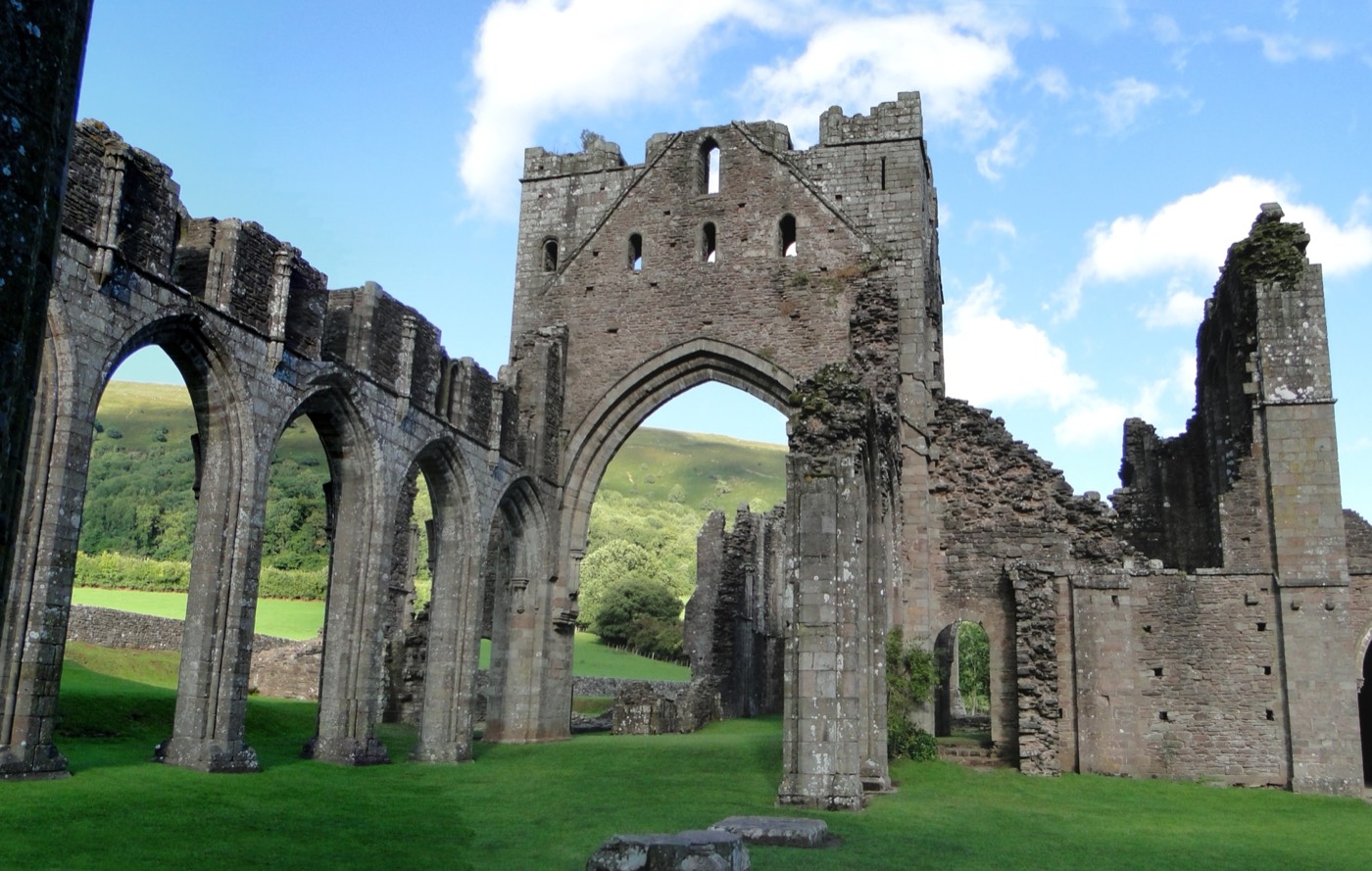
Sir Nicholas Arnold, who died in 1580, made the family’s fortune as a gentleman pensioner of Henry VIII and a servant of Thomas Cromwell during the Dissolution. His descendants held Llanthony Priory into the seventeenth century.
Spelling Variants and Related Names
The commonest variants are Arnhold and Arnholt in German, Arendt, Arend and Ahrens in the Low German north, Arnaud and Arnaut in French, Arnaldo and Arnaldi in Italian, Arnaldos in Spanish, and Arnoldson in Sweden.
Arnhold and Arnholt are spelling drifts, with an intrusive h that clerks added and never removed. The Dresden banking house Gebruder Arnhold, founded in 1864, is the best known bearer of the form.
Arendt, Arend, Arndt and Ahrens are northern contractions, the middle of the name worn away by Low German speech until only the frame was left. The philosopher Hannah Arendt carried one. England did the same more quietly: Arnall and Arnell are reduced forms of Ernald.
Arnold and Arnhold are also borne by Ashkenazi Jewish families. Jewish households in the German and Habsburg lands were required to register fixed surnames from the 1780s onwards, and many took ordinary German names. Arnold is sometimes explained as an echo of Aaron, though why a family settled on it is rarely recoverable.
The Arnolds in America
Arnolds reached America in three distinct streams: English colonists in the seventeenth century, German migrants across the eighteenth and nineteenth, and, after 1865, Black American families who took the name for themselves.
The English came first. William Arnold sailed in 1635 and settled at Providence in Rhode Island alongside Roger Williams; his line produced a colonial governor and, generations later, the most notorious Arnold in American history. They were the same early English stock described in our account of the English in Plymouth, Massachusetts.
German Arnolds came through Philadelphia and Baltimore, first with the Palatine migration into Pennsylvania and then in far greater numbers after 1848. They followed the German road west into the farm counties and mill towns of the Midwest, and the name is familiar in Catholic German settlements such as Jasper, Indiana and Columbia, Illinois, and in communal experiments like the Amana Colonies of Iowa.
The name had one quiet advantage during the anti-German feeling of the First World War: it needed no disguising. Where households called Wagner or Schmidt shortened, softened or translated, Arnold already looked and sounded English.
A substantial share of American Arnolds are Black. At the 2010 Census, 81.27 per cent of people with the surname identified as white and 13.34 per cent as Black or African American, with 2.41 per cent Hispanic, 1.87 per cent of two or more races, 0.57 per cent Asian or Pacific Islander and 0.55 per cent American Indian or Alaska Native. Those are self-identification proportions written on census forms, not a measure of ancestry.
That Black bearing arose chiefly through surname adoption after emancipation rather than through German or English descent. Freed people chose names around 1865 for many reasons: a former owner’s name, one already used privately within a family, a place, a trade, a public figure. The choice was more often their own than is commonly assumed, and the reasoning is rarely preserved. Arnolds carried the name north in the Great Migration to neighbourhoods like Bronzeville in Chicago.
And then there is the thing every American Arnold eventually hears. Benedict Arnold’s treason in 1780 turned the name into a byword, and for two centuries a teacher, a newspaper or a child in a playground could reach for it as a synonym for betrayal. It is a real part of the surname’s American story, and it has nothing to do with the families carrying it.
Notable People Named Arnold
Benedict Arnold (1741 to 1801)
Born in Norwich, Connecticut, and descended from an early governor of Rhode Island, he was one of the ablest American commanders of the early Revolution: Fort Ticonderoga in 1775, the punishing march on Quebec, a skilful delaying action at Valcour Island in 1776. At Saratoga in 1777 he ignored orders, led the assault that broke the British line, and took a wound to his left leg that left it two inches shorter than the right.
Three years later, embittered over promotions denied him and deep in debt, he agreed to surrender West Point to the British for twenty thousand pounds. The plot collapsed when his contact, Major John Andre, was captured with the papers on him. Arnold fled to the British side and died in London in 1801.
Matthew Arnold (1822 to 1888)
English poet and cultural critic, son of Thomas Arnold, the reforming headmaster of Rugby. He wrote Dover Beach and Culture and Anarchy while spending most of his working life as an inspector of schools.
Henry “Hap” Arnold (1886 to 1950)
American airman, taught to fly by the Wright brothers in 1911, who commanded the United States Army Air Forces through the Second World War. He remains the only officer to have held five-star rank in two American services.
Kokomo Arnold (1901 to 1968)
Born James Arnold in Georgia, a left-handed bottleneck slide guitarist whose Milk Cow Blues, recorded in 1934, was later cut by Elvis Presley, the Kinks and Willie Nelson. He influenced Robert Johnson and Elmore James, and died in Chicago.
Klas Pontus Arnoldson (1844 to 1916)
Swedish journalist and member of the Riksdag who helped found the Swedish Peace and Arbitration Society in 1883 and shared the 1908 Nobel Peace Prize with Fredrik Bajer. His surname is the Scandinavian route to the same root: Arnold’s son.
Frances Arnold (born 1956)
American chemical engineer at Caltech who won the 2018 Nobel Prize in Chemistry for the directed evolution of enzymes, only the fifth woman to take that prize.
How Common Is Arnold Today?
Arnold is the 201st most common surname in the United States, carried by 138,893 Americans at the 2010 Census. It is also among the hundred commonest surnames in Germany, and is well established in England, Wales and Australia.
| US rank (2010 Census) | #201 |
|---|---|
| Americans with the name | 138,893 |
| Origin | German and English |
| Meaning | From Arnwald: eagle plus rule or power |
Frequently Asked Questions
What does the surname Arnold mean?
It means roughly eagle power, from the Germanic personal name Arnwald: arn, eagle, plus wald, rule or power. It is a given name that became a hereditary surname, so it names an ancestor rather than a trade or a place.
Is Arnold German or English?
Genuinely both. It is native to German-speaking Europe, in continuous use since the early Middle Ages, and it is also a long-established English surname brought by the Normans, who displaced the Old English cognate Earnweald with it. Neither strand borrowed from the other.
Where does the Arnold family come from?
There is no single Arnold family. German Arnolds are thickest in Hesse, northern Baden-Wurttemberg and Saxony; English Arnolds are spread across the south and midlands, with pockets near Arnold in Nottinghamshire and Yorkshire; and a Welsh line held Llanthony in Monmouthshire.
How common is the surname Arnold?
It ranked 201st in the United States at the 2010 Census, with 138,893 bearers, and it is also among the hundred most common surnames in Germany, which makes it numerous in both countries at once.
Is there an Arnold family crest or coat of arms?
No. In English, Scottish and continental heraldry alike, arms are granted to an individual and pass to direct descendants, never to everybody sharing a surname. Particular families, such as the Arnolds of Llanthony, held arms of their own, but no crest belongs to the name itself. Sites selling one are selling a decoration, not a lineage.
Are American Arnolds related to Benedict Arnold?
Almost none of them. He belonged to one Rhode Island line descended from William Arnold, who arrived in 1635, while the great majority of American Arnolds descend from German immigrants, from other English families, or from Black households who adopted the name after 1865. The association is a matter of vocabulary, not of blood.
If your family carries the Arnold name, its route from the Rhineland, the English midlands or the Monmouthshire border to America is traceable. Atlas of Home can follow it from the parish register to wherever your family landed, and to where you are now.