
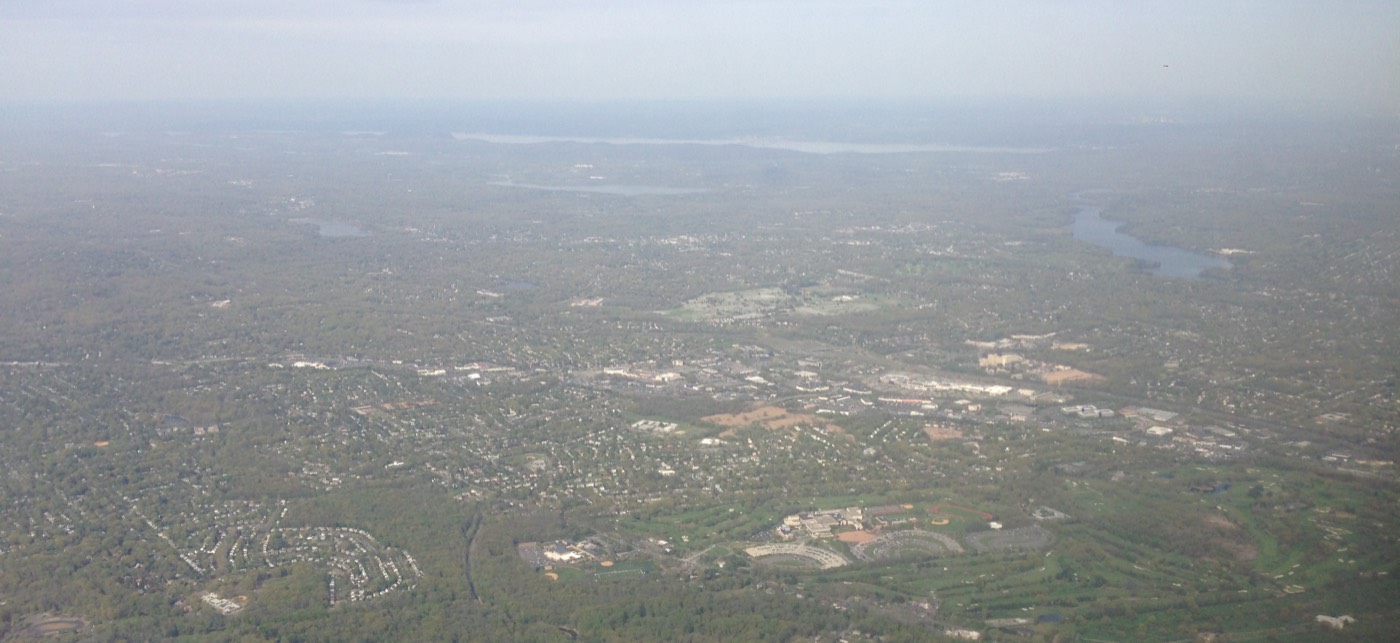
On a Saturday in central Bergen County, the parking decks at Garden State Plaza fill before noon, and somewhere in the slow crawl of traffic on Route 17 a family is talking, in Turkish, about which kebab house to drive to afterward. The Turks in Paramus are not a storefront enclave with a name on an archway. They are a professional, suburban community spread thinly across one of the wealthiest stretches of New Jersey, anchored by a town that sells more retail goods per ZIP code than anywhere else in America.
The Place
Paramus sits in the centre of Bergen County, roughly 15 to 20 miles northwest of Midtown Manhattan. It was incorporated as a borough in 1922, and its name comes from the Lenape word “Peremessing,” often translated as “land of the turkeys” or “pleasant stream.”
For most of its early life it was farmland. That changed in the 1950s and 1960s, when developers worked out that malls paid better than produce. Today the borough generates more than six billion dollars in annual retail sales, more than any other ZIP code in the United States, and yet it remains a quiet bedroom suburb the moment you turn off the highways.
It is also distinctly affluent. The 2010 median household income was just under $105,000, and fewer than two in a hundred families lived below the poverty line. This is the kind of town immigrant families move toward, not away from.
How It Became Turkish
To understand the Turks in Paramus, you have to start a few miles southwest, in Paterson, because almost nobody arrived in Bergen County first.
Little Istanbul, before the move up
South Paterson has been home to a Turkish community since the 1950s, and it is still known as Little Istanbul, the largest Turkish American enclave in the country. The first arrivals were working people, joined over the decades by Turks from Anatolia and by Karachay and other Turkic-speaking groups.
It was a dense, walkable, working-class neighbourhood of bakeries, halal butchers and coffee houses along Main Street. For a long time it was the centre of Turkish life in northern New Jersey, and by some counts the wider Turkish American population it served numbered in the tens of thousands.
That centre has thinned. Estimates of the South Paterson Turkish community have fallen from roughly 60,000 a generation ago to something closer to 20,000 today. People did not vanish. Many of them moved.
The professional wave
The shape of Turkish immigration to the United States explains where they went. From the mid-1920s, American quotas held Turkish arrivals to around a hundred people a year. When those limits were lifted in 1965, the character of the migration changed.
The post-war generation that followed was highly educated. Among the arrivals were thousands of engineers and physicians, and from the 1970s onward Turkish immigration to the country rose past two thousand people a year, weighted heavily toward professionals.
This is the group that gravitated to Bergen County. A doctor finishing a residency at a New Jersey hospital, an engineer at a firm off Route 4, a pharmacist or a small-business owner who had spent a decade getting established: for families like these, the next step was the same one their American neighbours were taking. Better schools, a bigger house, a shorter drive to a good hospital.
Paramus and the towns around it offered exactly that. The borough’s school system is well regarded, its commercial spine puts work and shopping within minutes, and the commuter routes into Manhattan are direct. The move from a Paterson walk-up to a Bergen County colonial was, for many Turkish families, the physical proof of a generation of work.
A scattered, suburban map
The result is a community that looks very different from Little Istanbul. There is no Turkish high street in Paramus. Instead, Turkish life is distributed across the surrounding towns of Bergen and Passaic, the way professional immigrant communities tend to settle once they reach the suburbs.
Bergen County now holds more Turkish residents than any other county in New Jersey, about 5,332 people, which is more than a fifth of the entire state’s Turkish population of roughly 24,900. Passaic County, which includes Paterson, ranks second. The two counties sit side by side, and Paramus straddles the seam between the old enclave and the new prosperity.
Most Turkish Americans are Sunni Muslims, and faith remains a connective thread, though the mosque that serves the community is not in Paramus itself. The pattern is consistent: the institutions cluster a short drive away, while the homes spread out.
The Landmarks
Garden State Plaza, 1 Garden State Plaza, Paramus. Opened in 1957, this is the gravitational centre of Paramus and, for many Bergen County Turkish families, the default weekend meeting point. It is not a Turkish institution, but it is where the suburban version of community happens: cousins meeting at the food court, teenagers circling, parents comparing notes between errands.
Kilim Mediterranean, River Edge. Just over the Paramus line, Kilim serves kebabs, seafood and Turkish dishes to a Bergen County clientele. Restaurants like this are how the diaspora keeps its table set once the corner bakery is twenty minutes away rather than around the block.
El Turco Grill, 270 Main Street, Hackensack. A short drive south of Paramus in the Bergen County seat, El Turco serves kebabs and Turkish-Mediterranean cooking. Hackensack’s Main Street has long been a practical hub for the county’s immigrant businesses, and El Turco is part of that everyday economy.
Ada Mediterranean Brasserie, 14-25 Plaza Road North, Fair Lawn. Sitting just across the Passaic County line from Bergen, Ada offers a more polished take on Turkish and Mediterranean food, the kind of place a family books for a celebration rather than a Tuesday dinner. It reflects how the cuisine has moved upmarket alongside the community.
Bergen Diyanet Mosque, 240 Knox Avenue, Cliffside Park. This Turkish mosque and cultural centre in eastern Bergen County is one of the religious anchors for the county’s Turkish Muslims. It is the kind of institution families will drive to for Friday prayer, for Ramadan, and for the festivals that punctuate the year.
Diyanet Ulu Mosque (Ulu Camii), 32 Chestnut Street, Paterson. Back in South Paterson, the Ulu Mosque remains a tie to the older Turkish heartland. Many Bergen County families still trace their American beginnings to these few blocks, and some still return here to worship.
Bergen Community College, 400 Paramus Road, Paramus. The county’s public college sits squarely in Paramus and serves as a common educational on-ramp. For immigrant families building toward the four-year degrees and professional careers that defined this community, the local college is often where the next generation begins.
Where They Came From
The Turkish Americans of Bergen County trace back to the Republic of Turkey, and the wave that built this suburban community came largely after 1965. Where the earliest Ottoman-era arrivals had often been rural and frequently returned home, the modern migration was urban, educated and intent on staying.
These were engineers, doctors, scientists and graduate students, the professional class that American immigration policy began to favour in the late 1960s and 1970s. Many came through New York City first, drawn by universities and hospitals, before settling across the Hudson into New Jersey.
New Jersey holds them in unusual concentration. The state’s Turkish population works out to around 0.27 percent of residents, several times the national average, and the bulk of it sits in the northern counties closest to New York. Bergen, with Paramus near its centre, is the densest of them all.
Paramus Today
The Turkish presence in Paramus is real but quiet, and it is easy to miss if you are looking for an enclave. There is no signposted Turkish quarter, no single street that announces it. What there is, instead, is a network: families who know one another through the mosque in Cliffside Park, through the restaurants scattered across Hackensack and Fair Lawn and River Edge, through school runs and weekend errands at the Plaza.
The borough around them has changed in ways that make the fit easier. Paramus is now markedly more diverse than it was at the turn of the century. Its Asian population has climbed past a quarter of residents, and Korean Americans have become the largest single minority group in town. A Turkish professional family raising children here is part of a broadly international, high-achieving suburb, not an outlier in it.
For a fuller sense of the area’s layered immigrant geography, it helps to read Paramus alongside its neighbours. The story of the Koreans in Paramus runs parallel to this one, two professional communities reshaping the same affluent town. A few miles southwest, the Turks in Paterson hold the older heartland this community grew out of. The Koreans in Norwood, the Chinese in Princeton and the Syrian Jews in Deal each tell a related New Jersey story of a community that found its footing and moved toward comfort.
What binds the Turks in Paramus is not a place you can stand in the middle of. It is a trajectory, from a Paterson walk-up to a Bergen County driveway, carried by a generation of engineers and doctors and the children they raised to do the same.
Frequently Asked Questions
Are there many Turks in Paramus, New Jersey?
There is a real but dispersed Turkish presence. Bergen County, where Paramus sits near the centre, has about 5,332 Turkish residents, the most of any county in New Jersey and more than a fifth of the state total. Rather than forming one enclave, the Turks in Paramus are spread across the surrounding affluent suburbs.
Why did Turkish families move to Paramus and Bergen County?
Most arrived in New Jersey through South Paterson, the largest Turkish American enclave in the country, then moved up as they prospered. The post-1965 Turkish immigration to America was heavily professional, including thousands of engineers and physicians, and Paramus offered the good schools, short commutes and affluence those families sought.
Where do Bergen County Turks worship?
The Bergen Diyanet Mosque and cultural centre at 240 Knox Avenue in Cliffside Park is a key religious anchor for the county’s Turkish Muslims, most of whom are Sunni. Many families also retain ties to the Diyanet Ulu Mosque at 32 Chestnut Street in Paterson, in the older Turkish heartland.
Where can you eat Turkish food near Paramus?
Turkish and Turkish-Mediterranean restaurants ring the town rather than sitting inside it. Options include Kilim Mediterranean in nearby River Edge, El Turco Grill at 270 Main Street in Hackensack, and Ada Mediterranean Brasserie at 14-25 Plaza Road North in Fair Lawn.
What is the difference between Turkish Paterson and Turkish Paramus?
Paterson’s Little Istanbul is the dense, historic working-class enclave where the community began in the 1950s. Paramus and Bergen County represent the suburban, professional next step, a scattered network of homes rather than a single neighbourhood. The Turks in Paramus largely grew out of Paterson.
Is Paramus a wealthy town?
Yes. Paramus is one of the more affluent boroughs in Bergen County, with a 2010 median household income near $105,000 and very low family poverty. It is also the top retail ZIP code in the United States by sales, which makes it a magnet for upwardly mobile professional families, including Turkish ones.
If your family’s story passed through Paramus, or any of the places Turks have made home in America, Atlas of Home can trace that journey. From the post-1965 professional wave out of Turkey, through the walk-ups of South Paterson, to a quiet driveway in central Bergen County, to wherever you are now.