
On a Saturday night in 1910, a man stepping off the streetcar at Cedar Avenue and Riverside could read every shop sign in Swedish, order coffee and cardamom buns without a word of English, buy a tin of snuff and the latest issue of the homeland press at the same counter, then climb the stairs at Dania Hall to hear a comic in a straw wig sing about a girl named Nikolina. The pavement underfoot was stained brown. So many Scandinavians spat the juice of their chewing tobacco onto the curb after a night of drinking that the street earned a name nobody printed in the guidebooks: Snoose Boulevard, after the snus tucked in their lips. It was crowded, loud, working-class, and for tens of thousands of new arrivals it was the first American place that felt like it belonged to them.
Cedar-Riverside: The Place
Cedar-Riverside sits on the west bank of the Mississippi just across the river from downtown Minneapolis, a compact half-square-mile wedge bounded by the river to the north and east, Interstate 94 to the south, and the freeways near Hiawatha Avenue to the west. Cedar Avenue is its spine, running south from the old Seven Corners junction where Washington, Cedar, and Nineteenth came together. The housing was dense and cheap: frame cottages, brick tenements, and boarding houses packed tight against the mills and the railroad. Today the Blue and Green light-rail lines stop at its edges, and the neighborhood is more commonly called the West Bank.
How Cedar-Riverside Became Snoose Boulevard
Before the Swedes
The land was platted in 1849, the year Minnesota became a territory, and the earliest settlers near the riverfront were a mix of Yankees and Central Europeans. Beneath the Washington Avenue bridge, on the Mississippi floodplain, a settlement called Bohemian Flats grew up among Czech, Slovak, and other immigrant families who built shacks on the riverbank. Two German breweries operated on the flats. But the river was the real draw. The falls of St. Anthony powered the largest concentration of flour mills in the world, and the sawmills upstream cut the white pine floated down from the north woods. That meant work, and work meant men.
The Swedes Arrive
Over a quarter of a million Swedes came to Minnesota between 1850 and 1930, more than settled in any other state. The first waves were farm families chasing the Homestead Act, but by the surge of the 1880s the cheap land was gone and the migration had turned urban. Falling grain prices at home and a booming economy in America pushed young Swedes toward the cities, and Minneapolis was swelling fast. Able-bodied men found wages in the lumber mills, the flour mills, construction, and the railroads. Young women went into domestic service and the millinery trade.
They needed somewhere to land first, and Cedar-Riverside was it. A newcomer could rent a bed in a boarding house, find a job through one of the employment agencies on Cedar Avenue, worship in his own language on Sunday, and drink with countrymen at night. The street filled with Scandinavian-owned businesses. At Samuelson’s confectionery you could buy groceries and sweets; appliance stores, delicatessens, saloons, and dance halls lined the blocks. Swedish, Norwegian, and Danish were the working languages of the street, and a man could spend a week here without needing English at all.
Cedar-Riverside at Its Peak
By 1910 the neighborhood held close to 20,000 people, and more than half were Scandinavian. It had become the cultural capital of Scandinavian Minneapolis, the place people came from across the Upper Midwest to buy snuff, pick up the latest Swedish-language newspaper, and be entertained in their own tongue. Minneapolis was not alone in this. Other cities with large Swedish populations had their own snoose strips, Chicago Avenue in Chicago and Payne Avenue in St. Paul among them, and Chicago’s Swedes would later cluster in the enclave of Andersonville. But Cedar Avenue’s was the famous one. The entertainment was real and ambitious. Dania Hall on Cedar Avenue hosted banquets, bazaars, dances, and evenings of Scandinavian vaudeville. In 1910 a second great venue opened nearby: the Southern Theatre, built specifically for the Cedar Avenue Scandinavian audience, where companies staged original-language plays by Strindberg and Ibsen alongside vaudeville bills.
Faith and drink ran side by side, and not always peacefully. Swedish Lutherans built Augustana congregations, Mission Covenant and Baptist chapels rose, and a Swedish Episcopal parish, St. Ansgarius, was founded in 1893. Temperance societies organized hard against the saloons of the snoose strip, and a working-class divide opened up. The prosperous Swedes who made money moved out to Summit Avenue grandeur and the lake districts, while the boulevard stayed the rowdy, immigrant, ground-floor city. That tension between the respectable and the rough ran through the whole neighborhood.
The Change
The boulevard began to thin almost as soon as it peaked. As Swedish families prospered, they followed the pattern of every immigrant generation and moved up and out, to the Seward neighborhood, the lakes, and eventually the suburbs. Prohibition gutted the saloon economy that had given Cedar Avenue its nickname and much of its nightlife. The neighborhood stayed heavily Scandinavian into the 1940s, but the Swedish-language theaters went dark, the newspapers consolidated, and the churches switched their services to English. By the 1950s the great migration that had filled Snoose Boulevard was a memory carried by aging people who had once been young there.
The Landmarks of Snoose Boulevard
Dania Hall, 427 Cedar Avenue South. The grandest of the Scandinavian halls was built in 1886 by Society Dania, a Danish fraternal aid group organized in 1875 to help young immigrants, and designed by the Norwegian-born architect Carl F. Struck. Five stories tall, it held stores at street level and a horseshoe-balconied theater on the upper floors where the Norwegian novelist Knut Hamsun lectured in the 1880s. A fire gutted the roof in 1991, and a full restoration was nearly complete when a second fire, started by a discarded cigarette, destroyed it on February 28, 2000. The ruin was demolished within months, and a commemorative pillar was raised on the site in October 2001. The lot still stands empty.
The Southern Theatre, 1420 Washington Avenue South. Opened in March 1910 and designed by Charles S. Sedgwick, the Southern was built for the Scandinavian playgoing public and named after Stockholm’s Södra Teatern, with which it ran an actor-exchange program. It staged Strindberg and Ibsen in the original languages, vaudeville, and Saturday silent films for children. It survives today as a performing-arts venue, the rare Snoose Boulevard institution still raising its curtain.
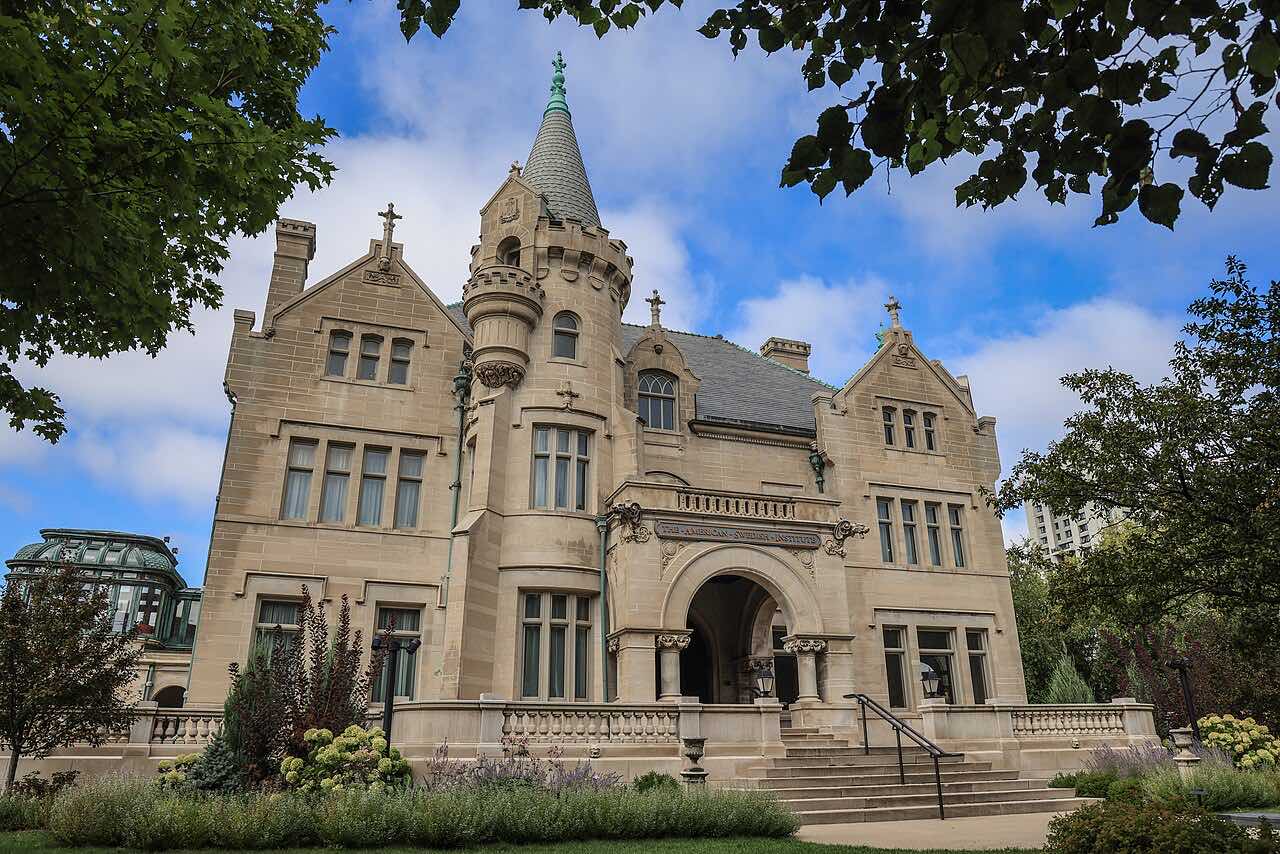
The American Swedish Institute, 2600 Park Avenue South. The single greatest monument the community left behind was not on the boulevard at all but a mile south, on Park Avenue’s “Golden Mile.” Swan Turnblad, the immigrant publisher who made the Swedish-language press a fortune, built a 33-room limestone château here between 1904 and 1908, fitted with eleven imported Swedish tile stoves and acres of hand-carved woodwork. In 1929 he gave away both the mansion and his newspaper to found an institute to preserve Swedish culture in America. It is Minneapolis’s only castle, and it is thriving.
Augustana Lutheran Church. Organized on April 16, 1866 by Swedish immigrants, Augustana was one of the mother congregations of Scandinavian Lutheran Minneapolis. Its Norwegian members withdrew in 1868 to found Trinity, the split that quietly marked the line between the city’s Swedes and Norwegians. The church anchored the religious life that ran in counterpoint to the saloons a few blocks away.
St. Ansgarius Swedish Episcopal Church. Founded in 1893 under the Reverend Olaf Toffteen, St. Ansgarius served Swedish Episcopalians in the heart of the immigrant district. It was one of four Swedish parishes that once dotted the Twin Cities, a reminder that the community was never religiously uniform, but a patchwork of Lutherans, Covenanters, Baptists, and Episcopalians who happened to share a homeland and a street.
Where the Snoose Boulevard Swedes Came From
The Swedes who filled Cedar Avenue came overwhelmingly from the rural provinces of a country that could not feed its own growing population. Sweden’s population had doubled in a century while its farmland was carved into ever-smaller plots, and a run of bad harvests pushed families off the land. The famine-stricken province of Småland in the south sent so many emigrants that it became shorthand for the whole exodus. Swan Turnblad’s family left a Småland farm in 1868 when he was eight.
Others came from the forest provinces farther north. The comic king of the boulevard, Hjalmar Peterson, was born in 1886 in Munkfors in Värmland, a district of ironworks and timber, before he emigrated in 1906. They left for the same reasons: too many people, too little land, too few wages, and letters home from Minnesota promising work in the mills. Chain migration did the rest, as each settler who found a footing sent word, and sometimes a ticket, back to the village.
Cedar-Riverside Today
Snoose Boulevard’s Swedish chapter closed, but the street never stopped being a port of entry. In the late 1960s the University of Minnesota’s expansion turned Cedar-Riverside into the West Bank, the “Haight-Ashbury of the Midwest,” a warren of music clubs, coffeehouses, and antiwar energy where a young folk scene took root. The Cedar movie theater where Scandinavian vaudeville once played became the Cedar Cultural Center. Then a new wave arrived. Today Cedar-Riverside is the heart of Minnesota’s Somali community, so concentrated that it is widely called Little Mogadishu, and home as well to many Somali families who made the West Bank their first American home and to the Oromo of Minneapolis. The boarding-house street of the 1890s is the immigrant-landing street still.
The Swedish memory was nearly lost before a folklorist saved it. In 1972 the accordionist Maury Bernstein staged the first Snoose Boulevard Festival on Cedar Avenue, with the Swedish singer Anne-Charlotte Harvey reviving the emigrant ballads and comic songs. The first festival drew 14,000 people; by 1974 the crowds topped 100,000. It ran six years, through 1977, before debts and a changing neighborhood ended it, but it put the boulevard’s music back on the record.
And the great house on Park Avenue endures. The American Swedish Institute draws thousands through Turnblad’s castle for craft exhibitions, Midsommar and Santa Lucia, and a Nordic café, FIKA, that serves gravlax and cardamom buns a few miles from where the boulevard’s bakeries once stood. The pavement no longer runs brown with snuff, and the shop signs read in other languages now. But on the plaques and in the music, Snoose Boulevard is remembered, and the work it did, taking in the newest arrivals and giving them a place to begin, goes on.
Frequently Asked Questions
Why did Swedish immigrants settle on Snoose Boulevard in Minneapolis?
Cedar-Riverside sat beside the flour mills, sawmills, and railroads that employed thousands of newly arrived men, and it offered cheap boarding houses, Scandinavian shops, churches, and saloons within a few blocks. A Swede could land here, find work and a bed, and live entirely in his own language while finding his feet. That convenience made Snoose Boulevard Minneapolis the natural first stop for the immigrant wave.
Is Cedar-Riverside still a Swedish neighborhood today?
No. The Swedes prospered and moved out to Seward, the lake districts, and the suburbs between the 1920s and the 1950s, and the Swedish-language theaters and newspapers faded with them. Today Cedar-Riverside is the center of Minnesota’s Somali community, often called Little Mogadishu. The neighborhood remains what it always was, a first home for new immigrants.
What were the most famous landmarks on Snoose Boulevard?
Dania Hall at 427 Cedar Avenue South was the great Scandinavian gathering place until fire destroyed it in 2000, and the Southern Theatre, opened in 1910, still operates today. The most spectacular survivor is the American Swedish Institute, the limestone castle that publisher Swan Turnblad built on Park Avenue and gave away in 1929 to preserve Swedish culture.
Where did the Swedes of Snoose Boulevard come from?
Most came from rural Sweden, where a doubling population and shrinking farms left little work. The southern province of Småland, hit hard by famine, sent enormous numbers, and forest provinces like Värmland sent many more. They left for the mills and wages of Minnesota, with each settler drawing relatives and neighbors along the chain.
When did Swedes first arrive on Snoose Boulevard Minneapolis?
Swedes began filling Cedar-Riverside in large numbers during the urban migration wave of the 1880s, and the neighborhood peaked around 1910 with close to 20,000 people, more than half of them Scandinavian. The name Snoose Boulevard, after the snuff residents chewed, was in common use by the 1890s. The Scandinavian character held into the 1940s before fading.
If your family’s story passed through the boarding houses and bakeries of Snoose Boulevard, the names and routes that carried them there are still recoverable, and worth tracing.