
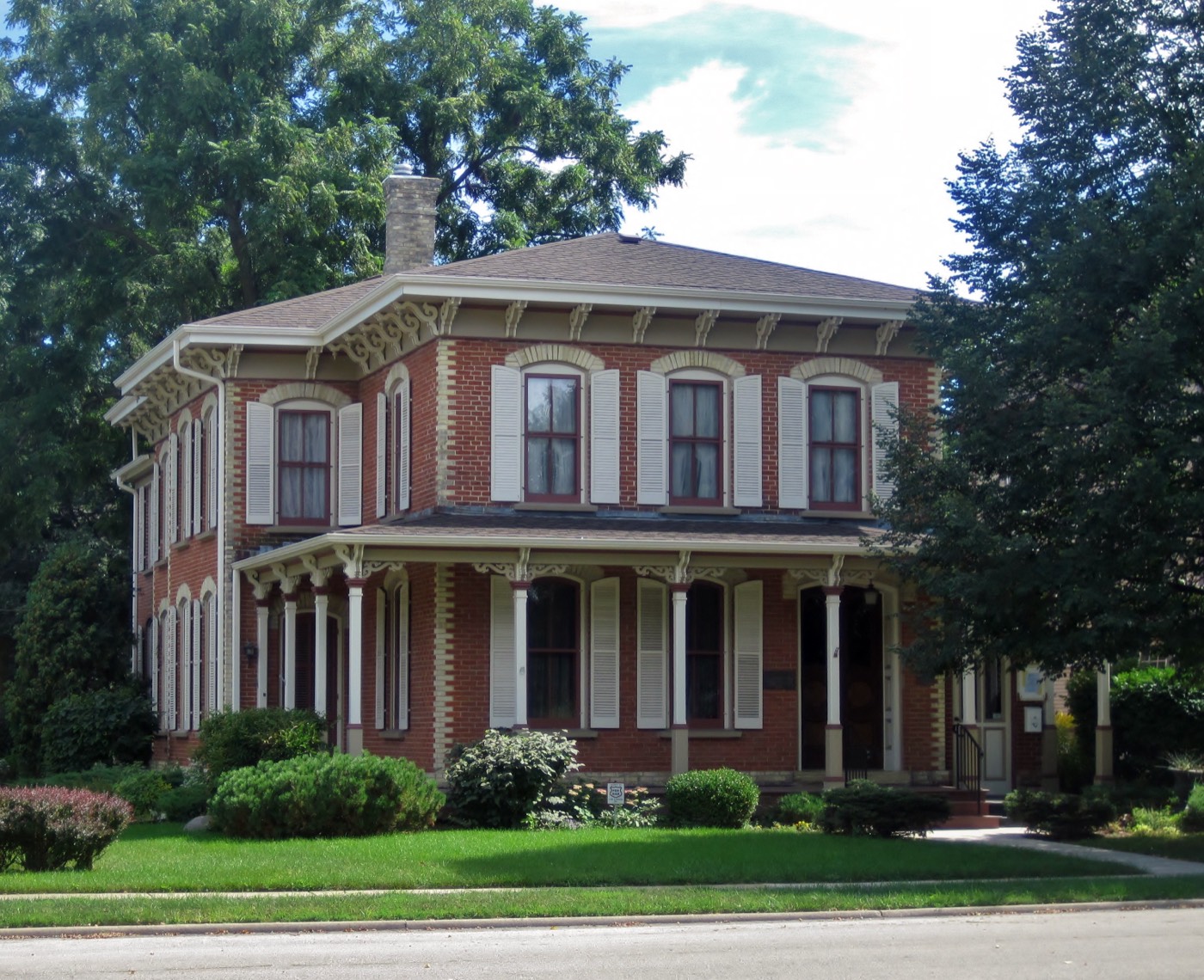
On a quiet east-side block in Rockford, a sturdy brick house built in 1871 still stands behind a wrought-iron fence, its rooms hung with rosemaled cabinets and dala horses. It is the surviving heart of one of the largest concentrations of Swedes in any American city outside the Twin Cities, a community that did not merely settle in Rockford but built it: its furniture, its banks, its socks, even its mascot. It is a story that rhymes with the Swedish furniture makers of Jamestown, New York and the prairie colonies further west. To understand the Swedes in Rockford is to understand how a prairie mill town on the Rock River became, for a few remarkable decades, one of the most Swedish places in the United States.
The Place
Rockford sits on the Rock River in northern Illinois, roughly ninety miles north-west of Chicago and a short drive from the Wisconsin line. It was founded in 1835 around the river’s natural ford, and the waterpower, the surrounding hardwood timber and the arrival of the railroads turned it into a manufacturing town early.
For much of the twentieth century Rockford was Illinois’s second city by population, a place of fasteners, machine tools and furniture rather than skyscrapers. It earned nicknames like the “Screw Capital of the World” for its fastener industry, and at one point trailed only Grand Rapids in furniture output.
None of that happened without the Swedes. The east side of the river, and a tight grid of streets now called Haight Village, became the cradle of Swedish Rockford, the neighbourhood where the immigrants worshipped, built workshops and raised the children who would run the factories, a counterpart on the prairie to the way the Irish settled Beverly in Chicago.
How It Became Swedish
The first Swede arrived in 1852. His name was John Nelson, a cabinet maker from Kärråkra in the province of Västergötland, and the trade he carried in his hands would set the pattern for everything that followed.
A trickle becomes a flood
Nelson did not come alone for long. By 1854 roughly a thousand Swedes had gathered in Rockford. The number climbed to about two thousand by 1862 and three thousand five hundred by 1872, swelling fastest in the years after the American Civil War, when famine and land hunger in rural Sweden pushed hundreds of thousands across the Atlantic. The same wave seeded the religious colony of the Swedes at Bishop Hill, Illinois and the college town the Swedes built at Lindsborg, Kansas.
They came overwhelmingly from the farming provinces of southern and central Sweden, above all Västergötland, the region around Falköping and Skövde. The chain ran district by district and parish by parish: a man wrote home, sent a ticket, and a cousin followed into the same workshop on the same street. Rockford’s east side filled with families who had been neighbours in the old country.
Furniture as a Swedish trade
The Swedes who landed in Rockford were not random labourers. A striking share were trained woodworkers, joiners and cabinet makers, and they arrived in a town with rivers, rail and forests of hardwood at its back.
In 1875 fifteen Swedish workmen pooled their savings, capitalised a company at fifty thousand dollars and founded the Forest City Furniture Company. It was a co-operative venture in spirit, owned and run by the immigrants themselves, and it became the template for a whole industry. Within a generation the Swedes of Rockford had organised some seventy furniture and related concerns.
The towering figure was Pehr August Peterson, born in 1846 in Södra Ving in Västergötland, who came with his parents in 1852 and grew into Rockford’s foremost industrialist. Peterson helped organise company after company, among them the Rockford Chair and Furniture Company in 1882 and the Scandia Furniture Company in 1890, lending his backing and his name to ventures across the east side.
The house on Third Street
John Erlander came from the same world. A Swedish immigrant who prospered in the furniture trade, he helped found the Rockford Union Furniture Company and the Excelsior Furniture Company, and in 1871 he built a handsome brick home at what is now 404 South Third Street.
That house outlived the factories. In 1938 a group of Rockford Swedes founded the Swedish Historical Society and made the Erlander home its museum, and it remains today the single most important monument to the community. Its rooms preserve the furniture, textiles and household goods of the immigrant generation, in the very neighbourhood they built.
The churches that anchored the east side
Faith arrived almost as early as the cabinet makers. First Lutheran Church, organised in 1854, was the first Swedish and the first Lutheran congregation in Rockford, gathered as a Scandinavian Evangelical Lutheran flock.
As the east side filled, the single congregation split into many. Emmanuel Lutheran followed in 1882, the Swedish Evangelical Lutheran Zion congregation enrolled 146 charter members in 1883, and Trinity Lutheran came in 1895. These churches were not only places of worship but social anchors, conducting services in Swedish well into the twentieth century and holding the language alive on American soil.
From socks to a national toy
John Nelson, the first Swede to arrive, made one more contribution that outran them all. A tinkerer as much as a cabinet maker, he turned to knitting machinery and patented an automatic sock-knitting machine, and in 1880 founded the Nelson Knitting Company.
The firm sold “Celebrated Rockford Seamless Hosiery,” and in 1932 it added a distinctive red heel to its socks so customers could tell a genuine Nelson sock from an imitation. During the Depression, thrifty crafters began stitching those worn-out red-heeled socks into stuffed monkeys. The Rockford Red Heel sock monkey, with its red knit mouth, became a national toy, and Rockford became its undisputed home.
The Landmarks
Erlander Home Museum, 404 South Third Street. The 1871 brick home of furniture maker John Erlander is the keystone of Swedish Rockford. Operated by the Swedish Historical Society since 1938, its period rooms hold immigrant furniture and textiles, and its garden hosts the city’s Swedish gatherings.
Nordic Cultural Center, 327 South Third Street. A short walk from the Erlander home, the centre is where museum tours begin and where the society stages its programmes. Together the two addresses form a small Swedish campus in the middle of Haight Village.
First Lutheran Church, Haight Village. Founded in 1854 as Rockford’s first Swedish and first Lutheran congregation, First Lutheran built its third church in 1884 and still worships there, having chosen to stay in the old Swedish neighbourhood rather than follow its members to the suburbs.
Zion Lutheran Church, Rockford. Organised in 1883 by 146 charter members as the Swedish Evangelical Lutheran Zion congregation and dedicated in 1885, Zion came to hold services in English as well as Swedish, a quiet record of how a Swedish parish became an American one without forgetting its tongue.
Haight Village Historic District, east side of the Rock River. Named for Daniel Shaw Haight, who founded the east-side town in 1835, this 42-acre district of Greek Revival, Classical Revival and Victorian homes became predominantly Swedish after the Civil War. It was listed on the National Register of Historic Places on 20 November 1987.
326 South Third Street. One of the district’s signature houses, an 1883 Gothic Revival dwelling crowned with a Second Empire tower, stands a few doors from the Erlander home as a reminder of the prosperity the furniture trade brought to these blocks.
Midway Village Museum, 6799 Guilford Road. On the city’s east side, this open-air history museum preserves and interprets Rockford’s industrial and immigrant past, including the Swedish furniture and knitting story and a noted sock-monkey collection.
Where They Came From
Rockford’s Swedes were, to an unusual degree, a single-province migration. The dominant homeland was Västergötland, the agricultural country of south-western Sweden around Falköping, Skövde and the parishes of the Skara plain.
The biographies confirm it. John Nelson came from Kärråkra in Västergötland. Pehr August Peterson was born in Södra Ving in the same province. Levin Faust, another Rockford industrialist, was born in Falköping in 1863 and arrived in 1887. Even the variations, like Oscar Sundstrand who came from Södermanland in 1882, stayed within the central Swedish farming belt.
The pull was simple. Sweden in the second half of the nineteenth century suffered crop failures, a fast-growing rural population and too little land to divide. America offered wages and, in Rockford, the specific promise of work for men who knew wood and machinery. The trade matched the town, and the town filled with Westrogothians.
Rockford Today
The Swedish century did not last. The furniture factories that the immigrants founded faded through the twentieth century, undone by changing tastes and competition, and Rockford’s manufacturing base contracted with the rest of the industrial Midwest, a fate shared by many Chicago-area enclaves such as the Irish neighbourhood of Sauganash. Plant closures and population loss left the city with the hard arithmetic of a Rust Belt town.
Yet the Swedish inheritance proved durable in unexpected ways. Two Rockford companies started by Swedish immigrants merged in 1926 to form the Sundstrand Corporation, which grew into a major aerospace manufacturer and survives, through its successors, as one of the city’s anchor employers. The cabinet makers’ descendants, in other words, helped put precision parts into aircraft.
The community itself is no longer the demographic giant it was. Swedish ancestry now accounts for only a few per cent of Rockford’s population, a long way from the day in 1952 when at least a third of the city’s hundred thousand people still claimed Swedish origin. The language has faded, and the old congregations have shrunk.
What endures is memory, well kept. The Erlander Home Museum still opens its doors on South Third Street, the Swedish Historical Society still holds its programmes, and every June the streets of Haight Village fill for a Midsommar festival that has run for more than eighty years, complete with a raised maypole, folk dancing and Swedish food, much as the Swedes of Andersonville in Chicago keep their own midsummer traditions an hour and a half down the highway. Rockford remembers that it was, and in many ways still is, a Swedish town.
Frequently Asked Questions
When did Swedes first settle in Rockford, Illinois?
The first Swede, cabinet maker John Nelson, arrived in 1852. Immigration accelerated after the American Civil War, and by 1872 around three thousand five hundred Swedes lived in the city, most of them on the east side of the Rock River.
How Swedish was Rockford at its peak?
Remarkably so. The 1900 census found that twenty-two per cent of Rockford’s residents had been born in Sweden, and counting the American-born children of Swedish parents, nearly forty-four per cent of the city was Swedish. As late as 1952 at least a third of Rockford’s hundred thousand people were still of Swedish origin.
Why did the Swedes in Rockford go into furniture?
Many of the immigrants were trained cabinet makers and joiners, and Rockford offered rivers, railroads and hardwood timber. In 1875 fifteen Swedish workmen founded the Forest City Furniture Company, and within a generation the Swedes had organised some seventy furniture and related firms, making Rockford a national furniture centre.
What is the Erlander Home Museum?
It is the 1871 brick home of Swedish furniture maker John Erlander at 404 South Third Street, in the Haight Village neighbourhood. Since 1938 it has been operated as a museum by the Swedish Historical Society of Rockford, preserving the furniture and household goods of the immigrant generation.
What does the sock monkey have to do with the Swedes in Rockford?
John Nelson, the first Swede to settle in Rockford, patented an automatic sock-knitting machine and founded the Nelson Knitting Company in 1880. After the firm added a red heel to its socks in 1932, Depression-era crafters began turning the worn socks into stuffed monkeys, and the Rockford Red Heel sock monkey became a national toy.
Where did Rockford’s Swedes come from in Sweden?
Overwhelmingly from Västergötland, the farming province of south-western Sweden around Falköping and Skövde. Leading figures such as John Nelson, Pehr August Peterson and Levin Faust all came from that region, the product of a tight chain migration parish by parish.
If your family’s story passed through Rockford, or any of the places Swedes have made home in America, Atlas of Home can trace that journey. From a parish in Västergötland to a cabinet shop on the Rock River, to wherever you are now.