
On the highest ground in Chicago, where Western Avenue runs straight as a ruler past green lawns and brick bungalows, the Irish in Beverly have built something that feels less like a city neighbourhood and more like a small Irish county set down on the South Side. Ask a local where they are from and they will not name a street. They will name a parish.
The Place
Beverly sits on the northern edge of the Blue Island Ridge, a glacial spine that gives the neighbourhood the only real hills in famously flat Chicago. It was sparsely settled until the late 19th century, incorporated as part of the village of Washington Heights in 1874 and annexed by the city in 1890.
What made it grow was the railway. When the Rock Island line opened its 91st Street and Beverly Hills station in 1889, the ridge became a commuter retreat for prosperous Chicagoans, who built grand houses on Longwood Drive and lined the side streets with the kind of solid masonry homes that still define the area.
Today Beverly is one of Chicago’s most stable and affluent neighbourhoods. The 2021 median household income was 113,824 dollars, almost double the citywide figure of 65,781 dollars, and more than a third of households earned over 150,000 dollars a year.
How It Became Irish
The first families on the ridge were not Irish at all. The early settlers were largely English and Protestant, drawn by the views and the railway, and the oldest houses on Longwood Drive reflect that genteel beginning. The Irish arrived later, and from below.
It is a pattern repeated across Irish America, from the commuter towns south of Boston such as the Irish in Milton, Massachusetts and the coastal Irish of Scituate, to the Irish of Greenwich, Connecticut. In each case a working-class first generation climbed, over decades, into the leafy ground their grandparents could only have served in.
From the canal to the ridge
The Irish story in Chicago begins with a ditch. Construction of the Illinois and Michigan Canal started in 1836 and drew Irish labourers by the thousand. Its completion in 1848 coincided almost exactly with the worst years of the Great Famine, and the men who dug the canal were joined by waves of refugees fleeing hunger in the west and south of Ireland.
These were not the Irish of Beverly’s lawns, not yet. They settled first in the working districts nearer the river and the stockyards, in Bridgeport and Canaryville and Back of the Yards, taking the hard jobs on the railroads, the docks and the killing floors. By the 1870s the Irish-born population of Chicago was approaching 70,000, more than a quarter of the entire city.
Climbing the South Side
What happened next is the quiet engine of South Side Irish history: upward mobility, one parish at a time. As the children and grandchildren of canal diggers and stockyard hands became police officers, firefighters, teachers, lawyers and contractors, they moved steadily south and west, away from the river and toward the green high ground.
By the early 20th century Beverly was seeing a large influx of Irish Americans, who set about doing what the Chicago Irish always did when they arrived somewhere: they built a church. New Roman Catholic parishes and Irish businesses followed, and the neighbourhood began its long transformation into what one history calls a stronghold of the city’s South Side Irish community.
The parish era
The decisive moment came in 1924. That spring, Irish-Catholic families in Beverly organised a new parish under their pastor, Reverend Timothy J. Hurley. At five o’clock on Christmas morning of 1924, Father Hurley celebrated the first Mass in the new church of St. Barnabas, the first Irish-Catholic parish in Beverly and Morgan Park.
St. Barnabas was not just a church. It set the template for how the neighbourhood would organise itself for the next century, around the parish school, the parish boundaries and the parish identity. More parishes followed, and with them more schools, until the map of Catholic Beverly became the real map of the neighbourhood.
The numbers tell the rest. During the 1950s, Irish Catholics moved into Beverly in such numbers that they became the leading nationality among the area’s ethnic groups, displacing the English Protestant founders as the defining culture of the ridge.
The parade
By the late 1970s the South Side Irish were confident enough to march. In 1979, two Morgan Park neighbours, George Hendry and Pat Coakley, gathered seventeen children, the so-called Wee Folks of Washtenaw and Talman, and walked them around the 10900 blocks of those two streets. It was a backyard idea, inspired by an older Southtown parade that had moved downtown in 1960.
In 1981 the little procession moved to Western Avenue, where it has stayed ever since, running from 103rd Street down to Kennedy Park. From seventeen children it has grown into one of the largest Saint Patrick’s Day celebrations outside Dublin. The 2026 edition was the 48th, with more than a hundred groups marching down Western.
The Landmarks
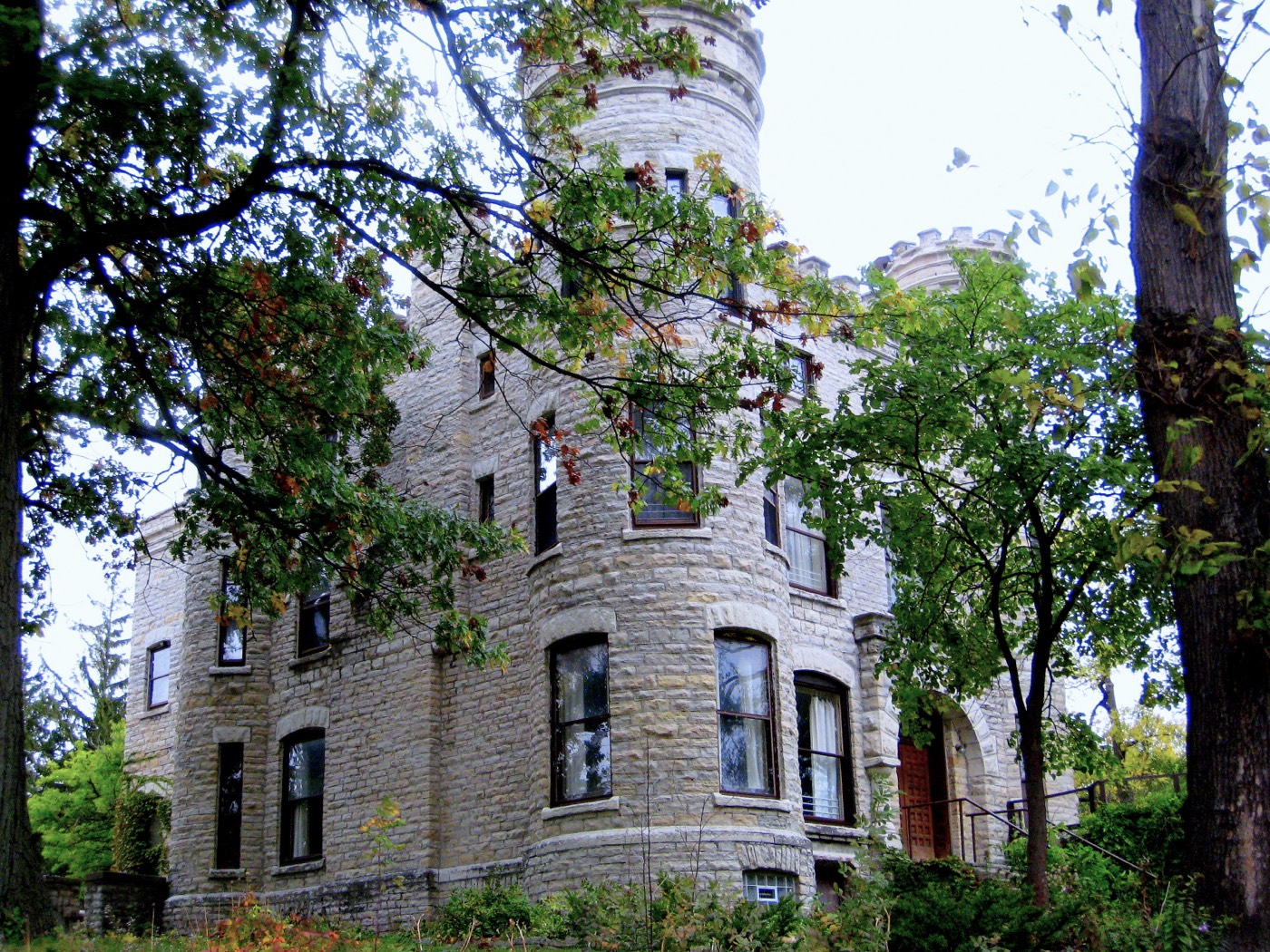
Givins Beverly Castle, 103rd Street and Longwood Drive. Built in 1886 and 1887 with three crenellated towers, this limestone folly was modelled on an Irish castle and is the single most recognisable building on the ridge. Fittingly for a neighbourhood this devout, it is now home to the Beverly Unitarian Church, a stone Irish castle pressed into Chicago service.
St. Barnabas Parish, 101st Street and Longwood Drive. The first Irish-Catholic parish in Beverly and Morgan Park, founded in 1924 under Father Timothy Hurley. Generations of Beverly families have measured their lives by this church and its school, and “St. Barnabas” remains shorthand for a whole stretch of the neighbourhood.
Cork & Kerry, 10614 South Western Avenue. Open since 2000 and named for two of the Irish counties that sent the most emigrants to Chicago, this pub anchors the Western Avenue strip that locals call the Irish mile. It pours more than twenty beers on tap and packs a 300-person beer garden, and on parade day it is the centre of the world.
Barney Callaghan’s, 10618 South Western Avenue. For decades this was Keegan’s Pub, long reputed to pull the best pint of Guinness in Chicago. In 2015 owner Bernard Callaghan rebuilt and renamed it for his family and the family dog, doubling its size and adding a basement room with a small stage, but the institution and its clientele carried straight across.
Beverly Arts Center, 2407 West 111th Street. Founded in 1968, this 40,000 square foot cultural centre holds a 400-seat theatre, galleries and studios, and serves as the neighbourhood’s gathering place for everything from drama to the annual exhibitions of South Side Irish life that line its walls each March.
Mother McAuley Liberal Arts High School, 3737 West 99th Street. An all-girls Catholic school named for Catherine McAuley, founder of the Sisters of Mercy, whose order reached Chicago in 1846. Together with the all-boys Brother Rice High School next door, it forms part of the Catholic schooling network that has kept Beverly’s Irish families rooted to the area for generations.
Longwood Drive Historic District. Designated a Chicago Landmark in 1981, this winding ridge-top avenue carries the grand early houses, some by architects of national note, that drew the first settlers here. The Irish who came after did not tear them down. They moved in, kept them up, and made the street their own.
Where They Came From
The Irish of Beverly trace back, almost to a family, to the west and south of Ireland. Most Chicago Irish came from counties Cork, Kerry, Clare, Galway and Mayo, with Donegal close behind, the poorest and most Famine-stricken corners of the island.
It was not a coincidence of names. West Cork and the western seaboard counties were precisely the places the Great Famine hit hardest, where blight and eviction emptied whole townlands in the late 1840s. The emigrants who survived the crossing carried county loyalties with them, and those loyalties echoed in the names above Chicago shopfronts and, eventually, on the green-painted facades of Beverly.
That is why a pub on Western Avenue is called Cork & Kerry rather than simply Irish. In Beverly the old counties never quite dissolved into a generic Irishness. They became the surnames in the parish registers, the songs at the parade, and the family stories handed down with the house on the ridge.
Beverly Today
Beverly is no longer purely Irish, and to its credit it has never tried to be. With a 2020 population of around 20,027, the neighbourhood was 55.3 per cent White and 32.4 per cent Black as of 2021, and it is widely recognised as one of the most racially integrated neighbourhoods in Chicago, a rare and deliberately maintained achievement on a segregated South Side. The same long arc of arrival shaped other Irish enclaves across the country, and indeed Beverly’s own corner of Illinois, where neighbourhoods like the Greeks of Park Ridge tell a parallel story of immigrant ascent in the Chicago suburbs.
Yet the Irish character has not faded so much as settled in. The parishes still define how people speak about home. The pubs on Western Avenue still fill on Sunday afternoons. And every March, for one enormous day, the whole of Irish Chicago comes back to the ridge for the parade their grandparents started with seventeen children and a borrowed idea.
It is a neighbourhood that knows exactly where it came from. The descendants of canal diggers and stockyard hands now live in the grand houses the first English settlers built, send their children to the schools the Mercy and Christian Brothers founded, and tell the time by the parish bells. The climb up the South Side took a hundred years. Beverly is where it arrived.
Frequently Asked Questions
Why are there so many Irish in Beverly, Illinois?
The Irish in Beverly are the descendants of Famine-era immigrants who first settled in Chicago’s working districts near the canal and stockyards, then moved south and up the Blue Island Ridge over several generations. By the 1950s Irish Catholics had become the leading ethnic group in the neighbourhood, building the parishes and pubs that define it today.
What is the South Side Irish Parade?
It is an annual Saint Patrick’s Day procession down Western Avenue in Beverly, founded in 1979 by neighbours George Hendry and Pat Coakley with just seventeen children. It moved to Western Avenue in 1981 and has grown into one of the largest Irish celebrations outside Dublin, reaching its 48th edition in 2026.
What is the Givins Beverly Castle?
Built in 1886 and 1887 on Longwood Drive, it is a limestone house modelled on an Irish castle, complete with three crenellated towers. It is the most recognisable landmark in Beverly and now serves as the home of the Beverly Unitarian Church.
Where on the ridge do you find the Irish pubs?
The heart of Irish Beverly runs along Western Avenue, sometimes called the Irish mile, where establishments like Cork & Kerry at 10614 South Western and Barney Callaghan’s, the former Keegan’s, at 10618 South Western draw crowds year round and especially on parade day. The Irish in Beverly have more Irish bars per block here than anywhere else in the city.
Which Irish counties did Beverly’s families come from?
Most trace their roots to the west and south of Ireland, particularly counties Cork, Kerry, Clare, Galway, Mayo and Donegal. These were the regions hit hardest by the Great Famine, and their county loyalties still surface in the names of Beverly’s pubs, parishes and families.
What does “what parish are you from” mean in Beverly?
In Beverly and the surrounding Morgan Park and Mount Greenwood, people locate themselves by Catholic parish rather than street, saying things like “I’m St. Barnabas” or “I’m Christ the King.” It is a habit so ingrained that it applies even to residents who are not Catholic, and it is the clearest sign of how deeply the Irish in Beverly shaped the neighbourhood.
If your family’s story passed through Beverly, or any of the places Irish families have made home in America, Atlas of Home can trace that journey. From a townland in Cork or Mayo to a brick house on the Blue Island Ridge, to wherever you are now.