
On a Saturday morning in season, the accent you catch over flat whites on Fifth Avenue South is as likely to be from Johannesburg as from the Midwest. The South Africans in Naples, Florida are a quiet presence in one of America’s wealthiest small cities: surgeons and engineers, retired farmers from the Free State, young families who left Sandton or Cape Town for the Gulf coast and never looked back. They are not numerous. They are unmistakable.
The Place
Naples sits on the Gulf of Mexico at the south-western edge of Florida, in Collier County, where the suburbs run out and the Everglades begin. It is a city of fewer than 20,000 permanent residents, a number that swells past 80,000 once the winter season arrives and the snowbirds reopen their second homes.
It is also, by most measures, the richest city in Florida. Kiplinger once ranked it sixth in the nation for per capita income, and it has long carried one of the highest concentrations of millionaires per capita in the United States. The streets behind the beach are lined with gated golf communities, art galleries and yacht slips.
For an affluent, professional diaspora, that profile matters. Naples is not a place people stumble into. It is a place they choose.
How It Became South African
There is no single founding moment for the South Africans in Naples, no boatload of arrivals or sponsoring church. The community accreted slowly, family by family, over three decades, following the same arc that took roughly 123,000 South African-born people to the United States by the early 2020s.
The first wave: professionals and doctors
Naples grew up as a winter resort. It was established on 6 November 1886 by the former Confederate general John Stuart Williams and the Louisville newspaperman Walter Haldeman, who likened its bay to the one at Naples, Italy. The pier opened in 1888, the Tamiami Trail linked the town to Miami in 1928, and the city was formally incorporated in 1949.
For most of the twentieth century it remained small and seasonal. The South Africans who arrived first, in the 1980s and 1990s, came as the wider professional emigration from South Africa was gathering pace. Many were doctors, dentists and specialists, drawn by a city building one of the better hospital systems in south-west Florida and by the steady demand of an older, wealthy population that could pay for the best care.
The 2000s: the safety migration
The larger movement came after 2000. The reasons South Africans gave for leaving were consistent and well documented: a faltering economy, chronic unemployment, high crime rates, unreliable electricity, and a wish to improve their children’s prospects. For families who could afford to be selective about where they landed, Florida had obvious appeal. There is no state income tax, the climate is close to what they knew, and the golf is excellent.
Naples offered something more specific. It is small, safe and orderly, the qualities that many emigrating South Africans say they miss most about the country they left and the qualities they could no longer count on at home. A surgeon from Pretoria or a financial adviser from Durban could rebuild a familiar suburban life here, with a pool, a braai and a gate, minus the fear that had pushed them out.
Chain migration and the seasonal pull
As with every diaspora, arrivals begat arrivals. Once a handful of South African families were established, relatives and old schoolfriends visited, saw the life, and made plans of their own. Retirees followed adult children who had come for work. Some bought seasonal homes first and converted them to year-round residences as they aged.
By the most recent census estimates, Collier County, where Naples sits, was home to around 308 South African-born residents, with a further 307 next door in Lee County around Fort Myers and Bonita Springs. The numbers are small. But against a national South African-born population of roughly 123,000, a couple of small Gulf-coast counties holding more than 600 between them is a meaningful concentration.
Florida overall counts somewhere above 8,000 South African residents, the second-largest such population of any state after California. Most cluster on the Atlantic side, around Palm Beach and Broward. Naples and its neighbours form the quieter western counterweight, an echo on the Gulf of the larger immigrant communities you find across the state, from Boca Raton and Weston to the Brazilians of Pompano Beach on the Atlantic side.
A community that does not advertise itself
What sets the Naples South Africans apart from the larger Atlantic-coast communities is how little infrastructure they have built. There is no South African church, no dedicated cultural centre, no annual heritage festival on the calendar. This is partly a function of size and partly of class. An affluent, professionally integrated diaspora tends to assimilate rather than cluster.
The threads that bind them are informal: rugby on a Saturday, a shared grocery run up the coast, a WhatsApp group, a braai in someone’s lanai. The community is real, but you have to know where to look for it.
The Landmarks
Few of these places are South African in any official sense. They are the stage on which a South African life in Naples is lived, plus the handful of spots where the accent gathers.
Legends B&G Sports Bar, 8955 Tamiami Trail North. This is the closest thing Naples has to a South African clubhouse. When the Springboks play, Legends has hosted dedicated watch parties with sliced biltong, boerewors rolls, peri-peri wings and Springbokkie shots on the menu. For a few hours the bar fills with green-and-gold jerseys and a crowd that knows the words to the anthem.
Fifth Avenue South, Old Naples. The Mediterranean-styled main street, with its outdoor cafes and palm-lined pavements, is where new arrivals first feel the resemblance to home. The architecture nods to Italy, but the pace and the easy outdoor café culture feel familiar to anyone who grew up on a Cape Town or Durban beachfront.
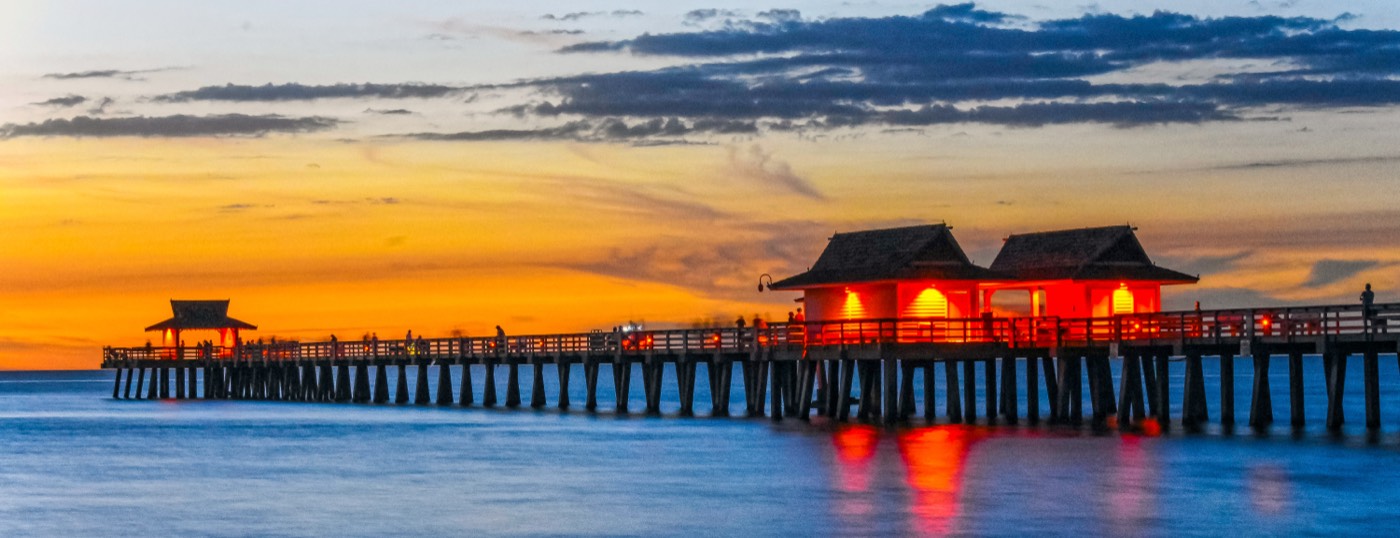
The Naples Pier, west end of 12th Avenue South. First opened in 1888 and rebuilt many times since, the pier reaches a thousand feet into the Gulf and remains the city’s emotional centre. It is where South African families bring visiting parents to watch the sunset and explain, without quite managing to, why they live here now.
Waterside Shops, 5415 Tamiami Trail North. An open-air luxury centre anchored by Saks Fifth Avenue, with Hermès, Louis Vuitton and Tiffany among its tenants. For the wealthier end of the South African community, the surgeons and the business owners, this is the everyday reminder of just how comfortable the life they chose can be.
Mercato, North Naples. A newer mixed-use centre anchored by a Whole Foods Market and the Silverspot Cinema, which pioneered the concierge-cinema concept here in 2009. Mercato’s restaurants and bars are a common Friday-night gathering point for younger South African professionals and their families.
Naples Botanical Garden, 4820 Bayshore Drive. A 170-acre garden of tropical and subtropical plants, several of which, the proteas and other fynbos relatives, will stop a South African in their tracks. For homesick visitors, it is an unexpected piece of the Cape on the Gulf coast.
Dutchy’s Market, 401 South State Road 7, Plantation. The nearest proper South African grocer is not in Naples at all but a long drive east across the Everglades, on the Atlantic side. South Africans in Naples make the pilgrimage, or order online, to stock up on biltong, droëwors, boerewors and Mrs Ball’s chutney. The distance is a small price for the taste of home.
Where They Came From
The South Africans in Naples are drawn from the country’s cities far more than its countryside. They come from Johannesburg and its northern suburbs, from Sandton and Pretoria, from Cape Town, Durban and the smaller centres of the old commercial heartland.
They are, in the main, the people the surveys describe as most likely to leave: the educated, the employed, the relatively wealthy, the young enough to start again. White South Africans of British and Afrikaner descent predominate in this Gulf-coast community, as they do in much of the wider United States diaspora, though the picture is never as uniform as the stereotype suggests.
Their reasons for leaving were rarely about Naples specifically and almost always about South Africa. Crime and safety came first in nearly every account, followed by the economy, the unreliable power supply, and the future they wanted for their children. Naples was the answer to a question the country had forced them to ask.
Naples Today
The South African community in Naples in the mid-2020s is small, prosperous and largely invisible to outsiders. It has no neighbourhood you could point to on a map, no commercial strip, no steeple. Its members are scattered through the golf communities of North Naples and the older streets near the beach, indistinguishable on paper from their American neighbours until they open their mouths.
That invisibility is, in a sense, the point. This is a diaspora that came to disappear comfortably into a good life, and on its own terms it has succeeded. The children grow up American, with a softening accent and a faint memory of a grandmother’s garden in Constantia. The braais continue, the rugby is followed religiously, and the trip to Dutchy’s gets made a few times a year.
It is a smaller, gentler version of the story playing out across Florida and beyond, from the larger communities of the Atlantic coast to the established South African presence near Atlanta in Sandy Springs. Naples is where a certain kind of South African family comes to exhale. After everything, that is no small thing.
Frequently Asked Questions
How many South Africans live in Naples, Florida?
Exact city-level figures are not published, but census estimates put the South African-born population of Collier County, which contains Naples, at around 308, with a further 307 in neighbouring Lee County. The South Africans in Naples form a small but distinct part of Florida’s wider community of more than 8,000 South African residents.
Why did South Africans move to Naples, Florida?
Most cite the same reasons that drove the wider South African emigration: crime and personal safety, a faltering economy, unreliable electricity and a wish to give their children better prospects. Naples appealed specifically because it is safe, affluent and orderly, with no state income tax and a warm climate close to the one they left behind.
Is there a South African neighbourhood in Naples?
No. Unlike larger communities elsewhere in Florida, the South Africans in Naples have not formed a single identifiable enclave. They are spread across the city’s golf communities and older beachside streets, an affluent and well-integrated group with few visible institutions of their own.
Where can you find South African food near Naples?
Naples itself has no dedicated South African grocer. The nearest established market is Dutchy’s in Plantation, on the Atlantic side of the state, a long drive east across the Everglades, where South Africans buy biltong, boerewors and other staples or order them online for delivery.
Where do South Africans in Naples watch rugby?
Legends B&G Sports Bar on Tamiami Trail North has hosted Springbok watch parties complete with biltong, boerewors rolls and Springbokkie shots. The area also has a local rugby club, and British-themed pubs in nearby Bonita Springs show major matches.
What kind of South Africans live in Naples?
The community skews professional and affluent: doctors, surgeons, engineers, business owners and retirees, drawn largely from Johannesburg, Pretoria, Cape Town and Durban. Naples suited a diaspora that could choose where it landed, and many chose the wealthiest, quietest city they could find.
If your family’s story passed through Naples, or any of the places South Africans have made home in America, Atlas of Home can trace that journey. From the northern suburbs of Johannesburg to a lanai braai off the Tamiami Trail, to wherever you are now.