
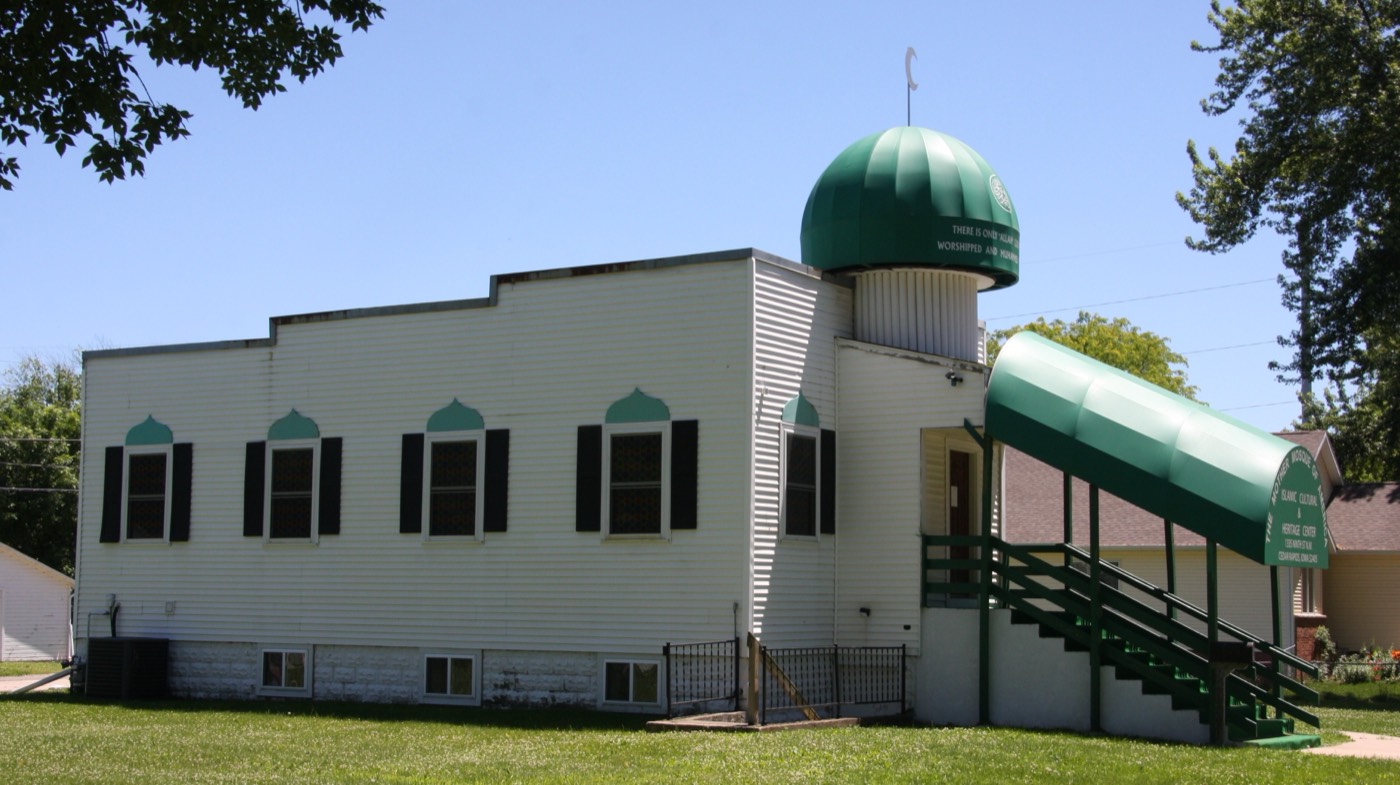
Walk down a quiet residential street on the north-west side of Cedar Rapids and you will find a small, pale building with a modest dome and a slender minaret, set among ordinary Iowa houses. This is the Mother Mosque of America, finished in 1934, and it is the reason the story of the Lebanese in Cedar Rapids is unlike any other in the country. Long before the large Arab American communities formed in the suburbs of Detroit, such as the Lebanese in Dearborn, Michigan, a handful of immigrants from the Ottoman provinces that became Lebanon built a house of worship here, by hand, in the middle of the corn belt.
The Place
Cedar Rapids sits on a bend of the Cedar River in Linn County, the second-largest city in Iowa with about 137,710 residents at the 2020 census. It was incorporated in 1849 and named for the rapids in a river lined with red cedar. Locals call it the City of Five Seasons, the fifth being the time to enjoy the other four. Its older immigrant story belongs to Bohemia, told in our piece on the Czechs in Cedar Rapids, Iowa, but a second, quieter migration was unfolding alongside it.
It is a working city, built on grain and machinery. The Quaker Oats mill here, dating to 1873, grew into the largest cereal mill in the world, and Collins Aerospace remains one of the region’s biggest employers. Into this practical, Midwestern place came an unlikely community of Arabic-speaking peddlers, and they stayed.
How It Became Lebanese
The first Muslims arrived in Cedar Rapids around 1895, part of a larger wave of Arabic-speaking Christians and Muslims leaving the mountains and villages of what was then Greater Syria under Ottoman rule. On paper they were Syrians, because Lebanon did not yet exist as a country. In memory and in cooking and in family ties, many of them were Lebanese.
The peddlers, 1895 to 1920
They began the way thousands of Levantine immigrants began across rural America: on foot, with a pack. A peddler would carry a backpack weighing up to two hundred pounds, loaded with clothing, fabric, needles, thread, lace and small household goods, and walk the farm roads selling to women who lived miles from any store.
It was hard, lonely work, but it required almost no capital and no English to start, and it taught the trade of selling. The Arab Muslim population of Cedar Rapids numbered just forty-five in 1914. Most were single men, some sending money home, some saving to bring over a wife or a brother.
One of them was Yahya Aossey, who left the Lebanon region in 1907 as a boy of about sixteen and settled in Iowa, first working as a farm-hand for German immigrant farmers. The Aossey name would echo through the next century of this community.
From the pack to the shop counter
The peddlers did not stay on the road. As they saved, they opened stores, trading the two-hundred-pound pack for a fixed address and a cash register. The shift was dramatic. By the 1950s, more than fifty grocery and dry-goods stores in Cedar Rapids were owned and operated by people of Lebanese descent.
That density of small Lebanese businesses gave the community something rare in the rural Midwest: visibility, money and a foothold. Children grew up behind shop counters and went to Cedar Rapids public schools. The community was no longer a scattering of single men but a network of settled families.
Building the Mother Mosque, 1925 to 1934
By the 1920s the community wanted a permanent place to pray. In 1925 a group calling itself the Rose of Fraternity Lodge rented a hall to serve as a temporary mosque. It was not enough. They wanted to build.
Construction of a true mosque was completed on 15 February 1934, in the depths of the Great Depression. Community members did much of the building themselves, raising money store by store and family by family. The result, at 1335 Ninth Street NW, was a small but unmistakable mosque: dome, minaret, and a prayer hall, set among ordinary frame houses.
It is recognised as the oldest still-standing purpose-built mosque in the United States. In 1996 it was added to the National Register of Historic Places, listed under its early name, the Moslem Temple.
A cemetery and a soldier’s letter, 1948 to 1953
For decades, Muslim Americans struggled to bury their dead. Many mainstream cemeteries would not accept them, and Islamic burial follows its own rites. In 1948 the Cedar Rapids community, led by the prominent Aossey family, established the National Muslim Cemetery, with land donated by William Aossey. It is regarded as the first Muslim cemetery of its kind in America, and it served the wider Midwest.
The same generation took its case to Washington. Abdullah Igram, a second-generation Lebanese American who had served in the United States Army during the Second World War, was frustrated that Muslim soldiers had no way to record their faith on their dog tags. He led a letter-writing campaign to President Dwight Eisenhower, and in 1953 the military formally recognised Islam as a faith for its servicemen.
Igram and others also organised nationally. The International Muslim Society was incorporated in Cedar Rapids in 1952, holding its first meeting on 28 June that year, and in 1954 it was renamed the Federation of Islamic Associations of the United States and Canada. For a time, this small Iowa city was a headquarters of Muslim life in North America.
Outgrowing the old mosque, 1965 to 1972
By the 1960s the community had grown beyond the little building on Ninth Street. In 1965 they bought a larger piece of land on the south-west side of town, and around 1971 to 1972 they opened the new Islamic Center of Cedar Rapids at 2999 First Avenue SW. The original mosque was sold.
It might have been lost. Instead, in 1991 the Islamic Council of Iowa bought the old building back, refurbished it, and restored it as a cultural and historic centre. The restoration was led by Imam Taha Tawil and the scholar Dr Thomas Irving. When the 2008 flood put ten feet of water in the basement and destroyed a collection of books and records, the community salvaged what it could and kept the doors open.
The Landmarks
Mother Mosque of America, 1335 Ninth Street NW. The heart of this story and the oldest standing purpose-built mosque in the country, completed in 1934 by Lebanese and Syrian immigrants during the Depression. Today it operates as an Islamic cultural and historic centre, welcoming visitors and school groups who come to see where Muslim America began.
National Muslim Cemetery, Cedar Rapids. Established in 1948 on land donated by the Aossey family, this is considered the first Muslim cemetery of its kind in the United States. For decades it was a final resting place for Muslims across the Midwest who had nowhere else to be buried according to their faith.
Islamic Center of Cedar Rapids, 2999 First Avenue SW. The larger mosque the community built in the early 1970s as it outgrew the original. Hundreds of worshippers gather here now, Iowans and immigrants alike, the living continuation of a congregation that began with peddlers in the 1890s.
Midamar, 1105 Sixtieth Avenue SW. Founded in 1974 by Bill Aossey, a grandson of the early immigrant generation, Midamar grew into one of the country’s pioneering halal food companies, supplying meat and groceries far beyond Iowa. It is a direct commercial descendant of the old Lebanese grocery trade.
Cedar’s Food Mart and Grill, Cedar Rapids. A family-run Mediterranean grocery and Lebanese grill, where customers come for chicken shawarma, tabouli, hummus, lentil soup and fresh-bread sandwiches. It is the kind of small, family-owned shop that has anchored this community for more than a century.
Quaker Oats mill, downtown Cedar Rapids. Not a Lebanese landmark, but the industrial heart of the city the immigrants chose. Dating to 1873 and grown into the largest cereal mill in the world, it is part of why a steady, working town could absorb and hold a new people.
Where They Came From
The Lebanese of Cedar Rapids came from the villages and mountains of what was then the Ottoman province of Greater Syria, the region that became the modern states of Lebanon and Syria. When they arrived, American officials recorded them as Syrians, and the distinction between Lebanese and Syrian identity hardened only later, with the drawing of borders after the First World War.
They left for the reasons most people leave: poverty, a heavy and arbitrary Ottoman rule, and the lure of a country where a man with a pack could make a living. Once a few had settled in eastern Iowa and written home, the chain pulled others. A young Aossey came in 1907, found work, and others followed, until a single Lebanese village’s families could be traced across Cedar Rapids.
What is striking is how far inland they went. Many Levantine immigrants stopped in the cities of the East Coast, and others gathered in Sun Belt hubs like the Lebanese in Houston, Texas or the Lebanese in San Diego, California. These ones kept going, into the corn country, and made one of the most consequential Arab American communities in the nation in a place no one would have predicted.
Cedar Rapids Today
The Lebanese community here is no longer a separate world. After four and five generations, its descendants are simply Cedar Rapidians: business owners, engineers, teachers, doctors. The old peddler economy is gone, and the fifty Lebanese grocery stores of the 1950s have dwindled to a handful of markets and grills that carry the food forward.
The faith remains the through-line. Worshippers fill the Islamic Center of Cedar Rapids on First Avenue, while the little Mother Mosque on Ninth Street stands as a museum and a memorial, visited by people who come from across the country to see the building where so much began. The community has also broadened, as newer Muslim arrivals from the wider Middle East, Bosnia, Africa and South Asia join a congregation the Lebanese founded. It is a different shape of Lebanese American life from the affluent enclaves elsewhere, such as the Lebanese in Troy, Michigan, yet it may be the most historically important of them all.
It is an honest kind of legacy. Not a tourist district, not a single street of restaurants, but a quiet, deep root: the oldest mosque in America, the first Muslim cemetery in America, and a city that, for once, let a new people belong from the start.
Frequently Asked Questions
Why are there so many Lebanese in Cedar Rapids, Iowa?
The Lebanese in Cedar Rapids trace back to immigrants who arrived from the Ottoman province of Greater Syria starting around 1895. They began as travelling peddlers selling dry goods to rural Iowa farms, then opened stores, and by the 1950s owned more than fifty grocery and dry-goods shops in the city. Chain migration from a few villages did the rest.
What is the Mother Mosque of America?
The Mother Mosque of America, at 1335 Ninth Street NW in Cedar Rapids, is the oldest still-standing purpose-built mosque in the United States. It was completed on 15 February 1934 by Lebanese and Syrian immigrants who built much of it themselves during the Great Depression. It is now an Islamic cultural and historic centre.
Were the early immigrants Lebanese or Syrian?
When they arrived around the turn of the twentieth century, the area now called Lebanon was part of the Ottoman province of Greater Syria, so American records listed them as Syrians. Many came from the mountains and villages of present-day Lebanon, and the Lebanese and Syrian identities separated only after national borders were drawn following the First World War.
What is the National Muslim Cemetery in Cedar Rapids?
Established in 1948 on land donated by the Aossey family, the National Muslim Cemetery in Cedar Rapids is considered the first Muslim cemetery of its kind in the United States. It was created because many mainstream cemeteries would not accept Muslim burials, and it served Muslim families across the Midwest.
Who was Abdullah Igram?
Abdullah Igram was a second-generation Lebanese American from Cedar Rapids who served in the United States Army in the Second World War. His letter-writing campaign to President Eisenhower led the military to formally recognise Islam as a faith for its soldiers in 1953. He also helped organise national Muslim associations based in Cedar Rapids.
Can you visit the Mother Mosque today?
Yes. The Mother Mosque of America operates as an Islamic cultural and historic centre and welcomes visitors and school groups who want to learn about the early history of the Lebanese in Cedar Rapids and Muslim life in America. The larger active congregation worships at the Islamic Center of Cedar Rapids on First Avenue SW.
If your family’s story passed through Cedar Rapids, or any of the places Lebanese immigrants have made home in America, Atlas of Home can trace that journey. From a village in the mountains of Ottoman Lebanon to a peddler’s route across the Iowa farm roads, to a mosque built by hand on Ninth Street, to wherever you are now.