
On a Friday evening on Harper Road, the parking lot at the Chabad Jewish Center of Solon fills with minivans, and inside roughly a hundred and fifty people sit down to a catered Shabbat lunch. It is an ordinary scene now, but it would have astonished anyone who knew this corner of Cuyahoga County a generation ago. The story of the Jews in Solon, Ohio is the last chapter of a long eastward journey that began in downtown Cleveland in the 1830s and kept moving, decade by decade, toward the Chagrin Valley.
The Place
Solon sits in the southeastern corner of Cuyahoga County, about eighteen miles from downtown Cleveland, where the suburban grid gives way to the wooded hills of the Chagrin River. Settlers from Connecticut arrived here in 1820, and the township took its name from Lorenzo Solon Bull, son of one of those early families, whose middle name honoured the ancient Greek lawgiver (Wikipedia).
For more than a century it stayed a quiet farming and quarrying township. Solon counted 887 residents in 1920 and only 6,333 as late as 1960. Then the population exploded, reaching 21,802 by 2000 and 24,262 in 2020, as Cleveland families chased space, safety, and one of the best public school systems in Ohio.
Today Solon is an affluent, diverse suburb. Its 2020 census recorded a population that was roughly 66 percent White, 16 percent Asian, and 12 percent Black, with a median household income well above six figures, and a school district that has appeared near the top of national rankings for years.
How It Became Jewish
To understand the Jews in Solon you have to understand the route they took to get there. Greater Cleveland’s Jewish community has been moving east, in slow and deliberate stages, for nearly two centuries.
The long march east, 1830s to 1950s
The first Jews arrived in Cleveland from the German states in the 1830s and settled in the crowded Central neighbourhood near downtown (History of the Jews in Greater Cleveland). As families prospered they pushed outward, first to Glenville on the city’s east side, then up the hill to Cleveland Heights and Shaker Heights in the first half of the twentieth century.
The institutions followed the families. When congregants relocated, the synagogues that served them packed up and rebuilt a few miles east, again and again. By the middle of the twentieth century the centre of Jewish Cleveland had shifted decisively into the Heights, a pattern echoed in other Midwestern industrial cities, from Squirrel Hill in Pittsburgh to West Bloomfield outside Detroit.
Beachwood and the postwar suburbs
After the Second World War the migration jumped the city line into Beachwood, which became the unofficial capital of suburban Jewish Cleveland. The Mandel Jewish Community Center settled there, as did the Joseph and Florence Mandel Jewish Day School, founded in 1969. For decades, if you were a Jewish family leaving the Heights, Beachwood was where you landed.
But Beachwood filled up and grew expensive, and the same restless logic that had carried the community out of Glenville kept working. By the mid 1970s families were buying into the newer developments of Orange and Pepper Pike, just to the south and east.
The turn toward Solon, 1990s
By the 1990s the leading edge of that migration reached Solon. The draw was straightforward: large new houses on generous lots, a famously strong school district, and a short drive back to the synagogues and shops of Beachwood and Pepper Pike. Young professional families, many with children, found exactly what they were looking for.
One couple saw the shift before almost anyone else. In 1991, Rabbi Zushe Greenberg and his wife Miriam, a family educator, noticed that Jews were moving to Solon in real numbers but that the city had no Jewish presence of its own. They started Solon Chabad in their living room.
The Soviet wave
The 1990s growth was accelerated by a second story unfolding at the same time. After Mikhail Gorbachev permitted Jewish emigration in 1989, the Jewish Federation of Cleveland resettled wave after wave of refugees from the former Soviet Union. Within a few years the local Soviet-Jewish population had climbed into the thousands, reaching an estimated 15,000 across Greater Cleveland by the early 2000s.
Many of those families settled in the eastern and southeastern suburbs, including Solon, alongside Mayfield Heights, Beachwood, and Orange. They added a distinctly Russian-speaking layer to the community taking shape along Harper Road.
For the Greenbergs at Solon Chabad, the timing was uncanny. They had opened their doors in 1991 precisely as both streams, the suburban movers from the Heights and the refugees from the Soviet Union, were converging on the same patch of southeastern Cuyahoga County. The living-room minyan that might have stayed small instead found a steady supply of newcomers who wanted somewhere local to belong.
By 2011, when the Jewish Federation of Cleveland conducted its population study, Solon and the surrounding southeastern suburbs were home to roughly 15,000 Jewish residents, a number that put the area within reach of the long-dominant Heights as a centre of Jewish life.
The Landmarks
Chabad Jewish Center of Solon, 5570 Harper Road. Founded in 1991 by Rabbi Zushe and Miriam Greenberg, the centre began in their living room, then moved through an office basement and even Solon High School before settling on Harper Road around 2004. An 11,000-square-foot addition completed in 2023 expanded a campus that now draws more than a thousand worshippers on the High Holy Days.
Solon Chabad preschool and Camp Gan Izzy, 5570 Harper Road. The centre’s children’s programmes are its heart. More than a hundred children attend the preschool and Mommy and Me classes, and about 250 pass through its two summer camps each year, making it the place where many local families first put down Jewish roots in the city.
Mandel Jewish Community Center, 26001 South Woodland Road, Beachwood. A short drive north of Solon, the Mandel JCC is the communal living room for the whole eastern suburban Jewish population: fitness, day camp, arts, and gathering space. For Solon families it remains the anchor institution that the city itself never had to duplicate.
Joseph and Florence Mandel Jewish Day School, Beachwood. Founded in 1969, the Mandel Jewish Day School educates children from across the affiliation spectrum, weaving Jewish and general studies through the day. Many Solon parents who want a day-school education make the drive rather than rely solely on the excellent public system.
B’nai Jeshurun Congregation, 27501 Fairmount Boulevard, Pepper Pike. One of the historic congregations that rode the eastward migration out of the city, B’nai Jeshurun now sits in Pepper Pike, within easy reach of Solon. Its move east mirrors the larger journey that brought so many families to the Chagrin Valley.
Uptown Solon, Solon. The Uptown Solon shopping centre is the commercial heart of the city, a gathering point for everyday errands that sold for around 10 million dollars in 2021. It is the kind of ordinary suburban crossroads where a transplanted community quietly becomes a settled one.
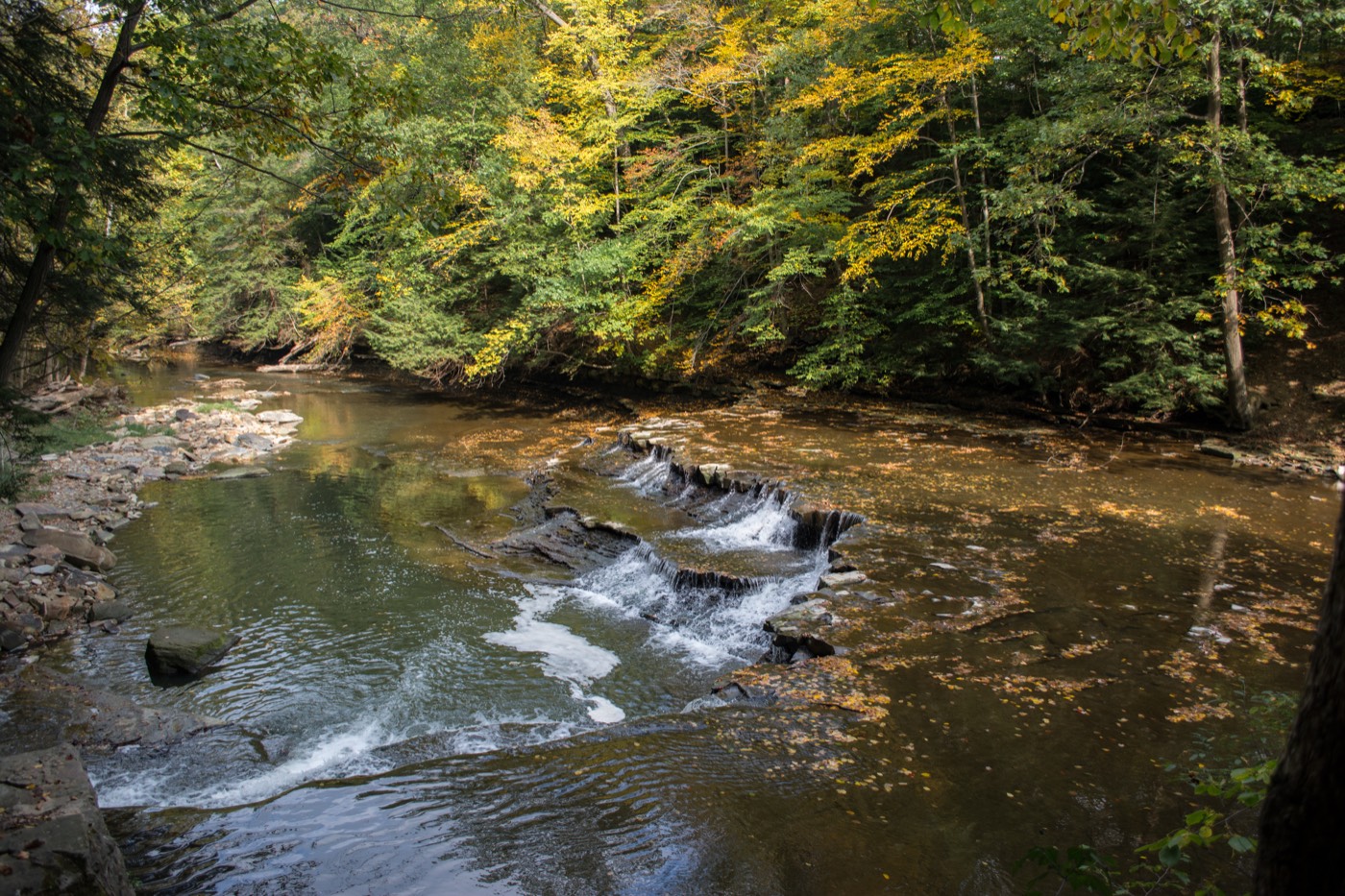
South Chagrin Reservation, Solon and Moreland Hills. Part of the Cleveland Metroparks, this wooded reservation along the Chagrin River wraps the southern edge of Solon with trails, waterfalls, and the 1938 Look About Lodge. It is the green backdrop against which the newer Solon was built.
Where They Came From
Solon’s Jews did not arrive in a single migration from abroad. Most came the short way, a few miles at a time, from Cleveland Heights, Shaker Heights, Beachwood, and Pepper Pike, the older Jewish suburbs whose own families traced back to German immigrants of the nineteenth century and the great Eastern European wave around 1900. The same pattern of professional Jewish families clustering around strong schools repeats in other Ohio communities, from Bexley outside Columbus to the Indian families who settled in nearby Dublin.
Layered onto that internal movement is the Soviet wave of the late 1980s and 1990s. Families from Moscow, Kyiv, Odessa, and beyond, resettled by the Jewish Federation, gave the southeastern suburbs a Russian-speaking community that remains visible in Solon today.
The common thread is not a single homeland but a single instinct: the search for good schools, room to grow, and a manageable distance from the institutions that hold a community together.
Solon Today
Solon today is a comfortable, professional suburb where Jewish life is woven quietly into a diverse whole. The community here has never built the dense institutional thicket of the Heights or Beachwood, and it has not needed to. Solon Chabad anchors religious life within the city limits, while the larger institutions sit a short drive north.
That arrangement suits the families who chose Solon. They came for the schools, the space, and the calm, and they kept their connection to the wider Jewish Cleveland that they had only partly left behind. On a Friday night the lights are on at Harper Road; on Sunday mornings the drive to Beachwood is short.
The community here is also unusually mixed. Native Clevelanders who moved a few miles south sit beside Russian-speaking families who crossed an ocean, and both share the city with a large and growing Asian American population that has made Solon one of the most diverse municipalities in the county. The Jewish presence is one thread in that wider fabric rather than the dominant colour, which is itself a kind of comfort for families who wanted a normal suburban life with their tradition close at hand.
It is a fitting final stop for a community that has spent nearly two hundred years moving east. From a single family near downtown in the 1830s to fifteen thousand Jewish residents across the southeastern suburbs today, the journey reads like a map drawn one move at a time, and for now the map ends in the hills above the Chagrin.
Frequently Asked Questions
How many Jews live in Solon, Ohio?
A 2011 study by the Jewish Federation of Cleveland estimated that around 15,000 Jewish residents lived in Solon and the surrounding southeastern suburbs. The Jews in Solon are part of a broader community that has steadily shifted southeast from the older Heights neighbourhoods.
Why did Jewish families move to Solon?
Jewish families were drawn to Solon by large new homes, one of the top-ranked public school districts in Ohio, and a short drive back to the synagogues and institutions of Beachwood and Pepper Pike. The move accelerated through the 1990s.
Is there a synagogue in Solon, Ohio?
Yes. The Chabad Jewish Center of Solon at 5570 Harper Road, founded in 1991 by Rabbi Zushe and Miriam Greenberg, is the main Jewish institution within the city. Larger congregations such as B’nai Jeshurun sit just north in Pepper Pike.
When did Jews start moving to Solon?
The first significant wave of Jewish families reached Solon in the 1990s, as the older suburbs of Beachwood, Orange, and Pepper Pike filled up. Solon Chabad was founded in 1991 specifically to serve those new arrivals.
Where did Solon’s Jewish community come from?
Most came a few miles at a time from Cleveland Heights, Shaker Heights, Beachwood, and Pepper Pike, part of a long eastward migration. A significant number are Soviet-Jewish families resettled in Greater Cleveland after 1989.
What is the eastward migration of Cleveland’s Jewish community?
It describes how Jewish Cleveland moved outward in stages over nearly two centuries, from the Central neighbourhood to Glenville, then Cleveland Heights and Shaker Heights, then Beachwood and Pepper Pike, and finally to Solon and the southeastern suburbs.
If your family’s story passed through Solon, or any of the places Jews have made home in America, Atlas of Home can trace that journey. From a German immigrant’s first address near downtown Cleveland to a Friday-night table on Harper Road, to wherever you are now.