
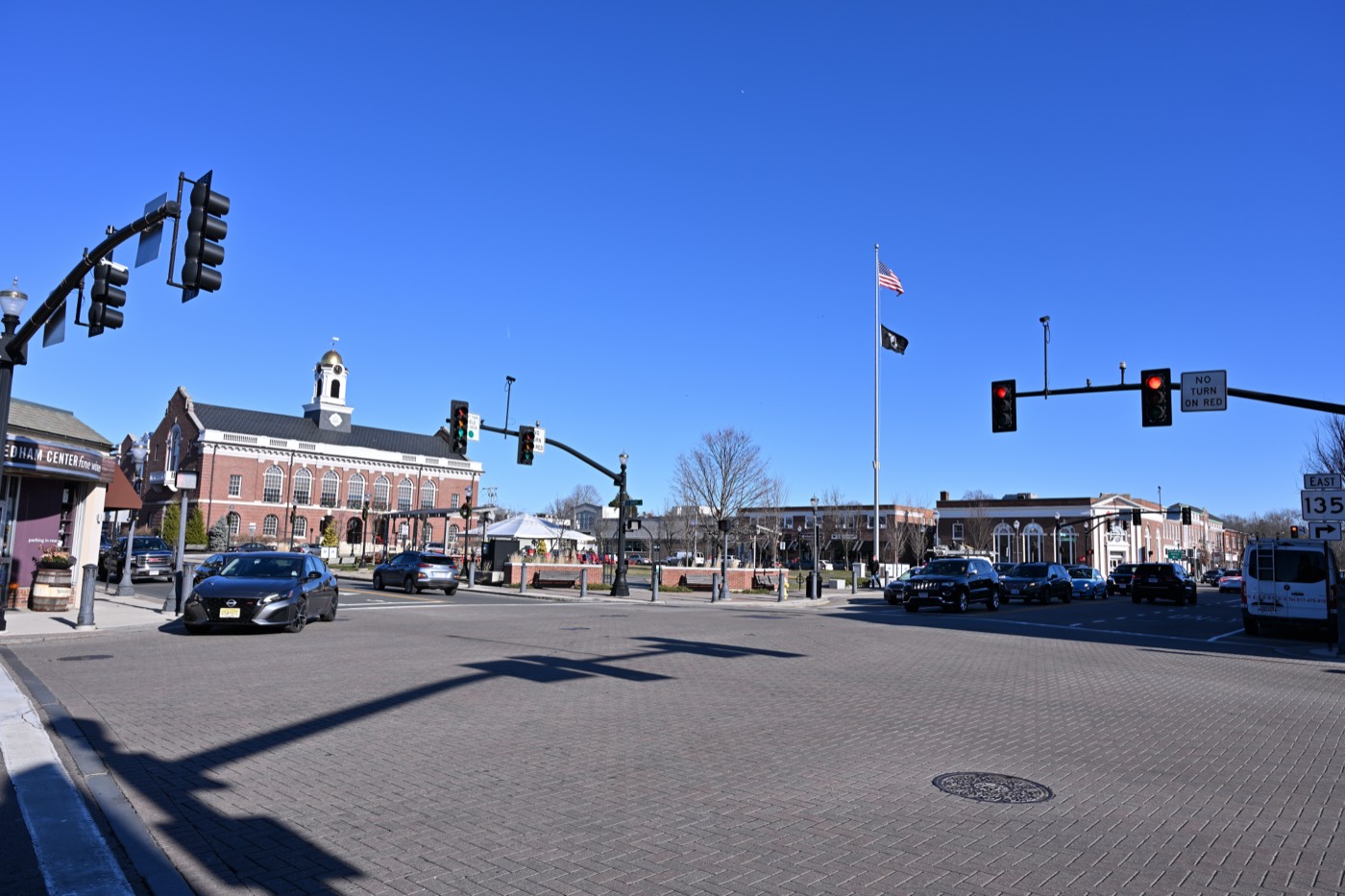
On a December evening in Needham Centre, the lights of Highland Avenue catch the windows of a town that, a century ago, had almost no Jewish residents at all. Today the Jews in Needham, Massachusetts are woven into the life of this affluent Norfolk County suburb so completely that two thriving synagogues sit barely two miles apart, one Reform and one Conservative, their parking lots full on a Saturday morning.
The Place
Needham sits on rocky uplands inside a loop of the Charles River, roughly ten miles southwest of Boston in eastern Norfolk County. It is bordered by Wellesley to the west, Newton to the north and northeast, and the West Roxbury section of Boston to the east.
First settled in 1680 and incorporated in 1711, Needham spent two centuries as farmland and mill village before the railway pulled it into Boston’s orbit. The Needham Line still runs through Needham Heights, Needham Centre, Needham Junction and Hersey, carrying commuters to South Station.
By 2026 the town held around 32,800 people, with a median household income above $200,000. It is, by almost any measure, one of Greater Boston’s wealthier suburbs, and one of its most education-obsessed.
How It Became Jewish
The first Jewish presence in Needham predates the community that defines it now by more than half a century. It arrived quietly, one family at a time.
The pioneers, 1897 to 1945
David and Elizabeth Simon settled in Needham in 1897, the first Jews recorded in the town. They were followed by Sam and Meyer Rosenblatt and David Cohen around 1900, Samuel Jacobs in 1904, and Philip Gordon in 1908.
These were not wealthy suburbanites. Most had come from Europe by way of Boston’s West End, the crowded immigrant quarter near the harbour where thousands of Eastern European Jews had landed in the decades around 1900. They came to Needham looking for room and a better life, often opening small shops or trades in a town that still ran on farming and milling.
For decades they were a scattering, not a community: a handful of families among Yankee Protestant neighbours, with no synagogue and no rabbi. Children grew up with little formal Jewish education, and the High Holidays meant a journey back into the city. The town’s Jewish population stayed small. By 1950 there were still only about fifty Jewish families in all of Needham.
That changed after the Second World War. In 1945, eighteen Jewish families organised the Needham Jewish Community Group to provide religious services and a place to gather. It was the first formal Jewish institution the town had known.
Temple Beth Shalom and the postwar boom
The group held its first High Holiday services in 1953 and launched a newsletter, The Scroll. In 1955 it affiliated with the Reform movement and took the name Temple Beth Shalom, with about 60 member families and a part-time rabbi, Herbert Yarrish.
The growth that followed mirrored the broader Jewish exodus to Boston’s western suburbs. The congregation bought land at Webster and Highland Avenues in 1955 for $10,000. Between 1955 and 1958 membership leapt from 60 families to 180, and when the first building, a single room serving as sanctuary, social hall and classroom, opened in 1959, the religious school already enrolled 132 children.
This was the same suburban migration that built the great Jewish communities of nearby Newton and reshaped Brookline. Families who had begun in the dense inner neighbourhoods of Boston moved outward as the postwar economy lifted them, and Needham, with its good schools and leafy streets, drew its share.
The numbers tell the story plainly. In 1957 the congregation celebrated its first bar mitzvah, that of Edward M. Appel, and founded a Sisterhood. The following year membership nearly doubled from 86 to 180 families. A nursery school opened in 1964. Each milestone marked a community that was no longer improvising but building institutions meant to last, with a religious school, a Sisterhood and eventually a full-time rabbi in Albert Yanow, who served from 1958 to 1961 and was followed by a steady line of successors.
The split that created two temples
By the early 1960s a single Reform congregation could not hold everyone. Families who preferred the more traditional liturgy and observance of the Conservative movement wanted their own home.
In December 1964 they founded Temple Aliyah as a separate Conservative congregation. In 1966 it purchased an old farmhouse on Central Avenue, which was expanded in 1971 and again in 1993. The town now had two synagogues, each anchoring a distinct stream of American Judaism, and that division has endured for sixty years.
The split was less a quarrel than a sign of growth. A community large enough to sustain two congregations was a community that had truly arrived. Reform families kept their home on Highland Avenue; Conservative families built theirs on Central Avenue. Between them they covered most of the religious spectrum a suburban Jewish family might want, and a child in Needham could now grow up entirely within Jewish institutions without ever leaving town.
From hundreds to over a thousand
Temple Beth Shalom passed 400 families by 1979 and kept climbing. By 2024 it counted more than 1,100 member families, a tenfold increase from its founding. Temple Aliyah grew to more than 400 member households drawn from Needham and the surrounding towns. The little group of eighteen families in 1945 had become one of the larger suburban Jewish communities west of Boston.
The Landmarks
Temple Beth Shalom, 670 Highland Avenue. The town’s Reform congregation and its largest Jewish institution, with over 1,100 member families. The building has been expanded and rebuilt across the decades, most recently in the Mikdash project completed in 2016, which redesigned nearly everything except the sanctuary.
Temple Aliyah, 1664 Central Avenue. Founded in 1964 as Needham’s Conservative congregation around an old farmhouse on Central Avenue. Today it is an egalitarian community of more than 400 households, with worship led by Rabbi Allison Poirier and Cantor Linda Sue Sohn.
The Children’s Center at Temple Beth Shalom. The congregation’s early-childhood programme traces back to the nursery school established in 1964, part of a long tradition of Jewish education in the town. Its religious school is organised into divisions named Mayim, Shorashim and Etzim.
Gan Aliyah and Mercaz Aliyah. Temple Aliyah’s preschool and its K to 7 religious school carry the Conservative movement’s emphasis on Hebrew and tradition to a new generation, alongside its bar and bat mitzvah programme.
Needham High School, 609 Webster Street. Not a Jewish institution, but central to why Jewish families chose Needham. Serving roughly 1,600 students, it ranks among the top public high schools in Massachusetts, with a four-year graduation rate above 98 per cent.
Needham Centre. The town’s compact downtown, clustered around Highland, Great Plain and Dedham Avenues, is where synagogue families shop, eat and run into one another. The commuter rail station here puts Boston within easy reach, one reason professional families have settled in the town for generations.
Where They Came From
The earliest Needham Jews came from Europe, arriving first in Boston’s West End before moving outward. They were part of the great wave of Eastern and Central European Jewish immigration that filled Boston’s inner neighbourhoods in the late nineteenth and early twentieth centuries.
The community that actually built the temples, though, came from closer by. Most arrived in the postwar decades from Boston itself and from the older Jewish strongholds to the north and east, especially Brookline and Newton, as rising incomes and a hunger for good schools pushed families further out along the rail lines.
That pattern of suburban resettlement was not unique to Needham. It echoes the story of Sharon, the heavily Jewish town further south in the same county, and of comparable communities far beyond Massachusetts, such as Scarsdale outside New York City. The engine was the same everywhere: a generation that had grown up in the city wanting lawns, good public schools and a synagogue within driving distance.
Needham Today
Needham today is a comfortable, high-achieving suburb where Jewish life is simply part of the civic fabric. Two healthy congregations, Reform and Conservative, run preschools, religious schools and adult learning, and their calendars shape the rhythm of Jewish families across the town.
The community is no longer the immigrant outpost of the Simons and the Rosenblatts. It is professional, settled and secure, drawn by the same things that draw any family to Needham: the schools, the proximity to Boston, the quiet streets. The Jewishness of the place is assumed rather than announced.
That security has not made the community complacent. In recent years Temple Beth Shalom has folded antisemitism awareness and social justice work into its programming, and both congregations remain active in the wider Greater Boston Jewish world. The town’s two synagogues draw members not only from Needham but from neighbouring communities, so that their reach extends well beyond the town line.
It remains, in the end, a suburban story. Needham never had a Jewish quarter or a kosher market row the way the old city neighbourhoods did. What it has instead is two synagogues, a few thousand Jewish residents, and a hundred and twenty-five years of steady arrival, from a single family in 1897 to a community that now helps define the town.
Frequently Asked Questions
How large is the Jewish community in Needham, Massachusetts?
The Jews in Needham, Massachusetts support two synagogues. Temple Beth Shalom counts more than 1,100 member families as of 2024, and Temple Aliyah has more than 400 member households, drawn from Needham and surrounding towns.
When did Jews first settle in Needham?
David and Elizabeth Simon arrived in 1897 as the first recorded Jewish residents, followed by a handful of families over the next decade. The organised community dates to 1945, when eighteen families founded the Needham Jewish Community Group.
What synagogues serve Needham?
Two. Temple Beth Shalom at 670 Highland Avenue is Reform, founded in 1955. Temple Aliyah at 1664 Central Avenue is Conservative, founded in 1964 after families seeking more traditional observance split from the original congregation.
Why did Jewish families move to Needham?
Most came in the postwar decades from Boston and the older Jewish suburbs of Brookline and Newton, drawn by Needham’s strong public schools, its commuter rail link to Boston and its quiet residential streets. It was part of the broader Jewish migration to Greater Boston’s western suburbs.
How does Needham relate to Newton, Brookline and Sharon?
Needham’s Jewish community grew largely out of the older communities in Newton and Brookline, as families moved further out along the rail lines. It shares its suburban Jewish story with Sharon, another heavily Jewish town in the same county.
Is Needham a good place for Jewish families today?
Many think so. The Jews in Needham, Massachusetts have access to two active congregations with preschools and religious schools, a top-ranked public high school, and an easy commute to Boston, which is why professional Jewish families have settled there for generations.
If your family’s story passed through Needham, or any of the places Jews have made home in America, Atlas of Home can trace that journey. From the tenements of Boston’s West End to a synagogue on Highland Avenue, to wherever you are now.