
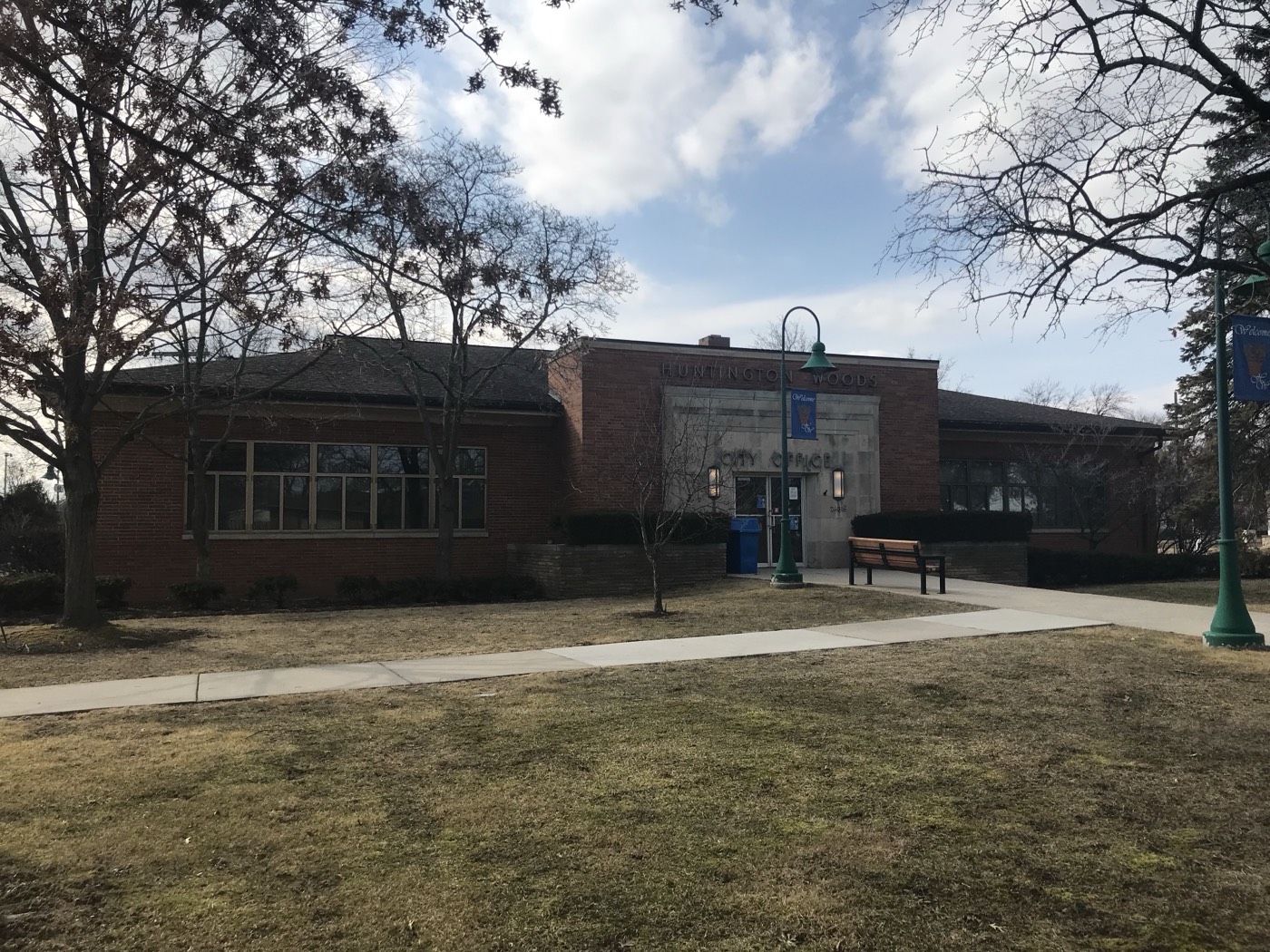
Drive north up Woodward Avenue from Detroit, past the old streetcar route, and somewhere around 10 Mile Road the city gives way to curving, tree-shaded streets and squat brick Tudors with leaded glass. This is Huntington Woods, a city of barely a square and a half, with no downtown and no traffic light, where roughly two in three households are Jewish. The story of Jews in Huntington Woods is, in miniature, the story of how an entire community walked itself up one avenue across a century.
The Place
Huntington Woods sits in southern Oakland County, about 12 miles northwest of downtown Detroit, wedged along the Woodward corridor between Royal Oak, Berkley, Pleasant Ridge and Oak Park. It covers just 1.49 square miles, all of it residential, which is why locals call it the “City of Homes.” There is no commercial strip, no supermarket, no office park.
The western portion of the Detroit Zoo lies inside the city limits, lending the place a leafy edge and a steady contribution to the tax base. What Huntington Woods has instead of commerce is housing: winding streets laid out in the 1910s and 1920s and lined with the steep-roofed, half-timbered Tudors that gave the town its identity. As of the 2020 census it held 6,388 residents.
How It Became Jewish
An English village transplanted to Oakland County
The land was carved out of a parcel owned by George Trowbridge Hendrie. In 1916 a developer named I.C. Freud, working with Charles W. Burton, president of the Huntington Woods Company, hired surveyor Sylvester N. Howard to plat the subdivision. Howard completed the plat on 12 July 1916, and it was approved in January 1917.
Freud had visited Huntingdon, England, and patterned the meandering streets after that town, which is also where the name came from. The deed restrictions were strict: homes had to have pressed brick fronts or stucco-covered block, and they had to cost at least $6,000 to $7,500 to build, real money in the 1920s. Most of the houses went up between 1924 and 1939, drawing Detroit’s upper-level executives. The town incorporated as a village in 1926 and as a city in 1932.
None of this was Jewish at the outset. The early Huntington Woods was a gentile professionals’ enclave, and like much of suburban Oakland County in that era, parts of it were not especially welcoming to Jews. The transformation came later, and it came along Woodward.
The long walk up Woodward
Detroit’s Jews had been moving in one direction for a century. From the immigrant blocks around Hastings Street, the community pushed northwest decade by decade: to the Oakland Avenue district, then to Twelfth Street and Dexter, then into northwest Detroit. Each move traded older housing for newer, denser blocks for greener ones.
After the Second World War the frontier crossed Eight Mile Road into the suburbs. Oak Park, just west of Huntington Woods, filled with Jewish families buying brick ranch houses on quiet streets in the late 1940s and 1950s. By 1958, roughly one-fifth of all Detroit Jews lived in Oak Park and Huntington Woods. The two towns, sharing schools and an unofficial border, effectively became one Jewish neighbourhood split by a city line.
Past the Woods, and back again
The migration did not stop in the 1960s. As Oak Park and Huntington Woods aged, the centre of gravity moved further northwest still, to Southfield, then Farmington Hills, and finally to West Bloomfield and Bloomfield Hills, where the largest share of the metro Detroit Jewish community settled and remains. For a time Huntington Woods looked like a way station, a place families passed through on the climb.
Then it reversed. In the past two decades a striking number of younger Jewish families have moved back down Woodward into the older Oakland County suburbs, drawn by walkable streets, original architecture and a tight, observant core. The Jewish Federation of Metropolitan Detroit’s 2018 population study counted 1,575 Jewish households in Huntington Woods, more than double the 720 households recorded in 2005.
That growth has made Huntington Woods, by share, the most Jewish municipality in Michigan. In the 48070 zip code, about 65 percent of households identify as Jewish. The walkability matters: an observant family can reach a synagogue on foot on Shabbat, and that single fact has pulled congregations and their rabbis into the small town. By one local count, a dozen rabbis of varied denominations now live within its borders.
The synagogues follow the families
Because Huntington Woods is so small and so dense, its Jewish institutions cluster along Woodward and just over the line in Oak Park, all within walking range. The Woodward Avenue Shul opened on the avenue itself as a come-as-you-are Jewish community centre, offering Torah classes, Shabbat dinners and services to families regardless of background. Kehillat Etz Chayim, a Modern Orthodox congregation formed in 2018 under Rabbi Asher Lopatin, serves the Huntington Woods and Oak Park community from nearby Coolidge Highway.
These newer congregations sit alongside long-established ones in the wider corridor, the mix of Orthodox, Conservative and progressive shuls that lets a family choose its tradition without changing its neighbourhood. The result is unusual for an American suburb this size: a place with no business district but a deep bench of houses of worship.
The Landmarks
Detroit Zoo, 8450 W. 10 Mile Road. Opened on 1 August 1928, the zoo straddles Huntington Woods and Royal Oak at the corner of Woodward and 10 Mile. Its western acres fall inside Huntington Woods, and generations of local children have grown up with the lions and the polar bears as near neighbours.
Woodward Avenue Shul, 25595 Woodward Avenue. A storefront-style Jewish community centre on the corridor that gives it its name. It markets itself as a place for Jews of every background to reconnect, with classes, holiday programmes and Shabbat meals, and has become a hub for the younger families moving back down Woodward.
Kehillat Etz Chayim, 26341 Coolidge Highway, Oak Park. A Modern Orthodox congregation founded in 2018 and led by Rabbi Asher Lopatin, serving Huntington Woods and north Oak Park. Its walkable location is the whole point: members reach it on foot on Shabbat without crossing a city line in spirit.
Gillham Recreation Center and Cultural Center. With no commercial downtown, this complex is the literal heart of Huntington Woods, bundling the recreation centre, the library and the city’s gathering spaces. It is where the town holds the events that a Main Street would otherwise host.
Huntington Woods Library. Founded by members of the local Study Club in 1947 and moved to its present home in 1960, the library serves both Huntington Woods and neighbouring Pleasant Ridge. For a town without a bookstore or a coffee shop, it functions as the public living room.
The Hill Historic District. Nine curving streets, among them Huntington Road, Hendrie Boulevard, Concord Road and York Road, make up the original platted core. Of its 108 single-family homes, 65 were built between 1924 and 1939, almost all in the Tudor style that defines the city’s look.
Norup International School, 14450 Manhattan Street, Oak Park. Part of the Berkley School District, Norup serves as the middle school for Huntington Woods and north Oak Park children. The shared district is one of the threads that has long stitched the two towns into a single community.
Where They Came From
The Jews who fill Huntington Woods did not arrive from abroad. They arrived from Detroit, and before that from the shtetls and cities of Eastern Europe, Poland, Lithuania, Russia and Ukraine, whose immigrants packed the Hastings Street district in the early twentieth century.
From there the route was internal and unmistakable, a steady northwest drift up Woodward through Oakland Avenue, Dexter, northwest Detroit and Oak Park. Huntington Woods is one stop on that line. Many of today’s residents are the grandchildren and great-grandchildren of families who made the climb, returning to a corridor their parents left for the farther suburbs.
Huntington Woods Today
Today Huntington Woods is one of the most sought-after small cities in metro Detroit, and one of the most quietly Jewish places in the country by proportion. The Tudors that executives built in the 1920s now shelter doctors, lawyers, professors and young families who chose the town precisely for its walkability and its tight community.
The absence of commerce, once a quirk, is now part of the appeal. Life centres on homes, on the library and recreation complex, on the schools shared with Oak Park, and on the synagogues strung along Woodward. On a Saturday morning you will see families walking to shul, a sight more common here than in suburbs ten times its size.
Huntington Woods is one tile in a larger Oakland County mosaic of communities that climbed the same northwest corridor. The Lebanese built their professional enclaves in Bloomfield Hills and Birmingham, and Indian families filled the newer subdivisions of West Bloomfield and Farmington Hills. Each group made its own version of the same suburban journey, and Huntington Woods is the Jewish chapter of that shared county story.
It is worth being honest about what the town is and is not. Huntington Woods is small, expensive and largely residential, with no kosher supermarket or commercial strip of its own; for those, residents lean on neighbouring Oak Park. But for a community that spent a century in motion, the appeal of a place where you can walk to everything that matters, and where your neighbours largely share your traditions, has proved powerful enough to reverse the long march north. The story of Jews in Huntington Woods is no longer about leaving. It is about staying.
Frequently Asked Questions
How many Jews live in Huntington Woods, Michigan?
The Jewish Federation of Metropolitan Detroit’s 2018 population study counted 1,575 Jewish households in Huntington Woods, more than double the 720 households recorded in 2005. In the 48070 zip code roughly 65 percent of households identify as Jewish.
Why is Huntington Woods so Jewish?
Jews in Huntington Woods are the result of a century-long migration up Woodward Avenue from Detroit, through Oak Park, with a recent wave of younger families moving back down the corridor. The town’s small size and walkable streets let observant families reach synagogues on foot, which has drawn congregations, rabbis and Jewish families to the city.
What synagogues serve Huntington Woods?
The Woodward Avenue Shul sits on Woodward Avenue in the city, and the Modern Orthodox Kehillat Etz Chayim, founded in 2018 under Rabbi Asher Lopatin, serves Huntington Woods from nearby Coolidge Highway in Oak Park. A dozen rabbis of varied denominations are said to live within the city limits.
Why is Huntington Woods called the “City of Homes”?
The 1.49-square-mile city is almost entirely residential, with no commercial downtown, no supermarket and no traffic signal. Apart from the western edge of the Detroit Zoo, the city is made up of houses, which is why it earned the nickname.
What is the architecture of Huntington Woods like?
The original Hill Historic District was platted in 1916 and patterned on Huntingdon, England, with curving, tree-lined streets. Deed restrictions required brick or stucco fronts, and most homes, built between 1924 and 1939, are in the steep-roofed, half-timbered English Tudor style.
Where did the Jews of Huntington Woods come from?
They descend largely from Eastern European immigrants who settled Detroit’s Hastings Street district in the early twentieth century, then moved northwest up Woodward through Oakland Avenue, Dexter and Oak Park. Many residents today are the descendants of families who once continued on to West Bloomfield and have returned to the older corridor.
If your family’s story passed through Huntington Woods, or any of the places Jews have made home in America, Atlas of Home can trace that journey. From the shtetls of Eastern Europe and the blocks of Hastings Street, up Woodward to the Tudors of Huntington Woods, to wherever you are now.