
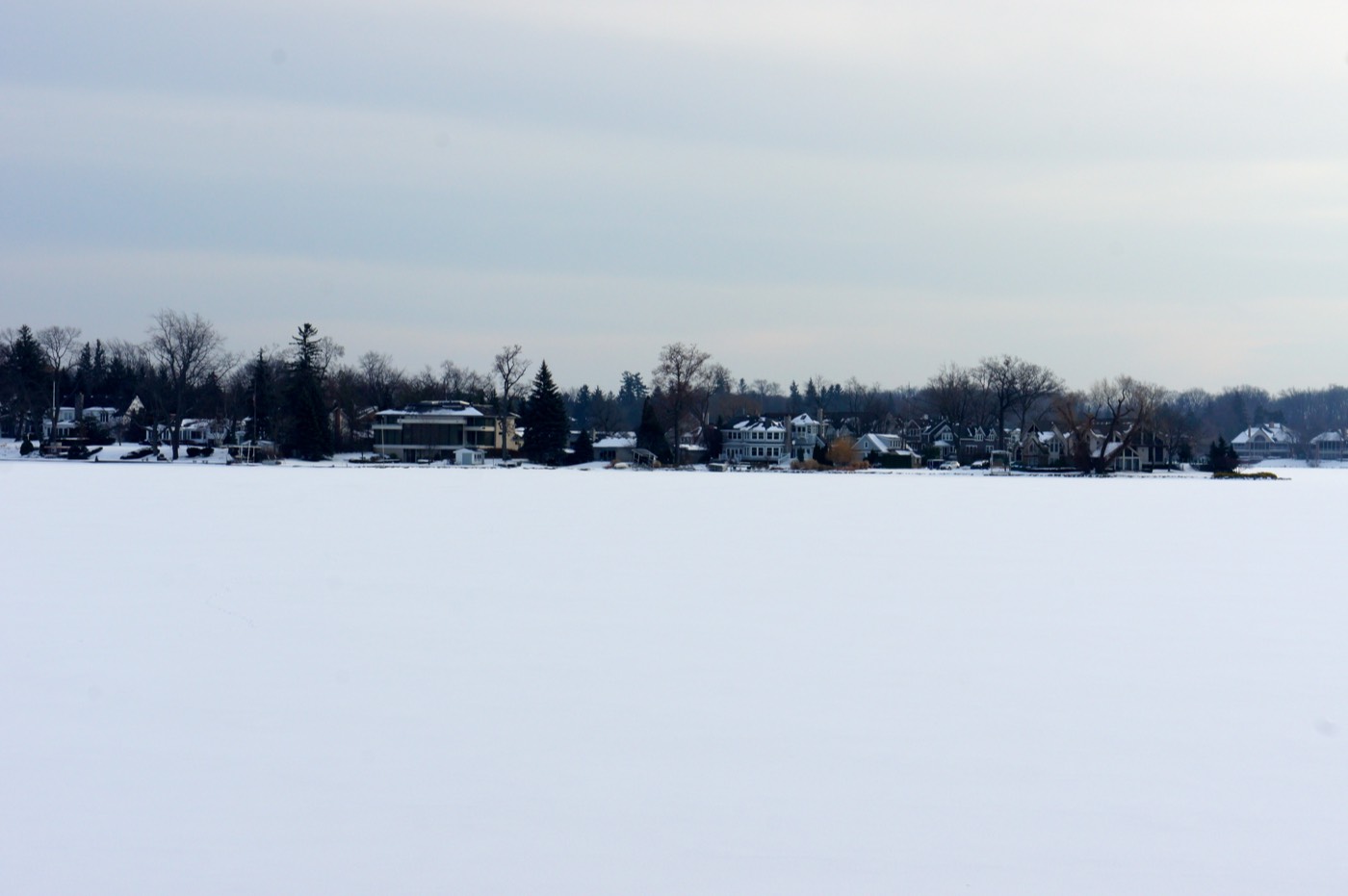
On a Saturday morning along Orchard Lake Road, the cars turning into Patel Brothers carry families who, an hour earlier, may have been at a faculty meeting at Henry Ford, a design review at an auto supplier, or a kid’s travel-soccer match by one of the township’s many lakes. The Indians in West Bloomfield, Michigan, did not arrive to a single street or storefront. They arrived to a green, lake-dotted township in Oakland County and quietly made it one of metro Detroit’s most comfortable places to raise an Indian American family.
The Place
West Bloomfield Township sits in the heart of Oakland County, northwest of Detroit, and is known as the lake township: Cass Lake, Pine Lake, Orchard Lake and dozens of smaller waters thread between the subdivisions. Founded in 1833 when Bloomfield Township was split in two, it spent more than a century as orchard and farm country before the postwar decades filled it with large homes on rolling hills.
Today roughly 68,000 people live here, and the township has long ranked among the highest-income communities of its size in the country. It is also among the most diverse places in Michigan, a town where Jewish, Lebanese, Chaldean and Indian families became neighbours rather than strangers.
For Indian arrivals, the appeal was legible at a glance: good schools, big lots, water views, and a short drive to the temples, grocers and engineering campuses that anchor Indian life across the suburbs.
How It Became Indian
The Indian story in metro Detroit is older than most people assume, and West Bloomfield is one of its later, more affluent chapters.
The first arrivals
The earliest Indians reached the Detroit area in the 1920s, when a small number of Punjabi Sikhs came north and east from California in search of better wages in the auto trades. They were pioneers more than a community. For decades the Indian presence in Michigan stayed tiny, scattered, and largely invisible outside a few factory towns.
That changed after 1965, when the Hart-Celler Act reopened the United States to immigrants from Asia and tilted the new system toward the skilled and the educated. For India, that meant doctors, engineers and scientists, exactly the people Detroit’s hospitals, universities and car companies were hiring.
Doctors, engineers and the auto economy
The Indians who settled across Oakland County in the 1970s and 1980s came overwhelmingly into two worlds: medicine and the automobile. Physicians filled residencies and staff posts at hospitals across the region. Engineers found work with the carmakers and the dense web of suppliers that surrounds them, applying training that, in many cases, began at the Indian Institutes of Technology.
By 1990, the broader Detroit region counted roughly 16,000 Asian Indians. The community was no longer a handful of pioneers; it was a professional class with mortgages, school-age children and a clear sense of where the good districts were.
Building institutions before building West Bloomfield
Before West Bloomfield had a noticeable Indian population, the wider community built the institutions that still serve it. In January 1975 about thirty Hindu families gathered at the Northwood Inn in Royal Oak to discuss founding a temple. That meeting led, eventually, to the Bharatiya Temple in Troy, still the largest Hindu temple in Michigan.
Those early institutions mattered to West Bloomfield in a specific way: they meant that a family choosing a home here was never more than a short drive from a temple, a grocer or a community of compatriots. The township could be the quiet residential base precisely because Troy, Farmington Hills and later Novi carried so much of the cultural infrastructure.
The move into the lake township
By the 1990s and 2000s, as Indian families moved up the income ladder, the lake suburbs of Oakland County became natural destinations. West Bloomfield offered what a successful physician or engineering manager wanted: space, status and schools, without the longer commutes of the far exurbs.
Indian families here have always been part of a constellation rather than a single enclave. The largest concentrations settled in Troy, Farmington Hills, Canton and Novi, with West Bloomfield and neighbouring Bloomfield Township forming a wealthier residential tier alongside them. The Orchard Lake Road corridor, running south from West Bloomfield into Farmington Hills, became the everyday spine of Indian life: groceries, sweets, restaurants and services strung along a single road.
In this respect West Bloomfield mirrors the pattern of its earlier arrivals. The township’s Jewish community and its Lebanese families had already made it a place where an immigrant professional class could feel at home. Indian families joined that arrangement, adding their own temples, festivals and storefronts to a township that had long known how to hold more than one heritage at once.
The Landmarks
Patel Brothers, 28958 Orchard Lake Road, Farmington Hills. Just down the corridor from West Bloomfield, this branch of the national Indian grocery chain is the weekend anchor for thousands of families. The aisles of lentils, atta, fresh produce and frozen parathas are where the cooking of a dozen Indian regions gets restocked.
Gift of India, 6718 Orchard Lake Road, West Bloomfield. An Indian grocery within the township itself, useful for the mid-week run when nobody wants to drive south. It keeps the corridor’s pantry close to the lake neighbourhoods.
Neehee’s Indian Vegetarian Street Food, Farmington Hills. Run by the Patel family, Neehee’s grew from humble beginnings at a local Indian grocery in 2004, famous for homemade samosas and fresh sugarcane juice, into a beloved chaat house with more than a hundred street-food dishes. For West Bloomfield families it is the default casual Indian meal out.
Bharatiya Temple, 6850 North Adams Road, Troy. Michigan’s largest Hindu temple, born from that 1975 gathering in Royal Oak, draws worshippers from across Oakland County. Beyond worship it runs classes in Hindi, yoga, meditation and the religious texts, and sports and cultural committees that knit families together.
Sri Venkateswara Temple and Cultural Center, 26233 Taft Road, Novi. Opened in the 2010s and named for a South Indian deity, the SVTCC serves the region’s Telugu and Tamil families in particular. Its Diwali and Durga Puja celebrations pull crowds from West Bloomfield and the surrounding suburbs.
Orchard Lake Road corridor. The stretch of Orchard Lake Road running south from West Bloomfield into Farmington Hills is less a single address than a phenomenon: Indian groceries, sweet shops, dress and jewellery stores, and restaurants clustered tightly enough that a Saturday’s errands can all be done on foot between a few plazas.
West Bloomfield High School. The township’s flagship public high school, set among the lakes, is part of why Indian families chose here. Its classrooms, robotics teams and science fairs are full of the children of the doctors and engineers who settled the area.
Where They Came From
The Indians of West Bloomfield are not from one place in India, and that is the point. The post-1965 migration drew on the country’s professional classes wherever they lived: Gujarati and Punjabi families in the older waves, then growing numbers of South Indians, Telugu, Tamil, Kannada and Malayalam speakers, as the IT and medical pipelines widened in the 1990s and 2000s.
What unites them is less a home state than a path. Many trace their journeys through the Indian Institutes of Technology, India’s medical colleges, or graduate programmes at American universities, before landing in the hospitals and engineering offices of metro Detroit.
The presence of two distinct major temples, the largely North Indian Bharatiya Temple in Troy and the South-Indian-rooted Sri Venkateswara Temple in Novi, is itself a map of these origins. West Bloomfield families belong to both congregations, a reminder that the township’s Indian community is a federation of regions rather than a single village transplanted whole.
West Bloomfield Today
Today the Indian presence in West Bloomfield is woven into ordinary township life rather than concentrated in a visible quarter. Asian residents make up roughly eight per cent of the township’s population, and Indian families are a substantial share of that, present in the schools, the medical offices, the engineering firms and the lake-side subdivisions without forming a single enclave.
Cultural life happens partly at home and partly down the corridor. Diwali is marked in living rooms and at the Troy and Novi temples; cricket is played on summer fields and followed obsessively online; weddings fill banquet halls across Oakland County. The Orchard Lake Road plazas keep the food, clothing and sweets within easy reach.
It is, in the end, a quietly Indian American story of arrival without rupture. West Bloomfield offered space, schools and lakes, and a township already practised at being many things at once. Indian families took the offer, and made the lake township a little more their own.
Frequently Asked Questions
How many Indians live in West Bloomfield, Michigan?
West Bloomfield Township has around 68,000 residents, of whom roughly eight per cent are Asian, and Indian families make up a significant portion of that group. There is no single Indian enclave; the community is spread across the township’s lake-side neighbourhoods and is part of a larger Indian presence across Oakland County.
Why did Indians settle in West Bloomfield rather than Detroit proper?
The Indians in West Bloomfield, Michigan, came largely as physicians and engineers after 1965, drawn by hospital and auto-industry jobs across the suburbs. West Bloomfield offered top schools, large homes and a short drive to temples and grocers, which made it attractive to a professional class moving up the income ladder.
Where do Indian families in West Bloomfield worship?
Most attend temples nearby rather than in the township itself. The Bharatiya Temple at 6850 North Adams Road in Troy is Michigan’s largest Hindu temple, and the Sri Venkateswara Temple and Cultural Center at 26233 Taft Road in Novi serves South Indian families with major Diwali and Durga Puja celebrations.
Where is the best Indian food and groceries near West Bloomfield?
The Orchard Lake Road corridor is the centre of Indian shopping and dining. Patel Brothers at 28958 Orchard Lake Road in Farmington Hills and Gift of India in West Bloomfield cover groceries, while Neehee’s in Farmington Hills is a popular Indian vegetarian street-food restaurant.
How does West Bloomfield relate to Troy, Farmington Hills, Novi and Canton?
These towns form a single Indian constellation across metro Detroit. Troy, Farmington Hills, Canton and Novi hold the largest populations and most of the cultural institutions, while West Bloomfield and Bloomfield Township form a wealthier residential tier linked to them by the Orchard Lake Road corridor.
What festivals do Indians in West Bloomfield celebrate?
Diwali is the largest, marked both at home and at the Troy and Novi temples, alongside Durga Puja and other Hindu festivals. Cricket in summer, classical music and dance classes, and large community weddings round out the cultural calendar across Oakland County.
If your family’s story passed through West Bloomfield, or any of the places Indians have made home in America, Atlas of Home can trace that journey. From a medical college in India or an engineering hall at an IIT, to a house among the lakes of Oakland County, to wherever you are now.