
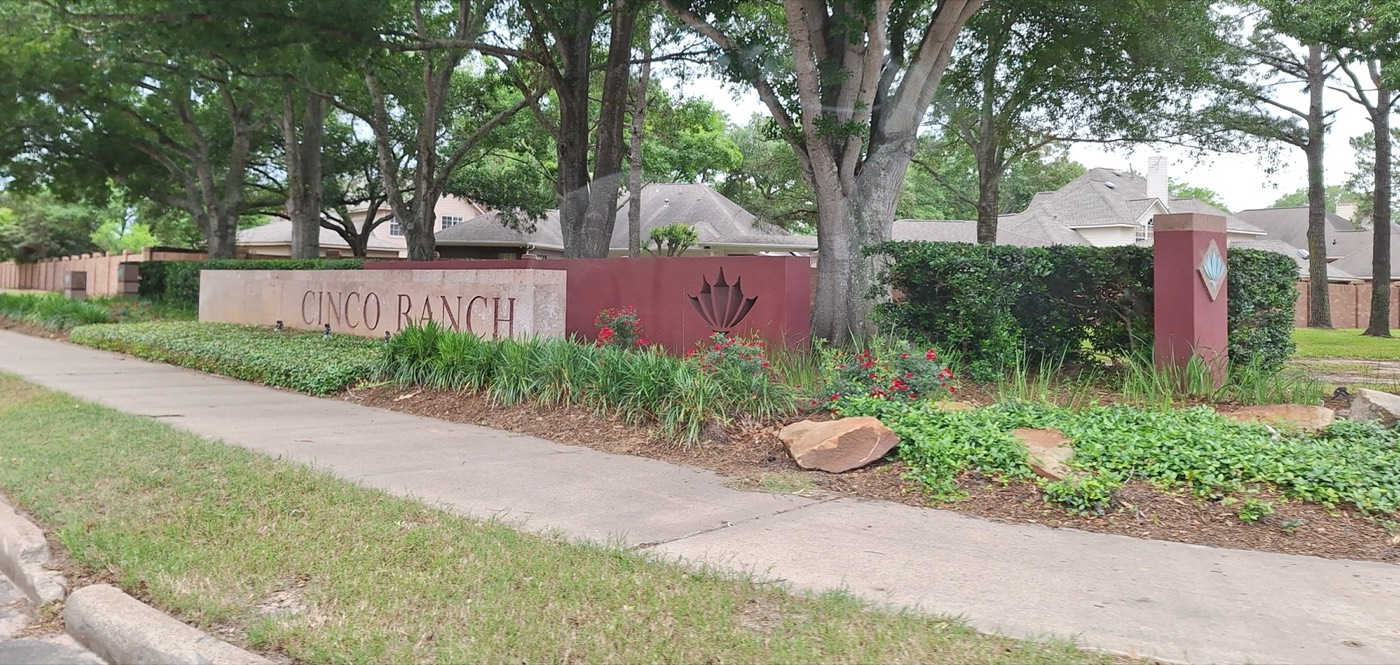
On a Saturday morning at LaCenterra, the open-air town centre at the heart of Cinco Ranch, the queue at the coffee kiosk carries half a dozen accents. A grandmother in a cotton sari steers a stroller past the fountain. Two engineers compare notes on a pipeline project in one breath and their daughters’ robotics team in the next. The Indians in Cinco Ranch did not arrive to a ready-made enclave. They built one quietly, between the cul-de-sacs and the top-ranked schools, in a master-planned community west of Houston that most maps still file simply under Katy.
The Place
Cinco Ranch is a planned community spread across roughly 8,000 acres in Fort Bend and Harris counties, about 25 miles west of downtown Houston and just southeast of the city of Katy. It is not an incorporated town but a census-designated place, governed in practice by its developers, its homeowners’ associations and the schools its residents prize.
The 2020 census counted 16,899 residents, with a median age of 41.5 and an Asian population of around 14.6 percent, a share that has climbed steadily since. The median household income sits near $162,000, which tells you most of what you need to know about who can buy in here.
What ties it together is design: 91 parks and pocket parks, seven lakes, an 18-hole golf course, and LaCenterra, the 34-acre commercial centre at Grand Parkway and Cinco Ranch Boulevard. It is suburbia engineered for a certain kind of family, and Indian families found that the engineering suited them.
How It Became Indian
The land has a longer memory than the homes on it. It was part of the old Blakely Ranch, established in 1824, and took its name in 1937 when five oil men bought it and called it Cinco Ranch, cinco being Spanish for five. For half a century it was cattle and prairie. Then, in 1984, a development group bought the ranch for $84 million in what was then the largest raw-land transaction in Houston’s history, and the prairie began turning into neighbourhoods.
The energy corridor pulls them west
Houston’s Indian story did not begin in Cinco Ranch. It began closer in, around the Mahatma Gandhi District on Hillcroft and in the older Asian neighbourhoods of southwest Houston. What sent families west was work. The Energy Corridor along Interstate 10, home to the offices of major oil and gas and engineering firms, sits a short drive north of Cinco Ranch.
For the petroleum engineers, geoscientists and project managers who came through the 1990s and 2000s, many on H-1B visas and many trained at Indian institutes of technology, the commute math was simple. Cinco Ranch put them within reach of the Energy Corridor while handing their children some of the best public schools in Texas.
Schools as the deciding factor
The community is zoned to Katy Independent School District, and specifically to high schools that draw families from across the country: Cinco Ranch High School, Seven Lakes High School and Obra D. Tompkins High School. Cinco Ranch High School ranks among the top 150 public high schools in Texas, and Katy ISD as a whole routinely lands near the top of statewide and national rankings.
For first-generation immigrant parents who had staked everything on education, this was decisive. A house in Cinco Ranch was not just a house. It was a guaranteed seat in a feeder system that ran from elementary to a high school sending graduates to engineering and medical programmes.
Word travelled the way it always does in immigrant communities, through temple gatherings, office referrals and family WhatsApp groups. A cousin who bought near Mason Road told a cousin in New Jersey. A colleague who liked the schools told a colleague still renting in Sugar Land. The numbers compounded.
The IT wave widens the door
If oil and gas opened Cinco Ranch to Indian families, information technology widened it. Houston’s growth as a corporate and medical hub created steady demand for software engineers, data professionals and consultants, and a large share of that talent came from South India.
Telugu-speaking families from Andhra Pradesh and Telangana, along with Tamil and Kannada speakers, became a visible presence in the Katy corridor through the 2010s. They came not only for a single employer but for the wider Houston job market, with the freedom to change firms without uprooting their children from a school they trusted.
Gujarati families, many with roots in business and the professions, layered in alongside them, as did Punjabi and Hindi-speaking North Indians. The result is not a single regional transplant but a cross-section of India, sorted into the same subdivisions by the same logic of schools, safety and square footage.
Building the institutions
A community announces itself through what it builds. The Katy corridor now supports Hindu temples, Indian grocery stores stocked for every regional kitchen, classical dance and music schools, and cricket leagues that fill the area’s parks on weekends.
These did not appear by decree. They were assembled by families who first drove into Houston for a bag of curry leaves and a darshan, then decided it was time to have those things closer to home. The grocers followed the customers west. The restaurants followed the grocers. The temples followed the families.
The Landmarks
LaCenterra at Cinco Ranch, 23501 Cinco Ranch Boulevard, Katy. Opened in March 2007 at Grand Parkway and Cinco Ranch Boulevard, this open-air town centre is the community’s living room. Its central park and fountain host outdoor events through the year, and on festival weekends it is as likely to fill with families dressed for Diwali as for a Friday concert.
Spice Mantra Indian Cuisine, 27131 Cinco Ranch Boulevard, Suite 650, Katy. One of the neighbourhood’s home-grown Indian kitchens, it earns a steady following for North Indian staples and weekend lunch buffets. For families who do not want to drive into Houston for a proper thali, it has become a default Sunday stop.
Keemat Grocers, 2133 South Mason Road, Katy. A long-running Indian supermarket on Mason Road, the corridor’s main artery for South Asian shopping. Its aisles carry the staples of multiple regional kitchens, from lentils and atta to fresh produce and spices that anchor a Telugu, Gujarati or Punjabi pantry.
Triveni Supermarket, 2727 Spring Green Boulevard, Katy. A newer Indian grocery built closer to the western subdivisions, stocking the food range of the Indian subcontinent. Its arrival signalled that the Indian population had grown dense enough to support more than one full-service grocer near Cinco Ranch.
Sri Govindaji Gaudiya Matha, 16628 Keith Harrow Boulevard, Houston. A Gaudiya Vaishnava temple whose congregation began meeting in 1994 and built its temple near Katy in 2012. It draws devotees from across the western suburbs for daily worship and festival celebrations, and is one of several Hindu places of worship that anchor the corridor’s religious life.
Cinco Ranch High School, 23440 Cinco Ranch Boulevard, Katy. The community’s namesake high school and, for many families, the reason they bought their house. It ranks among the strongest public high schools in Texas, and its student body reflects the neighbourhood’s mix, with South Asian families well represented in its honours and STEM programmes.
Mason Road corridor, Katy. Not a single address but a spine. Along South Mason Road, Indian, Chinese, Korean and Middle Eastern markets sit within minutes of one another, including H Mart and 99 Ranch nearby, making it the practical heart of immigrant Cinco Ranch.
Where They Came From
There is no single sending village behind Cinco Ranch, which is part of what makes it distinct from older, more concentrated diaspora enclaves. The community is a sorting of professional India rather than a transplant of one corner of it.
The largest streams trace to South India: Telugu speakers from Andhra Pradesh and Telangana drawn by IT and engineering work, alongside Tamil and Kannada-speaking families. Gujarati families bring a strong professional and business presence, and North Indian families from Punjab, Delhi and the Hindi belt round out the mix.
Many arrived not directly from India but from a first American stop. They came from Houston’s older inner suburbs, from New Jersey, from college towns where they earned graduate degrees. Cinco Ranch was rarely a first landing in the United States. It was the move families made once the career was stable and the priority became schools.
Cinco Ranch Today
Today the Indian presence in Cinco Ranch is woven into the ordinary texture of the place rather than set apart from it. The grocers and restaurants are established. The temples run festival calendars. Cricket and Carnatic music lessons share the weekend schedule with soccer and piano.
It remains, importantly, an integrated suburb rather than an ethnic enclave. White, Hispanic and a growing Asian population share the same streets and the same schools, and the Indian families here tend to describe themselves as Cinco Ranch residents first. The community sits alongside the larger and longer-established Indian populations of the wider Katy area and of Sugar Land across Fort Bend County, near the Taiwanese and Chinese families who settled Sugar Land too, part of a band of southwest-Houston suburbs that South Asian families have made their own.
The same pattern repeats elsewhere in the metro and beyond. Indian families who weighed schools and commutes the way Cinco Ranch families did made similar choices in Pearland on Houston’s southern edge and, far to the north in the Dallas suburbs, in Coppell near the airport corridor. Cinco Ranch is one node in a much wider Texas story.
What you will not find is a Little India of storefronts and street signs. Cinco Ranch’s Indian community is suburban by design and by choice, dispersed through subdivisions and stitched together by institutions a short drive apart. It is a model of diaspora life that prizes the school zone over the high street, and on the evidence of its growth, plenty of families consider that a fair trade.
Frequently Asked Questions
How many Indians live in Cinco Ranch, Texas?
Precise counts for the Indian community alone are not published separately, but the 2020 census recorded an Asian population of around 14.6 percent of Cinco Ranch’s 16,899 residents, a share that has grown since. Indian families form a substantial part of that Asian population, concentrated by the neighbourhood’s schools and proximity to the Energy Corridor.
Why did so many Indian families move to Cinco Ranch?
Two forces drew the Indians in Cinco Ranch: top-ranked Katy ISD schools and easy access to engineering and IT jobs in Houston’s Energy Corridor. Families weighed school zones above almost everything else, and Cinco Ranch combined strong public schools with the kind of housing and commute professional immigrant families wanted.
Are there Hindu temples near Cinco Ranch?
Yes. The Katy corridor is served by several Hindu places of worship, including Sri Govindaji Gaudiya Matha on Keith Harrow Boulevard, whose temple opened near Katy in 2012. Larger Houston-area temples are also within driving distance for major festivals.
Where do Indian families shop for groceries in Cinco Ranch?
The main hub is the Mason Road corridor and nearby Spring Green Boulevard, home to Indian grocers such as Keemat Grocers and Triveni Supermarket, alongside Chinese, Korean and Middle Eastern markets. These stores carry staples for Telugu, Gujarati, Punjabi and other regional Indian kitchens.
What is the difference between Cinco Ranch and Katy?
Cinco Ranch is a master-planned, census-designated community southeast of the city of Katy, not part of Katy’s incorporated limits, though it shares the Katy postal address and Katy ISD schools. The Indians in Cinco Ranch are part of the broader Katy-area South Asian community but live in a distinct, planned development with its own subdivisions and amenities.
Which regions of India do Cinco Ranch families come from?
The community draws broadly from across India rather than from a single region. Telugu-speaking families from Andhra Pradesh and Telangana are a large presence, alongside Tamil, Kannada, Gujarati and North Indian families, many of whom arrived via Houston’s inner suburbs or other American cities before settling here.
If your family’s story passed through Cinco Ranch, or any of the places Indians have made home in America, Atlas of Home can trace that journey. From a town in Andhra Pradesh or a workshop in Gujarat, to a cul-de-sac off Mason Road, to wherever you are now.