
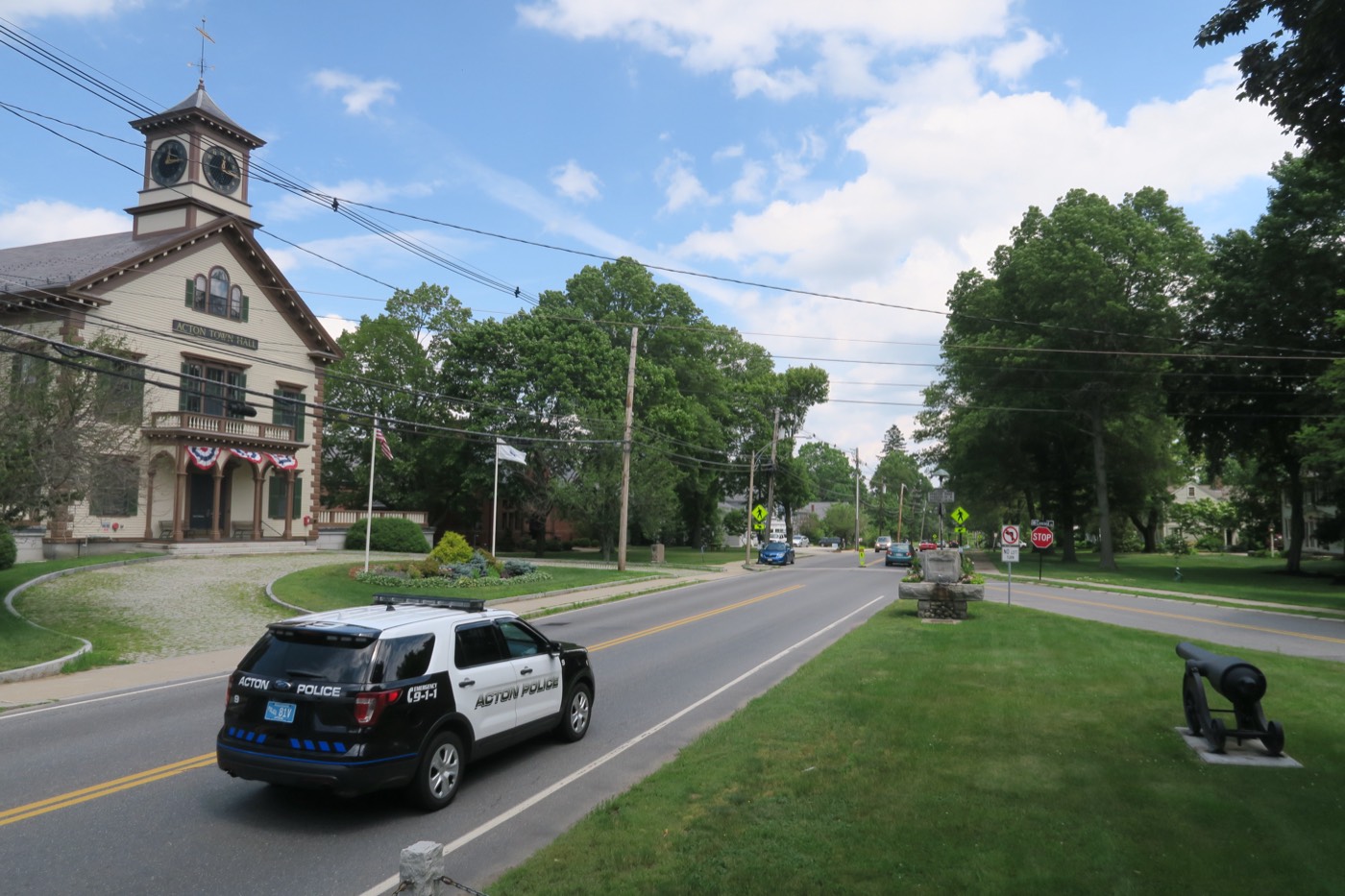
On a Saturday morning along Great Road, the parade of errands tells a quiet story. A family loads spice tins and lentils into the back of a hybrid SUV outside an Indian convenience store, then drives ten minutes to a strip-mall mandir where Lord Vishnu and Goddess Durga keep watch behind glass. The Indians in Acton, Massachusetts have not gathered in one visible enclave. They have woven themselves through an old colonial town, into its top-ranked classrooms and its weekend temples, until roughly a quarter of Acton now traces its roots to Asia.
The Place
Acton sits about 21 miles west-northwest of Boston, in Middlesex County, near the western edge of the Route 128 technology belt. It is a town of conservation land, commuter-rail platforms and good schools, the kind of place families move to and then quietly stay.
The town spans roughly 20 square miles, threaded by Nashoba Brook and dotted with ponds. Its 2020 median household income was $138,163, well above the Massachusetts figure, and Money magazine has repeatedly listed it among the best small towns in America.
None of that affluence is loud. Acton wears it in renovated farmhouses, in the South Acton commuter-rail lot full by 7am, and in a school system that draws people from across the country and across the world.
How It Became Indian
To understand why Indian families settled in Acton, you have to start centuries before any of them arrived, with an agricultural town that learned early how to reinvent itself.
From praying town to powder mills
Long before incorporation, the land around Fort Pond held Nashobah, one of the Praying Indian towns established for Native converts in the colonial period. That history belongs to the Nipmuc people, not to the South Asian community, but it is a reminder that Acton’s ground has been shared and contested for a very long time.
English settlement dates to 1639, and Acton was incorporated as a town on 3 July 1735. Its early identity was agricultural, orchards and small farms, before the Revolution gave it a martyr: Captain Isaac Davis of Acton, killed at the North Bridge in Concord on 19 April 1775, often called the first officer to die in the American Revolution.
In the 19th century Acton industrialised. It became a regional centre for cooperage, the making of barrels, alongside gristmills, sawmills and powder mills. The Fitchburg Railroad reached the town in 1844, and villages grew up around the depots at South and West Acton.
The suburban turn
The Acton that today’s Indian families know was largely built after the Second World War. Population climbed from 7,238 residents in 1960 to 17,544 by 1980 as Boston commuters filled in new subdivisions across the old farmland.
That growth coincided with the rise of the Route 128 corridor, the ring of laboratories and electronics firms that earned the nickname “America’s Technology Highway.” Acton sat close enough to ride that wave, with rail access straight into the city and land still cheap enough to build on.
By the time the technology economy shifted toward software, biotech and the Kendall Square boom, Acton had what skilled migrants prize most: commutable jobs, large houses and, above all, schools.
The schools that did the talking
The Acton-Boxborough Regional School District became the engine of the town’s demographic change. Acton-Boxborough Regional High School earned National Blue Ribbon recognition in 2009 and has ranked consistently among the top public high schools in Massachusetts.
For a generation of Indian engineers, researchers and physicians arriving on H-1B visas through the 1990s and 2000s, that reputation worked like a magnet. A house in Acton was an admission ticket to a school system that took academic achievement as seriously as the families themselves did.
The effect compounded. Newcomers told relatives and colleagues; relatives and colleagues bought houses nearby. The district’s student body is now about a third Asian, and that share climbed steadily as each cohort of arrivals settled and sent children through the same elementary, junior high and high schools.
From individuals to a community
Across Acton as a whole, the Asian share of the population rose from 9.1 percent in 2000 to 23.7 percent by 2020. Within the town’s main 01720 zip code, residents of Asian Indian background account for roughly 11 percent on their own, one of the highest concentrations of any town in Massachusetts.
What began as scattered tech-worker households became, over two decades, a community with its own infrastructure. Temples opened in commercial suites. Grocers stocked the rice and dal that supermarkets did not. Cultural organisations that had long operated out of Boston started looking westward, toward the suburb where so many of their members now actually lived.
Acton’s Indian story echoes patterns visible in other affluent, school-driven suburbs, from the Indians of Montgomery, New Jersey to the fast-growing community in Chanhassen, Minnesota. The combination is consistent: strong public schools, technology employers within reach, and houses big enough for multi-generational life.
The Landmarks
Hindu Temple of Massachusetts, 271 Great Road, Suite 26. Housed in a commercial suite on Acton’s main artery, this temple is dedicated to Lord Vishnu and Goddess Durga and serves the wider Hindu community of greater Boston. It is the kind of unassuming, strip-mall sanctuary common to American suburbs, where a doorway off a parking lot opens onto incense, bells and shrines.
NARA Park Amphitheater, 25 Ledge Rock Way. This town park, built around a former gravel quarry turned pond and beach, became a stage for the wider region’s Indian life when the India Association of Greater Boston chose it for its annual India Day celebration. After nearly two decades at Boston’s Hatch Shell, IAGB shifted the event to Acton, citing parking, comfort and room to grow.
Madhuri Indian Restaurant, 342 Great Road. One of the Indian kitchens lining Great Road, Madhuri serves the kind of everyday North and South Indian cooking that a transplanted community relies on, from dosas to curries packed for a weeknight at home. Restaurants like it turn a commercial strip into a place that smells and tastes of home.
Indo-American Convenience Store, 485 Great Road. A neighbourhood grocer stocking Indian groceries, spices and snacks, the sort of small shop that anchors a diaspora before any larger supermarket arrives. For families who do not want to drive to the big South Asian stores in Waltham, it is the nearest source of fresh curry leaves and the right brand of atta.
Acton-Boxborough Regional High School, 36 Charter Road. The Blue Ribbon school at the centre of the town’s reputation, and arguably the single biggest reason Indian families chose Acton over its neighbours. Its hallways, classrooms and science fairs have become a shared rite of passage for the children of the community.
South Acton Station, on the MBTA Fitchburg Line. The commuter-rail platform that ties Acton to Boston and to Kendall Square’s labs is more than transit infrastructure. For many Indian professionals it is the daily thread connecting a suburban house to a downtown career, the practical hinge on which the whole choice of Acton turns.
NARA Park, again at Diwali. Beyond India Day, the town and its neighbours host a three-town Diwali festival drawing Acton, Boxborough and Littleton together, with the Boxborough library and Acton venues lighting up each autumn. It is the clearest sign that the festival of lights has become part of the local calendar, not just a private observance.
Where They Came From
The Indians who settled in Acton arrived less through a single chain of village kin than through the channels of skilled migration. Many came on H-1B visas to technology, biotech and pharmaceutical firms across eastern Massachusetts, or as graduate students and researchers who never left.
That pathway shapes the origins. The community skews toward the educated metropolitan India that feeds the global tech economy: software and engineering talent from the southern technology hubs, professionals from the major cities of the north and west, and a strong representation of Tamil, Telugu, Kannada and other South Indian families alongside Gujarati, Hindi and Bengali speakers.
It is a pattern familiar across America’s prosperous suburbs, the same skilled-migration story that built the Indian community of Wake Forest, North Carolina and the newer enclave in Saratoga Springs, Utah. The destinations differ. The engine, ambitious professionals chasing good jobs and better schools, does not.
Acton’s Indian residents share their suburb with other communities drawn by the same forces, including a large Chinese population that mirrors the trajectory of the Chinese of Wellesley, Massachusetts and a long-settled Armenian presence in towns such as neighbouring Belmont. The Asian Acton of today is plural, and Indian families are its single largest strand.
Acton Today
Acton in the 2020s is a town quietly remade. The old colonial centre and the conservation trails remain, but the supermarket aisles, the temple suites and the school auditoriums tell you who lives here now. On a given weekend you might find a Carnatic music recital, a chess tournament thick with South Asian names, and a Diwali celebration drawing more than a thousand people across town lines.
It is not, by and large, a story of struggle. The Indians of Acton arrived with degrees and salaries, bought into one of Greater Boston’s strongest school systems, and built community institutions in the spaces a suburb provides: leased commercial suites, public parks, library function rooms. Their integration has been swift and, on the surface, smooth.
The honest tensions are the ordinary ones of any high-achieving suburb. Academic pressure runs hot in the schools. Housing is expensive, which keeps the community professional and selects for those who can afford to enter. And the very dispersal that let Indian families weave through Acton means there is no single street or square to point to, no Little India, just a quiet majority-minority town where, increasingly, the new American story and the South Asian story are the same story.
Frequently Asked Questions
How many Indians live in Acton, Massachusetts?
Exact counts vary by source, but residents of Asian Indian background make up roughly 11 percent of Acton’s main 01720 zip code, among the highest shares of any Massachusetts town. The town’s overall Asian population reached about 23.7 percent in the 2020 census, up from 9.1 percent in 2000, with Indians forming the largest single group.
Why did so many Indian families move to Acton?
The Indians in Acton were drawn primarily by the Acton-Boxborough Regional School District, a National Blue Ribbon school system ranked among the best in Massachusetts. Combined with commuter-rail access to Boston’s technology and biotech jobs and large suburban homes, Acton became a natural choice for skilled migrant families through the 1990s and 2000s.
Is there a Hindu temple in Acton?
Yes. The Hindu Temple of Massachusetts operates at 271 Great Road, Suite 26, dedicated to Lord Vishnu and Goddess Durga and open to all denominations. It serves the wider Hindu community of greater Boston from its Acton location.
Where can you find Indian groceries and food in Acton?
Great Road is the spine of Indian Acton. The Indo-American Convenience Store at 485 Great Road stocks Indian groceries, spices and snacks, while Madhuri Indian Restaurant at 342 Great Road serves North and South Indian dishes. Larger South Asian supermarkets are a short drive away in towns such as Waltham.
Does Acton celebrate Diwali?
Yes. A three-town Diwali festival brings together Acton, Boxborough and Littleton each autumn, with celebrations drawing well over a thousand attendees. The festival of lights has become part of the local seasonal calendar rather than a purely private observance.
What makes Acton different from other Indian suburbs near Boston?
Unlike towns with a dense central enclave, the Indians in Acton are dispersed through an old colonial suburb, woven into its schools, parks and shops rather than concentrated on one street. Its standout draw is the school district, which has made Acton one of the most sought-after addresses for Indian families in the region. The recent move of the India Association of Greater Boston’s India Day celebration to Acton’s NARA Park confirmed the town’s place at the centre of suburban Indian life.
If your family’s story passed through Acton, or any of the places Indians have made home in America, Atlas of Home can trace that journey. From a metropolitan childhood in India to a house within walking distance of a Great Road temple, to wherever you are now.